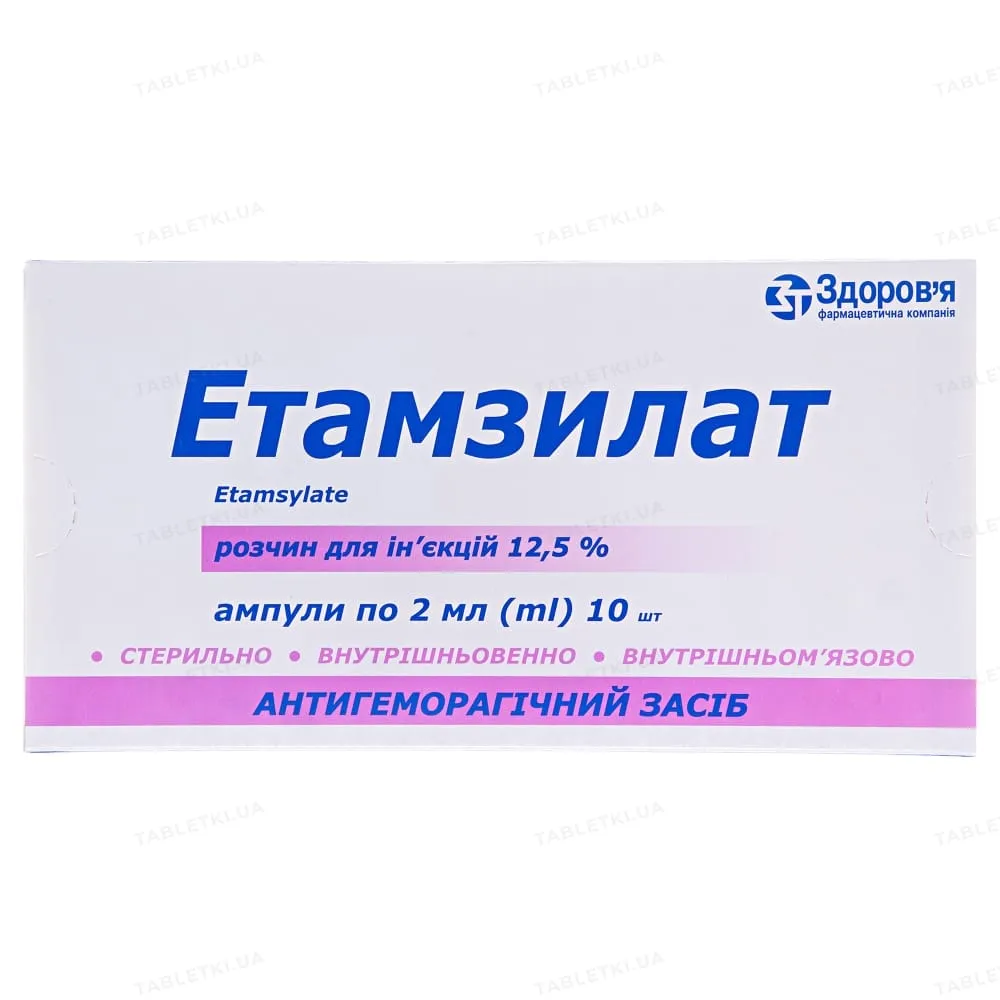
ETAMSYLATE
UkraineThe drug is used to prevent and stop capillary bleeding. It is prescribed during and after surgical operations (in dentistry, gynecology, urology, and other fields), for excessive menstruation, nosebleeds, gum bleeding, as well as for the prevention of bleeding in premature infants.
Frequently asked questions
How should Etamsylate be taken correctly?
The drug is administered intravenously (slowly) or intramuscularly. Adults are usually prescribed 1-2 ampoules 3-4 times a day. For children, the dosage is half of the adult dose. Local application using a gauze pad soaked in the drug is also possible.
Who should not use this drug?
Etamsylate is contraindicated in cases of hypersensitivity to its components, bronchial asthma, acute porphyria, increased blood clotting, thrombosis, and thromboembolism. In children, the drug should not be used in certain types of leukemia and osteosarcoma.
What are the possible side effects of Etamsylate?
Possible side effects include headache, dizziness, nausea, vomiting, diarrhea, abdominal pain, as well as allergic reactions (rash, itching, edema, or anaphylactic shock). Changes in arterial blood pressure and changes in blood parameters may also be observed.
Can the drug be taken during pregnancy and breastfeeding?
The drug is contraindicated during the first trimester of pregnancy. In the second and third trimesters, it can only be used if the benefit to the mother outweighs the risk to the child. During breastfeeding, use of the drug should be discontinued.
How does the drug interact with other medicines?
Etamsylate can be used together with other hemostatic agents. However, it should be administered one hour before the administration of dextrans to avoid loss of efficacy. It is also important to know that the drug inactivates vitamin B1 (thiamine).
Does the drug affect the ability to drive a vehicle?
The drug does not affect reaction speed; however, dizziness may occur during its use, which should be taken into account when driving a car or operating machinery.
Instructions for use
INSTRUCTIONS FOR MEDICAL USE OF THE MEDICINAL PRODUCT ETAMSYLATE
Composition:
Active substance: etamsylate;
1 ml of solution contains 125 mg of etamsylate;
Excipients: sodium metabisulfite (E 223), anhydrous sodium sulfite (E 221), disodium edetate, water for injections.
Pharmaceutical form. Solution for injection.
Main physico-chemical properties: clear, colorless or slightly yellowish liquid.
Pharmacotherapeutic group. Antihemorrhagic agents. Other systemic hemostatic agents. ATC code B02B X01.
Pharmacological properties.
Pharmacodynamics.
Etamsylate is an agent for prevention and cessation of bleeding. It affects the first stage of the haemostasis mechanism (interaction between endothelium and platelets). Etamsylate enhances platelet adhesiveness, normalizes capillary wall resistance thereby reducing their permeability, and inhibits biosynthesis of prostaglandins causing platelet disaggregation, vasodilation, and increased capillary permeability. As a result, bleeding time is significantly reduced and blood loss is decreased.
Pharmacokinetics.
After intravenous administration, the haemostatic effect is observed within 5–15 minutes, reaching maximum within 1 hour. Peak plasma concentration of etamsylate is achieved within 1 hour after intravenous or intramuscular administration of 500 mg etamsylate, and amounts to 30–50 mcg/mL. Approximately 90% of the drug binds to plasma proteins.
Approximately 72% of the administered dose is excreted unchanged in urine within the first 24 hours. The elimination half-life of etamsylate from plasma is approximately 2 hours. Etamsylate crosses the placental barrier. It is unknown whether etamsylate is excreted in breast milk.
Clinical characteristics.
Indications. Prevention and control of hemorrhages in superficial and internal capillaries of various etiologies, especially when bleeding is caused by endothelial damage, in particular:
- prevention and treatment of bleeding during and after surgical procedures in otorhinolaryngology, gynecology, obstetrics, urology, dentistry, ophthalmology, and plastic surgery;
- prevention and treatment of capillary bleeding of various etiologies and localizations: hematuria, metrorrhagia, primary hypermenorrhea, hypermenorrhea in women with intrauterine contraceptive devices, epistaxis, gingival bleeding;
- neonatology: prevention of periventricular hemorrhage in premature infants.
Contraindications. Hypersensitivity to ethamsylate or to any other component of the drug (especially to sodium sulfite); bronchial asthma, acute porphyria, increased blood coagulation, thrombosis, thromboembolism, hemoblastosis (lymphatic and myeloid leukemia, osteosarcoma) in children.
Interaction with other medicinal products and other types of interactions. Thiamine (vitamin B1) is inactivated by sulfite present in the drug solution.
Administration of ethamsylate one hour before infusion of dextrans (e.g. reopoliglucin) prevents their anti-aggregatory effect; administration after infusion of dextrans does not exert hemostatic effect.
The drug may be used concomitantly with other hemostatic agents.
If ethamsylate solution is mixed with 0.9% sodium chloride solution, it should be used immediately.
Special precautions for use
Before starting treatment, other causes of bleeding should be ruled out. If the drug is used to reduce excessive and/or prolonged menstrual bleeding and no improvement is observed, possible pathological causes (e.g., presence of uterine fibroids) should be excluded.
Use with caution in patients with a history of thrombosis or thromboembolism.
Due to the risk of decreased arterial pressure during parenteral administration, the drug should be used cautiously in patients with unstable arterial pressure or hypotension.
If a patient requires dextran infusion, etamsylate should be administered prior to the infusion.
The drug is ineffective in cases of reduced platelet count.
In hemorrhagic complications associated with anticoagulant overdose, specific antidotes are recommended.
Use of etamsylate in patients with impaired coagulation parameters is possible, but should be supplemented by administration of medicinal products that correct the identified deficiency or defect in coagulation factors.
Use in patients with renal impairment.
Safety and efficacy of etamsylate have not been studied in patients with renal impairment. Since etamsylate is almost entirely excreted by the kidneys, the dose should be reduced in cases of renal insufficiency.
Laboratory tests.
At therapeutic doses, etamsylate may reduce serum creatinine test values.
The use of this drug is contraindicated if there is a change in the color of the injection solution.
This medicinal product contains less than 1 mmol (23 mg)/dose of sodium, i.e., it is practically sodium-free.
The presence of sodium metabisulfite and sodium sulfite anhydrous in the formulation may rarely cause hypersensitivity reactions and bronchospasm.
Use during pregnancy or breastfeeding. There are no reliable data on the effect of the drug on the fetus during pregnancy. The drug is contraindicated during the first trimester of pregnancy. In the second and third trimesters of pregnancy, the drug may be used only if the benefit to the mother outweighs the potential risk to the fetus.
Breastfeeding should be discontinued during treatment with this drug.
Ability to influence reaction rate while driving or operating machinery. No significant effect; however, dizziness may occur during treatment, which should be taken into account when driving or operating machinery.
Administration and Dosage
The drug should be administered intravenously (slowly) or intramuscularly. The optimal daily dose for adults is 10–20 mg/kg body weight, given in 3–4 divided doses. In most cases, administer the contents of 1–2 ampoules 3–4 times daily. The daily dose for children is half the adult dose.
Surgical procedures: Administer the contents of 1–2 ampoules intravenously or intramuscularly 1 hour before surgery. During surgery, administer the contents of 1–2 ampoules intravenously; this dose may be repeated if necessary. After surgery, administer the contents of 1–2 ampoules every 4–6 hours until the risk of bleeding has passed.
Neonatology: The drug should be administered intramuscularly at a dose of 10 mg/kg body weight (0.1 ml = 12.5 mg). Treatment should begin within the first 2 hours after birth. Administer the drug every 6 hours for 4 days, up to a total cumulative dose of 200 mg/kg.
Etamsylate can be used locally (e.g., skin grafts, tooth extraction) using a sterile gauze pad moistened with the drug. Combination therapy with oral etamsylate and parenteral administration is possible.
Hepatic and renal impairment. Clinical data regarding dosage recommendations are insufficient; therefore, the drug should be used with caution in such patients.
Children. The drug is contraindicated in children with hemoblastosis (lymphoid and myeloid leukemia, osteosarcoma).
Overdose. Data are lacking. In case of overdose, symptomatic treatment should be administered.
Adverse reactions.
Central nervous system: headache, dizziness, hot flushes, paresthesia of lower limbs.
Cardiovascular system: thromboembolism, arterial hypotension, reduced tissue perfusion, which spontaneously recovers after some time.
Gastrointestinal tract: nausea, vomiting, diarrhea, abdominal pain.
Immune system: allergic reactions, hypersensitivity, skin rashes, urticaria, pruritus, anaphylactic shock, exacerbation of bronchial asthma; one case of angioneurotic edema has been reported.
Blood and lymphatic system: agranulocytosis, neutropenia, thrombocytopenia.
Musculoskeletal system: arthralgia.
Other: asthenia, fever, bronchospasm, acute porphyria.
Local reactions at site of injection: pruritus, erythema.
All adverse effects are mild and transient.
In children treated with etamsylate for prevention of bleeding in acute lymphoblastic and myeloid leukemia, severe leukopenia was observed more frequently.
Shelf life. 3 years.
Storage conditions. Store in original packaging at a temperature not exceeding 25 °C.
Keep out of reach of children.
Incompatibility. Etamsylate solution is incompatible with solutions of sodium hydrocarbonate and sodium lactate. Pharmaceutically incompatible (in the same syringe) with other medicinal products.
Packaging. 2 ml in ampoules, 10 in a pack; 10, 5x2 in blisters in a pack.
Prescription status. Prescription only.
Manufacturer.
Limited Liability Company "Research Plant "GNCLC".
LIMITED LIABILITY COMPANY "CORPORATION "ZDOROVIYA".
Manufacturer's address and place of business.
8 Vorobiova Street, Kharkiv, Kharkiv Region, Ukraine.
(Limited Liability Company "Research Plant "GNCLC")
22 Shevchenka Street, Kharkiv, Kharkiv Region, 61013, Ukraine.
(LIMITED LIABILITY COMPANY "CORPORATION "ZDOROVIYA")
Similar drugs
| Brand name | Dosage form | Active substance / Dosage | Manufacturer |
|---|---|---|---|
| DITSINON | solution for injection |
|
Lek Pharmaceuticals d.d. |
| ETAMSYLATE-DARNITSA | solution for injection |
|
PJSC «Pharmaceutical Company «Darnitsa» |
The original data is available in the language of the country of manufacture.
Data source: State Register of Medicinal Products of Ukraine
Data last verified: August 13, 2026