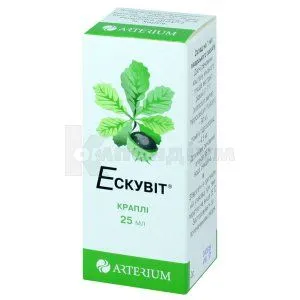
ESCUVIT
UkraineThe drug is used for chronic venous insufficiency (edema, calf cramps, pain, itching, and heaviness in the legs, varicose veins), hemorrhoids, post-thrombotic syndrome, and changes in the veins of the lower legs. It also helps to prevent and treat edema and hematomas following injuries or surgeries.
Frequently asked questions
How should Escuvit be taken correctly?
It is necessary to take 12–15 drops 3 times a day before meals, swallowing with a small amount of liquid. Shake the vial before use. The course of treatment usually lasts from 2 weeks to 2–3 months.
What side effects may occur from taking Escuvit?
Possible side effects include rapid heartbeat, decreased blood pressure, headache, dizziness, nausea, stomach pain, diarrhea, or vomiting. Allergic reactions (rash, itching, swelling) and renal reactions may also occur with the use of high doses.
Who should not take this drug?
The drug is contraindicated in cases of hypersensitivity to its components, renal failure, and allergic diseases. It is not recommended for pregnant or breastfeeding women, as well as children.
Can you drive a car during treatment?
Since the drug contains 96% alcohol, caution should be exercised when driving vehicles or operating dangerous machinery.
How does the drug interact with other medicines?
The drug may enhance the effect of antithrombotic agents. Concurrent use with certain antibiotics (cephalosporins) increases the risk of side effects, and combination with aminoglycosides may negatively affect the kidneys. Additionally, certain substances may reduce the effectiveness of vitamin B1 (thiamine) contained in the drug.
What should you do if unusual symptoms occur?
If pain or unusual sensations in the legs occur during administration, you should discontinue use and consult a physician.
Instructions for use
INSTRUCTION for medical use of the medicinal product ESKUVIT® (ESKUVIT)
Composition:
Active substances: 1 ml of the medicinal product contains: liquid extract of horse chestnut seeds (1:7.1) (extractum semen hippocastani fluidum) (extracting agent – ethanol 50%) – 90 mg, calculated as 9 mg of aescin; thiamine hydrochloride – 4.5 mg.
Excipients: ethanol 96%, purified water.
Pharmaceutical form. Drops.
Main physicochemical properties: yellowish-brown to red-brown liquid. A slight precipitate may form during storage.
Pharmacotherapeutic group. Capillary stabilizing agents. ATC code C05CX.
Pharmacological properties.
Pharmacodynamics.
Angioprotective, capillary-stabilizing, anti-edematous, anti-inflammatory agent. The mechanism of action of escin is due to stabilization of lysosomal membranes and inhibition of release of autolytic cellular enzymes, thereby reducing degradation of mucopolysaccharides and improving trophic processes in the walls of venous vessels and surrounding connective tissue. The drug reduces pathologically increased vascular-tissue permeability, preventing transcapillary filtration of low-molecular-weight proteins, electrolytes, and water into the interstitial space, increases venous wall tone, eliminates venous stasis (especially in the lower limbs), reduces peripheral edema, and alleviates sensations of leg heaviness, fatigue, tension, itching, and pain.
Pharmacokinetics.
After oral administration, escin is rapidly absorbed, primarily from the duodenum. It undergoes a pronounced first-pass effect in the liver. In tissue fluid and blood plasma, escin binds to proteins (approximately 84%) and cholesterol. It is metabolized in the liver. It is excreted from the body in urine and bile as metabolites.
Thiamine hydrochloride is converted in the body to active thiamine diphosphate, participates in carbohydrate and energy metabolism, and serves as a coenzyme in many enzymatic reactions.
Clinical characteristics.
Indications.
Chronic venous insufficiency:
- edema;
- calf muscle cramps;
- itching, as well as pain and sensation of heaviness in the legs;
- varicose veins.
Post-thrombotic syndrome.
Trophic changes in the veins of the lower limbs, e.g., leg ulcers.
Hemorrhoids.
Prevention and treatment of post-traumatic and postoperative edema and hematomas.
Contraindications.
Hypersensitivity to the components of the drug. Renal failure, allergic diseases.
Special precautions.
If unusual symptoms or pain occur in the legs, discontinue use of the drug and consult a physician.
Non-invasive treatment methods prescribed by a physician must be strictly followed (application of compresses, wearing supportive elastic stockings, cold water dousing).
Renal function should be monitored during drug administration.
Interaction with other medicinal products and other forms of interaction.
The drug may enhance the effect of antithrombotic agents. Cephalosporin antibiotics increase the concentration of free escin in blood and the risk of adverse effects. Concomitant use of the drug with aminoglycoside antibiotics should be avoided due to enhanced nephrotoxic effect of aminoglycosides.
Thiosemicarbazone and 5-fluorouracil, as well as simultaneous infusion of solutions containing sulfites, inhibit thiamine activity.
Special precautions for use.
The use of thiamine in high doses may interfere with the determination of theophylline in blood serum by spectrophotometric methods and urobilinogen using Ehrlich's reagent.
Use during pregnancy or breastfeeding.
The drug is not recommended during pregnancy or breastfeeding due to insufficient data on its safety during these periods.
Ability to affect reaction speed when driving or operating machinery.
Not studied; however, due to the content of 96% alcohol, the drug should be used with caution when driving vehicles or operating potentially hazardous machinery.
Dosage and Administration.
It is recommended to take 12-15 drops 3 times daily before meals, with a small amount of liquid. The treatment course lasts from 2 weeks to 2-3 months.
Due to the possible presence of plant-derived sediment, the preparation should be shaken before use.
Children. Not recommended for use in children.
Overdose.
Cases of overdose have not been reported. Overdose may enhance adverse effects. Symptoms of poisoning observed after ingestion of a large amount of horse chestnut fruit extract: feeling of anxiety, severe diarrhea, vomiting, mydriasis, drowsiness, delirium, and potentially fatal outcome due to respiratory paralysis within 24-48 hours.
Treatment: symptomatic. If a large amount of horse chestnut fruit extract has been ingested and vomiting has not occurred, gastric lavage is recommended (e.g., with a 0.02% potassium permanganate solution), along with administration of activated charcoal.
Adverse reactions.
Cardiovascular system: tachycardia, increased heart rate, arterial hypotension.
Nervous system: headache, dizziness.
Gastrointestinal tract: dyspeptic symptoms, epigastric pain, nausea, diarrhea, vomiting.
Immune system: hypersensitivity reactions, including urticaria, rash, pruritus, sensation of warmth, angioneurotic edema, shock.
When high doses of the drug are used, nephrotoxic reactions and thrombosis are possible.
Shelf life. 2 years.
Storage conditions. Store in the original packaging at a temperature not exceeding 25 ºC.
Keep out of reach of children.
Packaging. 15 ml or 25 ml in a dropper bottle, 1 dropper bottle per pack; 25 ml in a dropper bottle closed with a cap with a tamper-evident seal, 1 dropper bottle per pack.
Availability category. Over-the-counter.
Manufacturer: JSC "Halychpharm".
Manufacturer's location and address of business activity:
6/8 Opryshkivska Street, Lviv, 79024, Ukraine.
The original data is available in the language of the country of manufacture.
Data source: State Register of Medicinal Products of Ukraine
Data last verified: August 13, 2026