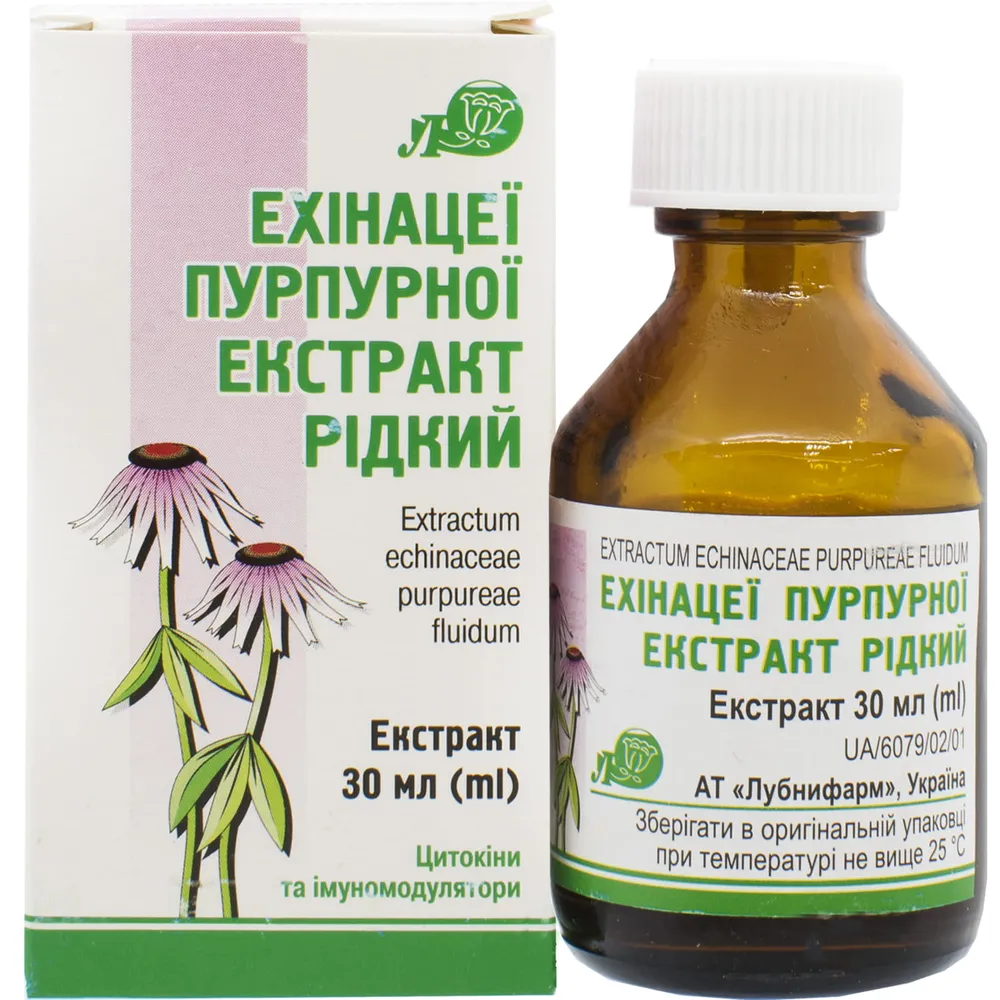
ECHINACEA PURPUREA LIQUID EXTRACT
UkraineThe drug is used for the complex treatment of states with reduced immunity during chronic inflammation, as well as after antibiotic treatment, radiation, or chemotherapy. It is applied at the first signs of ARVI (acute respiratory viral infection). The extract can also be used topically to treat wounds that are slow to heal.
Frequently asked questions
How should Echinacea purpurea liquid extract be taken correctly?
For adults in acute conditions, take 40 drops initially, then another 20 drops after 2 hours, and subsequently 20 drops 3 times a day. For children aged 12 and older, 5–10 drops (diluted with water in a 1:2 or 1:3 ratio) are prescribed 2–3 times a day before meals. For wound treatment, the drug is used externally in the form of compresses or tampons. Shake the bottle before use.
What are the possible side effects of Echinacea purpurea liquid extract?
Allergic reactions are possible: redness, itching, swelling, rash, or even severe conditions such as difficulty breathing or anaphylactic shock. Dizziness, nausea, vomiting, diarrhea, or a decrease in blood pressure may also occur. During prolonged use (more than 8 weeks), white blood cell levels in the blood may decrease.
Who should not take this drug?
Contraindications include blood diseases (e.g., leukemia), oncology, diabetes mellitus, tuberculosis, autoimmune diseases (multiple sclerosis, systemic lupus erythematosus), HIV/AIDS, and connective tissue disorders. The drug should also not be taken by those with hypersensitivity to plants of the Asteraceae family, pregnant women, or breastfeeding women.
Can children take the drug?
The drug is not recommended for children under 12 years of age due to its ethanol content.
How does the drug interact with other medicines?
Due to its alcohol content, the drug may enhance the effect of sedatives. An adverse reaction is also possible when taken simultaneously with certain antibacterial drugs.
What is the maximum duration of use?
The course of treatment should not exceed 8 weeks.
Instructions for use
INSTRUCTION FOR MEDICAL USE OF THE MEDICINAL PRODUCT ECHINACEAE PURPUREAE EXTRACTUM LIQUIDUM
Composition:
Active substance: dry alcoholic extract of the rhizome with roots of purple coneflower (Echinaceae purpureae radix);
1 bottle contains dry alcoholic extract of the rhizome with roots of purple coneflower (Echinaceae purpureae radix) (1:2.7) (extraction agent — ethanol 40% v/v) 30 ml or 50 ml or 100 ml.
Pharmaceutical form. Extract.
Main physicochemical properties: clear liquid, ranging in color from yellowish-brown to dark brown, with a characteristic odor. Formation of sediment during storage is permissible.
Pharmacotherapeutic group.
Cytokines and immunomodulators. ATC code L03A X.
Pharmacological properties.
The complex of active substances enhances phagocytic activity of neutrophils and macrophages, stimulates interleukin-1 synthesis, promotes transformation of B-lymphocytes into plasma cells, and improves functions of T-helper cells. Polysaccharides inulin, levulose, and betaine improve metabolic processes, especially in the liver and kidneys. It has antiviral, antibacterial, and antifungal properties.
Clinical Characteristics.
Indications.
As part of complex treatment of immunodeficiency states in chronic recurrent inflammatory diseases of various localization. Conditions following antibiotic, cytostatic, immunosuppressive, or radiation therapy. Early manifestations of respiratory viral infections (ARVI), during prolonged antibiotic use.
Topically: treatment of slowly healing wounds.
Contraindications.
Hypersensitivity to plants of the Asteraceae (Compositae) family or to components of the medicinal product; progressive systemic diseases such as tuberculosis, diabetes mellitus; leukocyte blood system disorders (e.g., leukemia, agranulocytosis); oncological diseases; rheumatism; connective tissue diseases (collagenoses); multiple sclerosis and other autoimmune diseases; AIDS; HIV infection; systemic lupus erythematosus; primary immunodeficiency; chronic viral diseases; primary immunosuppression.
Interaction with other medicinal products and other types of interactions.
The preparation contains ethanol, which may enhance the absorption and pharmacological effect of certain sedative drugs and, indirectly, by altering the activity of the cytochrome P450 system, may affect the elimination of medicinal products metabolized by enzymes of this system.
Ethanol may cause a disulfiram-like reaction when used concomitantly, for example, with certain antibacterial agents.
Special precautions for use.
The duration of treatment with echinacea extract should not exceed 8 weeks. During storage, the extract may become cloudy and form a sediment consisting of active polysaccharides; therefore, it should be shaken well before use.
If symptoms of the disease do not resolve during treatment or if adverse reactions not listed in the instructions for medical use occur, consult a physician.
Use during pregnancy or breastfeeding.
The medicinal product should not be used during pregnancy or breastfeeding due to its ethanol content.
Ability to affect reaction speed when driving or operating machinery.
The preparation contains ethanol, which should be taken into account by individuals driving vehicles or operating complex machinery.
Dosage and Administration
To achieve a rapid effect in acute conditions, adults should initially take 40 drops of the extract, followed by another 20 drops within the next 2 hours. Afterwards, the medication should be taken 3 times daily at a dose of 20 drops per administration. The treatment course should not exceed 8 weeks.
For children aged 12 years and older, the extract should be administered diluted 1:2 or 1:3, at a dose of 5–10 drops 2–3 times daily, 30 minutes before meals.
For wound treatment, apply the extract topically to affected areas. Externally used for compresses and tampons. Dilute 20–60 drops of the extract in 100 mL of 0.9% sodium chloride solution, moisten gauze with this solution, apply it to the wound, and cover with compress paper. Change the dressing twice daily. If the dropper cap is missing, use a medical glass pipette to measure the medication; the dosage remains unchanged.
The recommended duration of treatment with this medication is from 1 to 8 weeks.
Children
The medication should not be used in children under 12 years of age due to the presence of ethanol.
Overdose
Symptoms: nausea, vomiting, gastrointestinal disturbances, sleep disorders, increased excitability.
Treatment: symptomatic therapy.
Adverse Reactions
Echinacea may cause allergic reactions in predisposed patients. The frequency of such reactions is unknown. Rarely, hypersensitivity reactions may occur, manifesting as skin redness, itching, facial swelling. Occasionally, rash, urticaria, Stevens-Johnson syndrome, angioneurotic skin edema, Quincke's edema, dyspnea, bronchospasm with obstruction, bronchial asthma, anaphylactic shock may develop. Dizziness, arterial hypotension, nausea, vomiting, and diarrhea may occur uncommonly.
There have been isolated reports of autoimmune diseases associated with the use of this medicinal product.
Leukopenia may occur with prolonged use (over 8 weeks).
Shelf Life.
2 years.
Storage Conditions.
Store in the original packaging at a temperature not exceeding 25 °C.
Keep out of reach of children.
Packaging.
30 ml, 50 ml, or 100 ml in glass bottles.
30 ml, 50 ml, or 100 ml in a glass bottle; 1 bottle in a cardboard box.
Availability.
Over-the-counter (without prescription).
Manufacturer.
JSC "Lubnipharm".
Manufacturer's Address and Location of Business Activity.
16, Barvinkova Street, Lubny, Poltava Region, 37500, Ukraine.
The original data is available in the language of the country of manufacture.
Data source: State Register of Medicinal Products of Ukraine
Data last verified: August 13, 2026