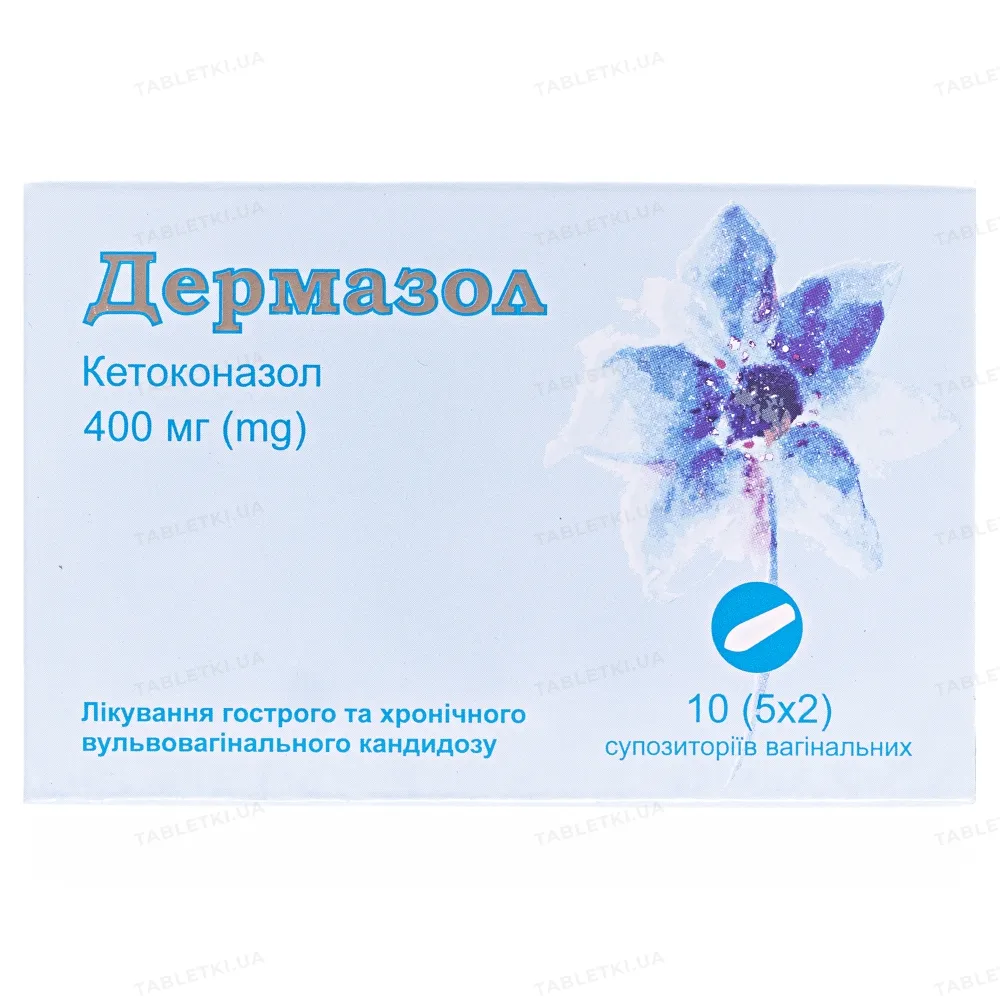
DERMAZOL
UkraineThe drug is used to treat acute and chronic recurrent vaginal mycosis, as well as for the prevention of fungal infections in cases of reduced immunity or during treatment with drugs that affect microflora.
Frequently asked questions
How should Dermazol be taken correctly?
One suppository should be inserted deep into the vagina at night while lying on the back. Depending on the disease, the course lasts from 3 to 5 days, and for the chronic form — 10 days. Suppositories must not be cut into pieces.
What side effects can Dermazol cause?
Possible side effects include irritation of the vaginal mucosa, itching, burning, redness, skin rash, nausea, abdominal pain, or dizziness. Allergic reactions, such as urticaria or edema, are also possible.
Who should not use this drug?
Contraindications include individual hypersensitivity to the components of the composition. The drug should not be used during the first trimester of pregnancy, and its use is not recommended for children.
Can condoms be used during treatment?
No, contact with latex products (condoms, diaphragms) should be avoided, as this reduces their reliability and may lead to pregnancy or infection.
Does the drug affect the sexual partner?
In isolated cases, local allergic reactions may occur in the sexual partner. To reduce the risk of reinfection, simultaneous treatment of the partner is recommended.
What should be done in case of irritation or overdose?
If side effects occur, the drug should be discontinued and a doctor should be consulted. In case of overdose, it is recommended to rinse the vagina with water.
Instructions for use
INSTRUCTIONS for medical use of the medicinal product DERMAZOLE (DERMAZOLE)
Composition:
Active ingredient: ketoconazole;
1 suppository contains ketoconazole 400 mg;
Excipients: hard fat, butylhydroxyanisole (E 320).
Dosage form. Vaginal suppositories.
Main physicochemical characteristics: suppositories from white to light yellow, torpedo-shaped.
Pharmacotherapeutic group.
Antibacterial and antiseptic agents for gynecological use. ATC code G01AF11.
Pharmacological properties.
Pharmacodynamics.
Ketoconazole is a synthetic derivative of imidazoldioxolane. It exerts fungicidal and fungistatic activity against dermatophytes (Trichophyton spp., Epidermophyton floccosum, Microsporum spp.), and yeasts (Candida spp., Pityrosporum spp.).
Its mechanism of action is directed at inhibition of ergosterol biosynthesis and alteration of the fungal membrane lipid composition.
Pharmacokinetics.
After intravaginal administration, the drug is poorly absorbed; only a negligible amount (less than 1%) enters the systemic circulation. The maximum plasma concentration after administration of 400 mg of ketoconazole ranges from 0 to 20.7 ng/mL.
Clinical characteristics.
Indications.
Treatment of acute and chronic recurrent vaginal mycosis.
Prophylaxis of vaginal fungal infections in conditions of decreased body resistance and during treatment with agents that disrupt the normal vaginal microflora.
Contraindications.
Individual hypersensitivity to any component of the drug.
Pregnancy (first trimester).
Interaction with other medicinal products and other forms of interaction.
When ketoconazole is used concomitantly with rifampicin and isoniazid, the plasma concentration of ketoconazole decreases. When used concomitantly with cyclosporine, oral anticoagulants, and methylprednisolone, ketoconazole may increase the plasma concentration of these agents. The clinical significance of these interactions in the treatment with ketoconazole in the form of vaginal suppositories is unknown.
Special precautions.
In isolated cases, local allergic reactions in the sexual partner are possible. To reduce the risk of disease recurrence, simultaneous treatment of the sexual partner is recommended. Contact with latex products (contraceptive diaphragms, condoms) should be avoided due to reduced reliability of mechanical contraception; therefore, pregnancy or transmission of sexually transmitted infections cannot be ruled out. Sexual intercourse should be avoided during treatment. The drug is recommended to be used at night, as it exerts an osmotic and draining effect, accompanied by increased vaginal discharge. It is recommended to use sanitary pads during nighttime treatment with Dermazol.
If adverse reactions develop, including hypersensitivity reactions, the drug should be discontinued and medical advice should be sought.
The product contains butylated hydroxyanisole (E 320), which may cause local skin reactions (e.g., contact dermatitis) or irritation of mucous membranes.
Use during pregnancy or breastfeeding.
The drug should not be used during the first trimester of pregnancy.
During the second and third trimesters of pregnancy and during breastfeeding, the drug should be used only when the expected benefit to the woman outweighs the potential risk to the fetus or infant.
Ability to affect reaction speed when driving or operating machinery.
Generally does not affect reaction speed; however, the possibility of dizziness occurring in hypersensitive individuals should be taken into account.
Method of Administration and Dosage.
Remove the suppository from the strip and insert deeply into the vagina while lying on the back with knees bent and drawn up to the chest, or in a knee-elbow position. Suppositories should not be cut into parts, as such alteration of the storage conditions may lead to uneven distribution of the active ingredient. Apply 1 suppository once daily before bedtime for 3–5 days, depending on the course of the disease. If necessary, repeat the treatment course until clinical recovery and laboratory-confirmed remission. In case of chronic candidiasis, apply 1 suppository daily for 10 days.
It is recommended to wash hands after application to prevent accidental contact of the residual drug with eyes, mucous membranes, or skin.
During pregnancy (II–III trimester) and breastfeeding, the method of administration and dosage are as usual.
Children.
There is no experience with the use of the drug in children; therefore, it should not be prescribed to this age group of patients.
Overdose.
In case of overdose, local reactions may occur: hyperemia, burning sensation, itching, irritation of the vaginal mucosa. In such cases, douching with water is recommended.
Adverse reactions.
Local reactions: irritation of the vaginal mucosa accompanied by itching, burning sensation, hyperemia.
Skin and subcutaneous tissue disorders: pruritus, rash, hyperemia.
Immune system disorders: hypersensitivity reactions, including anaphylactic and anaphylactoid reactions, angioedema, urticaria.
Gastrointestinal disorders: nausea, abdominal pain.
Nervous system disorders: dizziness.
Reporting of suspected adverse reactions
Reporting of suspected adverse reactions after authorization of the medicinal product is an important procedure. It allows continuous monitoring of the benefit-risk balance of the use of this medicinal product. Healthcare professionals should report any suspected adverse reactions through the national reporting system and the applicant via the feedback form on the website: https://kusum.ua/pharmacovigilance/.
Shelf life.
2 years.
Storage conditions.
Store in the original packaging at a temperature not exceeding 25 °C.
Keep out of the reach of children.
Packaging.
5 suppositories per strip. 1 or 2 strips per cardboard package.
Supply category.
Over-the-counter (without prescription).
Manufacturer.
KUSUM HEALTHCARE PVT LTD.
Manufacturer's address and location of business activity.
SP-289 (A), RIICO Industrial area, Chopanki, Bhiwadi, Dist. Alwar (Rajasthan), India.
Similar drugs
| Brand name | Dosage form | Active substance / Dosage | Manufacturer |
|---|---|---|---|
| KETODINE | suppositories, vaginal |
|
Joint Ukrainian-Spanish Enterprise "Sperko Ukraine" (full production cycle, batch release; quality control) |
The original data is available in the language of the country of manufacture.
Data source: State Register of Medicinal Products of Ukraine
Data last verified: August 13, 2026