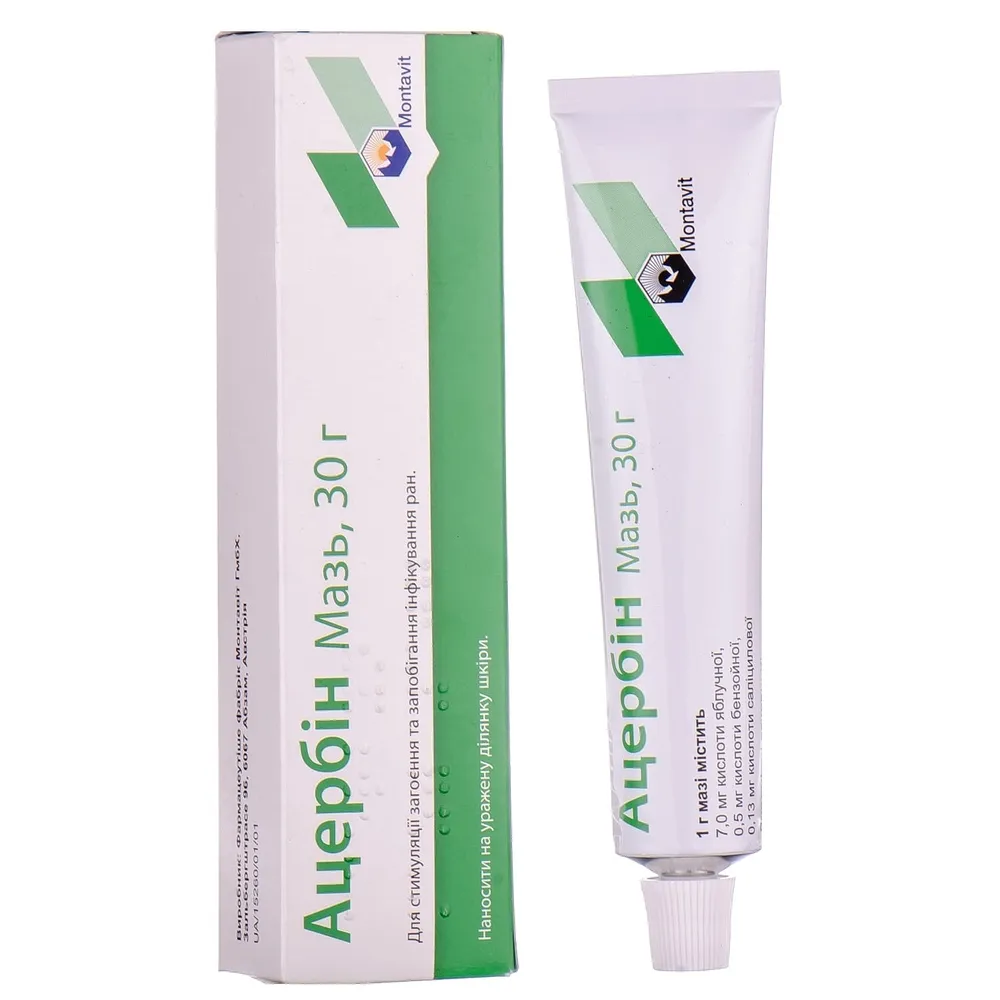
ACERBIN
UkraineThe ointment is used for the healing of superficial wounds, such as abrasions and lacerations, as well as sunburns and thermal burns.
Frequently asked questions
How should Acerbin be used correctly?
Apply a thin layer of the ointment to the affected area 2 or more times daily. If necessary, the product can be applied to a sterile gauze pad and secured with a bandage. A single dose should not exceed 7 g.
Who should not use this drug?
The product should not be used in infants under 1 month of age, nor in individuals with hypersensitivity to its components.
What are the possible side effects of Acerbin?
A sensation of warmth at the application site may occur frequently, which helps to relieve pain. Redness or skin rash around the wound may occur rarely. An allergic reaction to salicylic acid is possible very rarely.
Can the ointment be applied to large areas of skin?
In cases of severe renal impairment, it is not recommended to apply the drug to large areas of skin. In the event of extensive burns, wounds, or pressure ulcers, it is mandatory to consult a physician.
Can the product be used during pregnancy or breastfeeding?
The ointment should not be used during pregnancy, except for short-term treatment of a small area of skin. During breastfeeding, the product must not be applied to the mammary gland area.
Can the ointment be mixed with other medicines?
It is not recommended to use other medicinal products together with this drug without consulting a physician. If applied simultaneously with products containing iron salts, iodine, or borax, undesirable reactions may occur.
Instructions for use
INSTRUCTIONS FOR MEDICAL USE OF THE MEDICINAL PRODUCT AСERBINE (Acerbine®)
Composition:
Active substances:
1 g of ointment contains malic acid 7.0 mg, benzoic acid 0.5 mg, salicylic acid 0.13 mg;
Excipients: propylene glycol, xalifin 15, purified water.
Pharmaceutical form. Ointment.
Main physicochemical properties: white-colored oint游戏副本
Pharmacological Properties
Pharmacodynamics
Acerbin exerts an antiseptic, analgesic, and wound-healing effect, reduces exudate formation, and promotes eschar formation, granulation, and epithelialization. Skin grafts can be incorporated into wound surfaces previously treated with Acerbin.
Salicylic acid has a pronounced necrolytic effect and promotes healthy granulation and epithelialization.
Malic acid improves metabolic processes and fluid balance in the wound area. Enhanced elimination of carbon dioxide from the wound favors the healing process. Due to its pH, Acerbin prevents wound alkalization, thereby preventing infection and stimulating wound healing.
The antiseptic action—antibacterial and antimycotic—of benzoic and salicylic acids further supports wound healing.
Pharmacokinetics
Salicylic acid is rapidly absorbed through the skin and distributed throughout the body. The low volume of distribution (0.17 L/kg) is associated with a high degree of plasma protein binding (80–90%). The substance is metabolized in the liver; approximately 10% is excreted by the kidneys, while 80% remains unchanged, primarily as salicyluric acid and glucuronides. The elimination half-life in blood following administration of an analgesic dose (approximately 0.5 g) is 2–3 hours.
Absorption of benzoic acid through the skin and through wounds has not been studied. Benzoic acid is absorbed via the gastrointestinal tract, conjugates with glycine in the liver, and is rapidly excreted by the kidneys as hippuric acid. Benzoic acid does not accumulate in the body.
Clinical characteristics.
Indications.
A remedy for healing superficial wounds, such as thermal and sunburns, wounds, abrasions.
Contraindications.
Hypersensitivity to the components of the medicinal product.
Children under 1 month of age.
Special precautions.
Avoid contact with mucous membranes, especially eyes and oral cavity.
In case of extensive wounds and burns, pressure ulcers, ulcers, and prior to transplantation, medical consultation is required.
Acerbin, ointment, should not be applied to large areas of skin in patients with severe renal impairment.
Interaction with other medicinal products and other forms of interaction.
Not established.
When used simultaneously with topical preparations containing iron (III) salts, there is a possibility of complex formation; when used simultaneously with iodine, there is a possibility of precipitation reaction; when used with boric acid, neutralization reaction may occur. Salicylic acid may potentiate the effect of other agents applied to the same site. The use of other medicinal products is not recommended without consulting a physician.
Usage Notes.
Use during pregnancy or breastfeeding.
Data on the use of Acernbin ointment during pregnancy are lacking or limited.
Acernbin ointment should not be used during pregnancy, except for short-term treatment of a small skin area.
It is unknown whether systemic exposure to Acernbin ointment achieved after topical application could be harmful to the embryo/fetus.
During the third trimester of pregnancy, systemic use of prostaglandin synthetase inhibitors may cause cardiovascular and renal toxicity in the fetus. Prolonged bleeding may occur in both mother and child near term, and labor may be prolonged.
During breastfeeding, Acernbin ointment should not be applied to the area of the mammary glands.
Ability to influence reaction rate while driving or operating machinery.
Does not influence.
Method of Administration and Dosage
Apply topically to adults and children aged 1 month and older. Apply a thin layer of ointment to the wound or damaged skin area 2 or more times daily. The recommended single dose should not exceed 7 g (corresponding to an ointment strip 35 cm in length). If necessary, apply to a sterile gauze pad and secure with a dressing. The duration of treatment depends on the course of the disease and the rate of wound healing.
Children. Use in children aged 1 month and older. Consultation with a physician prior to initiating treatment is recommended.
Overdose.
Not observed.
Due to low concentrations of active ingredients, overdose with Acerbin ointment is practically impossible.
However, with prolonged application over large skin areas, especially in children, symptoms of salicylic acid intoxication may occur, including gastrointestinal symptoms such as nausea and vomiting, as well as dizziness, headache, tinnitus, and increased sweating. High doses of salicylic acid may lead to hemorrhages and prolonged blood coagulation time.
Side effects.
The following terms are used to describe the frequency of side effects:
very common (≥1/10);
common (≥1/100 to <1/10);
uncommon (≥1/1000 to <1/100);
rare (≥1/10,000 to <1/1000);
very rare (<1/10,000);
frequency not known (cannot be estimated from the available data).
Immune system disorders: very rare – hypersensitivity allergic reaction (contact sensitization) to salicylic acid.
Application site reactions: common – transient sensation of warmth at the application site, followed by rapid and prolonged pain relief; rare – mild erythema and urticarial rash on healthy skin around the wound surface to which the product has been applied.
When used correctly, Acersin ointment is well tolerated.
If any adverse reactions occur, consult a physician.
Shelf life.
3 years.
After opening the tube – 6 months.
Storage conditions.
Store in the original packaging to protect from light.
Packaging.
30 g or 100 g of ointment in an aluminum tube with a polyethylene cap; 1 tube per cardboard box.
Supply category.
Over-the-counter (without prescription).
Manufacturer.
Pharmazeutische Fabrik Montavit GmbH
Manufacturer's address and place of business.
Salzbergstrasse 96, 6067 Absam, Austria
Similar drugs
| Brand name | Dosage form | Active substance / Dosage | Manufacturer |
|---|---|---|---|
| ALTANOVA OINTMENT | ointment |
|
PJSC "Scientific and Production Center "Borshchahivskyy Chemical and Pharmaceutical Plant" |
| CALENDULA OINTMENT | ointment |
|
DKP "Pharmaceutical Factory" LLC |
| CALENDULA OINTMENT | ointment |
|
JSC "Lubnipharm" |
| CALENDULA OINTMENT | ointment |
|
PJSC Pharmaceutical Factory "Viola" |
| CALENDULA OINTMENT | ointment |
|
PJSC "Fitofarm" (responsible for manufacturing, primary packaging, quality control and batch release) |
| CALENDULA OINTMENT | ointment |
|
Ternofarm LLC |
| DALMAXIN | ointment |
|
PJSC "HIMFARMZAVOD "CHERVONA ZIRKA" |
| LEVOMEKOL | ointment |
|
PJSC Pharmaceutical Factory "Viola" |
| LEVOMEKOL | ointment |
|
Farmak JSC |
| LEVOMEKOL | ointment |
|
JSC "Lubnipharm" |
| LEVOMEKOL | ointment |
|
PJSC "Scientific and Production Center "Borshchahivskyy Chemical and Pharmaceutical Plant" |
| LEVOMEKOL | ointment |
|
PJSC "HIMFARMZAVOD "CHERVONA ZIRKA" |
The original data is available in the language of the country of manufacture.
Data source: State Register of Medicinal Products of Ukraine
Data last verified: August 13, 2026