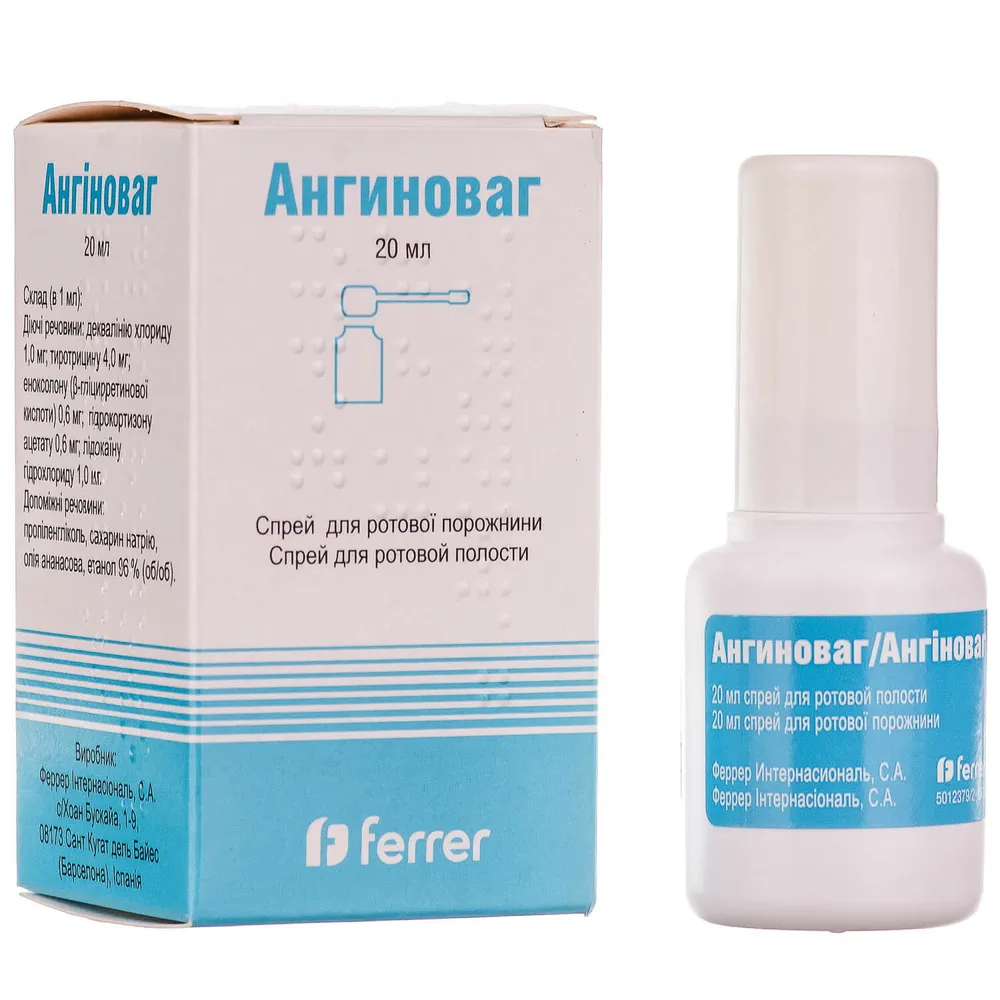
ANGINOVAG
UkraineThe drug is used for the local treatment of infectious and inflammatory diseases of the oral cavity and upper respiratory tract, such as tonsillitis, pharyngitis, laryngitis, stomatitis, and glossitis.
Frequently asked questions
How should Anginovag be taken correctly?
Adults and children aged 13 years and older should use 1–2 sprays every 2–3 hours for the first two days, and then 1 spray every 6 hours. It is recommended to rinse the mouth with warm water before use. Typically, the course of treatment lasts 5–7 days.
Who should not use this drug?
The drug is contraindicated in case of increased individual sensitivity to any of its components. It is also not recommended for use in children under 13 years of age.
What are the possible side effects of Anginovag?
Possible local irritation, burning, itching, or swelling. In rare cases, allergic reactions (rash, urticaria) or visual disturbances (blurred vision) may occur. In the very rare event of a large amount of the substance entering the bloodstream, dizziness, drowsiness, or cardiac disturbances may occur.
Does the drug affect other medicines or test results?
The ethanol content may enhance the effect of other agents. Antibacterial activity is reduced if toothpaste is used simultaneously. Additionally, a positive doping test is possible during the use of the drug.
Can the drug be used during pregnancy or breastfeeding?
There is no clinical data regarding the use of Anginovag during these periods, so caution should be exercised.
Can you drive a car during treatment?
There is no data regarding adverse effects on the ability to drive vehicles.
Instructions for use
INSTRUCTIONS FOR MEDICAL USE OF THE MEDICINAL PRODUCT ANGINOVAG (ANGINOVAG)
Composition:
Active substances: dequalinium chloride, tyrothricin, enoxolone (β-glycyrrhetinic acid), hydrocortisone acetate, lidocaine hydrochloride;
1 ml of spray contains: dequalinium chloride 1 mg; tyrothricin 4 mg; enoxolone (β-glycyrrhetinic acid) 0.6 mg; hydrocortisone acetate 0.6 mg; lidocaine hydrochloride 1 mg;
Excipients: propylene glycol, pineapple oil, sodium saccharin, ethanol 96% (v/v).
Pharmaceutical form. Oral spray.
Main physicochemical characteristics: clear solution, colorless to slightly yellowish.
Pharmacotherapeutic group. Medicinal products used in throat disorders. Antiseptics. ATC code R02A A20.
Pharmacological Properties.
Pharmacodynamics.
Anginovag combines within its composition substances with anti-inflammatory, analgesic, antibacterial, and antiseptic effects, which exhibit mutually complementary and synergistic actions.
These pharmacological properties provide comprehensive pathogenetic therapy for inflammatory diseases of the upper respiratory tract and the oral mucosa.
- Tyrothricin is a local antibiotic produced by the bacterium Bacillus brevis Dubos. It is active against many Gram-positive bacteria.
- Dequalinium chloride is an antiseptic and disinfectant agent. It has demonstrated activity against numerous bacteria, yeasts, and fungi.
- Hydrocortisone acetate is an anti-inflammatory agent, specifically effective against primary and secondary inflammation in the acute phase of the inflammatory process.
- Enoxolone is a potent inhibitor of the enzyme 11-hydroxysteroid dehydrogenase. Enoxolone has demonstrated the ability to enhance cortisol activity when used concomitantly.
- Lidocaine hydrochloride is a local anesthetic of the amide group. It acts by inhibiting ionic fluxes required for the initiation and conduction of nerve impulses.
Pharmacokinetics. No systemic absorption of any of the active ingredients has been detected.
Clinical characteristics.
Indications. Local treatment of infectious and inflammatory diseases of the oral cavity and upper respiratory tract: tonsillitis, pharyngitis, laryngitis, aphthous and ulcerative stomatitis, glossitis.
Contraindications. Hypersensitivity (allergy) to any component of the drug.
Interaction with other medicinal products and other forms of interactions. The product contains ethanol, which may alter or enhance the effect of other medicinal products.
The antibacterial activity of dequalinium is reduced when used concomitantly with anionic surfactants, for example, when using toothpaste.
Special precautions for use
The product contains ethanol. Each application includes approximately 0.075 g of ethanol, which may be harmful for patients suffering from alcoholism. Caution should be exercised when used in pregnant women and breastfeeding women, children, patients with liver disease, and patients with epilepsy.
Use of Anginovag may result in a positive doping test.
The product may cause skin irritation, as it contains propylene glycol.
Spray should be avoided in the eyes.
Visual disturbances
Visual disorders may occur during the use of systemic or topical corticosteroids. If a patient experiences symptoms such as blurred vision or other visual disturbances, the patient should consult an ophthalmologist to determine possible causes, including cataract, glaucoma, or rare conditions such as central serous chorioretinopathy (CSC), which has been reported after using systemic or topical corticosteroids.
Use during pregnancy or breastfeeding. There are no clinical data on the use of Anginovag during pregnancy or breastfeeding.
Ability to affect reaction speed when driving or operating machinery. There are no data on harmful effects on the ability to drive a vehicle or operate machinery.
Method of Administration and Dosage.
For use in adults and children aged 13 years and older. Before use, if necessary, rinse the mouth and throat with warm boiled water. Remove necrotic deposits from affected areas (ulcers, erosions) using a swab. During the first two days – 1–2 sprays every 2–3 hours; thereafter – 1 spray every 6 hours. The duration of treatment is determined individually by a physician, usually lasting 5–7 days.
Method of Administration.
For proper use, it is recommended to hold the bottle vertically; direct the oral applicator toward the affected area, but do not insert it completely into the oral cavity. Press the top part of the cap downward.
The bottle is equipped with a metering valve: each complete press results in a controlled release of the medication.
Children. Due to the lack of clinical data in this age group, Anginovag is not recommended for children under 13 years of age.
Overdose. No cases of overdose have been reported.
Adverse Reactions
When using Anginovag, local irritation may occur in some cases depending on the patient's hypersensitivity to the components of the drug; such irritation is generally temporary.
Below are the adverse reactions that may occur with monotherapy using one of the active substances in Anginovag
Diquafosel chloride
Hypersensitivity reactions may occasionally occur after administration of the drug, such as rash, itching, burning sensation, and irritation of the oral and pharyngeal mucosa. In rare cases, particularly with abuse, ulceration and necrosis may develop. If any unusual reactions occur, administration of the drug should be discontinued and medical advice must be sought regarding further therapy.
Tyrothricin
Hypersensitivity.
Contraindicated for intranasal use; there have been reports that such administration may lead to olfactory disturbances.
Hydrocortisone acetate
Hydrocortisone is a steroid component of the drug that may cause local adverse reactions such as burning, itching, irritation at the site of application, excessive drying, skin atrophy, contact dermatitis, eczema, rosacea-like dermatitis, perioral dermatitis, skin maceration, acneiform eruptions, telangiectasias, miliaria, rash, hypertrichosis, skin depigmentation, secondary skin infections, and folliculitis. Rebound effect may lead to steroid dependence; purpura, striae; delayed wound healing. Increased intraocular pressure and risk of cataract development (in case of repeated contact with the conjunctiva).
With prolonged use and/or application to large skin areas, hydrocortisone may penetrate into the bloodstream and cause systemic adverse effects typical of corticosteroids, including suppression of adrenal gland function.
Eye disorders: Frequency unknown: blurred vision (for detailed information see section "Special precautions for use.")
Lidocaine hydrochloride
Local effects. A burning sensation may occur upon application of the drug, which disappears after the onset of anesthetic effect (within 1 minute).
Transient erythema, swelling, and reduced sensitivity may occur at the site of application.
Allergic reactions, including skin rash, itching, urticaria, angioneurotic edema, bronchospasm, and in extremely severe cases, shock.
If hypersensitivity reactions occur, the drug should be discontinued.
Systemic effects. When used according to instructions, the incidence of systemic effects is extremely low, as the amount of active substance reaching the systemic circulation is very small. However, when high doses are used, with rapid absorption of lidocaine, or in cases of increased sensitivity, idiosyncrasy, or reduced tolerance, the following adverse effects may develop:
Central nervous system: excitation, depression, nervousness, dizziness, drowsiness, seizures, loss of consciousness, respiratory paralysis;
Cardiovascular system: arterial hypotension, myocardial infarction, bradycardia.
Shelf life. 4 years.
Storage conditions. Store at temperatures not exceeding 30 °C.
Incompatibility. Not described.
Packaging. 10 ml or 20 ml in a bottle; 1 bottle with an oral dosing device in a cardboard box.
Availability. Over-the-counter.
Manufacturer. Ferrer Internacional, S.A.
Manufacturer's location and address of place of business.
Legal address:
Gran Via Carlos III, 94, 08028, Barcelona, Spain.
Manufacturing site:
c/Joan Busquets, 1-9, 08173 Sant Cugat del Vallès (Barcelona), Spain.
Similar drugs
The original data is available in the language of the country of manufacture.
Data source: State Register of Medicinal Products of Ukraine
Data last verified: August 13, 2026