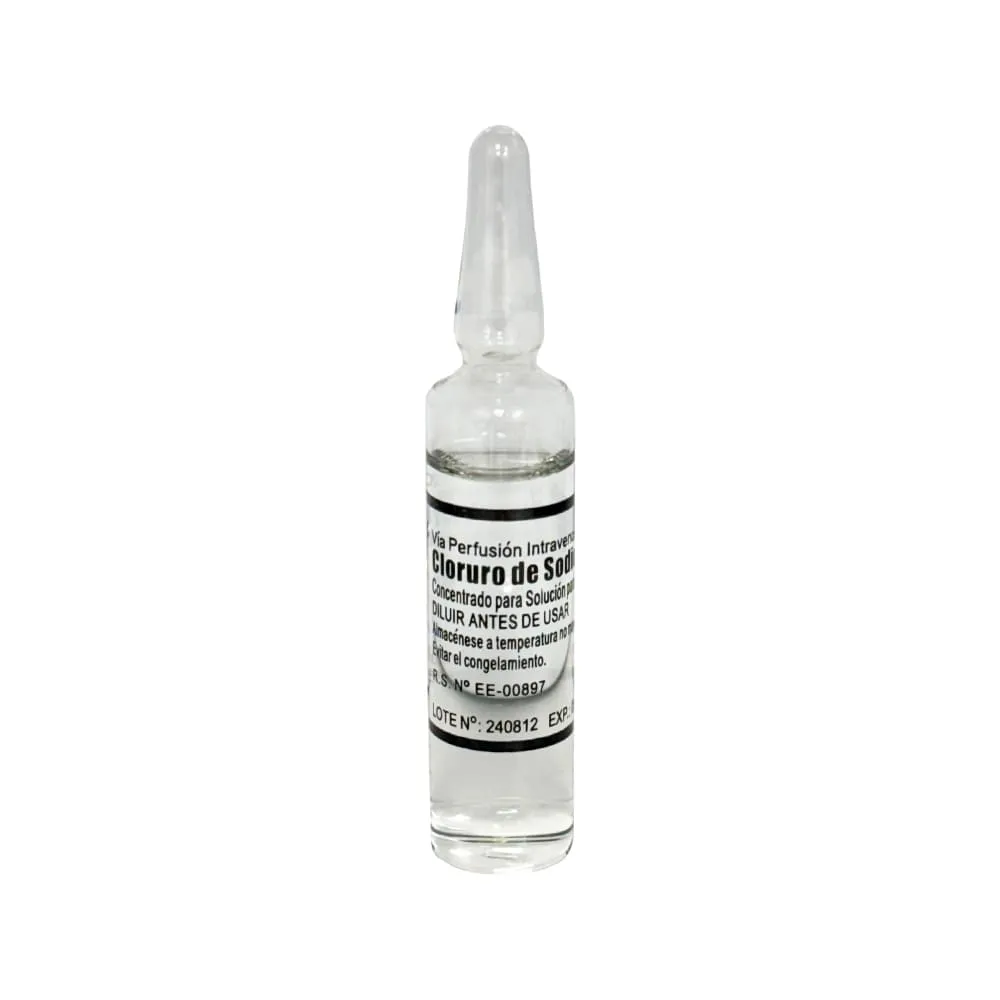
APIROSERUM SODIUM CHLORIDE 2% SOLUTION FOR INFUSION
SpainIt is used to treat disorders caused by a significant loss of salts without loss of water, such as symptoms of water intoxication, low blood sodium levels (hyponatremia) with severe symptoms, and high blood potassium levels associated with low sodium levels when large volumes of fluid cannot be administered.
Frequently asked questions
How should this medication be taken?
It is administered via infusion, meaning a drop-by-drop intravenous injection. The dose and administration rate will be determined by the physician based on the patient's condition.
When should APIROSERUM SODIUM CHLORIDE 2% not be used?
It should not be used if the administration of a hypertonic solution may worsen the clinical situation due to edema (swelling), hypertension (high blood pressure), hyposystole (decreased heart contraction strength), or hyperchloremic metabolic acidosis.
What precautions should I take before using it?
You must consult your doctor if you suffer from heart failure, kidney problems, preeclampsia, or any alteration related to sodium retention. In children, its use requires strict monitoring of blood sodium levels.
Does it interact with other medications?
APIROSERUM SODIUM CHLORIDE 2% may decrease the effect of lithium salts (medication for depression). It is important to inform your doctor about any other medication you are using.
What are the possible side effects of APIROSERUM SODIUM CHLORIDE 2%?
If used inappropriately, it may cause pulmonary edema, heart failure, increased blood volume, high sodium or low potassium levels, overhydration, thrombosis, inflammation of the veins (phlebitis), or pain and irritation at the injection site.
What should I do if too much is administered?
If administration is correct and controlled, there is no risk of intoxication. If these requirements are not met and symptoms appear, administration must be suspended and the appearing symptoms must be treated.
Instructions for use
Table of contents
- Introduction
- 1. What APIROSERUM SODIUM CHLORIDE is and what it is used for
- 2. What you need to know before using APIROSERUM SODIUM CHLORIDE 2%
- 3. How to use APIROSERUM SODIUM CHLORIDE 2%
- 4. Possible adverse effects
- 5. Storage of APIROSERUM SODIUM CHLORIDE 2%
- 6. Contents of the pack and other information
Patient Information Leaflet
Introduction
Patient Information Leaflet
APIROSERUM SODIUM CHLORIDE 2% solution for infusion
Sodium chloride
Read the entire leaflet carefully before you start using this medicine, because it contains important information for you.
- Keep this leaflet, as you may need to read it again.
- If you have any questions, consult your doctor or nurse.
- If you experience any adverse reactions, consult your doctor or nurse, even if they are not listed in this leaflet. See section 4.
Leaflet contents:
- What APIROSERUM SODIUM CHLORIDE 2% is and what it is used for
- What you need to know before using APIROSERUM SODIUM CHLORIDE 2%
- How to use APIROSERUM SODIUM CHLORIDE 2%
- Possible side effects
- Storage of APIROSERUM SODIUM CHLORIDE 2%
- Package contents and other information
1. What APIROSERUM SODIUM CHLORIDE is and what it is used for
APIROSERUM SODIUM CHLORIDE 2% is a replacement solution for intravenous use, primarily indicated in the treatment of the following disorders caused by significant salt depletion (loss of salts), without water loss:
- Symptoms of water intoxication.
- Relative hyponatremia (decreased sodium/water ratio due to overhydration) when symptoms of water intoxication (convulsions, vomiting, severe headaches) are present and spontaneous water elimination cannot be awaited.
- Hyperkalemia (elevated blood potassium levels) associated with hyponatremia (low blood sodium levels), when administration of large volumes of fluid is contraindicated.
2. What you need to know before using APIROSERUM SODIUM CHLORIDE 2%
Do not use APIROSERUM SODIUM CHLORIDE 2%
In situations where the administration of a hypertonic solution may worsen the clinical condition by increasing fluid volume, such as:
- Edema (swelling caused by fluid accumulation in body tissues),
- Hypertension (high blood pressure),
- Hyposystolia (reduced heart contraction force),
- Hyperchloremic metabolic acidosis (excess acid in metabolism).
Warnings and precautions
Consult your doctor or nurse before starting to use APIROSERUM SODIUM CHLORIDE 2%.
If you have congestive heart failure (heart failure with pulmonary congestion), renal dysfunction (impaired kidney function), preeclampsia (high blood pressure caused by pregnancy), or other conditions associated with sodium retention.
Children
The use of APIROSERUM SODIUM CHLORIDE 2% in children should be carried out under strict monitoring of blood sodium levels.
Use of APIROSERUM SODIUM CHLORIDE 2% with other medicines
Inform your doctor if you are taking, have recently taken, or might need to take any other medicines.
APIROSERUM SODIUM CHLORIDE 2% may reduce the therapeutic effect of lithium salts (antidepressant medication).
Pregnancy, breastfeeding, and fertility
If you are pregnant or breastfeeding, think you might be pregnant, or plan to become pregnant, consult your doctor before using this medicine.
Driving and using machines
This medicine has no influence on the ability to drive or operate machinery.
3. How to use APIROSERUM SODIUM CHLORIDE 2%
APIROSERUM SODIUM CHLORIDE 2% is administered by perfusion (intravenous infusion drop by drop). The dosage will be determined by the physician according to the patient's condition.
Use in children and adolescents
The administration of APIROSERUM SODIUM CHLORIDE 2% in children should only be carried out for the initial treatment of acute symptoms of hyponatremia (low sodium levels in the blood).
Use in elderly patients
Although there are no clinical experiences suggesting differences in therapeutic response in elderly patients, dosage adjustment should be cautious, starting with the lowest possible dose and assessing potential risks related to other disorders the patient may have.
APIROSERUM SODIUM CHLORIDE 2% must be injected completely or partially once the infusion set is connected to the bottle, to prevent possible contamination.
In case of multiple mixtures, maximum asepsis must be maintained during the addition of medications to intravenous fluids, and such mixtures should be used within 6 hours of preparation.
If you use more APIROSERUM SODIUM CHLORIDE 2% than you should
Given the nature of the product, if its indication and administration are correct and controlled, there is no risk of intoxication.
If these conditions are not met and any symptoms related to adverse effects occur, administration should be discontinued and symptomatic treatment should be initiated.
If you have any further questions about the use of this medicine, ask your doctor or nurse.
4. Possible adverse effects
Like all medicines, this medicine can cause adverse effects, although not everyone will experience them.
During the use of hypertonic solutions, the following adverse reactions have been observed, the frequency of which has not been accurately established. These reactions arise from inappropriate use of the medicine, either due to incorrect indication or to inappropriate dosage or administration technique:
-
Pulmonary edema and congestive heart failure.
-
Hypervolemia (abnormal increase in plasma volume in the body), hypernatremia (elevated blood sodium levels), decreased serum electrolytes, overhydration, hypokalemia (low blood potassium levels).
-
Thrombosis (clot formation inside a blood vessel), phlebitis (inflammation of the wall of a vein), extravasation (leakage of the medicine out of the vein and into the skin). Infusing the solution too rapidly may cause local pain and venous irritation.
Reporting of adverse effects
If you experience any type of adverse effect, consult your doctor, pharmacist, or nurse, even if it is a possible adverse effect not listed in this leaflet. You may also report them directly through the Spanish Pharmacovigilance System for Human Medicinal Products: www.notificaRAM.es. By reporting adverse effects, you can help provide more information on the safety of this medicine.
5. Storage of APIROSERUM SODIUM CHLORIDE 2%
Store below 25°C.
Keep this medicine out of sight and reach of children.
Do not use this medicine after the expiry date stated on the container after “EXP”. The expiry date refers to the last day of the month indicated.
6. Contents of the pack and other information
Composition of APIROSERUM SODIUM CHLORIDE 2%
- The active substance is sodium chloride. Each 100 ml of solution contains 2 g of sodium chloride.
Milliequivalents/litre: Chloride ion 342 mEq; Sodium ion 342 mEq
Osmolality: 684 mOsmol/litre
pH = 4.5–7.0
The other components (excipients) are water for injections, hydrochloric acid, and sodium hydroxide.
Appearance of the product and contents of the container
Apiroserum Sodium Chloride 2% is a clear, colourless solution.
Glass bottles containing 250, 500, and 1000 ml.
Clinical packs containing 12 bottles of 250 and 500 ml.
Only certain pack sizes may be marketed.
Marketing Authorization Holder and Manufacturer
Marketing Authorization Holder:
Fresenius Kabi España S.A.U.
Torre Mapfre – Vila Olímpica
Marina 16-18, 08005-Barcelona (Spain)
Manufacturer:
Fresenius Kabi Italia S.r.l.
Via Camagre, 41/43
I - 37063 Isola della Scala (Verona)
This summary of product characteristics was approved in January 2022
Detailed and up-to-date information on this medicinal product is available on the website of the Spanish Agency of Medicines and Health Products (Agencia Española de Medicamentos y Productos Sanitarios, AEMPS): http://www.aemps.gob.es/
This information is intended for healthcare professionals only:
Dosage and administration
Regarding the calculation of volume and rate of administration of a hypertonic sodium chloride solution in patients with severe symptoms, correction may be initiated at 1–2 mEq/l/hour. Rapid correction should be stopped once life-threatening symptoms have resolved or when a serum sodium concentration of 125–130 mEq/l is reached (or even lower if plasma sodium is below 100 mEq/l), without exceeding an increase of 12 mEq/l in the first 24 hours.
To avoid potential harm from excessive changes, serum sodium concentration should not increase by more than 25 mEq/l during the first 48 hours of treatment.
The correction rate of hyponatremia should be calculated using the following formula:
Conc. of Na in 1 litre of infusion – Serum Na
Estimated change in serum Na = ---------------------------------------------------------
Total body water + 1
Clinical use: Estimated effect of 1 litre of solution on serum sodium
Once the desired correction has been achieved, administration of a non-hypertonic saline solution may be considered.
Paediatric population
Intravenous administration of hypertonic solutions (>0.9%) should only be used for the initial treatment of acute hyponatremia symptoms; maintenance: 3–4 mEq/kg/day; maximum 100–150 mEq/day. In any case, dosage varies widely depending on clinical condition. Replacement should be guided by laboratory values.
Warnings and special precautions
Urine output and sodium levels should be monitored every 2 hours to adjust the infusion regimen accordingly.
Clinical response should be monitored after drug administration, with careful observation of intravascular volume expansion and increases in serum sodium levels (risk of hypernatremia due to overcorrection).
The solution must be administered using sterile equipment and an aseptic technique. The administration set should be primed with the solution to prevent air from entering the system.
An aseptic technique must be used when administering the solution and when preparing mixtures.
Prior to adding medications to the solution or administering concomitantly with other medicinal products, compatibility must be verified.
Similar drugs
The original data is available in the language of the country of manufacture.
Data source: Online Medicines Information Centre (CIMA) — AEMPS
Data last verified: September 21, 2026