ISOFUNDIN SOLUTION FOR INFUSION
SpainIt is used to replace fluid loss in the circulation and in cases where the blood may become or has become slightly acidic.
Frequently asked questions
How should this medication be taken?
It is administered intravenously via drip. The amount, rate, and duration of treatment will be determined by a doctor based on the patient's weight and condition.
When should Isofundin not be used?
It should not be used if you have excessive fluid in the circulation, severe heart disease with breathing difficulties or swelling in the feet and legs, severe kidney disease with difficulty urinating, tissue swelling due to fluid accumulation, high levels of potassium or calcium in the blood, or if your blood is too alkaline.
What side effects can Isofundin cause?
It may cause fever, infections, pain or irritation at the injection site, inflammation of the veins, or blood clots. Allergic reactions (urticaria) and, in rare cases, intestinal paralysis have also been described.
Are there interactions with other medications?
Yes. It is important to inform your doctor if you are taking steroid hormones, carbenoxolone, certain diuretics, transplant rejection prevention medications (such as tacrolimus or cyclosporine), digoxin, or vitamin D, as these may alter sodium, potassium, or calcium levels or affect heart function.
What happens if an excessive dose is received?
If administered more than required or too quickly, symptoms such as increased skin tension, swelling, fluid accumulation in the lungs, shortness of breath, or abnormalities in body salts and fluids may occur.
Instructions for use
Package leaflet: Information for the user
Introduction
Package leaflet: information for the user
Isofundin infusion solution
Read this entire leaflet carefully before you start using this medicine, because it contains important information for you.
- Keep this leaflet, as you may need to read it again.
- If you have any questions, ask your doctor or pharmacist.
- If you experience any adverse effects, consult your doctor or pharmacist, even if they are effects not listed in this leaflet. See section 4.
Contents of the leaflet
- What Isofundin is and what it is used for
- What you need to know before using Isofundin
- How to use Isofundin
- Possible side effects
- How to store Isofundin
- Contents of the pack and other information
1. What Isofundin is and what it is used for
Isofundin is an intravenous infusion solution.
This solution is used to replace circulating fluid losses. It can be used in conditions in which your blood may have become or has become slightly acidic.
2. What you need to know before using Isofundin
Do not use Isofundin
If you have:
? excess fluid in the circulation,
? severe heart disease with breathing difficulty and swelling of the feet and legs,
? severe kidney disease with inability or difficulty urinating,
? tissue swelling due to fluid accumulation,
? high levels of potassium or calcium in the blood,
? or if your blood is too alkaline.
Warnings and precautions
Consult your doctor or pharmacist before starting to use Isofundin.
Take special care with Isofundin if you have:
? any condition requiring reduced salt intake, such as mild or moderate heart failure, tissue swelling, or fluid accumulation in the lungs,
? sarcoidosis (a chronic immune system disorder affecting lymph nodes and connective tissue),
? mild or moderate increase in blood pressure,
? acute dehydration, for example, following massive tissue destruction due to severe burns, or due to impaired adrenal gland function,
? elevated levels of sodium and chloride in the blood,
? eclampsia (a complication occurring during pregnancy),
? mild or moderate impairment of kidney function,
? respiratory problems,
? any disease or medication you are taking that may reduce sodium excretion.
If any of the above warnings apply to you, your doctor will carefully decide whether this solution is suitable for you.
Your body fluid levels and blood electrolyte concentrations should be monitored during treatment with Isofundin to ensure they remain within normal limits.
Use of Isofundin with other medicines
Inform your doctor or pharmacist if you are taking, have recently taken, or might need to take any other medicines.
It is particularly important that your doctor knows if you are taking, using, or receiving:
? Medications associated with sodium and water retention such as:
- steroid hormones, or
- carbenoxolone.
If these medications are used with Isofundin, your body water and blood sodium levels may increase, potentially causing edema and elevated blood pressure.
? Medications affecting blood potassium levels such as:
- suxamethonium,
- certain diuretics (tablets that help eliminate water) that reduce potassium excretion, for example, amiloride, spironolactone, triamterene,
- tacrolimus, cyclosporine (medications used, for example, to prevent organ transplant rejection).
If these medications are used with Isofundin, your blood potassium levels may rise, which could lead to adverse effects on heart function. This is more likely if you have kidney failure.
? Digitalis glycosides (e.g., digoxin), used to treat heart weakness.
Their effects may be enhanced by increased blood calcium levels, potentially causing adverse effects such as irregular heartbeat. Therefore, your doctor may need to adjust your digoxin dose.
? Vitamin D, which may increase blood calcium levels.
Your doctor is aware of potential adverse effects that may occur when Isofundin is combined with the above-mentioned medicines and will ensure your infusion is correctly dosed.
Some medications must not be mixed with Isofundin. Doctors will only administer medications with Isofundin if they are certain the mixture is safe.
Pregnancy and breastfeeding
If you are pregnant or breastfeeding, think you might be pregnant, or plan to become pregnant, consult your doctor or pharmacist before using this medicine.
Your doctor will decide whether this solution is appropriate for you during pregnancy.
This medicine will be used with caution in pregnancy toxemia, a special complication that may occur during pregnancy.
Driving and using machines
Isofundin has no influence on the ability to drive or operate machinery.
Isofundin contains sodium
If you are on a low-sodium diet, please note that this medicine contains 145 mmol of sodium per 1000 ml.
3. How to use Isofundin
Route of administration
This medicine is administered intravenously by infusion.
Dosage
Your doctor will determine the amount of solution you need.
In adults, elderly patients, and adolescents, the dosage may range from 500 milliliters to 3 liters per day. The daily dose in infants and children may range from 20 to 100 milliliters per kilogram of body weight per day.
Rate of administration
Your doctor will determine the infusion rate of the solution, depending on your body weight and clinical condition.
Duration of treatment
Your doctor will determine how long you should receive this solution.
While receiving the infusion, your fluid and electrolyte levels and your blood acid-base balance should be monitored.
If you receive more Isofundin than you should
Since the dose administered will be controlled by your doctor or nurse, it is unlikely that you will receive an overdose of this solution.
However, if you accidentally receive too much solution or if the solution flows too quickly, you may experience symptoms such as:
- increased skin tension,
- venous congestion or swelling,
- fluid accumulation in the lungs,
- shortness of breath,
- abnormalities in the water and electrolyte composition of body fluids.
Excessively high levels of any individual component of Isofundin may be associated with specific symptoms that your doctor should monitor for.
In case of overdose, the infusion must be immediately discontinued and appropriate corrective treatment initiated.
If you have any further questions about the use of this medicine, ask your doctor or pharmacist.
4. Possible adverse effects
Like all medicines, this medicine can cause adverse effects, although not everyone will experience them.
Some adverse effects may be related to the administration technique. These may include fever, injection site infections, local reactions or pain, venous irritation, blood clots in veins, or inflammation of veins extending from the injection site.
Allergic reactions characterized by urticaria have been occasionally reported following the infusion of magnesium salts.
The frequency of these reactions cannot be estimated from the available data.
Rarely, intestinal paralysis has been reported after magnesium sulfate infusion. This may affect up to 1 in 1,000 people.
Reporting of adverse effects
If you experience any adverse effect, consult your doctor or pharmacist, even if it is a possible adverse effect not listed in this leaflet. You may also report them directly via the Spanish Pharmacovigilance System for Human Medicines: www.notificaRAM.es
By reporting adverse effects, you can help provide more information on the safety of this medicine.
5. Storage of Isofundin
Keep this medicine out of the sight and reach of children.
Glass vials and polyethylene plastic vials: Do not refrigerate or freeze.
Plastic bags: Do not store above 25°C. Do not refrigerate or freeze.
Do not use this medicine if the solution contains particles, is cloudy, or discolored. Do not use this product if the container shows leaks or other signs of deterioration. This product is for single use; partially used containers must not be reconnected.
Do not use this medicine after the expiry date stated on the label or carton after EXP.
6. Contents of the container and other information
Composition of Isofundin
The active substances in Isofundin infusion solution are:
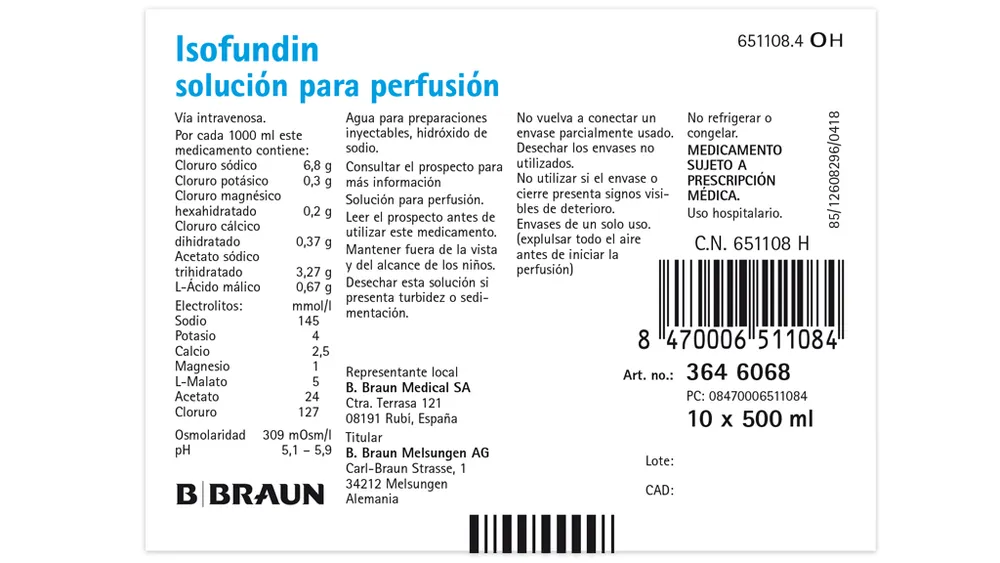
Each 1000 ml of this medicinal product contains:
Sodium chloride 6.8 g
Potassium chloride 0.3 g
Magnesium chloride hexahydrate 0.2 g
Calcium chloride dihydrate 0.37 g
Sodium acetate trihydrate 3.27 g
Malic acid 0.67 g
The other components are: Water for injections, sodium hydroxide (for pH adjustment).
Appearance of the product and contents of the container
Isofundin is an infusion solution (for intravenous administration using an infusion set). It is a clear, colourless solution.
It is supplied in:
- Plastic bottles containing 250 ml, 500 ml or 1000 ml, available in packs of 1 or 10 bottles
- Plastic bags containing 250 ml, 500 ml or 1000 ml, available in packs of 1 or 20 bags (250 ml and 500 ml) or 1 or 10 bags (1000 ml)
- Glass bottles containing 250 ml, 500 ml or 1000 ml, available in packs of 1 or 10 bottles (250 ml and 500 ml) or 1 or 6 bottles (1000 ml)
Marketing Authorization Holder
B|BRAUN
- Braun Melsungen AG
Carl-Braun Strasse, 1 Postal address:
34212 Melsungen 34209 Melsungen
Germany
Tel.: + 49-5661-71-0
Fax.: +49-5661-71-4567
Manufacturer responsible for manufacturing
B. Braun Melsungen AG
Carl-Braun Strasse, 1
34212 Melsungen
Germany
- Braun Medical, S.A.
Ctra. de Terrassa, 121
08191-Rubí (Barcelona)
Spain
- Braun Avitum AG
Schwarzenberger Weg 73-79
34212 Melsungen
Germany
This medicinal product is authorized in the Member States of the European Economic Area under the following names:
Austria | Sterofundin ISO Infusionslösung |
Belgium | Sterofundin ISO solution for infusion |
Bulgaria | Sterofundin ISO |
Cyprus | Sterofundin ISO |
Czech Republic | Ringerfundin B.Braun |
Denmark | Ringerfundin |
Estonia | Sterofundin ISO |
Finland | Ringerfundin infusion concentrate, solution |
France | Isofundine, solution for perfusion |
Germany | Sterofundin ISO Infusionslösung |
Greece | Sterofundin ISO |
Hungary | Ringerfundin B. Braun infusion |
Italy | Sterofundin |
Latvia | Sterofundin ISO |
Lithuania | Sterofundin ISO infusion solution |
Luxembourg | Sterofundin Iso solution for perfusion |
Malta | Sterofundin ISO |
Netherlands | Sterofundin ISO |
Norway | Ringerfundin infusion fluid |
Poland | Sterofundin ISO |
Portugal | Isofundin, solution for perfusion |
Romania | Sterofundin ISO perfusable solution |
Slovenia | Sterofundin ISO solution for infusion |
Slovakia | Ringerfundin |
Spain | Isofundin, solution for perfusion |
Sweden | Ringerfundin infusion solution, solution |
United Kingdom | Sterofundin ISO solution for infusion |
Date of last review of this leaflet: February 2018
Detailed information on this medicinal product is available on the website of the Spanish Agency of Medicines and Health Products (AEMPS) (http://www.aemps.gob.es/)
---------------------------------------------------------------------------------------------------------------This information is intended for healthcare professionals only:
Symptoms associated with excessive overdose of the individual components of the solution:
- Symptoms of hyperkalemia:
Paresthesia in the extremities, muscle weakness, paralysis, cardiac arrhythmia, asystole, and mental confusion.
- Symptoms of hypermagnesemia:
Loss of tendon reflexes and respiratory depression, nausea, vomiting, skin flushing, thirst, decreased blood pressure, somnolence, confusion, muscle weakness, bradycardia, coma, and cardiac arrest.
- Symptoms of hyperchloremia:
Loss of bicarbonate and acidosis.
- Symptoms of hypercalcemia:
Anorexia, nausea, vomiting, constipation, abdominal pain, muscle weakness, mental disturbances, polydipsia, polyuria, nephrocalcinosis, and, in severe cases, cardiac arrhythmias and coma. Intravenous injection of calcium salts administered too rapidly may cause a chalky taste and flushing.
- Symptoms of excessive overdose of acetate and malate:
Metabolic alkalosis, which may cause mood changes, fatigue, shortness of breath, muscle weakness, and cardiac arrhythmia, and, in the presence of low calcium levels, also spasms and cramps.
Handling
The solution must be administered using sterile equipment and an aseptic technique. The equipment should be primed with the solution to prevent air from entering the system.
If plastic bags are used, the outer bag should only be removed immediately before use.
If administration is performed via rapid infusion under pressure, all air must be removed from the plastic container and the infusion set prior to infusion, as otherwise there is a risk of gas embolism during infusion.
During administration, fluid balance, plasma electrolyte concentrations, and pH should be monitored. Isofundin may be administered as long as fluid replacement remains indicated.
Similar drugs
The original data is available in the language of the country of manufacture.
Data source: Online Medicines Information Centre (CIMA) — AEMPS
Data last verified: September 21, 2026