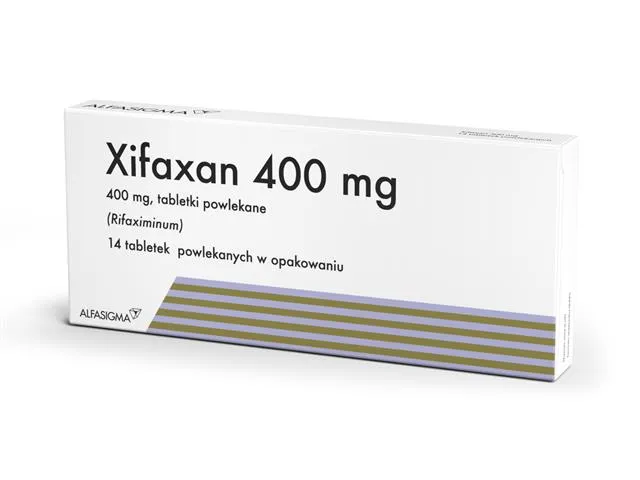
XIFAXAN
PolandThe medicine is used in adults and children over 12 years of age for intestinal infections and traveler's diarrhea (provided there is no fever or blood in the stool and no frequent, loose stools). In adults, it is also used in the case of hepatic encephalopathy and symptomatic, uncomplicated diverticular disease of the colon.
Frequently asked questions
How to take Xifaxan?
The medicine should be taken orally with a glass of water; it can be taken with or without food. The dosage depends on the purpose of treatment (e.g., for traveler's diarrhea, 1 tablet is taken every 8 hours for 3 days), therefore you must always strictly follow the doctor's instructions.
When should you not use this medicine?
It must not be used if you are allergic to rifaximin or any other ingredients of the medicine, or in the case of intestinal obstruction (even partial) or severe intestinal ulcers. It should also not be administered to children under 12 years of age.
What are the possible side effects of Xifaxan?
Common side effects may include, among others, abdominal pain, constipation, diarrhea, nausea, vomiting, pain, or dizziness. You should contact a doctor immediately if fever, a severe allergic reaction, a painful rash on the skin, mouth, or genitals, or worsening diarrhea symptoms occur.
Does Xifaxan interact with other products?
Inform your doctor about all medications you are taking, especially other antibiotics from the rifamycin group, warfarin, anti-epileptic drugs, anti-arrhythmic drugs, and cyclosporine. If you are taking activated charcoal, maintain at least a 2-hour interval from taking the medicine.
Can the urine change color after taking the medicine?
Yes, the urine may have a reddish tint. This is caused by the active substance, which has a red-orange color.
Instructions for use
Patient Information Leaflet
Warning! Keep this leaflet! Information on the immediate packaging in a foreign language.
Xifaxan (Normix 200 mg), 200 mg, coated tablets
Rifaximinum
Xifaxan and Normix 200 mg are different trade names for the same medicinal product.
Please read this leaflet carefully before taking this medicine, as it contains
important information for you.
- Keep this leaflet so that you can read it again if necessary.
- If you have any further questions, please consult your doctor or pharmacist.
- This medicine has been prescribed for a specific individual. Do not pass it on to others. It may harm other people, even if their symptoms are the same.
- If you experience any adverse reactions, including any not listed in this leaflet, inform your doctor or pharmacist. See section 4.
Table of contents of the leaflet:
- What Xifaxan is and what it is used for
- What you should know before taking Xifaxan
- How to take Xifaxan
- Possible side effects
- How to store Xifaxan
- Contents of the pack and other information
1. What Xifaxan is and what it is used for
Xifaxan is an oral antibacterial medicine. It contains rifaximin, an antibiotic belonging to a class of medicines known as rifamycins. However, unlike other rifamycins, it is only minimally absorbed from the intestine into the bloodstream (the α polymorphic form is absorbed at less than 1% of the administered dose), so it acts locally within the gastrointestinal tract against microorganisms present in the intestine. Xifaxan is active against most bacteria responsible for intestinal infections.
Indications
For adults and children over 12 years of age:
- Intestinal infections caused by bacteria sensitive to rifaximin, excluding diarrhoea associated with fever and/or blood in the stool, and also when the number of unformed stools is equal to or exceeds 8 per day.
- Travellers' diarrhoea, excluding diarrhoea associated with fever and/or blood in the stool, and also when the number of unformed stools is equal to or exceeds 8 per day.
For adults only:
- Hepatic encephalopathy,
- Symptomatic, uncomplicated diverticular disease of the colon in adult patients on a high-residue diet.
2. Important information before using Xifaxan
When not to use Xifaxan:
- if the patient is allergic to rifaximin or other rifamycins, or to any of the other ingredients of this medicine (listed in section 6);
- if the patient has intestinal obstruction, even partial (a blockage in the intestine that prevents the passage of food through the gut), or severe ulcerative intestinal damage.
Warnings and precautions
Before starting treatment, discuss the following issues with your doctor:
- if the patient has diarrhoea with fever or blood in the stool, or frequent bowel movements (8 times or more per day) – such symptoms are usually indicative of significant intestinal mucosal involvement by invasive intestinal pathogens (such as Campylobacter, Salmonella, and Shigella). Due to minimal absorption of Xifaxan in the gastrointestinal tract, it is not effective in these cases, and therefore this medicine should not be used;
- if the patient has impaired kidney function, as there are no studies available in this patient group;
- in patients with liver cirrhosis (a type of liver disease), a severe skin reaction, which may be life-threatening, may occur, characterized by painful rash or formation of blisters on the skin, mouth, eyes, and genitals. If a severe skin reaction or any other hypersensitivity reaction occurs, the medicine must be discontinued immediately and the patient should contact their doctor.
If diarrhoea symptoms worsen or persist for longer than 24–48 hours, discontinue Xifaxan. The doctor will consider alternative therapy.
Diarrhoea caused by Clostridium difficile infection (leading to a condition called pseudomembranous colitis) has been reported with the use of nearly all antibacterial agents. The most common symptoms of this infection include frequent watery stools, sometimes with blood, severe cramps or abdominal pain, and fever. A potential association between rifaximin treatment and the occurrence of this infection cannot be ruled out. Contact your doctor if symptoms of this disease occur.
Contact your doctor if reddish discoloration of urine occurs after taking Xifaxan. This is due to the active substance, which, like most antibiotics in the same class (rifamycins), has a red-orange colour.
Children
Xifaxan must not be given to children under 12 years of age.
Xifaxan and other medicines
Inform your doctor about all medicines you are currently taking, including those available without a prescription.
In particular, inform your doctor if you are taking the following medicines: another antibiotic from the rifamycin group for systemic bacterial infection, warfarin, antiepileptic drugs, antiarrhythmics, or cyclosporine.
If you are taking activated charcoal, Xifaxan should be taken at least 2 hours after activated charcoal.
In patients receiving warfarin-containing medicines who were also prescribed Xifaxan, both decreased and increased values of the International Normalized Ratio (INR) have been observed. If concomitant administration of both medicines is necessary, INR should be carefully monitored at the start and after completion of treatment with Xifaxan. Your doctor may consider it necessary to adjust the dose of oral vitamin K antagonists (anticoagulants).
Pregnancy, breastfeeding, and fertility
If you are pregnant or breastfeeding, think you may be pregnant, or are planning to become pregnant, consult your doctor before using this medicine.
As a precaution, use of rifaximin during pregnancy is not recommended.
If Xifaxan is used in breastfeeding women, the doctor will discuss with the patient whether to discontinue breastfeeding or to stop treatment with Xifaxan.
Animal studies have not shown any direct or indirect harmful effects on male or female fertility.
Driving and operating machinery
The influence of Xifaxan on the ability to drive motor vehicles and operate mechanical equipment is negligible.
However, exercise caution. If adverse effects such as dizziness, double vision, or drowsiness occur, do not drive or operate machinery.
Xifaxan contains less than 1 mmol (23 mg) of sodium per 2 tablets; therefore, this medicine is considered "sodium-free".
3. How to use Xifaxan
This medicine should always be taken exactly as prescribed by your doctor. If you are unsure, you should consult your doctor or pharmacist.
Recommended dosage of Xifaxan is:
Intestinal infections caused by bacteria sensitive to rifaximin:
Patients over 12 years of age: from 200 mg (1 tablet) every 8 hours to 400 mg (2 tablets) every 8–12 hours.
Traveler's diarrhea:
Patients over 12 years of age: 200 mg (1 tablet) every 8 hours for 3 days. Treatment should not last longer than 3 days. Repeating therapy is not recommended if diarrhea symptoms return after a short period following recovery (see “Warnings and precautions”).
Hepatic encephalopathy:
Adult patients: 400 mg (2 tablets) every 8 hours.
The treatment period should not exceed 7 days.
Symptomatic uncomplicated diverticular disease of the colon:
Adult patients on a high-fiber diet: 400 mg (2 tablets of 200 mg) every 12 hours for 7 days. If necessary, the doctor may recommend repeating the treatment once per month over the following 11 months, for a maximum of 12 cycles of 7 days each. After complete resolution of symptoms, the medication should be discontinued.
A single treatment course with rifaximin should not last longer than 7 days.
Each new course of treatment with rifaximin should be preceded by a 30-day treatment-free interval. If symptoms worsen or recur during this interval, the patient should contact their doctor immediately.
Patients with renal impairment: although dosage adjustment is not recommended, caution should be exercised in this patient group.
Patients with hepatic impairment: no dose adjustment is necessary in this patient group.
Elderly patients: no dose adjustment is required, as safety and efficacy data for Xifaxan have not shown any differences between elderly and younger patients.
Children: the efficacy and safety of rifaximin have not yet been established in children under 12 years of age.
Method of administration
The medicine may be taken with or without food. Administer orally with a glass of water.
Taking more Xifaxan than recommended
If you take more medicine than prescribed, contact your doctor or pharmacist immediately.
If possible, bring the medicine (both the medicine and its packaging) with you to show the doctor or pharmacist.
Missing a dose of Xifaxan
If you miss a dose at the scheduled time, take it as soon as possible.
However, if it is nearly time for your next dose, do not take the missed dose, but take the next dose at the usual time. Do not take a double dose to make up for a forgotten tablet.
4. Possible adverse reactions
Like all medicines, Xifaxan may cause adverse reactions, although not everyone experiences them.
You should contact a doctor or the emergency department of the nearest hospital immediately if the patient experiences:
- fever or severe generalized allergic reaction usually affecting: the circulatory system, lungs, skin (anaphylactoid reaction), allergic reaction manifesting as skin swelling (dermatitis, exfoliative dermatitis, purpura, rash, rough skin, redness of the skin, itching, blisters) and (or) mucous membranes (angioedema), pre-syncopal state
- life-threatening reaction with influenza-like symptoms and painful rash appearing on the skin, mouth, eyes, and genitals (Stevens-Johnson syndrome)*
- life-threatening reaction with influenza-like symptoms and formation of blisters on the skin, mouth, eyes, and genitals*.
* These reactions have been observed in patients with liver cirrhosis. See also "Warnings and precautions" in section 2.
Frequent adverse reactions (affecting 1 to 10 patients in 100): upper abdominal pain, constipation, sudden need for bowel movement, diarrhoea, bloating with passage of gas, increased abdominal wall tension, nausea, painful straining at stool, vomiting, fever, headache, dizziness.
Uncommon adverse reactions (affecting 1 to 10 patients in 1,000): upper abdominal pain, fluid in the abdominal cavity (ascites), dyspepsia, dry mouth, disturbances in gastrointestinal motility, presence of blood in stool, hard stools, stools containing mucus, taste disturbances, abnormal blood test results (increased number of white blood cells, i.e. lymphocytes, increased number of monocytes, decreased number of neutrophil granulocytes), palpitations, dizziness, ear pain, double vision, weakness, pain and discomfort, chills, cold sweats, excessive sweating, influenza-like illness, swelling of legs and (or) hands, increased activity of aspartate aminotransferase, candidiasis (thrush), candidal vaginal infection, Herpes simplex, rhinitis and pharyngitis, pharyngitis, upper respiratory tract infections, decreased appetite, dehydration, back pain, muscle cramps, decreased muscle strength, muscle pain, neck pain, hypoesthesia (sensory disturbances), migraine, limb paraesthesia, sinus pain, somnolence, sleep disturbances, low mood, insomnia, restlessness, presence of blood in urine, glucose in urine, frequent urination, excessive urination, protein in urine, abnormally frequent menstruation, cough, dry throat, shortness of breath (dyspnoea), nasal congestion, sore throat and larynx, watery nasal discharge, rash, skin eruptions, urticaria (skin changes), photoallergic reactions, sudden facial flushing, increased blood pressure.
Frequency unknown (frequency cannot be estimated from available data): abnormal blood test results (decreased platelet count, abnormal liver function tests, disturbances in international normalized ratio), infections with bacteria of the genus Clostridium (C. difficile), anaphylactic reactions, hypersensitivity, pre-syncopal state, angioedema (allergic reaction manifesting as swelling of the skin and (or) mucous membranes), dermatitis, exfoliative dermatitis, rash, erythema, pruritus, petechiae, urticaria.
Reporting of adverse reactions
If any adverse effects occur, including any adverse effects not listed in this leaflet, inform your doctor or pharmacist. Adverse reactions can be reported directly to the Department of Monitoring Adverse Drug Reactions of the Office for Registration of Medicinal Products, Medical Devices and Biocidal Products, Al. Jerozolimskie 181C, 02-222 Warsaw, tel.: +48 22 49 21 301, fax: +48 22 49 21 309, website: https://smz.ezdrowie.gov.pl.
Reporting adverse reactions helps to provide more information on the safety of this medicine.
5. How to store the medicine Xifaxan
Keep the medicine out of the sight and reach of children.
Store below 25°C in the original packaging.
Do not use the medicine Xifaxan after the expiry date stated on the packaging. The expiry date refers to the last day of the stated month.
Medicines must not be disposed of via wastewater or household waste. Ask your pharmacist how to dispose of medicines no longer required. Such measures help protect the environment.
6. Contents of the pack and other information
What Xifaxan contains
- The active substance is rifaximin. One coated tablet contains 200 mg of rifaximin.
- The other ingredients are:
Tablet core: sodium carboxymethyl starch (type A), glyceryl distearate, colloidal anhydrous silica, talc, microcrystalline cellulose
Coating: hypromellose (E 464), titanium dioxide (E 171), disodium edetate, propylene glycol, iron oxide red (E 172)
What Xifaxan looks like and contents of the pack
Xifaxan is a pink, round, biconvex coated tablet.
Xifaxan tablets are packed in PVC-PE-PVDC/Al blisters, placed in a cardboard box.
Pack of 12 tablets: 1 blister packed in a cardboard box.
Pack of 24 tablets: 2 blisters packed in a cardboard box.
For more detailed information, please contact the responsible party or parallel importer.
Marketing Authorisation Holder in Romania, country of export:
Alfasigma S.p.A.
Via Ragazzi del ’99, n. 5
40133 Bologna (BO)
Italy
Manufacturer:
Alfasigma S.p.A.
Via Enrico Fermi 1
65020 Alanno Scalo (Pescara)
Italy
Alfasigma S.p.A.
Via Pontina Km 30, 400
00071 - Pomezia (Rome)
Italy
Parallel Importer:
InPharm Sp. z o.o.
ul. Strumykowa 28/11
03-138 Warsaw
Poland
Repackaged by:
Pharma Innovations Sp. z o.o.
ul. Jagiellońska 76
03-301 Warsaw
Poland
InPharm Sp. z o.o. Services sp. k.
ul. Chełmżyńska 249
04-458 Warsaw
Poland
Marketing Authorisation Numbers in Romania, country of export: 12333/2019/01
12333/2019/02
Parallel Import Licence Number: 83/19
Similar drugs
| Brand name | Dosage form | Active substance / Dosage | Manufacturer |
|---|---|---|---|
| TIXTELLER | tablets, film-coated |
|
Alfasigma S.p.A |
| XIFAXAN | tablets, film-coated |
|
Alfasigma S.p.A. |
| XIFAXAN | tablets, film-coated |
|
Alfasigma S.p.A. |
| XIFAXAN | tablets, film-coated |
|
Alfasigma S.p.A. |
| XIFAXAN 400 MG | tablets, film-coated |
|
Alfasigma S.p.A. |
| XIFAXAN 400 MG | tablets, film-coated |
|
Alfasigma S.p.A. |
The original data is available in the language of the country of manufacture.
Data source: Register of Medicinal Products of Poland (URPL)
Data last verified: September 01, 2026