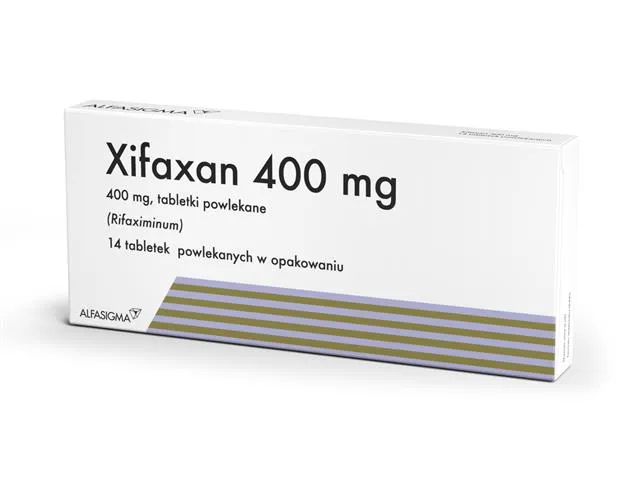
XIFAXAN 400 MG
PolandThe medicine is used for the symptomatic treatment of uncomplicated diverticular disease in adults who are on a high-fiber diet.
Frequently asked questions
How should Xifaxan 400 mg be taken?
Adults on a high-fiber diet should take 1 tablet (400 mg) every 12 hours for 7 days. The tablets should be swallowed with water; they can be taken with or without food.
When should this medicine not be used?
It must not be used if you are allergic to rifaximin or any other ingredients of the medicine, or in cases of intestinal obstruction (even partial) or severe ulcerative colitis.
Can Xifaxan 400 mg interact with other medicines?
Yes. You should inform your doctor if you are taking any other medicines, especially rifamycin antibiotics, warfarin, anti-epileptic drugs, anti-arrhythmic drugs, and cyclosporine. If you are taking activated charcoal, maintain at least a 2-hour interval from taking the medicine.
What side effects may occur?
Common symptoms include, among others, bloating, abdominal pain, constipation, diarrhea, nausea, vomiting, dizziness, and headache. A reddish color of urine may also occur, which is caused by the color of the active substance.
When should you contact a doctor immediately?
You should stop taking the medicine immediately and seek medical help if severe skin reactions occur (e.g., spots on the torso, blisters, skin peeling, oral ulcers) or a severe allergic reaction (e.g., swelling of the skin or mucous membranes, breathing difficulties).
What should I do if I miss a dose?
If you forget to take a dose, take it as soon as possible. However, if it is almost time for your next dose, skip the forgotten dose and take the next one at the usual time. Do not take a double dose to make up for a forgotten one.
Instructions for use
Package leaflet: Information for the user
Warning! Keep this leaflet! The information on the immediate packaging is in a foreign language.
Xifaxan 400 mg (Normix 400 mg), 400 mg, coated tablets
Rifaximinum
Xifaxan 400 mg and Normix 400 mg are different brand names for the same medicine.
Please read the leaflet carefully before using the medicine, as it contains
important information for the patient.
- Keep this leaflet so that you can read it again if necessary.
- If you have any doubts, consult your doctor or pharmacist.
- This medicine has been prescribed for a specific individual. Do not give it to others. This medicine may harm someone else, even if their symptoms are the same.
- If you experience any adverse reactions, including any not listed in this leaflet, inform your doctor or pharmacist. See section 4.
Table of contents of the leaflet
- What Xifaxan 400 mg is and what it is used for
- Important information before taking Xifaxan 400 mg
- How to take Xifaxan 400 mg
- Possible side effects
- How to store Xifaxan 400 mg
- Contents of the pack and other information
1. What Xifaxan 400 mg is and what it is used for
Pharmaceutical form and active substance content
Xifaxan 400 mg is in the form of coated tablets. Each coated tablet of Xifaxan 400 mg contains 400 mg of rifaximin.
Mechanism of action
Xifaxan 400 mg is an oral antibacterial medicine belonging to a class of drugs known as rifamycins. Unlike other rifamycins, it is only minimally absorbed from the intestine into the bloodstream (less than 1% of the administered dose), thus acting exclusively on microorganisms present in the intestine.
Indications
Xifaxan 400 mg is indicated for the treatment of symptomatic uncomplicated diverticular disease of the colon in adult patients following a high-residue diet.
If there is no improvement or if symptoms worsen after 7 days of treatment, consult your doctor.
2. Information before using Xifaxan 400 mg
When not to use Xifaxan 400 mg:
- if the patient is allergic to rifaximin or other rifamycins, or to any of the other ingredients of this medicine (listed in section 6);
- if the patient has intestinal obstruction, even partial (blockage of the intestine causing food to stop moving through the intestines), or severe ulcerative colitis.
Warnings and precautions
Before starting treatment, discuss the following with your doctor or pharmacist:
- If the patient has ever experienced severe skin rash, skin peeling, blisters, mouth sores, and/or oral ulcers after taking rifaximin.
- Contact your doctor if reddish discoloration of urine occurs after taking Xifaxan 400 mg. This is caused by the active substance, which, like most antibiotics in the same family (rifamycins), has a red-orange color. During prolonged treatment with high doses or in the presence of intestinal mucosal damage, a small amount of rifaximin (however, less than 1% of the administered dose) may be absorbed, potentially causing reddish discoloration of urine.
- Do not administer this medicine to children under 18 years of age.
- Use of Xifaxan 400 mg in patients with liver function disorders: dose adjustment is not required in this patient group.
- Use of Xifaxan 400 mg in elderly patients: Inform your doctor if the patient is 65 years of age or older.
- Use of Xifaxan 400 mg in patients with kidney function disorders: Inform your doctor if the patient has impaired kidney function.
- In case of diarrhoea accompanied by fever or presence of blood in stool, consult your doctor about the possibility of using Xifaxan 400 mg.
Extreme caution is required when using rifaximin. Serious skin reactions, including Stevens-Johnson syndrome and toxic epidermal necrolysis, have been reported during treatment with rifaximin. Most of these cases were reported in patients with liver diseases (such as cirrhosis or hepatitis). If any severe skin reaction described in section 4 occurs, rifaximin should be discontinued immediately and medical advice should be sought.
Xifaxan 400 mg and other medicines
Inform your doctor or pharmacist about all medicines the patient is currently taking, as well as any medicines the patient plans to take.
In particular, inform your doctor if the patient is taking any of the following medicines: another antibiotic from the rifamycin group used to treat systemic bacterial infection, warfarin, antiepileptic drugs, antiarrhythmic drugs, or cyclosporine.
If taking activated charcoal, Xifaxan 400 mg should be taken at least 2 hours after the charcoal.
Xifaxan 400 mg with food and drink
Xifaxan 400 mg may be taken with or without food. It should be taken with a glass of water.
Pregnancy, breastfeeding, and fertility
If the patient is pregnant, breastfeeding, suspects she may be pregnant, or is planning to become pregnant, she should consult her doctor or pharmacist before using this medicine.
Use of Xifaxan 400 mg during pregnancy is not recommended.
If Xifaxan 400 mg is used in women who are breastfeeding, a decision should be made whether to discontinue breastfeeding or to stop treatment with Xifaxan 400 mg.
Driving and operating machinery
If adverse effects such as dizziness or drowsiness occur, the patient should not drive or operate machinery.
In all other cases, caution should be exercised.
Xifaxan 400 mg contains less than 1 mmol (23 mg) of sodium per tablet, i.e. the medicine is considered "sodium-free".
3. How to use Xifaxan 400 mg
This medicine should always be used as directed by a physician. In case of doubt, consult a
physician or pharmacist.
The recommended dose of Xifaxan 400 mg is:
Symptomatic uncomplicated diverticular disease of the colon:
Adult patients on a high-residue diet: 400 mg (1 tablet of 400 mg) every 12 hours.
To achieve optimal treatment outcomes for symptom relief, the medicine should be taken for 7
days. Repeating the therapy once per month for up to one year, i.e., 12 cycles of 7 days each, may be necessary.
After complete resolution of symptoms, treatment should be discontinued. If there is no improvement in symptoms within 7 days of therapy, the patient should contact the physician immediately.
During long-term therapy, the patient should remain under close medical supervision.
Unless otherwise prescribed, a single treatment course should not exceed 7 days.
In the case of symptomatic uncomplicated diverticular disease of the colon, if repeated treatment is necessary, each subsequent treatment period should be preceded by a 30-day treatment-free interval. If symptoms worsen or recur during this period, the patient should contact the physician immediately.
Use in children and adolescents:
Xifaxan 400 mg is intended only for use in adult patients.
Patients with renal impairment: Exercise caution in this patient group.
Patients with hepatic impairment: Dose adjustment is not required in this patient group.
Elderly patients: Dose adjustment is not required.
Xifaxan 400 mg coated tablets should be swallowed with water.
Use of a higher than recommended dose of Xifaxan 400 mg:
If a higher than recommended dose of the medicine is taken, seek immediate advice from a physician or
pharmacist.
Bring the medicine Xifaxan 400 mg (the medicine and its packaging) with you to show the physician or
pharmacist.
Missed dose of Xifaxan 400 mg
If a dose is missed at the scheduled time, take it as soon as possible. However,
if it is almost time for the next dose, do not take the missed dose, but take the next dose at the usual time. Do not take a double dose to make up for a missed dose.
4. Possible adverse reactions
Like any medicine, Xifaxan 400 mg may cause adverse reactions, although not everyone experiences them.
Rifaximin should be discontinued immediately and the patient should contact a doctor or the emergency department of the nearest hospital if any of the following symptoms occur:
- Reddish, flat, disc-shaped or round spots on the trunk, often with a centrally located blister, skin peeling, and ulceration of the mouth, throat, nose, genitals, and eyes. These severe skin reactions may be preceded by fever and flu-like symptoms;
- Fever or severe generalized allergic reaction usually affecting: the circulatory system, lungs, skin (pseudoanaphylactic reaction), allergic reaction manifested by: skin swelling (dermatitis, exfoliative dermatitis, purpura, rash, rough skin, skin redness, itching, blisters) and (or) mucous membranes (angioedema), pre-syncopal state. See also "Warnings and precautions" in section 2.
Frequent adverse reactions (occurring in 1 to 10 patients out of 100): abdominal distension, abdominal pain, constipation, sudden urge to defecate, diarrhea, flatulence, nausea, painful straining at stool, vomiting, fever, dizziness, headache.
Uncommon adverse reactions (occurring in 1 to 10 patients out of 1,000): upper abdominal pain, fluid in the abdominal cavity (ascites), dyspepsia, dry mouth, disturbances in gastrointestinal transit, presence of fresh blood in stool, mucus in stool, taste disturbances, abnormal blood test results (increased white blood cell count, i.e. lymphocytes, increased monocyte count, decreased neutrophil count), palpitations, dizziness, ear pain, double vision, weakness, pain and discomfort, chills, lack of efficacy of the medicine, fatigue, influenza-like illness, swelling of legs and (or) hands, fungal infection (candidiasis), vaginal yeast infection, rhinopharyngitis, pharyngitis, upper respiratory tract infections, increased liver enzyme activity (elevated aspartate aminotransferase activity), increased blood pressure, presence of blood cells and blood in urine, loss of appetite (anorexia), dehydration, back pain, muscle cramps, decreased muscle strength, neck pain, muscle pain, loss of taste, hypogeusia, migraine, tingling and burning sensations, sinus pain, somnolence, sleep disturbances, insomnia, nervousness, blood in urine, glucose in urine, frequent urination, polyuria, abnormally frequent menstruation, cough, dry throat, dyspnea, rhinitis, sore throat and larynx, watery rhinorrhea, cold sweats, rash, exanthema (skin lesions), photosensitivity reactions, sudden flushing of the face.
Frequency not known (frequency cannot be estimated from the available data): abnormal blood test results (decreased platelet count, abnormal liver function tests, hypersensitivity, disturbances in the international normalized ratio (INR), infections with Clostridium bacteria (C. difficile), generalized reaction resembling a severe allergic reaction affecting multiple organs simultaneously, usually the circulatory system, lungs, skin (pseudoanaphylactic reaction), allergic reaction manifested by swelling of the skin and/or mucous membranes (angioedema), facial swelling, dermatitis, rash, skin redness, pruritus, petechiae, urticaria, purpura, pre-syncopal state.
Reporting of adverse reactions
If any adverse reactions occur, including any not listed in this leaflet, inform a doctor or pharmacist. Adverse reactions can be reported directly to the Department of Monitoring of Adverse Drug Reactions at the Office for Registration of Medicinal Products, Medical Devices and Biocidal Products, Al. Jerozolimskie 181C, 02-222 Warsaw, phone: +48 22 49 21 301, fax: +48 22 49 21 309, website: https://smz.ezdrowie.gov.pl.
Reporting adverse reactions helps to provide more information on the safety of the medicine.
5. How to store Xifaxan 400 mg
Keep the medicine out of the sight and reach of children.
No special storage instructions are required.
Do not use Xifaxan 400 mg after the expiry date stated on the packaging.
The expiry date refers to the last day of the stated month.
Medicines must not be disposed of via wastewater or household waste. Ask your pharmacist how to dispose of medicines no longer required. This will help protect the environment.
6. Contents of the packaging and other information
What Xifaxan 400 mg contains
- The active substance is rifaximin.
- One coated tablet contains 400 mg of rifaximin.
- Other components of the medicine are: Tablet core: sodium carboxymethyl starch (type A), glycerol distearate, colloidal anhydrous silica, talc, microcrystalline cellulose; Coating: hypromellose 2910, titanium dioxide (E 171), disodium edetate, propylene glycol, iron oxide red (E 172).
What Xifaxan 400 mg looks like and contents of the pack
Xifaxan 400 mg is a medicine in the form of pink, round, biconvex coated tablets.
Xifaxan 400 mg coated tablets are packed in PVC/PE/PVDC/Al blisters, in a cardboard box.
Pack containing 14 coated tablets: 1 blister in a cardboard box.
For more detailed information, please contact the responsible party or the parallel importer.
Marketing Authorisation Holder in the Czech Republic, country of export:
Alfasigma S.p.A.
Via Ragazzi del ’99 n. 5
40133 Bologna (BO)
Italy
Manufacturer:
Alfasigma S.p.A.
Via Enrico Fermi, 1
65020 Alanno (PE)
Italy
Parallel importer:
InPharm Sp. z o.o.
ul. Strumykowa 28/11
03-138 Warsaw
Repackaged in:
InPharm Sp. z o.o. Services sp. k.
ul. Chełmżyńska 249
04-458 Warsaw
Marketing Authorisation number in the Czech Republic, country of export: 15/159/17-C
Parallel import authorisation number: 445/24
Similar drugs
| Brand name | Dosage form | Active substance / Dosage | Manufacturer |
|---|---|---|---|
| TIXTELLER | tablets, film-coated |
|
Alfasigma S.p.A |
| XIFAXAN | tablets, film-coated |
|
Alfasigma S.p.A. |
| XIFAXAN | tablets, film-coated |
|
Alfasigma S.p.A. |
| XIFAXAN | tablets, film-coated |
|
Alfasigma S.p.A. |
| XIFAXAN | tablets, film-coated |
|
Alfasigma S.p.A. |
| XIFAXAN 400 MG | tablets, film-coated |
|
Alfasigma S.p.A. |
The original data is available in the language of the country of manufacture.
Data source: Register of Medicinal Products of Poland (URPL)
Data last verified: September 01, 2026