OXYGEN MEDICAL COMPRESSED SIAD
PolandIt is used as a supplementary oxygen source in the treatment of, among others, severe heart and lung diseases, shock, severe bleeding, carbon monoxide poisoning, high fever, and in situations of sudden cardiac or respiratory arrest. It is also used during general anesthesia and in pre- and post-operative care.
Frequently asked questions
How should SIAD compressed medical oxygen be administered?
In hospital settings, oxygen is administered by a healthcare professional using a mask or nasal cannula. Always follow the instructions of medical personnel and the set flow rate.
What precautions should be taken when using oxygen?
During therapy, smoking is prohibited and one must not be near open flames, as oxygen increases the intensity of the flame. Oil-based moisturizing creams should not be used while using the equipment.
What side effects may occur?
Very rarely, the following may occur: retinal damage (in newborns), muscle spasms, loss of consciousness, disorientation, chest pain, pain in body cavities, or nausea. Uncommonly, the following may occur: a feeling of pressure in the ears, pleurisy, or a sensation of shortness of breath in the lungs.
Can oxygen interact with other medicines?
High concentrations of oxygen may worsen lung damage caused by certain drugs, such as bleomycin or nitrofurantoin. You should inform your doctor about all medications you are taking.
When can the use of oxygen be risky?
Particular caution should be exercised with premature infants and elderly persons with chronic bronchitis. In hyperbaric chambers at pressures above 3 bar, the dose should be limited to 3 hours.
Instructions for use
Table of contents
- 1. What Compressed Medical Oxygen SIAD is and what it is used for
- 2. Important information before using Compressed Medical Oxygen SIAD
- 3. How to use Compressed Medical Oxygen SIAD
- 4. Possible adverse reactions
- 5. How to store Compressed Medical Oxygen SIAD
- 6. Contents of the package and other information
PACKAGE LEAFLET: INFORMATION FOR THE USER
Compressed Medical Oxygen SIAD, 99.5% v/v, compressed medical gas
Oxygenium
Please read carefully the entire leaflet before using this medicine, because it contains
important information for the patient.
- Keep this leaflet, as you may need to read it again.
- If you have any questions, please consult your doctor or pharmacist.
- This medicine has been prescribed for a specific individual. Do not pass it on to others. The medicine may harm another person, even if their symptoms are the same.
- If the patient experiences any adverse reactions, including any not listed in this leaflet, they should inform their doctor or pharmacist. See section 4.
Leaflet Contents
- What Compressed Medical Oxygen SIAD is and what it is used for
- Important information before using Compressed Medical Oxygen SIAD
- How to use Compressed Medical Oxygen SIAD
- Possible side effects
- How to store Compressed Medical Oxygen SIAD
- Contents of the pack and other information
1. What Compressed Medical Oxygen SIAD is and what it is used for
Compressed Medical Oxygen SIAD contains at least 99.5% v/v oxygen (Oxygenium).
Compressed Medical Oxygen SIAD is used as a supplementary source of oxygen in the treatment of the following conditions:
As part of anaesthesia (general anaesthesia) and intensive care, such as:
- pre- and post-operative care,
- treatment of acute cardiac and respiratory arrest due to trauma or drug overdose,
- resuscitation of critically ill patients with impaired blood circulation,
- neonatal resuscitation.
In many cases during treatment of hypoxia, such as:
- severe heart and lung diseases,
- shock, severe bleeding,
- blockage of heart vessels,
- carbon monoxide poisoning,
- high fever (40–41°C).
2. Important information before using Compressed Medical Oxygen SIAD
Compressed medical oxygen is prescribed exclusively by a healthcare professional.
Ensure that the healthcare provider is aware of any medical conditions or health-related factors the patient may have.
Warnings and precautions:
- in premature infants and elderly patients with chronic bronchitis (bronchitis), when it is necessary to control the flow rate of medical oxygen.
- when medical oxygen has been administered in a hyperbaric chamber operating at a working pressure exceeding 3 bar, the dose should be limited to 3 hours.
Compressed Medical Oxygen SIAD and other medicines
Inform your doctor or pharmacist about all medicines the patient is currently using or has recently used, as well as any medicines the patient plans to use.
The pharmacokinetic effect of compressed medical oxygen is modified by changes in arterial partial pressure of carbon dioxide, but without clinically significant consequences. High concentrations of oxygen may worsen lung injury caused by toxic agents such as bleomycin and nitrofurantoin. High concentrations of oxygen may also react, for example, with NO, forming NO and other nitrogen oxides (NOx).
Pregnancy, breastfeeding and fertility
Women who are pregnant or breastfeeding may also use medical oxygen.
Driving and operating machinery
The use of medical oxygen does not impair the ability to drive or operate machinery.
However, in cases where continuous oxygen therapy is required, the ability to drive or operate machinery must be confirmed by a physician.
3. How to use Compressed Medical Oxygen SIAD
In a hospital or clinic, compressed medical oxygen is administered by a healthcare professional
after ensuring that the therapeutic oxygen dose is appropriate for the individual patient and that
the equipment has been correctly set up to deliver the required amount of oxygen.
To inhale oxygen, a mask or nasal cannula is used. The ends of the cannula are inserted into
the nostrils, the tubing is placed over the ears and adjusted at the back of the neck for comfort. A face mask
or nasal cannula is connected via tubing to the provided oxygen delivery system.
Always use compressed medical oxygen devices exactly as demonstrated by a healthcare professional
and at the prescribed flow rate. If in doubt, consult a healthcare professional.
DO NOT SMOKE CIGARETTES OR BE NEAR AN OPEN FLAME DURING OXYGEN THERAPY.
OXYGEN WILL SIGNIFICANTLY INCREASE THE INTENSITY OF FLAMES.
WHEN USING OXYGEN EQUIPMENT, NEVER USE OIL-BASED MOISTURISING CREAMS.
Use of a higher than recommended dose of Compressed Medical Oxygen SIAD
If the patient follows the healthcare professional's instructions, overdose is unlikely in most cases.
If experiencing discomfort or having concerns about having received too much medical oxygen,
or if there are any questions regarding the proper use of oxygen, consult a healthcare professional.
4. Possible adverse reactions
Like all medicinal products, compressed medical oxygen SIAD may cause adverse reactions, although
not everyone experiences them.
Exceptionally, after several hours of exposure to medical oxygen at pressures above 3 bar, the following
adverse reactions may occur:
Very rare (affects less than 1 in 10,000 people):
- in newborns exposed to high oxygen concentrations, retinal damage may occur, potentially leading to subsequent retinal detachment and blindness,
- muscle spasms, loss of consciousness,
- disorientation,
- chest pain associated with coughing and breathing difficulties,
- pain in body cavities,
- nausea.
Uncommon (affects less than 1 in 1,000 people):
- painful and unpleasant sensation of pressure in the ears,
- pleuritis,
- feeling of lack of air in the lungs.
Reporting of adverse reactions
If any adverse reactions occur, including those not listed in this leaflet, inform a doctor or pharmacist.
Adverse reactions can be reported directly to the Department of Monitoring Adverse Drug Reactions
at the Office for Registration of Medicinal Products, Medical Devices and Biocidal Products,
Al. Jerozolimskie 181C, 02-222 Warsaw, tel.: 22 49-21-301, fax: 22 49-21-309,
e-mail: [email protected]. Adverse reactions can also be reported to the marketing authorization holder.
Reporting adverse reactions helps to enhance the safety information regarding the use of this medicinal product.
5. How to store Compressed Medical Oxygen SIAD
Keep the medicine out of the sight and reach of children.
Do not use this medicine after the expiry date stated on the packaging following the term
"Expiry date". The expiry date refers to the last day of the specified month.
All instructions regarding handling of gas cylinders must be observed.
Gas cylinders must be stored in adequately ventilated areas, protected from rain and direct sunlight.
Gas cylinders must be protected from impacts, falls, flammable substances and petroleum products (oil, grease, etc.),
moisture, and sources of heat or ignition. Store at temperatures between -30°C and +50°C.
Store in rooms designated for the storage of medicinal gases. Full and empty gas cylinders must be stored separately.
Transport of compressed gas cylinders
Gas cylinders must be transported using appropriate materials that protect them from hazardous shocks and falls, and keep them in an upright position.
The gas cylinder must be securely closed. Do not completely empty the cylinder to prevent contamination or to allow gas identification. Maintain a residual pressure in the cylinder of 3 to 5 bar.
Keep the cylinder and regulator clean, and never use any oils or greases, as they may cause spontaneous ignition.
Medicines must not be disposed of via wastewater or household waste. Ask your pharmacist how to dispose of medicines no longer in use. Such measures will help protect the environment.
6. Contents of the package and other information
What Tlen medyczny sprężony SIAD contains
The active substance is oxygen, min. 99.5% vol.
The medicine does not contain any other excipients.
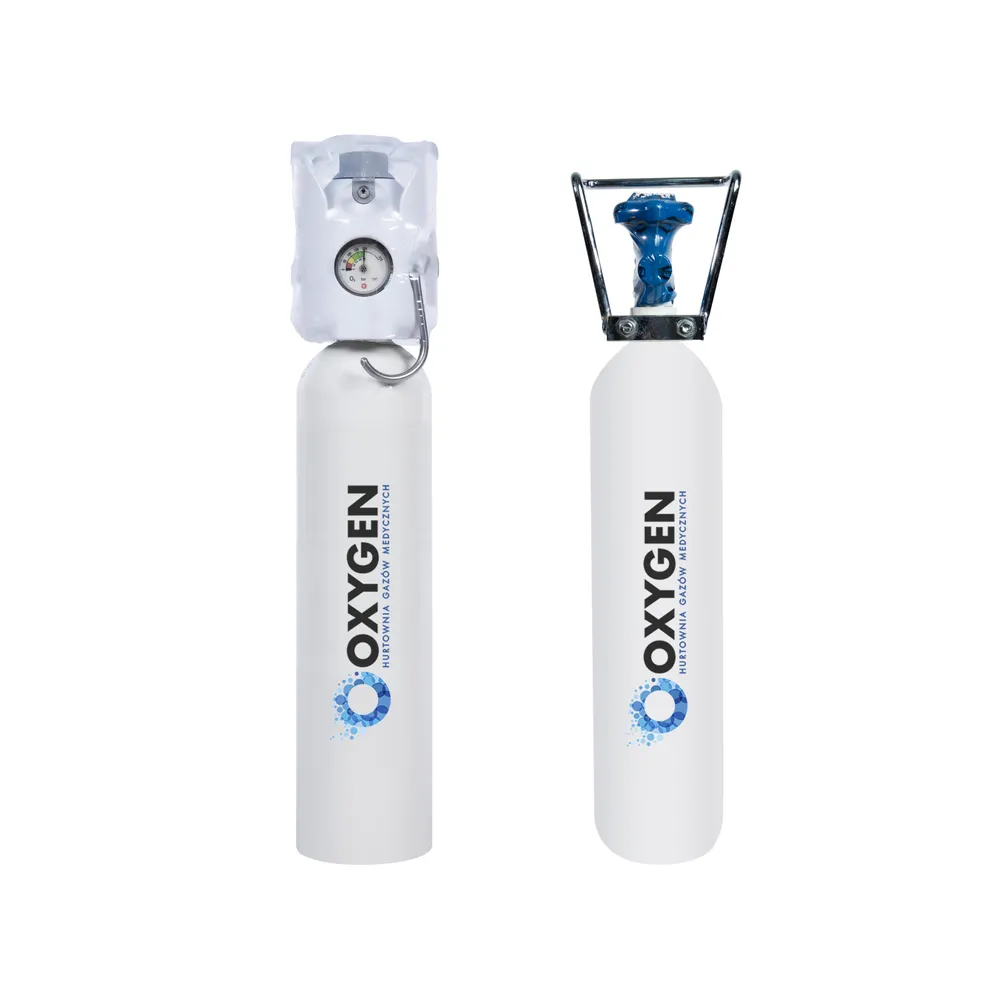
What Tlen medyczny sprężony SIAD looks like and contents of the pack
Oxygen is a colourless and odourless gas.
Gas volume in cylinders of various sizes filled at a pressure of 200 bar:
| Water capacity of cylinder in liters | Gas volume in liters (at temperature 15 °C and pressure 1.013 bar) | Material of the cylinder | Type of closing valve | Material of the valve |
| 2 l | 430 | Steel | Standard +) with threaded side connection W 21.8 x 1/14'' | Chromed brass |
| 2 l | 430 | Steel | RPV with threaded side connection W 21.8 x 1/14'' | Chromed brass |
| 2 l | 430 | Steel | Standard +) with threaded side connection G 3/4'' | Chromed brass |
| 2 l | 430 | Steel | RPV with threaded side connection G 3/4'' | Chromed brass |
| 2 l | 430 | Aluminium | Integrated with check valve and built-in pressure and flow rate regulator | Nickel-plated brass |
| 3 l | 675 | Steel | Standard +) with | Chromed |
| threaded side connection W 21.8 x 1/14'' | brass | |||
| 3 l | 675 | Steel | RPV with threaded side connection W 21.8 x 1/14'' | Chromed brass |
| 3 l | 675 | Steel | Standard +) with threaded side connection G 3/4'' | Chromed brass |
| 3 l | 675 | Steel | RPV with threaded side connection G 3/4'' | Chromed brass |
| 5 l | 1 080 | Steel | Standard +) with threaded side connection W 21.8 x 1/14'' | Chromed brass |
| 5 l | 1 080 | Steel | RPV with threaded side connection W 21.8 x 1/14'' | Chromed brass |
| 5 l | 1 080 | Steel | Standard +) with threaded side connection G 3/4'' | Chromed brass |
| 5 l | 1 080 | Steel | RPV with threaded side connection G 3/4'' | Chromed brass |
| 10 l | 2 160 | Steel | Standard +) with threaded side connection W 21.8 x 1/14'' | Chromed brass |
| 10 l | 2 160 | Steel | RPV with threaded side connection W 21.8 x 1/14'' | Chromed brass |
| 10 l | 2 160 | Steel | Standard +) with threaded side connection G 3/4'' | Chromed brass |
| 10 l | 2 160 | Steel | RPV with threaded side connection G 3/4'' | Chromed brass |
| 10 l | 2 160 | Steel | Integrated with check valve and built-in pressure and flow rate regulator | Nickel-plated brass |
| 20 l | 4 320 | Steel | Standard +) with threaded side connection W 21.8 x 1/14'' | Chromed brass |
| 20 l | 4 320 | Steel | RPV with threaded side connection W 21.8 x 1/14'' | Chromed brass |
| 20 l | 4 320 | Steel | Standard +) with threaded side connection G 3/4'' | Chromed brass |
| 20 l | 4 320 | Steel | RPV with threaded side connection G 3/4'' | Chromed brass |
| 40 l | 8 640 | Steel | Standard +) with threaded side connection W 21.8 x 1/14'' | Chromed brass |
| 40 l | 8 640 | Steel | RPV with threaded side connection W 21.8 x 1/14'' | Chromed brass |
| 40 l | 8 640 | Steel | Standard +) with threaded side connection G 3/4'' | Chromed brass |
| 40 l | 8 640 | Steel | RPV with threaded side connection G 3/4'' | Chromed brass |
| 50 l | 10 800 | Steel | Standard +) with threaded | Chromed brass |
| side connection W 21.8 x 1/14'' | ||||
| 50 l | 10 800 | Steel | RPV with threaded side connection W 21.8 x 1/14'' | Chromed brass |
| 50 l | 10 800 | Steel | Standard +) with threaded side connection G 3/4'' | Chromed brass |
| 50 l | 10 800 | Steel | RPV with threaded side connection G 3/4'' | Chromed brass |
| 16 x 50 l (cylinder bundle) | 172 800 | Steel (cylinder connection–stainless steel) | Standard +) with threaded side connection W 21.8 x 1/14'' | Chromed brass |
| 16 x 50 l (cylinder bundle) | 172 800 | Steel (cylinder connection–stainless steel) | Standard +) with threaded side connection G 3/4'' | Chromed brass |
Note:
+) The standard closure valve is a valve without a non-return valve
Gas volume in cylinders of various sizes filled at a pressure of 150 bar:
| Water capacity of cylinder in liters | Gas volume in liters (at 15 °C and 1.013 bar pressure) | Material of cylinder construction | Type of closure valve | Material of valve construction |
| 2 l | 320 | Steel | Standard+) with side connection thread G 3/4´´ | Chromed brass |
| 2 l | 320 | Steel | RPV with side connection thread G 3/4´´ | Chromed brass |
| 2 l | 320 | Steel | Standard+) with side connection thread W 21.8 x 1/14'' | Chromed brass |
| 2 l | 320 | Steel | RPV with side connection thread W 21.8 x 1/14'' | Chromed brass |
| 2 l | 320 | Aluminium | Integrated with check valve and built-in pressure and flow rate regulator | Nickel-plated brass |
| 3 l | 500 | Steel | Standard+) with side connection thread G 3/4´´ | Chromed brass |
| 3 l | 500 | Steel | RPV with side connection thread G 3/4´´ | Chromed brass |
| 3 l | 500 | Steel | Standard+) with side connection thread W 21.8 x 1/14'' | Chromed brass |
| 3 l | 500 | Steel | RPV with side connection thread W 21.8 x 1/14'' | Chromed brass |
| 5 l | 810 | Steel | Standard+) with side connection thread G 3/4´´ | Chromed brass |
| 5 l | 810 | Steel | RPV with side connection thread G 3/4´´ | Chromed brass |
| 5 l | 810 | Steel | Standard+) with side connection thread W 21.8 x 1/14'' | Chromed brass |
| 5 l | 810 | Steel | RPV with side connection thread W 21.8 x 1/14'' | Chromed brass |
| 10 l | 1 620 | Steel | Standard+) with side connection thread G 3/4´´ | Chromed brass |
| 10 l | 1 620 | Steel | RPV with side connection thread G 3/4´´ | Chromed brass |
| 10 l | 1 620 | Steel | Standard+) with side connection thread W 21.8 x 1/14'' | Chromed brass |
| 10 l | 1 620 | Steel | RPV with side connection thread W 21.8 x 1/14'' | Chromed brass |
| 10 l | 1 620 | Steel | Integrated with check valve and built-in pressure and flow rate regulator | Nickel-plated brass |
| 20 l | 3 240 | Steel | Standard+) with | Chromed |
| side connection thread G 3/4´´ | brass | |||
| 20 l | 3 240 | Steel | RPV with side connection thread G 3/4´´ | Chromed brass |
| 20 l | 3 240 | Steel | Standard+) with side connection thread W 21.8 x 1/14'' | Chromed brass |
| 20 l | 3 240 | Steel | RPV with side connection thread W 21.8 x 1/14'' | Chromed brass |
| 40 l | 6 480 | Steel | Standard+) with side connection thread G 3/4´´ | Chromed brass |
| 40 l | 6 480 | Steel | RPV with side connection thread G 3/4´´ | Chromed brass |
| 40 l | 6 480 | Steel | Standard+) with side connection thread W 21.8 x 1/14'' | Chromed brass |
| 40 l | 6 480 | Steel | RPV with side connection thread W 21.8 x 1/14'' | Chromed brass |
| 50 l | 8 100 | Steel | Standard+) with side connection thread G 3/4´´ | Chromed brass |
| 50 l | 8 100 | Steel | RPV with side connection thread G 3/4´´ | Chromed brass |
| 50 l | 8 100 | Steel | Standard+) with side connection thread W 21.8 x 1/14'' | Chromed brass |
| 50 l | 8 100 | Steel | RPV with side connection thread G 3/4´´ | Chromed brass |
| 16 x 50 l (cylinder bundle) | 129 600 | Steel (cylinder connection–stainless steel) | Standard+) with side connection thread G 3/4´´ | Chromed brass |
| 16 x 50 l (cylinder bundle) | 129 600 | Steel (cylinder connection–stainless steel) | Standard+) with side connection thread W 21.8 x 1/14'' | Chromed brass |
Note:
+) The standard closing valve is a valve without a non-return valve.
Gas cylinder colour coding:
The rounded upper part of the cylinder is white with two black letters "N" placed opposite each other; the cylindrical part of the cylinder is white.
Not all package sizes may be marketed.
Marketing Authorisation Holder:
SIAD Czech spol. s r.o.
K Hájům 2606/2b
Praha 5 - Stodůlky
155 00
Czech Republic
Tel.: +420 235 097 520
Fax: +420 235 097 525
Manufacturer:
SIAD Czech spol. s r.o.
K Hájům 2606/2b
Praha 5 - Stodůlky
155 00
Czech Republic
Tel.: +420 235 097 520
Fax: +420 235 097 525
Other sources of information:
For information on the medicinal product Tlen medyczny sprężony SIAD, contact:
SIAD Czech spol. s r.o.
K Hájům 2606/2b
Praha 5 - Stodůlky
155 00
Czech Republic
Tel.: +420 235 097 520
Fax: +420 235 097 525
Similar drugs
| Brand name | Dosage form | Active substance / Dosage | Manufacturer |
|---|---|---|---|
| OXYGEN MEDICINALIS TZF | gas, compressed medical |
|
Spawmet Ltd. |
The original data is available in the language of the country of manufacture.
Data source: Register of Medicinal Products of Poland (URPL)
Data last verified: September 01, 2026