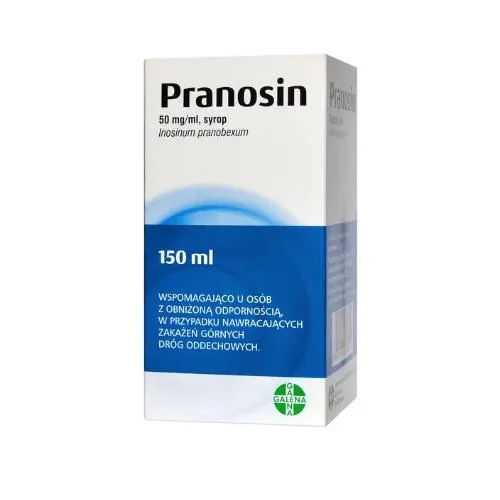
PRANOSIN
PolandThe medicine is used as a supportive treatment in individuals with reduced immunity in cases of recurrent upper respiratory tract infections. It has antiviral properties and stimulates the immune system.
Frequently asked questions
How should Pranosin be dosed?
The dose depends on body weight. Adults typically take approximately 60 ml of syrup per day, divided into 3 or 4 doses. In children over 1 year of age, the dose is also determined based on body weight (1 ml of syrup per 1 kg of body weight per day), divided into 3 or 4 portions. The included measuring cup should be used for dosing.
When should you not take this medicine?
The medicine should not be used if there is an allergy to any of the ingredients, if a gout attack is currently ongoing, or if tests have shown increased uric acid levels in the blood. The medicine must not be administered to children under 1 year of age.
Can Pranosin be taken with other medicines?
Inform your doctor about all medicines you are taking, especially those used to treat gout (e.g., allopurinol), diuretics, medicines affecting the immune system, and zidovudine.
What are the possible side effects of Pranosin?
An increase in uric acid levels in the blood or urine may occur frequently. Other possible symptoms include, among others, nausea, vomiting, headache, dizziness, joint pain, fatigue, diarrhea, or constipation. Contact a doctor immediately if difficulty breathing, wheezing, or swelling of the face, lips, or throat occurs.
What should I do if I do not feel better after a few days?
If there is no improvement after 5 to 14 days, or if you feel worse, you should contact a doctor.
Instructions for use
Patient Information Leaflet
Pranosin
50 mg/ml, syrup
Inosinum pranobexum
Please read all of this leaflet carefully before taking this medicine, because it contains
important information for you.
This medicine should always be taken exactly as described in this patient leaflet or as directed by
your doctor or pharmacist.
- Keep this leaflet so that you can read it again if necessary.
- If you need advice or further information, please consult your pharmacist.
- If you experience any adverse reactions, including any adverse reactions not listed in this leaflet, inform your doctor or pharmacist. See section 4.
- If there is no improvement after 5 to 14 days, or if you feel worse, contact your doctor.
Leaflet Contents
- What Pranosin is and what it is used for
- Important information before taking Pranosin
- How to take Pranosin
- Possible side effects
- How to store Pranosin
- Contents of the pack and other information
1. What Pranosin is and what it is used for
Pranosin syrup contains as the active substance inosine pranobex, which has
antiviral activity and stimulates the immune system (enhances immunity).
Indications
As an adjunctive treatment in individuals with reduced immunity, in cases of recurrent upper respiratory tract infections.
If there is no improvement after 5 to 14 days, or if you feel worse, consult your doctor.
2. Important information before using Pranosin
When not to use Pranosin
- if the patient is allergic to the active substance (pranobex inosine) or to any of the other ingredients of this medicine (listed in section 6); symptoms of an allergic reaction may include: rash, itching, difficulty breathing, swelling of the face, lips, throat or tongue;
- if the patient currently has an attack of acute gout (severe joint pain with swelling and redness of the skin, or effusion in large joints), or tests have shown increased levels of uric acid in the blood.
Warnings and precautions
Before starting treatment with Pranosin, discuss the following with your doctor or pharmacist:
- if the patient has previously experienced gout attacks or elevated uric acid levels, because Pranosin may cause transient increases in blood and urinary uric acid levels;
- if the patient has previously had kidney stones;
- if the patient has impaired kidney function; during treatment with Pranosin, the doctor should regularly monitor blood tests and kidney function. If symptoms of an allergic reaction occur, such as: rash, itching, difficulty breathing, swelling of the face, lips, throat or tongue, treatment must be stopped immediately and medical advice sought. If treatment is prolonged (lasting 3 months or longer), the doctor will order regular blood tests and monitoring of kidney and liver function. Long-term treatment may lead to the formation of kidney stones.
Children
Pranosin must not be used in children under 1 year of age.
Pranosin with other medicines
Inform your doctor or pharmacist about all medicines the patient is currently taking or has recently taken, as well as any medicines planned for future use.
In particular, inform your doctor or pharmacist if any of the following medicines are being taken, as they may interact with Pranosin:
- allopurinol or other medicines used in the treatment of gout;
- medicines that increase uric acid excretion, including diuretics (which increase urine production), e.g. furosemide, torasemide, ethacrynic acid, hydrochlorothiazide, chlorthalidone, indapamide;
- medicines affecting the immune system, e.g. those used after organ transplantation;
- zidovudine (AZT, azidothymidine) used in the treatment of AIDS.
Pregnancy, breastfeeding and fertility
If the patient is pregnant or breastfeeding, suspects she may be pregnant, or is planning to become pregnant, she should consult her doctor or pharmacist before using this medicine.
Driving and operating machinery
Pranosin has no effect or has a negligible effect on the ability to drive vehicles and operate machinery.
Pranosin contains sucrose, methyl parahydroxybenzoate, propyl parahydroxybenzoate, ethanol and sodium
Sucrose
If the patient has previously been diagnosed with intolerance to certain sugars, the patient should consult a doctor before taking this medicine.
1 ml of Pranosin contains 625 mg of sucrose. This should be taken into account in patients with diabetes.
Methyl parahydroxybenzoate and propyl parahydroxybenzoate
This medicine may cause allergic reactions (including delayed-type reactions).
Ethanol (component of raspberry flavour)
This medicine contains 0.006 mg of alcohol (ethanol) per 1 ml of syrup. The amount of alcohol in 1 ml of this medicine is equivalent to less than 0.011 ml of beer or 0.004 ml of wine. The small amount of alcohol in this medicine will not produce noticeable effects.
Sodium
The medicine contains less than 1 mmol (23 mg) of sodium per 20 ml of syrup, meaning the medicine is considered "sodium-free".
3. How to use Pranosin medicine
This medicine should always be taken exactly as described in this patient leaflet or as directed by a doctor or pharmacist. If in doubt, consult your doctor or pharmacist.
Administer orally.
Recommended dose
The dose is determined based on the patient's body weight. The daily dose should be divided into equal single doses given several times a day.
Adults, including elderly people
The recommended daily dose is 50 mg of inosine pranobex per kilogram of body weight per day (1 ml of syrup per 1 kg of body weight per day), usually 60 ml of syrup per day, administered in 3 or 4 divided doses, i.e.: 20 ml of syrup 3 times a day or 15 ml of syrup 4 times a day.
The maximum dose is 80 ml of syrup, i.e. 4 g of inosine pranobex per day.
Children over 1 year of age
The recommended dose in children over 1 year of age is 50 mg of inosine pranobex per kilogram of body weight per day (1 ml of syrup per 1 kilogram of body weight per day), given in 3 or 4 equal divided doses throughout the day.
The table below shows dosing according to the patient's body weight.
| Child's body weight | Dosage (ml of syrup) |
| 10 - 14 kg | 3 × 5 ml |
| 15 - 20 kg | 3 × 5 to 7.5 ml |
| 21 - 30 kg | 3 × 7.5 to 10 ml |
| 31 - 40 kg | 3 × 10 to 15 ml |
| 41 - 50 kg | 3 × 15 to 17.5 ml |
To measure the correct dose of the medicine, use the dosing device provided in the
package.
Duration of treatment
Treatment usually lasts from 5 to 14 days. It is recommended to continue taking the medicine for 1 to 2 days after symptoms have subsided.
Use of a higher than recommended dose of Pranosin
Cases of overdose have not been reported so far. If in doubt, consult a doctor immediately.
Missed dose of Pranosin
If a dose is missed, take it as soon as possible, unless it is almost time for the next dose. Do not take a double dose to make up for a missed dose.
Discontinuation of Pranosin
If treatment is discontinued, the expected therapeutic effect may not be achieved or symptoms of the disease may worsen.
If you have any further doubts regarding the use of this medicine, consult your doctor or pharmacist.
4. Possible adverse reactions
Like any medicine, this medicine can cause adverse reactions, although not everyone experiences them.
You should consult a doctor immediately if any of the following symptoms occur:
- sudden onset of wheezing,
- difficulty breathing,
- swelling of the eyelids, face or lips,
- rash or itching (especially if affecting the whole body).
Other possible adverse reactions of Pranosin
Very common (occurring in more than 1 in 10 patients):
increased blood uric acid levels, increased urinary uric acid levels.
Common (occurring in less than 1 in 10 patients):
increased liver enzyme activity, increased blood urea levels, rash,
itching, joint pain, nausea, vomiting, discomfort in the upper abdomen, fatigue (tiredness),
malaise (weakness), headache, dizziness.
Uncommon (occurring in less than 1 in 100 patients):
diarrhea, constipation, nervousness, drowsiness or difficulty sleeping (insomnia), increased urine volume (polyuria).
Frequency not known (cannot be estimated from available data):
upper abdominal pain, angioedema (swelling of the face, lips, eyelids or throat, possibly impairing breathing), urticaria, allergic reaction, anaphylactic reaction (allergic reaction affecting the whole body), dizziness, erythema (skin redness).
Reporting of adverse reactions
If any adverse reactions occur, including any adverse reactions not listed in this leaflet, inform your doctor, pharmacist or nurse. Adverse reactions can be reported directly to the Department of Monitoring of Adverse Drug Reactions at the Office for Registration of Medicinal Products, Medical Devices and Biocidal Products
Al. Jerozolimskie 181C
02-222 Warsaw
Phone: +48 22 49 21 301
Fax: +48 22 49 21 309
Website: https://smz.ezdrowie.gov.pl
Adverse reactions can also be reported to the marketing authorization holder.
Reporting adverse reactions helps to provide more information on the safety of the medicine.
5. How to store the medicine Pranosin
Keep the medicine out of the sight and reach of children.
Store below 30ºC.
Do not use this medicine after the expiry date stated on the label and carton following:
Expiry date:. The expiry date refers to the last day of the stated month.
The shelf life after first opening the bottle is 2 years.
Medicines must not be disposed of via wastewater or household waste. Ask your pharmacist how to dispose of medicines no longer in use. Such measures help protect the environment.
6. Contents of the packaging and other information
What Pranosin contains
- The active substance is inosine pranobex (a complex containing inosine and 4-acetamidobenzoate 2-hydroxypropylodimethylammonium in a molar ratio of 1:3). 1 ml of syrup contains 50 mg of inosine pranobex.
- Other ingredients: sucrose, methyl parahydroxybenzoate (E218), propyl parahydroxybenzoate (E216), sodium citrate (E331), sodium hydroxide (for pH adjustment), raspberry flavour (containing: flavouring substances, propylene glycol, lactic acid, acetic acid, ethanol, water, ascorbic acid), purified water.
What Pranosin looks like and contents of the pack
Pranosin syrup is a clear, colourless or slightly yellow syrup with a raspberry odour and sweet taste.
The packaging consists of a 150 ml amber glass type III bottle. The bottle is fitted with an aluminium cap with a tamper-evident seal and a low-density polyethylene liner. Each unit pack includes a polypropylene measuring cup with a capacity of 15 ml, marked in 2.5 ml increments. The bottle with the cap and the measuring cup are placed in a cardboard box together with the patient leaflet.
Marketing Authorisation Holder:
Zakład Farmaceutyczny ,,Amara” sp. z o. o.
ul. Stacyjna 5
30-851 Kraków
Tel. +48 12 657 40 40
[email protected]
Manufacturer:
Farmaceutyczna Spółdzielnia Pracy „GALENA”
ul. Krucza 62
53-411 Wrocław
Similar drugs
The original data is available in the language of the country of manufacture.
Data source: Register of Medicinal Products of Poland (URPL)
Data last verified: September 01, 2026