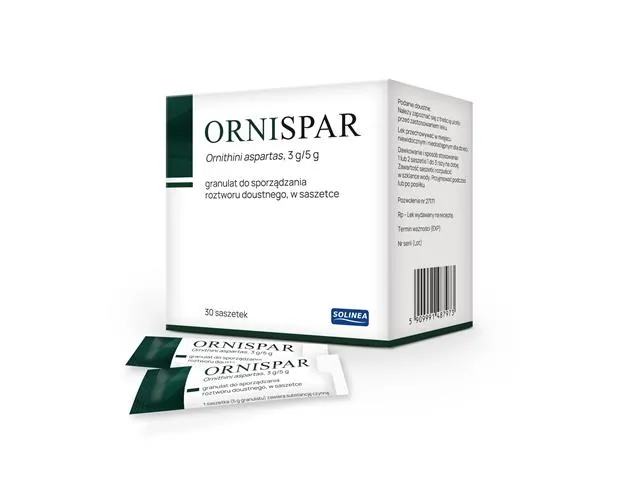
ORNISPAR
PolandIt is used in the treatment of latent and overt hepatic encephalopathy occurring in the course of chronic liver diseases, such as cirrhosis or chronic hepatitis.
Frequently asked questions
How to use Ornispar?
Dissolve the contents of one sachet in a glass of water and take it during or after a meal. Usually, 1 or 2 sachets are taken 1 to 3 times daily, always according to the doctor's instructions.
When not to take this medicine?
It should not be used in case of hypersensitivity to the ingredients of the medicine, severe renal impairment, disorders of amino acid metabolism involved in the urea cycle, and fructose intolerance.
Can Ornispar cause side effects?
It may cause nausea, vomiting, stomach pain, bloating, or diarrhea. Very rarely, limb pain may occur. These effects are usually transient.
Can the medicine be used during pregnancy or breastfeeding?
Avoid using the medicine during pregnancy and breastfeeding unless expressly advised otherwise by a doctor.
Does the medicine interact with other medicines?
There are no known interactions of this medicine with other preparations; however, always inform your doctor about all medicines you are currently taking or have previously taken.
Should caution be exercised when using the medicine in children?
Before administering the medicine to infants or children, it is essential to consult a doctor due to the risk of previously undiagnosed fructose intolerance in the child.
Instructions for use
Package leaflet: Information for the patient
Ornispar, 3 g/5 g, granules for oral solution in sachet
Ornithini aspartas
Please read carefully the entire leaflet before taking this medicine, as it contains
important information for the patient.
- Keep this leaflet, so that you may read it again if necessary.
- If you have any questions, please consult your doctor or pharmacist.
- This medicine has been prescribed for a specific individual. Do not pass it on to others. This medicine may harm other people, even if their symptoms are identical.
- If the patient experiences any adverse reactions, including any not listed in this leaflet, inform your doctor or pharmacist. See section 4.
Table of contents:
- What Ornispar is and what it is used for
- Important information before taking Ornispar
- How to take Ornispar
- Possible side effects
- How to store Ornispar
- Contents of the pack and other information
1. WHAT ORNISPAR IS AND WHAT IT IS USED FOR
Ornispar is used in the treatment of covert and overt hepatic encephalopathy occurring in the course of chronic liver diseases, such as chronic hepatitis, liver cirrhosis.
2. IMPORTANT INFORMATION BEFORE USING ORNISPAR
When not to use Ornispar
Do not use Ornispar in patients with the following conditions:
- hypersensitivity to L-ornithine L-aspartate or to any of the other components of the medicine;
- severe renal impairment (serum creatinine concentration above 3 mg/100 ml);
- disorders of amino acid metabolism involved in the urea cycle, e.g. due to enzymatic defects;
- fructose intolerance.
Warnings and precautions
Ornispar contains 360 mg of sorbitol per sachet. Sorbitol is a source of fructose. If the patient has previously been diagnosed with intolerance to certain sugars or hereditary fructose intolerance, a rare genetic disorder in which the patient's body cannot break down fructose, the patient should consult a doctor before taking this medicine.
Ornispar contains isomalt. If the patient has previously been diagnosed with intolerance to certain sugars, the patient should consult a doctor before taking this medicine.
Ornispar contains 1% propylene glycol.
Before administering Ornispar to a child under 4 weeks of age, consult a doctor or pharmacist, especially if the child is taking other medicines containing propylene glycol or alcohol.
Prolonged use of Ornispar may cause dental caries.
Children:
There is a lack of data on the use of Ornispar in children.
Before administering Ornispar to infants or children, it is essential to consult a doctor, due to the possibility of previously undiagnosed fructose intolerance in the child.
Ornispar with other medicines
Inform your doctor about all medicines the patient is currently taking or has recently taken, as well as any medicines the patient plans to take.
No interactions between Ornispar and other medicines are known.
Pregnancy and breastfeeding
If the patient is pregnant or breastfeeding, suspects she may be pregnant, or is planning to have a child, she should consult a doctor before using this medicine.
Pregnancy:
There are insufficient data on the safety of Ornispar during pregnancy; therefore, use during pregnancy should be avoided. Ornispar may be taken by pregnant women only if recommended by a doctor.
Breastfeeding:
It is not known whether L-ornithine L-aspartate (the active substance in Ornispar) passes into breast milk. Use of Ornispar should be avoided during breastfeeding.
Ornispar may be taken by breastfeeding women only if recommended by a doctor.
Driving and operating machinery
The ability to drive motor vehicles and operate machinery may be impaired due to the underlying disease being treated with Ornispar.
Ornispar contains sorbitol, isomalt, and propylene glycol.
See section "Warnings and precautions".
3. HOW TO USE ORNISPAR
This medicine should always be used as directed by the physician. If in doubt, consult a doctor or pharmacist.
The usual dose is 1 or 2 sachets, 1 to 3 times daily.
The contents of the sachet should be dissolved in a glass of water. Take during or after a meal.
If the patient feels that the effect of the medicine is too strong or too weak, they should contact their doctor or pharmacist.
Route of administration
Oral administration.
Overdose of Ornispar
Symptoms of poisoning following overdose of Ornispar have not been observed to date.
In case of overdose, symptomatic treatment is applied.
Missed dose of Ornispar
Take the next dose at the scheduled time, according to the dosing instructions. Do not take a double dose to make up for a missed dose. If in doubt regarding use of the medicine, consult a doctor or pharmacist.
4. POSSIBLE ADVERSE REACTIONS
Like all medicines, this medicine can cause adverse reactions, although not everybody will experience them.
Uncommon adverse reactions (occurring in less than 1 in 100 people):
nausea; vomiting; stomach pain; bloating; diarrhoea.
Very rare adverse reactions (occurring in less than 1 in 10,000 people):
limb pain.
The listed adverse reactions are usually transient and do not require discontinuation of the medicine.
Reporting of adverse reactions
If any adverse effects occur, including any adverse effects not listed in this leaflet, inform your doctor, pharmacist or nurse. Adverse reactions can be reported directly to the Department of Monitoring Adverse Drug Reactions of the Office for Registration of Medicinal Products, Medical Devices and Biocidal Products,
Al. Jerozolimskie 181C
02-222 Warsaw
tel.: +48 22 49 21 301,
fax: +48 22 49 21 309
website: https://smz.ezdrowie.gov.pl
Adverse reactions can also be reported to the marketing authorization holder.
Reporting adverse reactions helps to provide more information on the safety of the medicine.
5. HOW TO STORE ORNISPAR
Keep the medicine out of sight and reach of children.
No special storage instructions are required for this medicine.
Do not use the medicine after the expiry date stated on the cardboard box. The expiry date refers to the last day of the specified month.
Medicines must not be disposed of via wastewater or household waste. Ask your pharmacist how to dispose of medicines no longer in use. This will help protect the environment.
6. CONTENTS OF THE PACKAGE AND OTHER INFORMATION
What Ornispar contains
The active substance is L-ornithine L-aspartate.
One sachet (5 g of granules) contains 3 g of L-ornithine L-aspartate.
Excipients:
citric acid, sorbitol, pineapple flavour (flavouring agents, maltodextrin from waxy maize, modified starch from waxy maize), sucralose (E 955), anhydrous colloidal silica, peppermint flavour (natural menthol, peppermint oil Mentha piperita L., spearmint oil Mentha spicata L., maltodextrin, gum arabic, propylene glycol), disodium riboflavin phosphate (E 101), isomalt.
What Ornispar looks like and contents of the pack
Ornispar is white or slightly yellow granules.
Pack: 10, 20, 30, 50 or 100 sachets made of 4-layer laminate (paper/PE/Aluminium/Surlyn) or 5-layer laminate (paper/solvent-based two-component polyurethane/Aluminium/solvent-based two-component polyurethane/LDPE), packed in a cardboard box.
Not all pack sizes may be marketed.
Marketing Authorisation Holder:
Solinea Sp. z o.o.
Elizówka, ul. Szafranowa 6
21-003 Ciecierzyn
Poland
tel.: +48 81 463 48 82
[logo Solinea]
Manufacturer:
Mako Pharma Sp. z o.o.
ul. Władysława Reymonta 2
05-092 Dziekanów Leśny
Medicofarma S.A.
ul. Tarnobrzeska 13
26-613 Radom
Similar drugs
| Brand name | Dosage form | Active substance / Dosage | Manufacturer |
|---|---|---|---|
| ORNISPAR | granules for oral solution, in sachet |
|
Mako Pharma Sp. z o.o. |
The original data is available in the language of the country of manufacture.
Data source: Register of Medicinal Products of Poland (URPL)
Data last verified: September 01, 2026