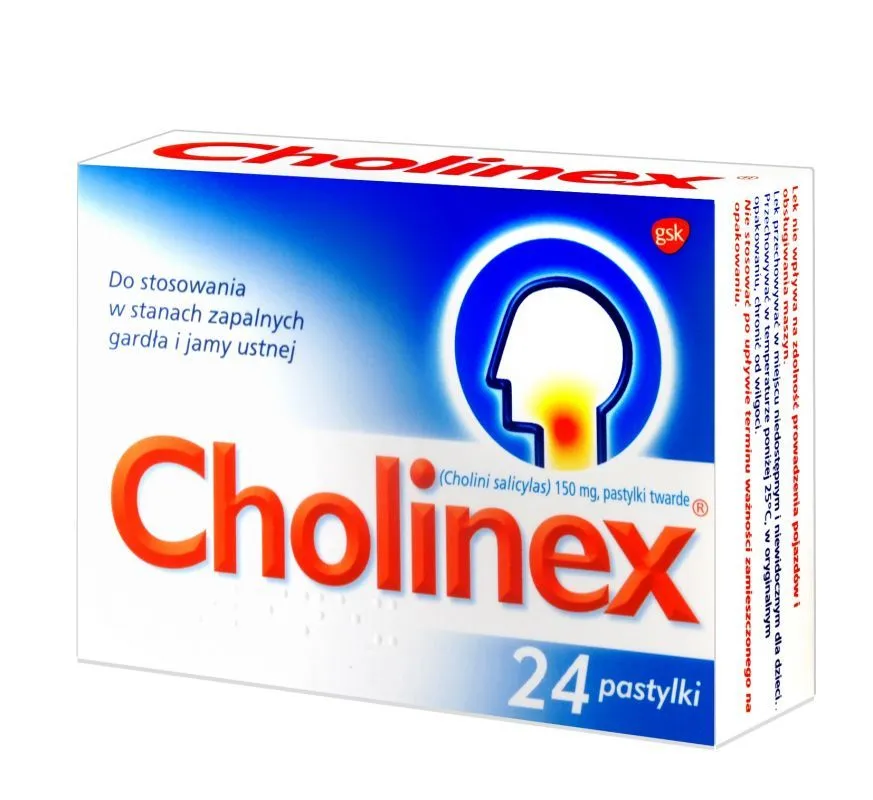
CHOLINEX
PolandIt is used for inflammation, pain, and swelling of the throat and oral cavity. It may also be used to treat inflammation of the gums and periodontal tissues and as support during antibiotic therapy for oral and throat infections.
Frequently asked questions
How to use Cholinex?
Adults and children over 12 years of age should suck one lozenge 4 to 6 times a day (not more than 6 lozenges per day).
When should you not take this medicine?
Do not use this medicine if you are allergic to salicylates, other non-steroidal anti-inflammatory drugs, or any of the ingredients of the preparation, or if you suffer from esophageal varices or phenylketonuria.
Can Cholinex be combined with other medicines?
Caution should be exercised, as the medicine may weaken the effect of other anti-inflammatory drugs or enhance the effect of sedatives, hypnotics, anti-diabetic, and anticoagulant drugs. It may also increase the risk of bleeding when used with certain anticoagulants or steroids.
What are the possible side effects?
Rarely, allergic reactions (e.g., rash, facial swelling, difficulty breathing) and gastrointestinal problems (abdominal pain, vomiting, bleeding) may occur. In children under 12 years of age, there is a risk of Reye's syndrome.
Can the medicine be used during pregnancy or breastfeeding?
Use of the medicine is not recommended during pregnancy. A doctor must decide whether it can be used during breastfeeding.
Is the medicine safe for people with diabetes?
Yes, the sugar-free version is safe for people with diabetes as well as for people concerned with dental health (it protects against tooth decay).
What should I do if I do not feel better after 1-2 days?
If the sore throat does not subside within 1-2 days or if you feel worse, you should contact a doctor.
Instructions for use
Package leaflet: information for the patient
Cholinex
150 mg, hard pastilles
Choline salicylate
Please read all of this leaflet carefully before taking this medicine, because it contains
important information for you.
This medicine should always be taken exactly as described in this patient leaflet or as directed by
your doctor, pharmacist, or nurse.
- Keep this leaflet, so that you can read it again if necessary.
- If you need advice or further information, please consult your pharmacist.
- If you experience any adverse reactions, including any possible side effects not listed in this leaflet, inform your doctor, pharmacist, or nurse. See section 4.
- If there is no improvement after 1–2 days, or if you feel worse, contact your doctor.
Contents of the leaflet:
- What Cholinex is and what it is used for
- What you need to know before taking Cholinex
- How to take Cholinex
- Possible side effects
- How to store Cholinex
- Contents of the pack and other information
1. What Cholinex is and what it is used for
The active substance of Cholinex pastilles – choline salicylate – acts locally:
- anti-inflammatory, reducing swelling and congestion of the oral and pharyngeal mucosa,
- analgesic (pain-relieving),
- stimulating saliva secretion, thereby enhancing the anti-inflammatory effect.
Indications for Cholinex:
- inflammatory conditions of the oral and pharyngeal mucosa,
- pain and swelling of the throat associated with inflammatory conditions,
- as an adjunct to antibiotic therapy in infections of the oral and pharyngeal mucosa caused by certain microorganisms,
- in dental treatment of inflammatory conditions of the gums and periodontal tissues.
2. Important information before using Cholinex
When not to use Cholinex
Do not use this medicine if the patient has:
an allergy to the active substance, salicylates, other non-steroidal anti-inflammatory drugs, or
any of the other ingredients of this medicine (listed in section 6),
oesophageal varices (due to risk of bleeding),
phenylketonuria.
Warnings and precautions
Before starting treatment, consult a doctor if the patient has:
- gastrointestinal inflammatory conditions,
- gastric or duodenal ulcer disease,
- bronchial asthma.
Cholinex and other medicines
Tell your doctor or pharmacist about all medicines the patient is currently taking or has recently taken, including those obtained without a prescription, as well as any medicines the patient intends to take.
There is a slight possibility that choline salicylate contained in the medicine may:
- reduce the effectiveness of other non-steroidal anti-inflammatory drugs,
- enhance the effects of sedatives, hypnotics, antidiabetic, and anticoagulant medicines,
- increase the risk of bleeding when administered together with steroid or non-steroidal anti-inflammatory drugs, anticoagulants, fibrinolytics (clot-dissolving agents), or medicines inhibiting platelet aggregation (preventing blood platelets from clumping).
Cholinex with food and drink
Cholinex may be taken independently of meals.
Cholinex sugar-free may be safely used by people with diabetes or those prone to dental caries, as it does not contain sugar.
Pregnancy, breastfeeding, and fertility
If the patient is pregnant or breastfeeding, suspects she may be pregnant, or is planning to have a baby, she should consult a doctor or pharmacist before using this medicine.
The use of Cholinex is not recommended during pregnancy.
The decision to use Cholinex during breastfeeding should be made by a doctor.
Driving and operating machinery
This medicine does not affect the ability to drive or operate machinery.
Cholinex contains aspartame (E 951), isomalt, and maltitol
Aspartame (E 951)
The medicine contains 1.75 mg of aspartame in each hard pastille.
Aspartame is a source of phenylalanine. It may be harmful to patients with phenylketonuria. This is a rare genetic disorder in which phenylalanine accumulates in the body due to impaired excretion.
Isomalt and maltitol
If the patient has previously been diagnosed with intolerance to certain sugars, he or she should consult a doctor before taking this medicine.
The medicine may have a mild laxative effect. Calorific value: 2.3 kcal/g of isomalt. Calorific value: 2.3 kcal/g of maltitol.
3. How to use Cholinex
This medicine should always be taken exactly as described in this patient leaflet, or as directed by a doctor or pharmacist. If in doubt, consult a doctor, pharmacist, or nurse.
The usual dosage of Cholinex for adults and children aged 12 years and above is:
Suck one tablet 4 to 6 times daily (maximum 6 tablets per day).
If sore throat symptoms do not improve within 1 to 2 days, consult a doctor.
Use in children
Before using Cholinex in children under 12 years of age, consult a doctor due to the risk of Reye's syndrome.
Taking more Cholinex than recommended
If more medicine has been taken than recommended, consult a doctor or pharmacist immediately.
Missed dose of Cholinex
Continue treatment as before without increasing the next dose.
Do not take a double dose to make up for a missed dose.
4. Possible adverse reactions
Like all medicines, this medicine can cause adverse reactions, although not everybody will experience them.
Adverse reactions are listed according to frequency of occurrence, using the following terms:
rare – occurring in fewer than 1 in 1,000 people but more than 1 in 10,000 people;
very rare – occurring in fewer than 1 in 10,000 people.
The following adverse reactions may occur during oral administration of salicylates:
Rare:
allergic reactions – skin redness and rash, cough, feeling of nasal congestion, swelling of the face, tongue or lips, difficulty swallowing or breathing difficulties;
gastrointestinal mucosal damage (abdominal pain, vomiting, bleeding).
Very rare:
in children under 12 years of age, Reye's syndrome may occur following oral administration of salicylates, which is characterized by: sudden and profuse vomiting, disturbances in consciousness (drowsiness or agitation), coma with convulsions, abnormal breathing (deep inhalations and exhalations), decreased blood sugar levels (so-called hypoglycemia), cyanosis, fatty infiltration and enlargement of the liver (detected during biopsy).
If any of the adverse reactions worsen or if any adverse reactions not listed in this leaflet occur, inform your doctor or pharmacist.
Reporting of adverse reactions
If any adverse reactions occur, including those not listed in this leaflet, inform your doctor, pharmacist or nurse. Adverse reactions can be reported directly to the Department of Monitoring Adverse Drug Reactions at the Office for Registration of Medicinal Products, Medical Devices and Biocidal Products: Al. Jerozolimskie 181C, 02-222 Warsaw, phone: +48 22 49 21 301, fax: +48 22 49 21 309, website: https://smz.ezdrowie.gov.pl.
Adverse reactions can also be reported to the marketing authorization holder.
Reporting adverse reactions helps to provide more information on the safety of this medicine.
5. How to store Cholinex
Keep this medicine out of sight and reach of children.
Store below 25°C. Protect from moisture.
Keep in the original packaging.
Do not use this medicine after the expiry date stated on the packaging. The expiry date refers to the last day of the stated month.
Medicines must not be disposed of via wastewater or household waste. Ask your pharmacist what to do with medicines no longer required. Such measures help protect the environment.
6. Contents of the packaging and other information
What Cholinex contains
- The active substance is: choline salicylate. One tablet contains 150 mg of choline salicylate.
- Other ingredients are: isomalt, liquid maltitol, aspartame (E951), acesulfame potassium, peppermint oil. The product does not contain sugar.
What Cholinex looks like and contents of the pack
Cholinex is in the form of tablets with a flat cylindrical shape, glassy white to pale yellow in colour, and with a mint flavour.
One pack contains 8, 16, 24 or 32 tablets.
Marketing Authorisation Holder
STADA Arzneimittel AG
Stadastrasse 2-18
61118 Bad Vilbel
Germany
Manufacturer
Przedsiębiorstwo Produkcyjno-Handlowe „EWA” S.A.
ul. Zamkowy Folwark 9
63-700 Krotoszyn
Poland
Similar drugs
| Brand name | Dosage form | Active substance / Dosage | Manufacturer |
|---|---|---|---|
| CHOLINEX | tablets, hard |
|
Production and Trading Enterprise EWA S.A. |
The original data is available in the language of the country of manufacture.
Data source: Register of Medicinal Products of Poland (URPL)
Data last verified: September 01, 2026