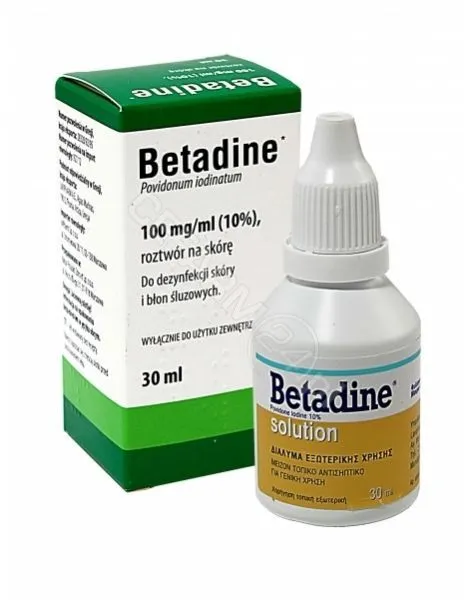
BETADINE
PolandThe medicine is used for skin disinfection before procedures such as injections, blood sampling, biopsies, or transfusions. It is also used to treat bacterial and fungal infections and for aseptic wound dressing.
Frequently asked questions
How to use Betadine?
The preparation can be used in undiluted form or in aqueous solutions (1% or 10%), depending on the purpose. For skin disinfection before puncture, it is applied for 1–2 minutes. For treating infections or disinfecting wounds, a 10% solution is used. For preoperative bathing, a 1% solution is applied to the whole body, left for at least 2 minutes, and then rinsed off with lukewarm water.
When should you not use this medicine?
It should not be used if there is an allergy to iodine or povidone, if hyperthyroidism or other thyroid diseases have been diagnosed, if dermatitis herpetiformis (Duhring's disease) is present, or in case of renal failure. It must also not be used before and after radioactive iodine treatment.
Can Betadine cause side effects?
Hypersensitivity reactions or contact dermatitis (redness, itching, small blisters) may occur. Very rarely, serious allergic reactions (breathing difficulties, swelling of the face or throat) and hyperthyroidism may occur. Prolonged use may lead to hypothyroidism or renal dysfunction.
Which medicines may interact with the preparation?
The medicine should not be used simultaneously with medicines containing mercury, medicines with reducing, acidic, or alkaloid properties, nor with hydrogen peroxide or silver preparations. Use should be avoided in persons treated with lithium.
Can the medicine be used during pregnancy or breastfeeding?
Use in these cases is permitted only if a doctor decides the medicine is necessary after a thorough diagnosis. It should be noted that iodine passes into the placenta and breast milk; therefore, use should be limited to a short period and conducted under medical supervision.
Instructions for use
Table of contents
- 1. What Betadine 100 mg/ml solution for skin is and what it is used for
- 2. Important information before using Betadine 100 mg/ml, cutaneous solution
- 3. How to use Betadine, 100 mg/ml, cutaneous solution
- 4. Possible adverse reactions
- 5. How to store Betadine, 100 mg/ml, cutaneous solution
- 6. Package contents and other information
Package leaflet: Information for the user
Warning! Keep this leaflet! Information on the immediate packaging in a foreign language.
Betadine
100 mg/ml (10%) solution for skin
Povidone iodine
Please read this leaflet carefully before using the medicine, because it contains
important information for the patient.
This medicine should always be used exactly as described in this patient leaflet or as directed by a
doctor or pharmacist.
- Keep this leaflet, so that you can read it again if necessary.
- If you need advice or further information, please contact your pharmacist.
- If you experience any adverse reactions, including any adverse reactions not listed in this leaflet, tell your doctor, pharmacist or nurse. See section 4.
- If you feel unwell, contact your doctor.
Table of contents:
- What Betadine 100 mg/ml solution for skin is and what it is used for
- What you need to know before using Betadine 100 mg/ml solution for skin
- How to use Betadine 100 mg/ml solution for skin
- Possible side effects
- How to store Betadine 100 mg/ml solution for skin
- Contents of the pack and other information
1. What Betadine 100 mg/ml solution for skin is and what it is used for
Betadine 100 mg/ml solution for skin is intended for topical use only.
It acts against a wide range of microorganisms (bactericidal, fungicidal, selectively virucidal, and anti-protozoal).
The product is indicated for skin disinfection prior to injection, blood sampling, needle biopsy, transfusion, disinfection of skin and mucous membranes before surgical procedures, aseptic wound care, treatment of bacterial and fungal infections, and for complete or partial disinfection of the patient prior to surgery.
2. Important information before using Betadine 100 mg/ml, cutaneous solution
When not to use Betadine 100 mg/ml, cutaneous solution
- if the patient is allergic to iodine or povidone, or to any of the other ingredients of this medicine (listed in section 6),
- if the patient has hyperthyroidism or other overt thyroid disorders,
- if the patient has dermatitis herpetiformis (Duhring's disease),
- if the patient has renal insufficiency,
- before and after radioactive iodine therapy for hyperthyroidism, or diagnostic procedures using radioactive iodine.
Warnings and precautions
Before starting to use this medicine, discuss it with your doctor or pharmacist.
In patients with latent thyroid dysfunction (especially in elderly individuals),
prolonged use of this medicine for more than 14 days or application over large skin areas
(over 10% of body surface) is permitted only if decided by a physician after careful consideration of expected benefits versus potential risks. In such cases, the physician should monitor for early signs of hyperthyroidism and evaluate thyroid function, even after discontinuation of treatment (up to 3 months).
During surgical preparation, pooling of the solution under the patient should be avoided. Prolonged exposure to the medicine may cause irritation or, less frequently, severe skin reactions. Chemical skin burns may occur due to pooling of the liquid. In case of skin irritation, contact dermatitis, or hypersensitivity to the medicine, its use should be discontinued.
Do not warm the medicine before application. Keep out of reach of children.
Patients with goitre, thyroid nodules, or other non-toxic thyroid diseases are at risk of developing hyperthyroidism after administration of large amounts of iodine. In these patients, prolonged use or application over large skin areas should be avoided unless a physician has determined that use is necessary. The physician should monitor for early signs of hyperthyroidism and assess thyroid function.
Particular caution is required when using this medicine regularly in patients with pre-existing renal insufficiency.
Avoid using BETADINE 100 mg/ml, cutaneous solution, in patients receiving lithium therapy.
Use of the medicine may lead to reduced iodine uptake by the thyroid gland, which may interfere with the results of certain diagnostic tests and make it difficult to perform certain procedures (e.g., thyroid scintigraphy, protein-bound iodine determination, diagnostic procedures involving radioactive iodine), thereby preventing planned radioactive iodine therapy for thyroid diseases.
After discontinuation of the medicine, such tests should not be performed for at least 1–4 weeks.
The oxidizing effect of the medicine may lead to false-positive results in various diagnostic tests (e.g., toluidine and guaiac resin tests for haemoglobin and glucose in faeces and urine).
The oxidizing properties of the medicine may cause corrosion of metals, whereas plastics and synthetic materials are generally resistant to povidone-iodine. Reversible staining of certain textile materials (e.g., clothing) may occasionally occur.
The medicine can be easily removed from textiles and other materials with warm water and soap. For stubborn stains, an ammonia solution or sodium thiosulphate solution should be used.
The dark brown colour of the medicine is an indicator of its efficacy. If the colour becomes less intense, this indicates reduced antimicrobial activity. Exposure to light and temperatures above 40°C accelerate the decomposition of the medicine. The medicine has antibacterial activity within a pH range of 2–7.
Avoid contact with the eyes. If the medicine gets into the eyes, open the eyelids and rinse the eyes thoroughly with a large amount of running water for 10–15 minutes. The patient should be examined by an ophthalmologist.
Children and adolescents
In newborns and infants up to 6 months of age, the medicine should be used only if decided by a physician in cases of confirmed diagnosis and strict indications for povidone-iodine use. Thyroid function should be monitored.
Newborns and infants up to 6 months of age are at risk of developing hypothyroidism after administration of large amounts of iodine. Therefore, use of this medicine in newborns and infants up to 6 months of age should be restricted to the absolute minimum due to significant systemic absorption through the skin and increased sensitivity to iodine.
The child must be protected from accidental ingestion of the medicine.
Betadine 100 mg/ml, cutaneous solution and other medicines
Inform your doctor or pharmacist about all medicines currently used, recently used, or planned for use.
Concomitant use of this medicine with hydrogen peroxide, enzymatic wound treatment preparations containing silver or taurolidine, and other antiseptics may result in mutual reduction of efficacy.
This medicine must not be used simultaneously with mercury-containing medicines due to the risk of forming a corrosive compound of iodine and mercury.
If this medicine is applied to the same or adjacent skin area simultaneously or immediately after antiseptic products containing octenidine, temporary skin discoloration may occur.
Reactions with proteins and unsaturated organic complexes may occur, which may require higher doses of this medicine (povidone-iodine) to compensate.
Chronic use of the medicine, especially over large skin areas, should be avoided in patients receiving lithium therapy.
This medicine should not be applied to the skin simultaneously with other medicines having reducing, acidic properties, or containing alkaloids.
Note
Due to the oxidizing properties of this medicine, contamination with the product may lead to false-positive results in certain tests for occult blood in faeces or for blood or glucose in urine.
During use of the medicine, iodine uptake by the thyroid gland may be reduced, which in turn may interfere with certain diagnostic procedures (e.g., thyroid scintigraphy, protein-bound iodine determination, tests using radioactive iodine) or prevent treatment of thyroid diseases with iodine. To obtain accurate test results, an adequate interval (1–4 weeks) should be maintained between discontinuation of this medicine and thyroid scintigraphy.
Pregnancy and breastfeeding
If the patient is pregnant, breastfeeding, suspects she may be pregnant, or is planning to become pregnant, she should consult her doctor before using this medicine.
Povidone-iodine has no teratogenic effects.
Use of the medicine during pregnancy and breastfeeding is permitted only if decided by a physician in cases of confirmed diagnosis and absolute indications for use.
Thyroid function in both mother and child should be monitored.
Use of the medicine should be limited to a short duration.
Iodine crosses the placenta and is excreted in breast milk, reaching higher concentrations in milk than in blood.
The infant must be protected from accidental ingestion of the medicine.
Driving and operating machinery
This medicine has no influence on the ability to drive or operate machinery.
3. How to use Betadine, 100 mg/ml, cutaneous solution
This medicine should always be used exactly as described in the patient leaflet or as directed by a
physician. If in doubt, consult a doctor or pharmacist.
Betadine 100 mg/ml cutaneous solution is applied either undiluted or as a 10% aqueous solution (dilution 1:10) or a 1% aqueous solution (dilution 1:100), depending on the site of application.
The diluted solution should be prepared immediately before use.
For skin disinfection prior to injection, blood sampling, needle biopsy, transfusion, or infusion, apply the medicine to healthy, intact skin for 1–2 minutes.
For aseptic wound care, disinfection of mucous membranes, and treatment of bacterial and fungal infections, use the 10% (1:10) solution of the medicine.
For preoperative patient bathing, use the 1% (1:100) solution of the medicine. It is best to evenly distribute the diluted solution over the entire body, leave it on for at least 2 minutes, then rinse off with lukewarm water.
During preoperative preparation, pooling of the medicine under the patient should be avoided. Prolonged exposure to the medicine may cause irritation or, less frequently, severe skin reactions. Chemical skin burns may occur as a result of fluid accumulation.
Use in children
In newborns and infants up to 6 months of age, this medicine should be used only if decided by a physician, in cases of confirmed diagnosis and strict indications for its use. Thyroid function should be monitored.
Use of a higher than recommended dose of the medicine:
If a larger dose than recommended is used, contact a doctor immediately. After administration of very large amounts of the medicine, symptoms of poisoning may occur, such as anuria, circulatory collapse, laryngeal edema, absence of pulse or weak pulse, pulmonary edema, and metabolic disturbances.
In case of accidental ingestion of the medicine, contact a doctor or hospital immediately.
If there are any further doubts regarding the use of this medicine, consult a doctor, pharmacist, or nurse.
4. Possible adverse reactions
Like all medicines, this medicine can cause adverse reactions, although not everyone will experience them.
Uncommon adverse reactions (occur in 1 to 10 out of 10,000 people):
Hypersensitivity reactions, contact dermatitis (with symptoms such as redness, small blisters, and itching). If such symptoms occur, discontinue use of the medicine and inform your doctor.
Very rare adverse reactions (occur in fewer than 1 in 10,000 people):
Anaphylactic reaction (a serious allergic reaction causing, among others, breathing difficulties, dizziness, and drop in blood pressure). If such symptoms occur, immediately discontinue use of the medicine and inform your doctor.
Angioedema (a serious allergic reaction causing swelling of the face or throat). If such symptoms occur, immediately discontinue use of the medicine and inform your doctor.
Hyperthyroidism (overactivity of the thyroid gland causing, among others, increased appetite, weight loss, sweating, rapid heartbeat, or motor restlessness).
Adverse reactions with unknown frequency (cannot be estimated from available data):
Hypothyroidism after prolonged or more intensive use of the medicine.
Kidney function disorders.
Chemical skin burns (may occur due to pooling of the medicine under the patient during surgical preparation); electrolyte disturbances, metabolic acidosis, acute kidney failure, abnormal blood osmolality (may occur after application of large amounts of the medicine).
Reporting of adverse reactions
If any adverse reactions occur, including any adverse reactions not listed in this leaflet, inform your doctor, pharmacist, or nurse. Adverse reactions can also be reported directly to the Department of Monitoring Adverse Drug Reactions at the Office for Registration of Medicinal Products, Medical Devices and Biocidal Products
Al. Jerozolimskie 181C, 02-222 Warsaw
Phone: +48 22 49 21 301
Fax: +48 22 49 21 309
Website: https://smz.ezdrowie.gov.pl
Reporting adverse reactions helps to provide more information on the safety of the medicine.
5. How to store Betadine, 100 mg/ml, cutaneous solution
Do not store above 25°C.
Shelf life after first opening of the bottle: 3 months, when stored at 5°C - 15°C.
Do not use this medicinal product after the expiry date stated on the packaging. The expiry date refers to the last day of the stated month.
Keep out of sight and reach of children.
Medicinal products should not be disposed of down the drain or in household waste. Ask your pharmacist how to dispose of medicines no longer required. Such measures help protect the environment.
6. Package contents and other information
1 ml of solution contains 100 mg of povidone-iodine and excipients: glycerol,
nonoxynol 9, citric acid, potassium iodate, sodium phosphate, sodium hydroxide, purified water.
What Betadine, 100 mg/ml, solution for skin looks like and contents of the pack
The medicine is a solution of iodine colour.
Bottle made of white plastic with dropper and white screw cap, in a cardboard box.
For further information, please contact the marketing authorisation holder or the parallel importer.
Marketing authorisation holder in Greece, the country of export:
Lavipharm A.E.
Agias Marinas
190 02 Peania
Attica
Greece
Manufacturer:
Lavipharm A.E.
Agias Marinas
190 02 Peania
Attica
Greece
Parallel importer:
InPharm Sp. z o.o.
Strumykowa 28/11
03-138 Warsaw
Relabelled and/or repackaged in:
InPharm Sp. z o.o. Services sp. k.
Chełmżyńska 249
04-458 Warsaw
Marketing authorisation numbers in Greece, the country of export: 44734/07/6-5-2008
28328/92/10-05-1995
Marketing authorisation number for parallel import: 927/12
Similar drugs
| Brand name | Dosage form | Active substance / Dosage | Manufacturer |
|---|---|---|---|
| BETADINE | solution, topical |
|
Lavipharm S.A. |
| BETADINE | solution, topical |
|
Lavipharm A.E. |
| BRAUNOL 7.5%, SOLUTION FOR SKIN | solution, topical |
|
B. Braun Melsungen AG |
The original data is available in the language of the country of manufacture.
Data source: Register of Medicinal Products of Poland (URPL)
Data last verified: September 01, 2026