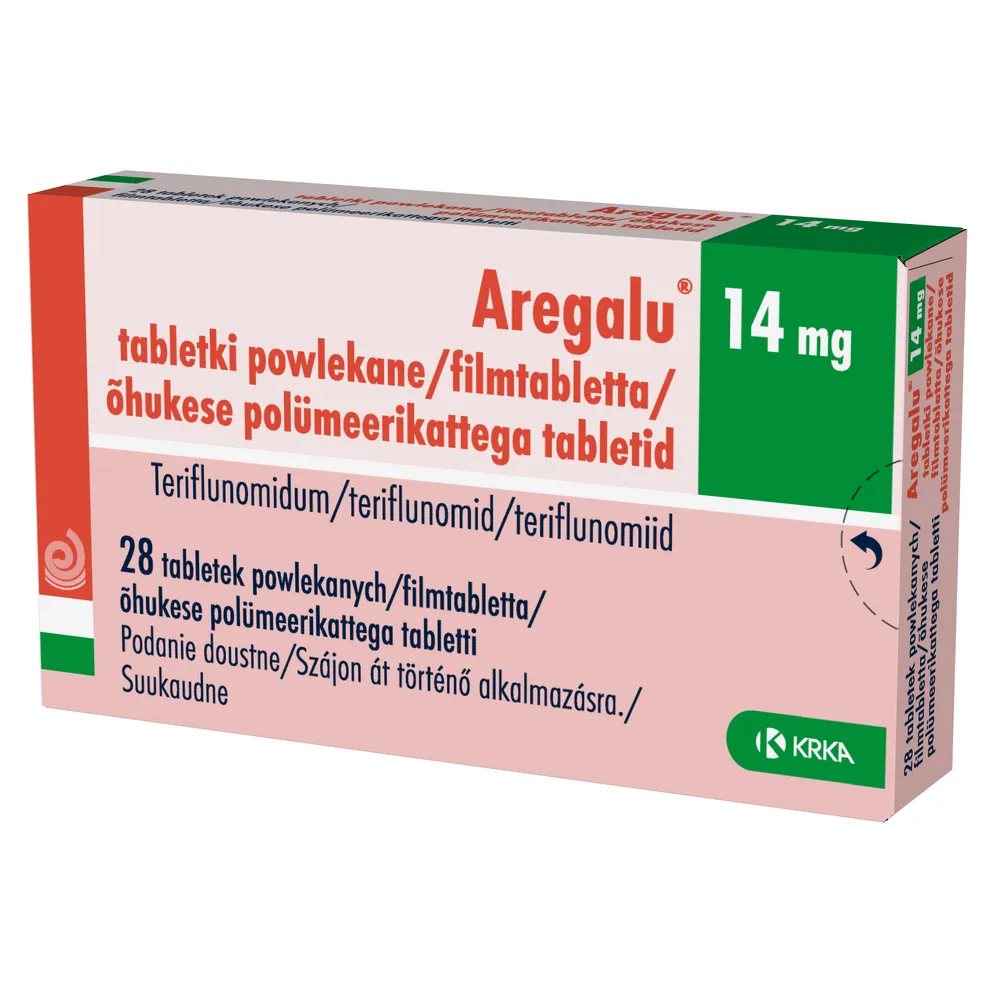
AREGALU
PolandThe medicine is used to treat adults as well as children and adolescents (over 10 years of age) with relapsing-remitting multiple sclerosis. It helps protect the nervous system from attacks by the immune system.
Frequently asked questions
How should Aregalu be taken?
Tablets should be taken orally, every day at any time, as a single daily dose. They can be taken with or without food. Adults take one 14 mg tablet per day, whereas in children and adolescents, the dose depends on body weight (14 mg or 7 mg).
When should you not use this medicine?
Do not use the medicine if you are allergic to its ingredients, have severe liver disease, severe kidney disease requiring dialysis, severe immune system diseases (e.g., AIDS), severe bone marrow disorders, or severe infections. Use is also contraindicated in women who are pregnant or breastfeeding.
Can Aregalu affect pregnancy?
Yes, the medicine must not be taken during pregnancy or while breastfeeding. Women of childbearing potential are required to use effective contraception both during treatment and after its completion, until a doctor confirms that the active substance has been completely eliminated from the body (this may take up to 2 years).
What are the possible side effects of Aregalu?
Very common side effects may include: headache, diarrhea, nausea, hair thinning, and increased liver enzyme activity. Infections (e.g., respiratory tract, urinary tract, herpes) and increased blood pressure also occur frequently. You should contact a doctor immediately if abdominal pain, nausea, or vomiting occurs (this may indicate pancreatitis) or if yellowing of the skin and whites of the eyes appears.
Can you drive while undergoing treatment?
The medicine may cause dizziness, which can impair concentration and reaction time. If such symptoms occur, you should not drive vehicles or operate machinery.
Can the medicine be combined with other preparations?
You must inform your doctor about all medicines you are currently taking. Particular caution should be exercised when using the medicine with leflunomide, methotrexate, anti-epileptic drugs, certain diabetes medications, anticoagulants, or hormonal contraception.
Instructions for use
Package leaflet: Information for the patient
Aregalu, 14 mg, coated tablets
Teriflunomide
Please read all of this leaflet carefully before taking this medicine, because it contains
important information for you.
- Keep this leaflet. You may need to read it again.
- If you have any further questions, please ask your doctor or pharmacist.
- This medicine has been prescribed for a specific individual. Do not pass it on to others. It may harm other people, even if their symptoms are the same.
- If you experience any side effects, including any not listed in this leaflet, tell your doctor or pharmacist. See section 4.
Contents of the leaflet
- What Aregalu is and what it is used for
- What you need to know before taking Aregalu
- How to take Aregalu
- Possible side effects
- How to store Aregalu
- Contents of the pack and other information
1. What Aregalu is and what it is used for
What Aregalu is
Aregalu contains the active substance teriflunomide, which is an immunomodulatory agent
that regulates the immune system in order to reduce its attack on the nervous system.
What Aregalu is used for
Aregalu is used to treat adults, children, and adolescents (aged 10 years and older)
with relapsing-remitting multiple sclerosis.
What multiple sclerosis is
Multiple sclerosis is a chronic disease that attacks the central nervous system. The central
nervous system consists of the brain and spinal cord. In multiple sclerosis, inflammation
destroys the protective covering (called myelin) around the nerves in the central nervous system.
This process is known as demyelination. This impairs the nerves' ability to function properly.
In people with relapsing forms of multiple sclerosis, there are recurring attacks (relapses)
of physical symptoms caused by abnormal nerve function. Symptoms vary among patients,
but usually include:
- difficulty walking
- vision problems
- balance problems.
These symptoms may completely disappear after a relapse ends, but over time, some problems
may persist between relapses. This may lead to physical disability, making it difficult
to perform daily activities.
How Aregalu works
Aregalu helps protect the central nervous system from the immune system by limiting
the increase in number of certain white blood cells (lymphocytes). This reduces inflammation,
which in patients with multiple sclerosis leads to nerve damage.
2. Important information before using Aregalu
When not to use Aregalu
- if the patient is allergic to teriflunomide or any of the other ingredients of this medicine (listed in section 6),
- if the patient has ever had a severe skin rash, skin peeling, blisters and/or oral ulceration after taking teriflunomide or leflunomide,
- if the patient has severe liver disease,
- if the patient is pregnant, suspects she may be pregnant, or is breastfeeding,
- if the patient has any severe diseases affecting the immune system, e.g. acquired immunodeficiency syndrome (AIDS),
- if the patient has any severe bone marrow disorders or has low numbers of red or white blood cells or reduced platelet count,
- if the patient has a severe infection,
- if the patient has severe kidney disease requiring dialysis,
- if the patient has very low levels of protein in the blood (hypoproteinemia). If in doubt, consult a doctor or pharmacist before taking this medicine.
Warnings and precautions
Before starting treatment with Aregalu, discuss with your doctor or pharmacist if:
- the patient has impaired liver function and/or drinks large amounts of alcohol. The doctor may perform blood tests to check liver function before and during treatment. If test results indicate impaired liver function, the doctor may discontinue treatment with Aregalu. See section 4.
- the patient has high blood pressure (hypertension), regardless of whether it is controlled with medication or not. Aregalu may cause an increase in blood pressure. The doctor will check the patient's blood pressure before starting treatment and regularly thereafter. See section 4.
- the patient has an infection. The doctor will ensure that the patient has adequate levels of white blood cells and platelets before starting Aregalu. Aregalu may affect the body's ability to fight infections, as it reduces the number of white blood cells in the blood. The doctor may perform a blood test to check white blood cell count if the patient suspects having any infection. Viral infections, including herpes simplex (cold sores) or herpes zoster (shingles), may occur during treatment with teriflunomide. In some cases, serious complications have occurred. Immediately inform the doctor if any symptoms suggestive of herpes virus infection are suspected. See section 4.
- the patient has severe skin reactions.
- the patient has respiratory symptoms.
- the patient experiences weakness, numbness, or pain in the hands and feet.
- the patient intends to receive vaccination.
- the patient is taking leflunomide together with Aregalu.
- the patient is switching from another medication to Aregalu or from Aregalu to another medication.
- the patient is scheduled for a specific blood test (calcium level measurement). Calcium test results may be falsely low.
Respiratory system reactions
Inform the doctor if the patient develops unexplained cough or shortness of breath (shallow breathing). The doctor may order additional tests.
Children and adolescents
Aregalu is not recommended for use in children under 10 years of age, as it has not been studied in pediatric patients with multiple sclerosis.
The warnings and precautions listed above also apply to children. The following information is important for children and their caregivers:
- Cases of pancreatitis have been observed in patients receiving teriflunomide. The child's doctor may perform blood tests if pancreatitis is suspected.
Aregalu and other medicines
Tell your doctor or pharmacist about all medicines the patient is currently taking or has recently taken, as well as any medicines the patient plans to take.
In particular, inform the doctor or pharmacist if the patient is taking any of the following medicines:
- leflunomide, methotrexate, and other medicines affecting the immune system (often called immunosuppressive or immunomodulatory drugs)
- rifampicin (a medicine used to treat tuberculosis and other infections)
- carbamazepine, phenobarbital, phenytoin, used to treat epilepsy
- St. John’s wort (an herbal medicine used to treat depression)
- repaglinide, pioglitazone, nateglinide, or rosiglitazone, used to treat diabetes
- daunorubicin, doxorubicin, paclitaxel, or topotecan, used to treat cancer
- duloxetine, used to treat depression, urinary incontinence, or kidney disease in diabetic patients
- alosetron, used to treat severe diarrhea
- theophylline, used to treat asthma
- tizanidine, a muscle relaxant
- warfarin, an anticoagulant medicine used to thin the blood (i.e. make it more fluid) to prevent clots
- oral contraceptives (containing ethinylestradiol and levonorgestrel)
- cefaclor, benzylpenicillin (penicillin G), ciprofloxacin, used to treat infections
- indometacin, ketoprofen, used for pain relief or treatment of inflammation
- furosemide, used to treat heart conditions
- cimetidine, used to reduce gastric acid secretion
- zidovudine, used to treat HIV infection
- rosuvastatin, simvastatin, atorvastatin, pravastatin – medicines used to treat hypercholesterolemia (high cholesterol levels in the blood)
- sulfasalazine, a medicine used to treat inflammatory bowel disease and rheumatoid arthritis
- cholestyramine, used to treat high cholesterol levels or itching in liver disease
- activated charcoal, used to reduce absorption of medicines or other substances
Pregnancy and breastfeeding
Do not take Aregalu if the patient is pregnant or suspects she may be pregnant. Pregnant women or those who become pregnant while taking Aregalu have an increased risk of congenital malformations in the child. Women of childbearing potential must not take this medicine unless they are using effective contraception. If a girl starts menstruating during treatment with Aregalu, this should be reported to the doctor, who will provide specialist advice regarding contraception and potential risks in case of pregnancy.
Inform the doctor if planning a pregnancy after stopping Aregalu, as it is necessary to ensure that the medicine has been eliminated from the body before attempting conception. Elimination of the active substance may take up to 2 years. This period can be shortened to several weeks by taking certain medicines that accelerate the removal of Aregalu from the body. In both cases, blood testing must confirm that the active substance has been sufficiently eliminated from the body. The treating doctor should confirm that the blood concentration of Aregalu is low enough to allow pregnancy.
Contact the doctor for further information about laboratory tests.
If pregnancy is suspected during treatment with Aregalu or within two years after stopping treatment, discontinue Aregalu immediately and promptly contact the doctor to perform a pregnancy test. If the test confirms pregnancy, the doctor may recommend certain medicines to rapidly and adequately eliminate Aregalu from the body to reduce risk to the fetus.
Contraception
During treatment with Aregalu and after stopping it, women should use effective contraception. Teriflunomide remains in the blood for a long time after discontinuation. Therefore, effective contraception should continue after stopping treatment.
- This method should be used until blood levels of Aregalu are sufficiently low – this will be verified by the doctor.
- Discuss with the doctor the most suitable contraceptive method for the patient and whether a change in contraceptive method may be needed.
Do not take Aregalu while breastfeeding, as teriflunomide passes into human milk.
Driving and operating machinery
Aregalu may cause dizziness, which may impair the ability to concentrate and react. Patients experiencing such symptoms should not drive or operate machinery.
Aregalu contains lactose and sodium
Aregalu contains lactose (a type of sugar). If the patient has previously been diagnosed with intolerance to certain sugars, consult a doctor before taking this medicine.
This medicine contains less than 1 mmol (23 mg) of sodium per coated tablet, meaning the medicine is considered "sodium-free".
3. How to take Aregalu
The use of Aregalu will be supervised by a physician experienced in the treatment of multiple sclerosis.
This medicine should always be taken exactly as prescribed by your doctor. If in doubt, consult your doctor.
Adults
The recommended dose is one 14 mg tablet per day.
Children and adolescents (aged 10 years and older)
The dose depends on body weight:
- Children with body weight greater than 40 kg: one 14 mg tablet per day.
- Children with body weight less than or equal to 40 kg: one 7 mg tablet per day.
Children and adolescents who reach a stable body weight above 40 kg will be informed by their doctor to change the dose to one 14 mg tablet daily.
The 7 mg strength of Aregalu is not commercially available. To administer this dose, alternative available medicines containing teriflunomide should be used. Please consult your doctor or pharmacist for more information about available alternatives.
Route/administration method
Aregalu is administered orally. Aregalu should be taken daily at any time of day as a single daily dose.
Aregalu may be taken with or without food.
Taking more Aregalu than prescribed
If you take more Aregalu than prescribed, contact your doctor immediately. Adverse reactions similar to those described in section 4 below may occur.
Missing a dose of Aregalu
Do not take a double dose to make up for a missed tablet. Take the next dose according to the prescribed dosing schedule.
Stopping Aregalu
Do not stop taking Aregalu or change the dose without first consulting your doctor.
If you have any further questions about the use of this medicine, consult your doctor or pharmacist.
4. Possible side effects
Like all medicines, this medicine can cause side effects, although not everybody will experience them.
The following side effects may occur after using this medicine.
Serious side effects
Some side effects may be severe or may become serious. If any of the following symptoms occur, contact your doctor immediately.
Common (may affect up to 1 in 10 people)
- Inflammation of the pancreas, which may cause symptoms such as abdominal pain, nausea or vomiting (frequency is common in children and adolescents and uncommon in adult patients).
Uncommon (may affect up to 1 in 100 people)
- Allergic reactions, which may cause symptoms including rash, hives, swelling of the lips, tongue or face, or sudden breathing difficulties;
- Severe skin reactions, which may cause symptoms including skin rash, blisters on the skin, fever or mouth ulcers;
- Severe infections or sepsis (a type of infection that may be life-threatening), which may cause symptoms including high fever, seizures, chills, reduced urine flow or confusion;
- Lung inflammation, which may cause symptoms including shortness of breath or persistent cough.
Unknown frequency (cannot be estimated from available data):
- Serious liver disease, which may cause symptoms including yellowing of the skin or whites of the eyes, darker than normal urine, unexplained nausea and vomiting, or abdominal pain.
Other side effects may occur with the following frequency:
Very common (may affect more than 1 in 10 people)
- Headache
- Diarrhoea, nausea
- Increased ALT activity (elevated levels of certain liver enzymes in blood tests)
- Hair thinning
Common (may affect up to 1 in 10 people)
- Flu, upper respiratory tract infection, urinary tract infection, bronchitis, sinusitis, sore throat and discomfort when swallowing, bladder inflammation, viral gastroenteritis, tooth infection, laryngitis, fungal foot infection
- Herpes virus infections, including cold sores and shingles, with symptoms such as blisters, burning, itching, numbness or pain of the skin, usually on one side of the upper body or face, and other symptoms such as fever and fatigue
- Laboratory findings: reduced number of red blood cells (anaemia), changes in the liver and white blood cell test results (see section 2), increased activity of muscle enzymes (creatine kinase) has also been observed
- Mild allergic reactions
- Feeling anxious
- Tingling sensation, feeling weak, numbness, tingling or pain in the lower back or leg (sciatica); numbness, burning, tingling or pain in the hands and fingers (carpal tunnel syndrome)
- Sensation of "heart pounding"
- Increased blood pressure
- Being unwell (vomiting), toothache, upper abdominal pain
- Rash, acne
- Pain in tendons, joints, bones, muscle pain (musculoskeletal pain)
- Need to pass urine more often than usual
- Heavy menstrual periods
- Pain
- Lack of energy or feeling weak (asthenia)
- Weight loss
Uncommon (may affect up to 1 in 100 people)
- Reduced number of platelets (mild thrombocytopenia)
- Increased sensations or sensitivity, especially of the skin; stabbing or pulsating pain along one or more nerves, nerve disorders of arms or legs (peripheral neuropathy)
- Nail disorders, severe skin reactions
- Injury-related pain
- Psoriasis
- Inflammation of the mouth and/or lips
- Abnormal levels of fats (lipids) in the blood
- Inflammation of the large intestine (colitis)
Rare (may affect up to 1 in 1000 people)
- Inflammation or damage to the liver
Unknown frequency (cannot be estimated from available data)
- Pulmonary hypertension
Children (aged 10 years and older) and adolescents
The side effects listed above also apply to children and adolescents. The following additional information is important for children, adolescents and their caregivers:
Common (may affect up to 1 in 10 people)
- Inflammation of the pancreas
Reporting of side effects
If any side effects occur, including any not listed in this leaflet, tell your doctor or pharmacist. Side effects can be reported directly to the Department of Monitoring Adverse Drug Reactions of the Office for Registration of Medicinal Products, Medical Devices and Biocidal Products
Al. Jerozolimskie 181C,
02-222 Warsaw
Tel.: +48 22 49 21 301
Fax: +48 22 49 21 309
Website: https://smz.ezdrowie.gov.pl
Side effects can also be reported to the marketing authorisation holder.
Reporting side effects helps provide more information on the safety of this medicine.
5. How to store Aregalu
Keep this medicine out of sight and reach of children.
Do not use this medicine after the expiry date stated on the blister and outer packaging after the word "EXP". The expiry date refers to the last day of the specified month.
No special storage conditions are required for this medicinal product.
Medicines must not be disposed of via the sewage system or household waste. Ask your pharmacist how to dispose of medicines no longer required. Such measures will help protect the environment.
6. Contents of the pack and other information
What Aregalu contains
- The active substance is teriflunomide. Each coated tablet contains 14 mg of teriflunomide.
- The other ingredients (excipients) are monohydrate lactose, corn starch, hydroxypropylcellulose (type LF), microcrystalline cellulose (type 200), sodium carboxymethyl starch (type A), magnesium stearate (E 470b), colloidal anhydrous silica in the tablet core, and in the coating: hypromellose type 2910 (5 mPa·s), titanium dioxide (E 171), macrogol 8000, and indigo carmine, aluminium lake (E 132). See section 2 "Aregalu contains lactose and sodium".
What Aregalu looks like and contents of the pack
Film-coated tablets (tablets) in blue colour, round, biconvex film-coated tablets with the imprint "14" on one side. Tablet diameter: approximately 7 mm.
Aregalu 14 mg film-coated tablets are available in packs containing:
- 28 film-coated tablets in blister packs within a cardboard carton.
- 28 film-coated tablets in blister packs, in calendar packs within a cardboard carton.
Not all pack sizes may be marketed.
Marketing Authorisation Holder
KRKA, d.d., Novo mesto, Šmarješka cesta 6, 8501 Novo mesto, Slovenia
Manufacturer
KRKA, d.d., Novo mesto, Šmarješka cesta 6, 8501 Novo mesto, Slovenia
KRKA-FARMA d.o.o., V. Holjevca 20/E, 10450 Jastrebarsko, Croatia
For further information on the product names in other European Economic Area countries, please contact the local representative of the Marketing Authorisation Holder:
KRKA-POLSKA Sp. z o.o.
ul. Równoległa 5
02-235 Warszawa
Tel. 22 57 37 500
Similar drugs
The original data is available in the language of the country of manufacture.
Data source: Register of Medicinal Products of Poland (URPL)
Data last verified: September 01, 2026