FIBRYGA
ItalyIt is used to treat episodes of bleeding and for prevention during surgical procedures in people with a congenital fibrinogen deficiency. It is also used to supplement fibrinogen in patients presenting with severe and uncontrolled bleeding due to an acquired deficiency during surgery.
Frequently asked questions
When should you not use FIBRYGA?
You must not take it if you are allergic to human fibrinogen or to any of the components of this medicine, or if you have experienced allergic reactions to FIBRYGA in the past.
How is the drug administered?
FIBRYGA is administered via intravenous infusion or injection (into a vein) by a healthcare professional.
What are the recommended infusion rates?
For patients with congenital deficiency, the maximum rate is 5 mL per minute. For patients with acquired deficiency, the maximum rate is 10 mL per minute.
What are the possible side effects of FIBRYGA?
Reported side effects include allergic or anaphylactic reactions (such as skin rash, redness, chest tightness, or wheezing), cardiovascular problems (inflammation of the veins and blood clot formation), and increased body temperature.
What should be done in case of allergic reactions?
If signs of an allergic reaction occur, such as hives, rash, wheezing, or low blood pressure, the FIBRYGA infusion must be stopped immediately and a doctor must be consulted at once.
Are there risks of clot formation?
Yes, there is a risk of blood clot formation in the blood vessels, especially if high or repeated doses have been administered, or in the presence of specific conditions such as liver disease or previous heart attacks.
Can the medicine interact with other products?
FIBRYGA must not be mixed with other medicines.
Instructions for use
Table of contents
Package leaflet: Information for the user
FIBRYGA, 1 g
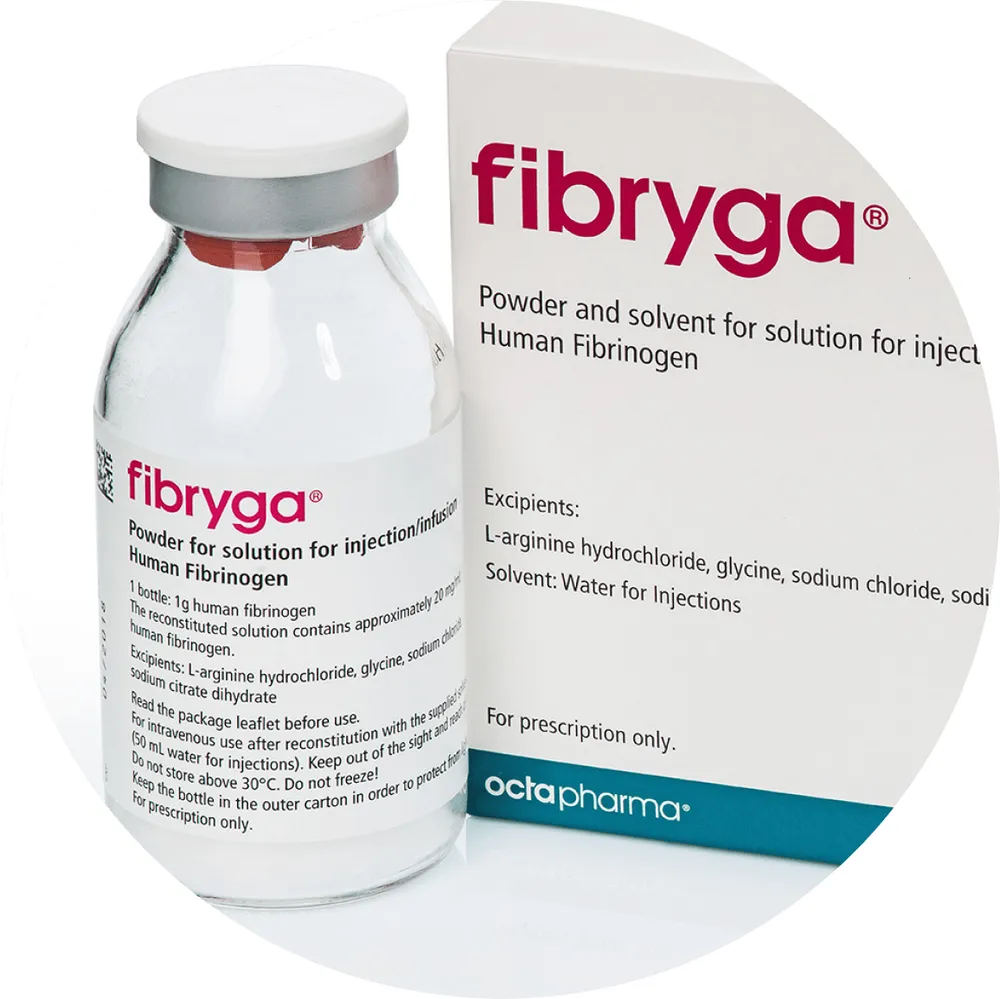
Powder and solvent for solution for injection/infusion
Human fibrinogen
Please read all of this leaflet carefully before you use this medicine because it contains important information for you.
- Keep this leaflet. You may need to read it again.
- If you have any questions, ask your doctor or pharmacist.
- This medicine has been prescribed for you only. Do not pass it on to others, even if their symptoms are the same as yours, as it may be harmful to them.
- If you experience any adverse reactions, including those not listed in this leaflet, inform your doctor or pharmacist. See section 4.
Contents of this leaflet:
- What FIBRYGA is and what it is used for
- What you need to know before using FIBRYGA
- How to use FIBRYGA
- Possible side effects
- How to store FIBRYGA
- Contents of the pack and other information
1. What FIBRYGA is and what it is used for
What FIBRYGA is
FIBRYGA contains human fibrinogen, a protein important for blood clotting.
A deficiency of fibrinogen results in reduced ability of the blood to clot, leading to an increased tendency to bleed. Replacement of human fibrinogen with FIBRYGA corrects the coagulation defect.
What FIBRYGA is used for
FIBRYGA is used for:
- treatment of bleeding episodes and prophylaxis for surgical procedures in patients with congenital fibrinogen deficiency (hypo- or afibrinogenemia) associated with a bleeding tendency.
- fibrinogen supplementation in patients with severe uncontrolled bleeding accompanied by acquired fibrinogen deficiency during surgical procedures.
2. What you should know before using FIBRYGA
Do not use FIBRYGA:
- if you are allergic to human fibrinogen or to any of the other ingredients of this medicine (listed in section 6).
- if you have previously experienced allergic reactions to FIBRYGA. Inform your doctor if you are allergic to any medicine.
Warnings and precautions
Talk to your doctor or pharmacist before using FIBRYGA.
Risk of blood clots
Your doctor must evaluate the benefits of this medicine against the risk of blood clot formation, particularly if:
- you have received a high dose or repeated doses of this medicine
- you have had a heart attack (history of coronary artery disease or myocardial infarction)
- you have liver disease
- you have recently undergone surgery (postoperative patients)
- you are undergoing surgery (perioperative patients)
- in newborns
- you have a tendency to form blood clots or clotting disorders (patients at risk of thromboembolic events or disseminated intravascular coagulation).
Your doctor may ask you to undergo additional coagulation tests to monitor the risk.
Allergic or anaphylactic reactions
Any medicine derived from human blood (containing proteins), such as FIBRYGA, and administered intravenously, may cause allergic reactions. If you have previously experienced allergic reactions to FIBRYGA, your doctor may advise you to take an antiallergic medicine.
Your doctor will explain the warning signs of allergic or anaphylactic reactions.
Pay particular attention to early signs of allergic reactions (hypersensitivity), such as:
- hives
- skin rash
- chest tightness
- wheezing
- low blood pressure
- or anaphylaxis (when one or all of the above symptoms develop rapidly and are severe).
If any of these signs occur, the injection/infusion of FIBRYGA must be stopped immediately.
Viral safety
When medicines are prepared from human blood or plasma, certain measures are taken to prevent transmission of infections to patients. These measures include:
- careful selection of blood and plasma donors to ensure that those at risk of carrying infections are excluded
- testing of each donation and plasma pool for signs of viruses/infections
- inclusion of steps during processing of blood or plasma that can inactivate or remove viruses.
Despite these measures, when medicines prepared from human blood or plasma are administered, the possibility of transmitting an infection cannot be completely ruled out. This applies to any unknown or emerging virus or other types of infections.
The measures taken are considered effective against enveloped viruses such as human immunodeficiency virus (HIV), hepatitis B virus, hepatitis C virus, and the non-enveloped hepatitis A virus. The measures may have limited effectiveness against non-enveloped viruses such as parvovirus B19.
Parvovirus B19 infection may be severe in pregnant women (fetal infection) and in individuals with weakened immune systems or certain types of anemia (e.g., sickle cell anemia or abnormal destruction of red blood cells).
It is strongly recommended to record the product name and batch number each time you receive a dose of FIBRYGA, in order to maintain a record of the batches used.
Your doctor may recommend that you consider vaccination against hepatitis A and B if you regularly or repeatedly receive fibrinogen products derived from human plasma.
Children and adolescents
No specific or additional warnings or precautions apply to children and adolescents.
Other medicines and FIBRYGA
Inform your doctor or pharmacist if you are taking, have recently taken, or might take any other medicines.
FIBRYGA must not be mixed with other medicines except those mentioned in the section "The following information is intended exclusively for healthcare professionals / Reconstitution".
Pregnancy, breastfeeding and fertility
If you are pregnant, think you may be pregnant, are planning to become pregnant, or are breastfeeding, ask your doctor or pharmacist for advice before taking this medicine. This product should be used during pregnancy or breastfeeding only after consulting your doctor or pharmacist.
Driving and using machines
FIBRYGA does not impair the ability to drive or operate machinery.
FIBRYGA contains sodium
This medicine contains up to 132 mg of sodium (a main component of cooking salt) per vial. This corresponds to 6.6% of the maximum daily recommended dietary intake for an adult. This should be taken into consideration if you are on a sodium-restricted diet.
3. How to use FIBRYGA
Use this medicine exactly as your doctor has told you. If you have any doubts, consult your doctor.
FIBRYGA is administered as an intravenous infusion (infusion into a vein) by a healthcare professional.
The dose and dosing regimen depend on:
- your body weight
- the severity of your condition
- the site of bleeding, or
- the type of surgical procedure you are undergoing, and
- your overall health status
Use in children and adolescents
Administration of FIBRYGA in children and adolescents (by intravenous route) does not differ from administration in adults.
If you use more FIBRYGA than you should
To avoid the risk of overdose, your doctor will regularly perform blood tests to monitor your fibrinogen levels.
In case of overdose, the risk of abnormal blood clots forming in your blood vessels may increase.
If you have any doubts about using this medicine, consult your doctor or pharmacist.
Method of administration
This medicine must be injected or infused intravenously after reconstitution with the solvent provided.
If you have any doubts about the use of this medicine, consult your doctor or pharmacist.
4. Possible side effects
Like all medicines, this medicine can cause side effects, although not everyone gets them.
Immediately contact your doctor:
- if you experience any side effect
- if you notice any side effect not listed in this leaflet
The following side effects have been reported for FIBRYGA and other fibrinogen-containing products (the frequency of the listed side effects is unknown):
- Allergic or anaphylactic reactions: skin reactions such as rash or redness of the skin (see section 2 "Warnings and precautions")
- Cardiovascular: inflammation of the veins and formation of blood clots (see section 2 "Warnings and precautions")
- Increase in body temperature
If you experience any of the symptoms listed above, immediately contact your doctor.
Reporting of side effects
If you experience any side effect, including those not listed in this leaflet, contact your doctor or pharmacist. You may also report side effects directly via the national reporting system at https://www.aifa.gov.it/content/segnalazioni-reazioni-avverse .
By reporting side effects, you can help provide more information on the safety of this medicine.
5. How to store FIBRYGA
Keep this medicine out of the sight and reach of children.
Do not use this medicine after the expiry date stated on the label and carton.
The expiry date refers to the last day of that month.
Do not store above 25 °C. Do not freeze. Keep the vial in the outer carton to protect the medicine from light.
The powder must be dissolved only immediately before injection/infusion. The reconstituted solution has been shown to be stable for 24 hours at room temperature (maximum 25 °C). Nevertheless, to prevent contamination, the solution should be used immediately and for a single use only. The reconstituted product must not be refrigerated or frozen.
Do not dispose of any medicine via wastewater or household waste. Ask your pharmacist how to dispose of medicines you no longer use. This will help protect the environment.
6. Package contents and other information
What FIBRYGA contains
- The active substance is human fibrinogen.
- After reconstitution with the solvent supplied (50 mL of water for injections), FIBRYGA contains 1 g of human fibrinogen per vial or 20 mg/mL of human fibrinogen.
- The other components are L-arginine hydrochloride, glycine, sodium chloride and disodium citrate dihydrate.
Description of the appearance of FIBRYGA and package contents
FIBRYGA is supplied as a powder and solvent for injectable solution/infusion and is
available in glass vials.
The powder is white or pale yellow and hygroscopic; it appears as a friable mass.
The solvent is a clear, colourless liquid.
The reconstituted solution is almost colourless and slightly opalescent.
FIBRYGA is supplied in a carton containing:
- 1 vial containing powder for injectable/infusion solution
- 1 vial containing solvent (water for injections)
- 1 nextaro transfer device
Marketing Authorization Holder
Octapharma (IP) SPRL
Allée de la Recherche 65
1070 Brussels
Belgium
Legal representative and distributor:
Octapharma Italy S.p.A.
Via Cisanello, 145
56100 Pisa
Italy
Manufacturers
Octapharma Pharmazeutika Produktionsges.m.b.H.,
Oberlaaer Strasse 235, 1100 Vienna, Austria
Octapharma AB,
Lars Forssells gata 23, 112 75 Stockholm, Sweden
This medicinal product is authorized in the Member States of the European Economic Area under the following names:
Fibryga: Austria, Belgium, Bulgaria, Croatia, Cyprus, Czech Republic, Denmark, Estonia, Finland, France, Germany, Hungary, Iceland, Ireland, Italy, Latvia, Lithuania, Luxembourg, Malta, Norway, Netherlands, Poland, Portugal, United Kingdom (Northern Ireland), Romania, Slovakia, Spain, Sweden,
Fibrema: Slovenia
The following information is intended for healthcare professionals only:
Dosage
The dosage and duration of replacement therapy depend on the severity of the disorder, the
location and extent of bleeding, and the patient's clinical condition.
To determine the individual dose, the (functional) fibrinogen level should be measured, and the
amount and frequency of administration must be established for each individual patient based on
regular monitoring of plasma fibrinogen levels and continuous assessment of the patient's clinical
status and other concomitant replacement therapies.
In the case of major surgery, precise monitoring of replacement therapy using coagulation tests is
essential.
- Prophylaxis in patients with congenital hypo- or afibrinogenemia and known bleeding tendency
To prevent excessive bleeding during surgical procedures, prophylactic treatment is recommended to raise fibrinogen levels to 1 g/L and maintain fibrinogen at this level until hemostasis is secured, and above 0.5 g/L until wound healing is complete. In the case of surgery or treatment of a bleeding episode, the dose should be calculated as follows:
Dose (mg/kg body weight) = [Desired level (g/L) – measured level (g/L)] / 0.018 (g/L per mg/kg body weight)
Subsequent dosing (dose and frequency of injection) should be adjusted according to the patient’s clinical condition and laboratory results.
The biological half-life of fibrinogen is 3–4 days. Therefore, in the absence of consumption, repeated administration of human fibrinogen is usually required. Due to accumulation that may occur with repeated administration for prophylactic use, the dose and frequency should be determined based on the physician’s therapeutic goals for a given patient.
Paediatric population
For surgery or treatment of a bleeding episode, the dose in adolescents should be calculated using the formula above for adults. The dose for children aged <12 years should be calculated as follows:
Dose (mg/kg body weight) = [Desired level (g/L) – measured level (g/L)] / 0.014 (g/L per mg/kg body weight)
Subsequent dosing should be adjusted according to the patient’s clinical condition and laboratory results.
Elderly patients
Clinical studies with FIBRYGA did not include patients aged 65 years or older; therefore, it is not possible to provide definitive evidence regarding whether they respond differently compared to younger patients.
- Treatment of bleeding
Bleeding in patients with congenital hypo- or afibrinogenemia
Bleeding episodes should be treated according to the formulas above for adults/adolescents and children, respectively, aiming to achieve a recommended plasma fibrinogen level of 1 g/L. This level should be maintained until hemostasis is secured.
Bleeding in patients with acquired fibrinogen deficiency
Adults
Initially, 1–2 g is generally administered, followed by subsequent infusions as needed. In cases of severe hemorrhage, e.g., during major surgery, higher amounts (4–8 g) of fibrinogen may be required.
Paediatric population
Dosage should be based on body weight and clinical need, but is usually 20–30 mg/kg.
Instructions for preparation and administration
General instructions
- The reconstituted solution should be almost colourless and slightly opalescent. Do not use cloudy solutions or those containing deposits.
- FIBRYGA is for single use only. Do not reuse any components.
- For microbiological safety, the solution should be administered immediately after reconstitution. The reconstituted solution has been shown to be chemically and physically stable for up to 24 hours at room temperature (maximum 25 °C). After reconstitution, do not refrigerate or freeze the FIBRYGA solution.
Reconstitution
-
Ensure that the vial of powder (FIBRYGA) and the solvent vial are at room temperature. This temperature should be maintained throughout reconstitution. If a water bath is used for warming, take care that water does not come into contact with the rubber stoppers or peel-off seals of the containers. The water bath temperature must not exceed 37 °C.
-
Remove the peel-off seals from the vial of powder (FIBRYGA) and the solvent vial to expose the central portion of the stoppers. Clean the rubber stoppers with an alcohol swab and allow them to dry.
-
Open the transfer device (nextaro) packaging by removing the lid (Fig. 1). To maintain sterility, do not remove the transfer device from the transparent blister. Do not touch the tip.
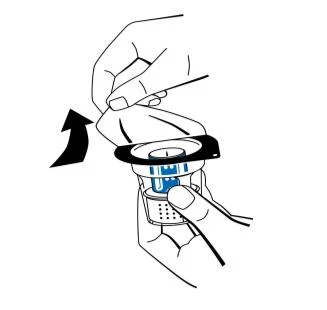
- Place the solvent vial on a flat, clean surface and hold it firmly. Without removing the blister, place the blue part of the transfer device onto the solvent vial. Press firmly downward until it clicks into place (Fig. 2). Do not rotate during connection.
Note: The transfer device must first be connected to the solvent vial and then to the vial of lyophilized powder. Otherwise, vacuum loss will occur and solvent transfer will not take place.
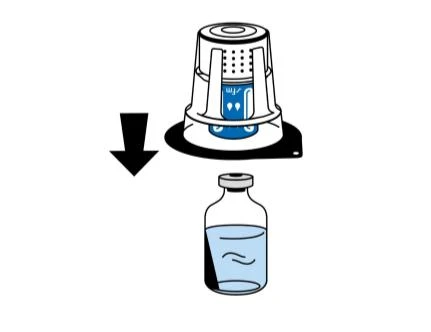
- While holding the solvent vial, carefully remove the blister from the transfer device (nextaro) by pulling vertically upward. Ensure that the device remains securely attached to the solvent vial (Fig. 3).
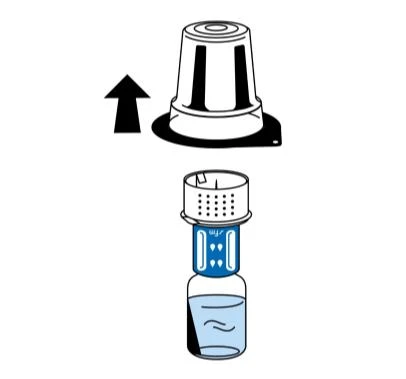
- Place the vial of powder (FIBRYGA) on a flat, clean surface and hold it firmly. Take the solvent vial with the attached transfer device and invert it. Position the white part of the transfer device connector over the vial of powder (FIBRYGA) and press firmly downward until it clicks into place (Fig. 4). Do not rotate during connection. The solvent will automatically flow into the vial of powder (FIBRYGA).
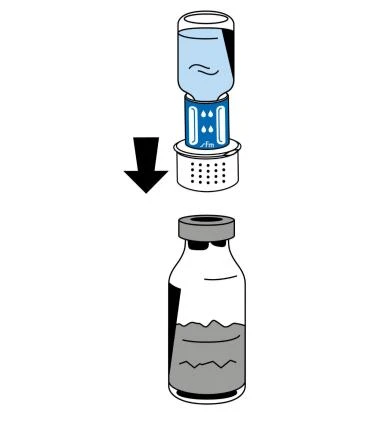
-
With the solvent vial still attached, gently swirl the FIBRYGA vial until the powder is completely dissolved. To avoid foaming, do not shake the vial. The powder should fully dissolve within approximately 5 minutes. Dissolution should not take longer than 20 minutes. If the powder has not dissolved within 20 minutes, the product must be discarded.
-
In the rare event that undissolved powder is observed floating during transfer of water for injectable preparations or if reconstitution time is longer than expected, the dissolution process may be facilitated by more vigorous horizontal agitation of the vial.
-
Once reconstitution is complete, unscrew the connecting device (blue part) counterclockwise to separate the two parts (Fig. 5). Do not touch the Luer lock connector on the white part of the transfer device.
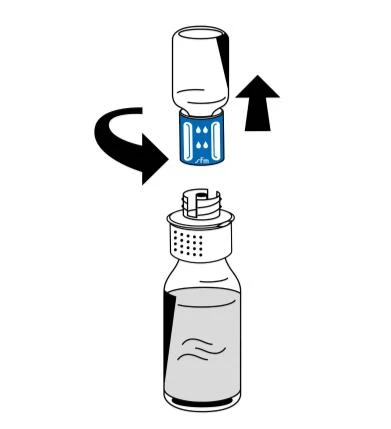

- Discard the empty solvent vial together with the blue part of the transfer device.
Administration
-
Carefully attach a syringe to the Luer lock connector on the white part of the transfer device (Fig. 6).
-
Invert the FIBRYGA vial and draw the solution into the syringe (Fig. 7).
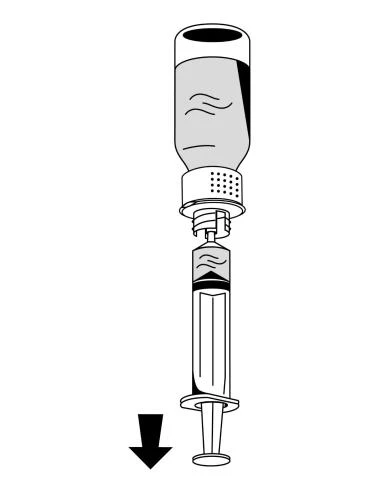
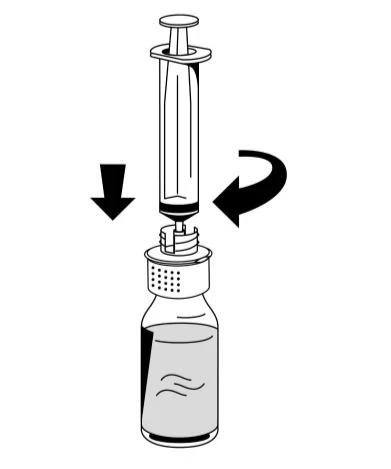
- After completing solution transfer, firmly grasp the barrel of the syringe (with plunger pointing downward) and detach the syringe from the transfer device (Fig. 8).
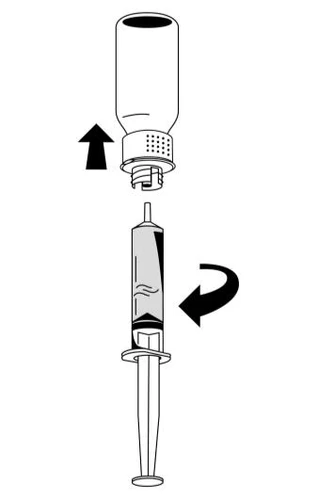
- Discard the white part of the transfer device together with the empty FIBRYGA vial.
For intravenous administration of the reconstituted solution at room temperature, a standard infusion set is recommended.
Any unused medicine and waste material derived from this medicine must be disposed of in accordance with local regulations.
Method of administration
Intravenous infusion or injection.
FIBRYGA must be administered slowly by intravenous route at a maximum recommended rate of 5 mL per minute for patients with congenital hypo- or afibrinogenemia and at a maximum recommended rate of 10 mL per minute for patients with acquired fibrinogen deficiency.
Incompatibilities
This medicinal product must not be mixed with other medicinal products.
Similar drugs
| Brand name | Dosage form | Active substance / Dosage | Manufacturer |
|---|---|---|---|
| FIBRICLOTTE | solution for injection/infusion, powder and solvent for preparation of | LABORATOIRE FRANCAIS DU FRACTIONNEMENT ET DES BIOTECHNOLOGIES |
The original data is available in the language of the country of manufacture.
Data source: Italian Medicines Agency (AIFA)
Data last verified: September 21, 2026