DECASTIN
ItalyIt is an antihistamine that helps relieve allergy symptoms, such as sneezing, runny nose, watery eyes, and itchy skin rashes. It is used for seasonal rhinitis (hay fever) and chronic allergic rhinitis (including allergic conjunctivitis) in adults and children aged 12 years and older. In adults over 18 years of age, it is also used for the itching and wheals of urticaria.
Frequently asked questions
How should Decastin be taken?
The tablets are orally disintegrating: they should be placed on the tongue where they dissolve in seconds, without the need for water. They can be taken regardless of meals. The dosage must follow the doctor's instructions: usually one 10 mg tablet per day for urticaria, or one or two 10 mg tablets (or one 20 mg tablet) per day for allergic rhinitis.
When should the medicine not be taken?
You must not take the medicine if you are allergic to ebastine or any of its other components. It is necessary to consult a doctor before use if you have low blood potassium levels, cardiac arrhythmias, or severe hepatic impairment. It should not be taken if you are breastfeeding.
What are the side effects of Decastin?
The most common effects include headache, insomnia, and dry mouth. Other effects may include nosebleeds, sore throat, drowsiness, dizziness, nausea, or taste disturbances. In rare cases, palpitations, abdominal pain, or liver problems may occur. It is necessary to stop use immediately and contact a doctor if facial, tongue, or throat swelling and breathing difficulties occur.
Are there interactions with other medicines?
Taking it may interfere with certain drugs such as ketoconazole, itraconazole (for fungal infections), erythromycin (an antibiotic), and rifampicin (for tuberculosis). It is important to inform the doctor of any other medication being taken.
Can the drug affect driving or the use of machinery?
Although most patients can drive, it is necessary to monitor your response to the drug before performing complex activities, as some patients may experience drowsiness or dizziness.
Are there any special warnings for people with intolerances?
The medicine contains lactose, so those with sugar intolerance should consult a doctor. It also contains aspartame, which can be harmful to those suffering from phenylketonuria (PKU).
Instructions for use
PACKAGE LEAFLET: INFORMATION FOR THE USER
Decastin 10 mg orodispersible tablets, 20 mg orodispersible tablets
Ebastine
Equivalent medicine
Please read this leaflet carefully before taking this medicine because it contains important information for you.
- Keep this leaflet. You may need to read it again.
- If you have any questions, consult your doctor or pharmacist.
- This medicine has been prescribed for you only. Do not give it to others, even if their symptoms are the same as yours, as it could be harmful.
- If you experience any adverse reaction, including those not listed in this leaflet, consult your doctor or pharmacist (See section 4).
Contents of this leaflet
- What Decastin is and what it is used for
- What you need to know before taking Decastin
- How to take Decastin
- Possible side effects
- How to store Decastin
- Contents of the pack and other information
1. What DECASTIN is and what it is used for
Decastin is an antihistamine that helps relieve allergy symptoms such as sneezing, runny nose,
watery eyes, and itchy skin rashes.
In adults and children aged 12 years and older, Decastin is used to relieve symptoms of seasonal
rhinitis (hay fever) and chronic allergic rhinitis, including allergic conjunctivitis.
In adults aged over 18 years, Decastin 10 mg is also used to relieve itching and the appearance of wheals in urticaria.
2. What you need to know before taking DECASTIN
Do not take Decastin
- If you are allergic to ebastine or to any of the other ingredients of this medicine (listed in section 6).
Warnings and precautions
Talk to your doctor before taking Decastin if:
- you have low levels of potassium in the blood.
- you suffer from heart rhythm disorders (prolonged QTc interval on ECG), which tend to occur in the presence of heart diseases.
- you are already taking antibiotics or medicines for fungal infections: see "Other medicines and Decastin" below.
- you have severely impaired liver function (hepatic insufficiency).
Children and adolescents
This medicine should only be given to children aged 12 years and older. Do not give this medicine to children under 12 years of age, as safety and efficacy in this age group have not yet been established.
Other medicines and DECASTIN
Tell your doctor or pharmacist if you are taking, have recently taken, or might take any other medicines.
Taking Decastin may interfere with certain medicines containing the following active substances:
- ketoconazole, itraconazole (medicines used to treat fungal infections).
- erythromycin (an antibiotic).
- rifampicin (a medicine used to treat tuberculosis).
DECASTIN with food and drinks
You can take Decastin regardless of meal times.
Pregnancy, breastfeeding and fertility
Currently, there is limited data available in humans regarding safety for the fetus. For this reason, you should take Decastin during pregnancy only if your doctor considers that the expected benefit outweighs the potential risks.
Do not take Decastin if you are breastfeeding, as it is unknown whether the active substance passes into breast milk.
If you are pregnant, think you might be pregnant, planning to become pregnant, or breastfeeding, consult your doctor or pharmacist before taking this medicine.
Driving and using machines
Most patients treated with Decastin can drive or perform other activities requiring good reaction ability. However, as with all other medicines, you should monitor your individual response after taking Decastin before driving or performing complex tasks; some patients may experience drowsiness or dizziness.
DECASTIN contains aspartame
One 10 mg Decastin tablet contains 2.5 mg of aspartame. One 20 mg Decastin tablet contains 5 mg of aspartame. Aspartame is a source of phenylalanine. It may be harmful in patients with phenylketonuria (PKU), a rare genetic disorder in which phenylalanine accumulates because the body cannot eliminate it properly.
DECASTIN contains lactose
If your doctor has diagnosed you with an intolerance to certain sugars, contact your doctor before taking this medicine.
DECASTIN contains sodium
This medicine contains less than 1 mmol of sodium (23 mg) per tablet; it can therefore be considered "sodium-free".
3. How to take DECASTIN
Take Decastin exactly as directed by your doctor or pharmacist. If you have any doubts, consult your doctor or pharmacist.
The recommended dose is:
| Indication | Age | Dose | |||
| Allergic rhinitis In case of severe symptoms | Adults and children aged 12 years and older | One Decastin 10 mg tablet (10 mg of ebastine) daily Two Decastin 10 mg tablets or one Decastin 20 mg tablet (20 mg of ebastine) once daily | |||
| Skin rash (urticaria) | Adults over 18 years of age | One Decastin 10 mg tablet (10 mg of ebastine) daily | |||
No dosage adjustment is required in patients with impaired renal function.
No dosage adjustment is required in patients with impaired or compromised hepatic function.
To date, there are no clinical studies evaluating the safety profile of doses exceeding 10 mg in patients with severe hepatic impairment; therefore, the dose should not exceed 10 mg in these patients.
Do not push the tablet out of its compartment to avoid breakage. Each blister contains tablets separated into compartments by perforations. Detach one compartment along the dotted lines (Figure 1). (Figure 1)
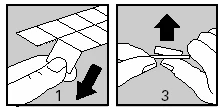
Carefully remove the covering foil, starting from the corner indicated by the arrow (Figures 2 and 3).
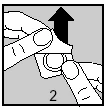
With dry hands, remove the tablet from the strip.
Place the tablet on the tongue, where it will dissolve within a few seconds: water or other liquids are not required.
You may take Decastin regardless of meal times.
Your doctor will determine the duration of treatment.
If you take more Decastin than you should
There is no specific antidote for the active substance ebastine.
If you think you have taken an excessive dose of Decastin, inform your doctor. Depending on the severity of intoxication, your doctor will take appropriate measures if necessary (monitoring of vital functions, including ECG monitoring with assessment of the QT interval for at least 24 hours, symptomatic treatment, and gastric lavage).
If you forget to take Decastin
Do not take a double dose to make up for a forgotten dose.
Consult your doctor or pharmacist if you have any doubts about the use of this medicine.
4. Possible Side Effects
Like all medicines, this one may cause side effects, although not everyone experiences them.
Stop taking Decastin and contact your doctor immediately, or go to the nearest hospital
if you experience any of the following conditions:
Itching, hives, and swelling of the face, tongue, or throat, which may cause breathing or swallowing difficulties. These may be signs of hypersensitivity to Decastin, such as anaphylaxis and angioedema, which are rare side effects (may affect up to 1 in 1,000 people).
Other possible side effects are:
Very common side effects – may affect more than 1 in 10 people
Headache
Common side effects – may affect up to 1 in 10 people
Insomnia
Dry mouth
Uncommon side effects – may affect up to 1 in 100 people
Nosebleed
Sore throat (pharyngitis)
Runny nose (rhinitis)
Rare side effects – may affect up to 1 in 1,000 people
Nervousness
Insomnia
Drowsiness
Dizziness
Reduced sense of touch
Taste disturbances
Palpitations (rapid or irregular heartbeat)
Tachycardia
Abdominal pain
Vomiting
Nausea
Indigestion
Hepatitis (liver inflammation)
Cholestasis (impaired bile flow)
Abnormal liver function tests
Skin rash, urticaria, widespread skin eruption
Menstrual disorders
Edema (fluid accumulation in tissues)
Weakness (asthenia)
Very rare side effects – may affect less than 1 in 10,000 people
Altered sense of touch
Eczema, skin inflammation
Painful menstruation
Frequency not known: Frequency cannot be estimated from the available data
Weight gain
Increased appetite
Reporting of side effects
If you experience any side effect, including those not listed in this leaflet, consult your doctor. You may also report side effects directly via the national reporting system at the following website:
https://www.aifa.gov.it/content/segnalazioni-reazioni-avverse
By reporting side effects, you can help provide more information on the safety of this medicine.
5. How to store DECASTIN
Keep this medicine out of the sight and reach of children.
Do not use this medicine after the expiry date stated on the blister and the carton after "Exp". The expiry date refers to the last day of the month.
Store in the original packaging to protect from light.
Do not dispose of medicines via wastewater or household waste. Ask your pharmacist how to dispose of medicines you no longer use. This will help protect the environment.
6. Package contents and other information
What Decastin contains
The active substance is ebastine. Each 10 mg orodispersible tablet contains 10 mg of
ebastine. Each 20 mg orodispersible tablet contains 20 mg of ebastine.
The other ingredients are: microcrystalline cellulose, lactose monohydrate, maize starch, sodium
croscarmellose, aspartame (E951), peppermint flavour, anhydrous colloidal silica and magnesium
stearate.
Description of the appearance of DECASTIN and pack contents
Orodispersible tablet
Decastin 10 mg: white, biconvex, round tablets with a diameter of approximately 7 mm, imprinted with "E10" on one side, smooth on the other.
Decastin 20 mg: white, biconvex, round tablets with a diameter of approximately 9 mm, imprinted with "E20" on one side, smooth on the other.
Available pack sizes:
10 mg: 20 orodispersible tablets
20 mg: 20 orodispersible tablets
Not all pack sizes may be marketed.
Marketing Authorisation Holder and Manufacturer
Laboratorio Chimico Deca Dr. Capuani S.r.l.
Via Giotto 1, 30172 Venezia
Italy
Manufacturer
Teva Pharmaceutical Works Private Limited Company (Teva, HU)
Pallagi út 13.
Debrecen H-4042, Hungary
Similar drugs
| Brand name | Dosage form | Active substance / Dosage | Manufacturer |
|---|---|---|---|
| EBARIC | tablets, orodispersible | ARISTO PHARMA GMBH | |
| EBASTINE AUROBINDO | tablets, orodispersible | AUROBINDO PHARMA (ITALIA) S.R.L. | |
| EBASTINE DOC GENERICI | tablets, orodispersible | DOC GENERICI SRL | |
| EBASTINE MYLAN PHARMA | tablets, orodispersible | MYLAN S.P.A. | |
| EBASTINE SANDOZ | tablets, orodispersible | SANDOZ S.P.A. | |
| EBASTINE TEVA | tablets, orodispersible | TEVA ITALIA S.R.L. |
The original data is available in the language of the country of manufacture.
Data source: Italian Medicines Agency (AIFA)
Data last verified: September 21, 2026