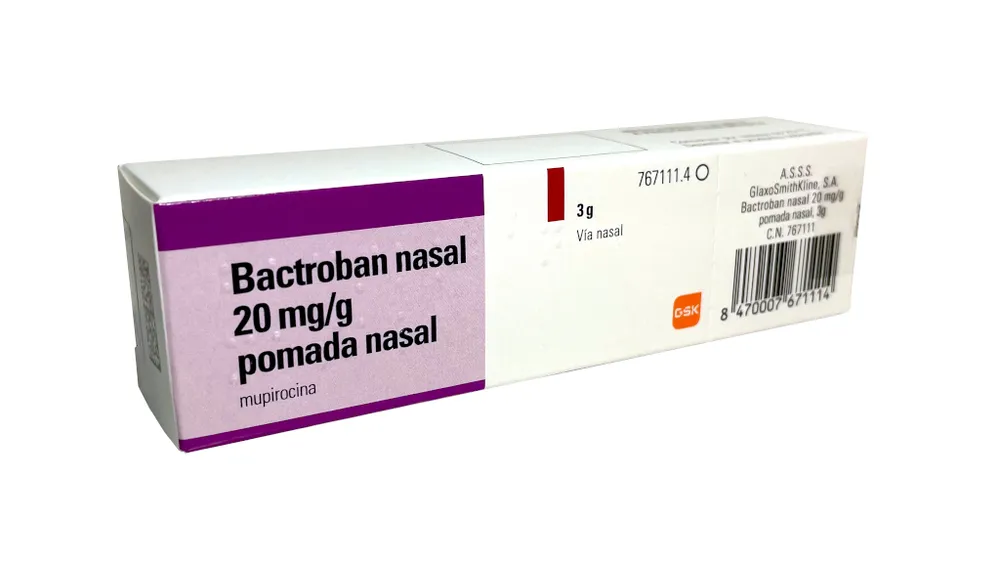
BACTROBAN NASALE
ItalyIt is an antibiotic ointment used to eliminate a group of bacteria present in the nose called Staphylococcus aureus, including methicillin-resistant strains.
Frequently asked questions
How should Bactroban Nasale be applied?
The ointment should be applied in the nose twice daily for 5 days. You must wash and dry your hands, take a small amount (approximately the size of a match head) with your pinky finger or a cotton swab, and apply it to the front of each nostril, then press the sides of the nose to distribute it.
When should you not use this medicine?
It must not be used if you are allergic to mupirocin, mupirocin calcium salt, or any of the other ingredients. It is also not indicated for use in the eyes.
What are the side effects of Bactroban Nasale?
Symptoms such as itching, redness, burning, tingling, or pain in the nose may occur. In very rare cases, serious allergic reactions may occur, such as skin rashes, hives, swelling of the skin and mucous membranes, itching, or pain. In rare instances, the use of antibiotics can cause intestinal inflammation with diarrhea (often with blood and mucus), stomach pain, and fever.
What should I do in case of a serious allergic reaction?
If facial swelling, difficulty breathing, or other serious skin reactions occur, you must wash off the ointment with plenty of water, stop using it, and inform a doctor immediately.
What should I do if I forget a dose?
If you forget to apply it, do so as soon as possible. However, if the next dose is due within one hour, skip the forgotten dose and never apply a double dose to make up for it.
Can I use the product if I am pregnant or breastfeeding?
In these cases, it is necessary to seek advice from a doctor or pharmacist; use during pregnancy should only occur if strictly necessary and under close medical supervision.
Instructions for use
Package leaflet: Information for the user
Bactroban Nasal 20 mg/g Ointment
Mupirocin
Please read all of this leaflet carefully before you start using this medicine because it contains important information for you.
- Keep this leaflet. You may need to read it again.
- If you have any questions, ask your doctor or pharmacist.
- This medicine has been prescribed for you only. Do not give it to other people, even if their symptoms are the same as yours, as it may be harmful.
- If you experience any side effects, including those not listed in this leaflet, tell your doctor or pharmacist. See section 4.
Contents of this leaflet:
- What Bactroban Nasal is and what it is used for
- What you need to know before using Bactroban Nasal
- How to use Bactroban Nasal
- Possible side effects
- How to store Bactroban Nasal
- Contents of the pack and other information
1. What Bactroban Nasal is and what it is used for
Bactroban Nasal 20 mg/g ointment (referred to as 'Bactroban Nasal' in this leaflet)
contains a medicine called mupirocin. Bactroban Nasal is an antibiotic ointment.
It is used to:
- eliminate a group of bacteria from the nose, called Staphylococcus aureus,
- this group includes methicillin-resistant Staphylococcus aureus (MRSA) strains.
2. What you need to know before using Bactroban Nasal
Do not use Bactroban Nasal:
- if you are allergic to calcium mupirocin, mupirocin or any of the other ingredients of this medicine (listed in section 6).
If you are unsure whether this applies to you, do not use this medicine. Talk to your doctor or pharmacist before using Bactroban Nasal.
Warnings and precautions
Talk to your doctor or pharmacist before using Bactroban Nasal
- Bactroban Nasal may cause serious skin reactions or allergies. See 'Conditions to be aware of' in section 4. In such cases, your doctor will advise you to stop treatment and switch to an alternative therapy for infections.
- Bactroban Nasal is not intended for ophthalmic use.
- Rarely, antibiotic medicines such as Bactroban may cause inflammation of the colon (large intestine), leading to diarrhoea, usually with blood and mucus, stomach pain, and fever (pseudomembranous colitis). If you experience prolonged diarrhoea or develop abdominal cramps, contact your doctor immediately.
If Bactroban Nasal is used for prolonged periods, fungal infections (e.g. candidiasis) may develop. If this occurs, inform your doctor or pharmacist. Prolonged use may also lead to the emergence of resistant bacterial strains.
Keep the ointment away from the eyes.
If the ointment accidentally comes into contact with the eyes, rinse thoroughly with water.
Other medicines and Bactroban Nasal
Inform your doctor or pharmacist if you are taking, have recently taken, or might take any other medicines.
Pregnancy and breastfeeding
If you are pregnant, suspect you may be pregnant, planning a pregnancy, or are breastfeeding, consult your doctor or pharmacist before using this medicine.
Use Bactroban Nasal during pregnancy only if strictly necessary and under close medical supervision.
Driving and using machines
Bactroban Nasal does not affect the ability to drive or operate machinery.
3. How to use Bactroban Nasal
Use this medicine exactly as instructed by your doctor or pharmacist. If you have any doubts, consult your doctor or pharmacist.
Bactroban Nasal is applied inside the nose twice daily for 5 days.
- Wash and dry your hands thoroughly.
- Apply a small amount of Bactroban Nasal, approximately the size of a match head, onto the little finger.
- Apply it inside one nostril to the front part.
- Repeat steps 2 and 3 for the other nostril.
- Press the sides of the nose together to spread the ointment around the inside of the nostrils.
- Close the tube with the cap and wash your hands.
A cotton swab may be used instead of the little finger to apply the ointment, especially in children or seriously ill patients.
Do not mix Bactroban Nasal with other cream or ointment medicines for external use on the infected skin area, as this may reduce the effectiveness of the product.
How long to use Bactroban Nasal?
Use Bactroban for the length of time prescribed by your doctor. If you are unsure, consult your doctor or pharmacist.
Normally, bacteria are eliminated from the nose within 3–5 days after starting treatment.
Treatment must not last longer than 10 days.
If after one week of treatment you notice no improvement, or if the infection worsens, inform your doctor.
Dispose of any remaining product after treatment is completed.
If you swallow Bactroban Nasal
If you accidentally swallow the ointment, seek advice from your doctor or pharmacist, or go to the nearest hospital. Take the medicine tube with you.
If you forget to use Bactroban Nasal
- If you forget to apply Bactroban Nasal, apply it as soon as you remember.
- If the next dose is due within one hour, skip the missed dose.
- Do not use a double amount to make up for the missed dose.
If you stop using Bactroban Nasal
If you stop using Bactroban Nasal too early, not all bacteria may have been eliminated and they may continue to grow. Consult your doctor or pharmacist if you decide to stop using the ointment.
If you have any questions about how to use this product, consult your doctor or pharmacist.
4. Possible side effects
Like all medicines, this medicine can cause side effects, although not everybody gets them.
Conditions to watch for
Severe skin reactions or allergies
if you develop a severe skin reaction or an allergy, and particularly if you experience
swelling of the face and breathing difficulties:
- wash the ointment off thoroughly with plenty of water,
- stop using it, and
- contact your doctor as soon as possible.
The following side effects may occur with this medicine:
Uncommon (may affect up to 1 in 100 people)
- Itching, redness (erythema), burning, tingling or stinging pain in the nose.
Very rare (may affect up to 1 in 10,000 people)
- Some people may develop a skin reaction or a severe allergic reaction. Symptoms may include rash, hives, swelling of the skin and mucous membranes (angioedema), itching, redness or pain.
Reporting of side effects
If you experience any side effect, including those not listed in this leaflet, talk to your doctor, pharmacist or nurse. You can also report side effects directly via the national reporting system at www.agenziafarmaco.gov.it/it/responsabili. By reporting side effects, you can help provide more information on the safety of this medicine.
5. How to store Bactroban Nasal
- Keep out of the sight and reach of children.
- Do not store above 25°C.
- Do not use Bactroban Nasal after the expiry date stated on the tube. The expiry date refers to the last day of that month.
- Do not use Bactroban Nasal if it appears different from normal (see "Description of the appearance of Bactroban Nasal and contents of the pack").
- Do not dispose of medicines via wastewater or household waste. Ask your pharmacist how to dispose of medicines you no longer use. This will help protect the environment.
6. PACKAGING CONTENTS AND OTHER INFORMATION
What Bactroban Nasal contains
- The active substance is mupirocin. 1 g of nasal ointment contains 20 mg of mupirocin.
- The other ingredients are vaseline and glycerol esters.
Description of the appearance of Bactroban Nasal and contents of the pack
- Bactroban Nasal is a white, homogeneous ointment.
- Bactroban Nasal is available in a 3 g tube. Each tube is contained in a carton.
Marketing Authorisation Holder and Manufacturer
Marketing Authorisation Holder
GlaxoSmithKline S.p.A. Via Alessandro Fleming, 2 - Verona
Manufacturer
Glaxo Operations UK Ltd - Harmire Road – Barnard Castle – United Kingdom
Other sources of information
More detailed information on this medicinal product is available on the AIFA website
The original data is available in the language of the country of manufacture.
Data source: Italian Medicines Agency (AIFA)
Data last verified: September 21, 2026