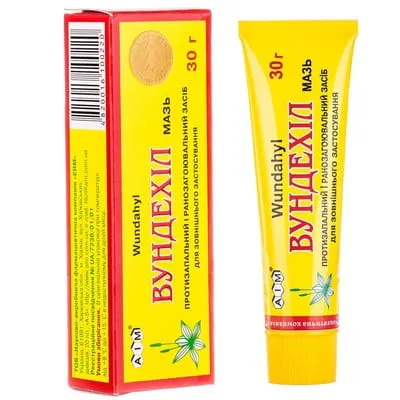
WUNDEHIL
UkraineThe ointment is used to treat wounds of various origins (inflamed, infected, postoperative), burns, bedsores, ulcers, hematomas, as well as for psoriasis, neurodermatitis, nipple cracks during breastfeeding, and gynecological erosions.
Frequently asked questions
How should Wundehil be used correctly?
The ointment should be applied in a thin layer 2–3 times daily. 2–3 hours after application, any remaining ointment should be removed with a cotton swab or wipe soaked in an antiseptic (e.g., furacilin). Once the wound has dried (approximately after one hour), the ointment can be applied again. In case of burns, the ointment should be applied as soon as possible (within 10–15 minutes after the injury).
When should this drug not be used?
The ointment should not be used if you have hypersensitivity to any of its components, an allergy to bee products, or to plants of the Asteraceae family. Additionally, the product should not be applied to a wound in its initial stage when it is actively weeping (exudation).
What are the possible side effects of Wundehil?
The drug is generally well-tolerated, but due to its composition, an allergic reaction may occur: rash, itching, skin peeling, or swelling or redness of the skin on the face, torso, or limbs.
Can the ointment be used during pregnancy or breastfeeding?
During these periods, the drug may only be used as prescribed by a physician.
Does the ointment interact with other medicines?
At present, there is no information regarding interactions between the ointment and other medicinal products.
Can the drug be given to children?
Yes, the drug is used in pediatric practice.
Instructions for use
INSTRUCTIONS FOR MEDICINAL USE OF THE MEDICINAL PRODUCT VUNDEHIL
Composition:
Active substances: 1 g of ointment contains propolis tincture (Tinctura Propolisi) (1 : 10) (extractant — 80% ethanol) 50 mg, carophyllene (Carophylenum) 30 mg, Sophorae japonicae tincture (Tinctura Sophorae japonicae) (1 : 2) (extractant — 48% ethanol) 30 mg, Potentillae tincture (Tinctura Potentillae) (1 : 5) (extractant — 70% ethanol) 20 mg, Millefolii tincture (Tinctura Millefolii) (1 : 5) (extractant — 70% ethanol) 20 mg;
Excipients: refined sunflower oil, lard (animal fat), anhydrous lanolin, beeswax.
Pharmaceutical form. Ointment.
Main physicochemical properties: yellow-brown ointment with a mild specific odor.
Pharmacotherapeutic group. Agents for the treatment of wounds and ulcerative lesions. ATC code D03AX.
Pharmacological properties.
Pharmacodynamics.
The combination of biologically active substances in WUNDEHIL ointment provides highly effective anti-inflammatory, bactericidal, and healing effects on affected tissues and mucous membranes, rapidly relieves pain and swelling, intensively removes necrotic (purulent) formations, promotes normalization of metabolic processes, and accelerates tissue regeneration (healing).
In addition to its wound-healing and anti-inflammatory effects, WUNDEHIL ointment possesses antimicrobial (bacteriostatic) properties, thereby preventing wound infection by hospital-acquired infectious strains.
In almost all cases of application, WUNDEHIL ointment promotes wound healing with formation of delicate scar tissue.
Due to the lipophilic base of the ointment, it prevents adherence of the dressing to the injured tissue sites.
Clinical characteristics.
Indications. Wounds of various origins, such as slowly healing wounds (inflamed and infected, postoperative, including after rectal surgery), skin lesions caused by radiation, traumatic soft tissue injuries, ulcers (varicose and diabetic), hemorrhages into soft tissues (hematomas), thermal burns, pressure ulcers, gynecological erosions, psoriasis, neurodermatitis, keratodermias of palms and soles, hyperkeratotic forms of mycosis. Cracked nipples during breastfeeding.
Contraindications. Hypersensitivity to any component of the drug, to plants of the Asteraceae family, as well as allergy to beekeeping products.
Interaction with other medicinal products and other types of interactions. Interaction of WUNDEHIL ointment with other medicinal products is currently unknown.
Special precautions for use.
Since the ointment has a lipophilic base, it should not be used in the initial stage of the wound process when active exudation is present.
Use during pregnancy or breastfeeding. During pregnancy or breastfeeding, the medication should be used only as prescribed by a physician.
Ability to affect reaction rate when driving vehicles or operating machinery. Has no effect.
Administration and Dosage
It is recommended to apply the ointment thinly to the affected area 2–3 times daily. 2–3 hours after each application, residual ointment should be removed using a cotton swab or wipe moistened with an antiseptic solution (e.g., furacilin solution or tincture of Chelidonium majus diluted with water 1:3). After the wound has dried (approximately 1 hour), reapply the ointment.
For wounds, apply the ointment at the end of phase I, after exudation (weeping) has ceased, and during phases II and III of the wound healing process. For wounds caused by mechanical tissue injury, therapeutic effect is typically observed within 2–7 days of treatment.
For the treatment of chronic anal fissures and hemorrhoids, insert a tampon impregnated with ointment into the rectal lumen daily for 2–3 hours. The duration of treatment depends on the severity and form of the disease (from 5 days to 1 month).
For cervical erosion, apply the ointment thickly onto a cotton or gauze tampon and insert deeply into the vagina for 2–3 hours daily. The treatment course lasts from 1 to 4 weeks.
For thermal burns of degree I and II, to prevent the development of severe complications and to achieve faster healing, the ointment should be applied as soon as possible to the affected skin (within 10–15 minutes after injury). The duration of treatment depends on the degree and extent of the burn, and, above all, on the time elapsed between the burn and the first application of the ointment, and ranges from 3 to 15 days.
For sunburn, apply the ointment in a thin layer for 2–3 hours, then remove any residue with a wipe. WUNDEHEIL rapidly relieves pain and skin redness.
The duration of treatment depends on the nature of the pathological process, the size of the affected areas, and the therapeutic response achieved.
Children. The drug may be used in pediatric practice.
Overdose. Not reported.
Side effects.
The drug is generally well tolerated by patients. However, due to its multi-component composition, allergic reactions may occur in individual cases, usually associated with individual hypersensitivity to the components of the drug or with violation of the recommended regimen of use. Such reactions may include skin rashes, itching, epidermal peeling, and/or swelling and/or hyperemia of the skin of the face, trunk, and extremities. If any adverse reactions occur, medical advice must be sought.
Shelf life. 2 years.
The medicinal product should not be used after the expiry date stated on the packaging.
Storage conditions. In the original packaging, at a temperature from +2 °C to +8 °C, in a place inaccessible to children.
Packaging. 15 g or 30 g in tubes.
Availability. Over-the-counter.
Manufacturer. LLC "Scientific and Production Pharmaceutical Company "EYM".
Manufacturer's address and place of business. Ukraine, 61091, Kharkiv region, Kharkiv, st. Kharkivskikh Diviziy, 20, building "A-5".
Similar drugs
| Brand name | Dosage form | Active substance / Dosage | Manufacturer |
|---|---|---|---|
| ACERBIN | ointment | Pharmazeutische Fabrik Montavit GmbH | |
| ALTANOVA OINTMENT | ointment |
|
PJSC "Scientific and Production Center "Borshchahivskyy Chemical and Pharmaceutical Plant" |
| CALENDULA OINTMENT | ointment |
|
DKP "Pharmaceutical Factory" LLC |
| CALENDULA OINTMENT | ointment |
|
JSC "Lubnipharm" |
| CALENDULA OINTMENT | ointment |
|
PJSC Pharmaceutical Factory "Viola" |
| CALENDULA OINTMENT | ointment |
|
PJSC "Fitofarm" (responsible for manufacturing, primary packaging, quality control and batch release) |
| CALENDULA OINTMENT | ointment |
|
Ternofarm LLC |
| DALMAXIN | ointment |
|
PJSC "HIMFARMZAVOD "CHERVONA ZIRKA" |
| LEVOMEKOL | ointment |
|
PJSC Pharmaceutical Factory "Viola" |
| LEVOMEKOL | ointment |
|
Farmak JSC |
| LEVOMEKOL | ointment |
|
JSC "Lubnipharm" |
| LEVOMEKOL | ointment |
|
PJSC "Scientific and Production Center "Borshchahivskyy Chemical and Pharmaceutical Plant" |
The original data is available in the language of the country of manufacture.
Data source: State Register of Medicinal Products of Ukraine
Data last verified: August 13, 2026