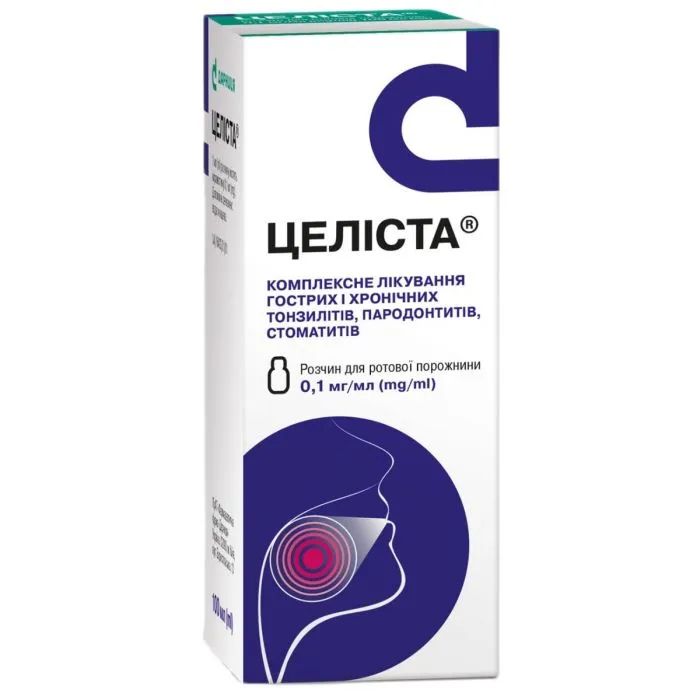
CELESTA
UkraineThe drug is used for the complex treatment and prevention of tonsillitis, pharyngitis, laryngitis, as well as for the treatment of stomatitis, gingivitis, periodontitis, and oral mucosal candidiasis. It is also used for the hygienic treatment of removable dentures and the prevention of infections following oral surgery.
Frequently asked questions
How should Celesta be taken correctly?
Adults and children from 3 years of age should use the solution locally (rinse the mouth or throat) 3–4 times a day. The dosage depends on age and purpose: for children aged 3–6 years — 3–5 ml per rinse, for children aged 7–14 years — 5–7 ml, for adults and adolescents aged 14 years and older — 10–15 ml. The duration of treatment is usually from 4 to 10 days.
What are the possible side effects of Celesta?
Hypersensitivity reactions (allergy) are possible. In some cases, a brief burning sensation may occur, which subsides on its own within 15–20 seconds and does not require discontinuation of the drug.
Who should not use this drug?
The drug should not be used in children under 3 years of age, nor in individuals with hypersensitivity to miramistin.
Can the drug be used during pregnancy or breastfeeding?
Yes, use is permitted, as the medicinal product is almost not absorbed into the body.
Does the drug affect the ability to drive a vehicle?
No, the drug does not affect reaction speed or concentration of attention.
How does the drug interact with antibiotics?
When used simultaneously with antibiotics, a decrease in the resistance of microorganisms to antibiotics is observed.
Instructions for use
INSTRUCTIONS FOR MEDICAL USE OF THE MEDICINAL PRODUCT CELISTA® (CELISTA)
Composition:
Active ingredient: miramistin;
1 ml of solution contains miramistin 0.1 mg;
Excipients: purified water.
Pharmaceutical form. Oral solution.
Main physicochemical properties: colorless or slightly yellowish clear liquid, which foams when shaken.
Pharmacotherapeutic group. Antiseptics and disinfectants. ATC code D08A J.
Pharmacological Properties.
Pharmacodynamics.
The action of miramistin is based on the direct hydrophobic interaction of its molecules with lipids in microbial cell membranes, leading to their fragmentation and destruction. Part of the miramistin molecule penetrates into the hydrophobic region of the membrane, disrupting the supramembrane layer, loosening the membrane structure, increasing its permeability for high-molecular-weight substances, and altering the enzymatic activity of microbial cells by inhibiting enzyme systems. This results in suppression of microbial viability and subsequent cytolysis.
Unlike other antiseptics, miramistin exhibits high selectivity against microorganisms, as it exerts almost no effect on human cell membranes. This selectivity is attributed to the different structure of human cell membranes, which have significantly longer lipid radicals that greatly limit the possibility of hydrophobic interaction with miramistin.
Miramistin demonstrates pronounced antimicrobial activity against Gram-positive (including Staphylococcus spp., Streptococcus spp., Streptococcus pneumoniae, etc.) and Gram-negative (including Pseudomonas aeruginosa, Escherichia coli, Klebsiella spp., etc.) bacteria, as well as aerobic and anaerobic, spore-forming and non-spore-forming bacteria, both as monocultures and microbial associations, including hospital strains. It also exhibits antiviral activity against herpes viruses and human immunodeficiency virus (HIV), among others.
Miramistin has antifungal activity against ascomycetes of the genus Aspergillus and Penicillium, yeasts (Rhodotorula rubra, Torulopsis gabrata), yeast-like fungi (Candida albicans, Candida tropicalis, Candida krusei), dermatophytes (Trichophyton rubrum, Trichophyton mentagrophytes, Trichophyton verrucosum, Trichophyton schoenleini, Trichophyton violaceum, Epidermophyton Kaufman-Wolf, Epidermophyton floccosum, Microsporum gypseum, Microsporum canis), and other pathogenic fungi such as Pityrosporum orbiculare (Malassezia furfur), both as monocultures and microbial associations, including fungal microflora resistant to chemotherapeutic agents. Under the influence of miramistin, microbial resistance to antibiotics is reduced. Miramistin has no allergenic properties and does not cause local irritation.
Pharmacokinetics.
When applied topically, miramistin is not absorbed through the skin or mucous membranes.
Clinical characteristics.
Indications.
- Complex treatment of acute and chronic tonsillitis, pharyngitis, and laryngitis;
- Treatment and prevention of infectious and inflammatory diseases of the oral cavity: stomatitis, gingivitis, periodontitis. Hygienic care of removable dentures;
- Prevention of microbial complications following surgical interventions on the oral mucosa;
- Treatment and prevention of candidiasis of the oral mucosa.
Contraindications.
Individual hypersensitivity to miramistin.
Children under 3 years of age.
Interaction with other medicinal products and other forms of interaction.
When antibiotics are used concomitantly with miramistin, a reduction in microbial resistance to antibiotics is observed.
Special precautions for use.
Use during pregnancy or breastfeeding.
Since absorption of the medicinal product is almost nonexistent, Celistar® may be used during pregnancy or breastfeeding.
Ability to affect reaction speed when driving or operating machinery.
The medicinal product Celistar® does not affect the ability to drive or operate vehicles and machinery, or engage in other potentially hazardous activities requiring increased attention and speed of psychomotor reactions.
Method of Administration and Dosage
Apply locally to adults and children aged 3 years and older.
To measure the required amount of the medicinal solution, use the measuring cup provided. The duration of therapy ranges from 4 to 10 days, depending on the clinical response and the time required to achieve remission.
For the treatment of tonsillitis, laryngitis, pharyngitis:
Children aged 3–6 years: rinse the throat with Celist**®** solution 3–4 times daily. The amount of medicinal agent per rinse is 3–5 mL.
Children aged 7–14 years: rinse the throat with Celist**®** solution 3–4 times daily. The amount of medicinal agent per rinse is 5–7 mL.
Adults and children aged 14 years and older: the amount of medicinal agent per rinse is 10–15 mL, 3–4 times daily.
For the treatment of stomatitis, gingivitis, periodontitis: rinse the oral cavity with Celist**®** solution 3–4 times daily. The amount of medicinal agent per rinse is 10–15 mL.
If rinsing is not feasible, the solution may be applied locally as compresses under a gauze dressing or as medicated swabs (tampons) soaked in the solution and placed in the oral cavity.
For the treatment of periodontitis, miramidin solution is introduced into periodontal pockets via pledgets, followed by 15-minute applications to the gums. During exacerbations, irrigate periodontal pockets with Celist**®** using a syringe and insert medicated pledgets into the abscess cavity. After vestibuloplasty, and
|
For frenulectomy, the medicinal product should be used in the form of rinses in outpatient settings.
For hygiene cleaning of removable dentures, leave the dentures overnight in a miramistin solution. Before use, thoroughly rinse the dentures with running water.
For prevention of microbial complications after surgical procedures, gauze swabs moistened with the medicinal product are applied and fixed on the wound surface.
In case of oral mucosal candidiasis, apply the medicinal product onto a sterile gauze swab and place it in the oral cavity three times daily.
Children.
Use in children aged 3 years and older.
Overdose.
Symptoms of overdose have not been observed.
Adverse reactions.
Immune system disorders: hypersensitivity reactions.
Other: in individual cases, a transient burning sensation may occur, which resolves spontaneously within 15–20 seconds and does not require discontinuation of the medicinal product.
Reporting of suspected adverse reactions.
Reporting of suspected adverse reactions after authorization of the medicinal product is an important procedure. It allows continuous monitoring of the benefit-risk balance of the medicinal product. Healthcare professionals are required to report any suspected adverse reactions through the national reporting system.
Shelf life. 3 years.
Storage conditions.
Store in the original packaging at a temperature not exceeding 25 °C. Do not freeze. Keep out of reach and sight of children.
Packaging.
100 ml in a bottle; 1 bottle with a measuring cup in a carton.
Availability. Over-the-counter.
Manufacturer. JSC "Pharmaceutical Company "Darnytsia".
Manufacturer's address and location of operations.
13, Borispilska Street, Kyiv, 02093, Ukraine.
The original data is available in the language of the country of manufacture.
Data source: State Register of Medicinal Products of Ukraine
Data last verified: August 13, 2026