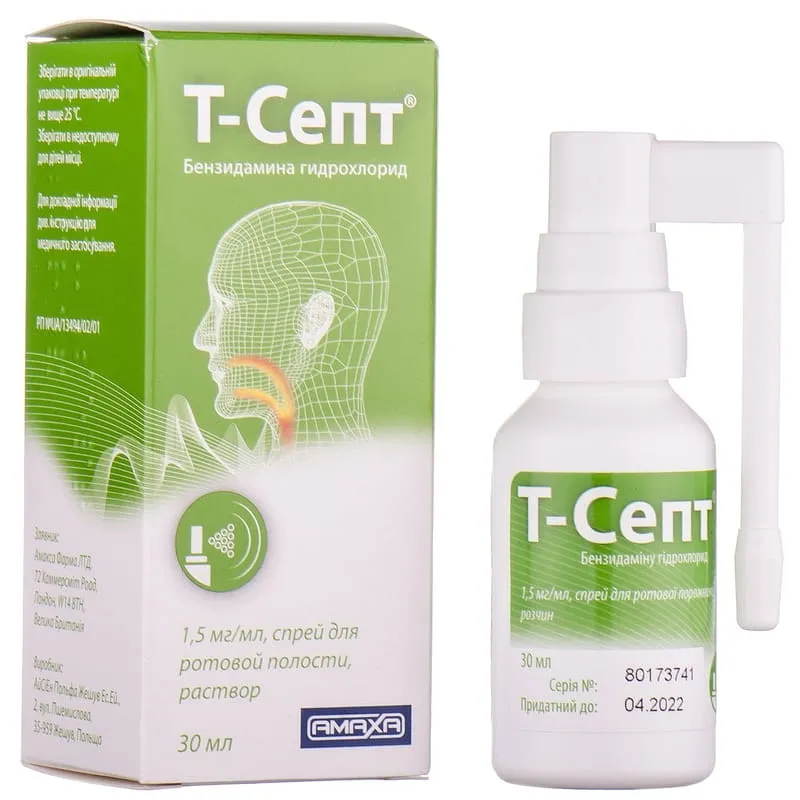
T-SEPT®
UkraineThe drug is used to relieve symptoms of oropharyngeal inflammation and irritation, as well as to treat pain in gingivitis, stomatitis, and pharyngitis. In dentistry, it is applied after tooth extraction or for preventive purposes.
Frequently asked questions
How should T-sept® be taken correctly?
Adults should take 4–8 sprays 2–6 times daily. Children aged 6 to 12 years — 4 sprays 2–6 times daily. Children aged 4 to 6 years — 1 spray for every 4 kg of body weight, but no more than 4 sprays at one time (and up to 6 times daily).
Who should not use this drug?
It must not be used in case of hypersensitivity to the active substance or other components. It is also not recommended for people with hypersensitivity to acetylsalicylic acid or other non-steroidal anti-inflammatory drugs (NSAIDs). It should not be used during pregnancy and breastfeeding.
What are the possible side effects of T-sept®?
The following reactions are possible: taste alteration, dryness or burning in the mouth, nausea, vomiting, tongue swelling, headache, dizziness, rash, itching, or allergic reactions. In very rare cases, bronchospasm or edema may occur.
Can the drug be used in asthma?
Patients with bronchial asthma or those suffering from it should be cautious, as the use of the drug may cause bronchospasm.
What should be done if symptoms do not disappear?
If symptoms worsen, do not subside within 3 days, or if you develop a fever, it is necessary to consult a physician (general practitioner or dentist).
Does the drug affect the ability to drive a vehicle?
When used at the recommended doses, the drug does not affect the ability to drive motor vehicles or operate other mechanisms.
Instructions for use
INSTRUCTIONS for medical use of the medicinal product T-Sept® (T-Sept®)
Composition:
Active substance: benzidamine hydrochloride;
1 ml of solution contains 1.5 mg of benzidamine hydrochloride;
Excipients: methyl 4-hydroxybenzoate (E 218), sodium cyclamate, sodium bicarbonate, glycerol, polysorbate 80, 96% ethanol, peppermint flavor, concentrated phosphoric acid, purified water.
Pharmaceutical form. Oral spray, solution.
Main physicochemical characteristics: clear, colorless solution with a characteristic odor.
Pharmacotherapeutic group. Agents for use in dentistry. Other agents for local use in the oral cavity.
ATC code A01AD02.
Pharmacological Properties
Pharmacodynamics
Benzidamine is a non-steroidal anti-inflammatory drug (NSAID) with analgesic and anti-exudative properties.
Clinical studies have demonstrated that benzidamine is effective in relieving symptoms associated with localized inflammatory conditions of the oral cavity and pharynx. In addition, benzidamine exerts anti-inflammatory and local analgesic effects, producing a local anesthetic action on the mucous membrane of the oral cavity.
Pharmacokinetics
Absorption through the mucous membranes of the oral cavity and pharynx has been confirmed by the presence of measurable amounts of benzidamine in human plasma. However, this is insufficient to produce any systemic pharmacological effect.
Excretion occurs mainly via urine, primarily in the form of inactive metabolites or conjugated compounds.
With local application, an effective concentration of benzidamine accumulates in inflamed tissues due to its ability to penetrate through the mucous membrane.
Clinical characteristics.
Indications.
Symptomatic treatment of irritation and inflammation of the oropharynx; pain associated with gingivitis, stomatitis, pharyngitis; in dentistry, following tooth extraction or for prophylactic purposes.
Contraindications.
Hypersensitivity to the active substance or to other components of the medicinal product.
Interaction with other medicinal products and other forms of interaction.
Interaction studies have not been conducted.
Special precautions for use
Avoid contact with eyes.
In some patients, ulcers of the buccal or pharyngeal mucosa may be caused by serious underlying pathological conditions. Therefore, patients whose symptoms worsen or do not improve within 3 days, or who develop fever or other new symptoms, should seek medical advice from a physician or, where appropriate, a dentist.
The use of this medicinal product may cause allergic reactions. If such symptoms occur, administration should be discontinued and medical advice should be sought regarding appropriate therapy.
Benzidamine is not recommended for patients with hypersensitivity to acetylsalicylic acid or other NSAIDs.
The use of this product may cause bronchospasm in patients with bronchial asthma or a history of bronchial asthma. Such patients must be warned accordingly.
T-Septyl® contains methyl parahydroxybenzoate (E 218), which may cause allergic reactions (including delayed-type reactions) and, rarely, bronchospasm.
This medicinal product contains 81.40 mg of ethanol per 1 ml, which corresponds to 13.84 mg per 0.17 ml (one spray actuation). The amount of ethanol in one spray actuation (0.17 ml) of this medicinal product is equivalent to less than 0.4 ml of beer or 0.2 ml of wine. The small amount of alcohol in this product is unlikely to have a noticeable effect on the patient.
The product contains less than 1 mmol of sodium (23 mg) per spray actuation (0.17 ml), i.e., it is practically sodium-free.
For athletes: The use of medicinal products containing ethanol may result in a positive doping test, depending on the thresholds established by certain sports federations.
Use during pregnancy or breastfeeding
There are currently insufficient data available on the use of benzidamine in pregnant or breastfeeding women. The ability of this product to pass into breast milk has not been studied. Animal studies are insufficient to allow conclusions regarding the effects of this product during pregnancy or breastfeeding. The potential risk to humans is unknown.
The product should not be used during pregnancy or breastfeeding.
Effect on ability to drive or operate machinery
When used at the recommended doses, this medicinal product has no effect on the ability to drive or operate machinery.
Method of Administration and Dosage
Pressing the pump produces an aerosol containing 1 dose of spray – 0.17 mL, corresponding to 0.255 mg of benzidamine hydrochloride.
Before use, the spray device must be properly positioned:
- Position the spray device horizontally relative to the bottle (see Fig. 1);
- If the medicinal product is used for the first time, press the spray device with the index or thumb finger while holding the bottle in an upright vertical position until the medicinal product appears;
- Direct the end of the spray device into the oral cavity and press down on the device (see Fig. 2)
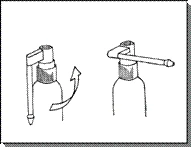
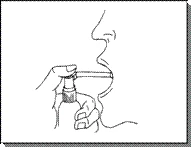
Fig. 1 Fig. 2
Dosage
Adults: 4–8 sprays 2–6 times daily.
Children (6–12 years): 4 sprays 2–6 times daily.
Children (4–6 years): 1 spray per 4 kg of body weight, up to a maximum dose equivalent to 4 sprays 2–6 times daily.
Do not exceed the recommended dosage.
Children
The medicinal product can be used in children aged 4 years and older.
Overdose
Systemic intoxication is possible only in case of accidental ingestion of a large dose of benzidamine (>300 mg).
Symptoms associated with benzidamine overdose are mainly gastrointestinal and central nervous system-related. The most common gastrointestinal symptoms include nausea, vomiting, abdominal pain, and esophagitis. Central nervous system symptoms include dizziness, hallucinations, excitement, nervousness, and irritability.
In acute overdose, only symptomatic treatment is possible. Close monitoring of the patient is required, along with supportive therapy. Adequate hydration should be maintained.
Adverse Reactions.
Within each frequency group, adverse effects are listed in decreasing order of severity.
Adverse reactions are classified according to the frequency of their occurrence: very common (≥ 1/10); common (≥ 1/100 to < 1/10); uncommon (≥ 1/1000 to < 1/100); rare (≥ 1/10000 to < 1/1000); very rare (< 1/10000); frequency not known (cannot be estimated from available data).
Gastrointestinal disorders: rare − burning sensation in the mouth, dry mouth; frequency not known − oral hypoaesthesia, nausea, vomiting, swelling and discoloration of the tongue, taste alterations.
Immune system disorders: frequency not known − anaphylactic reaction, hypersensitivity reaction.
Respiratory, thoracic and mediastinal disorders: very rare − laryngospasm; frequency not known − bronchospasm.
Skin and subcutaneous tissue disorders: uncommon – photosensitivity; very rare − angioneurotic edema; frequency not known − rash, pruritus, urticaria.
Nervous system disorders: frequency not known − dizziness, headache.
T-Septy**®** contains methylparaben, which may cause allergic reactions (including delayed-type reactions).
Shelf life.
3 years.
Storage conditions.
Store in the original packaging at a temperature not exceeding 25 °C.
Keep out of reach of children.
Packaging.
30 ml of spray in a bottle with an atomizing device, 1 in a cardboard box.
Pharmaceutical category.
Over-the-counter (without prescription).
Manufacturer.
ICN Polfa Rzeszow S.A.
ICN Polfa Rzeszów S.A.
Manufacturer's address and place of business.
2 Przemyslowa Street, 35-959 Rzeszow, Poland.
2, ul. Przemyslowa, 35-959 Rzeszów, Poland.
Marketing authorization holder.
Amexa LTD.
Amaxa LTD.
Address of the marketing authorization holder.
31 John Islip Street, London SW1P 4FE, United Kingdom.
31 John Islip Street, London SW1P 4FE, United Kingdom.
Similar drugs
| Brand name | Dosage form | Active substance / Dosage | Manufacturer |
|---|---|---|---|
| FORTESSA | spray, oral solution |
|
Abdi Ibrahim Ilac Sanayi ve Ticaret A.S. |
| TONZIHELP | spray, oral solution |
|
JSC "Stoma" |
The original data is available in the language of the country of manufacture.
Data source: State Register of Medicinal Products of Ukraine
Data last verified: August 13, 2026