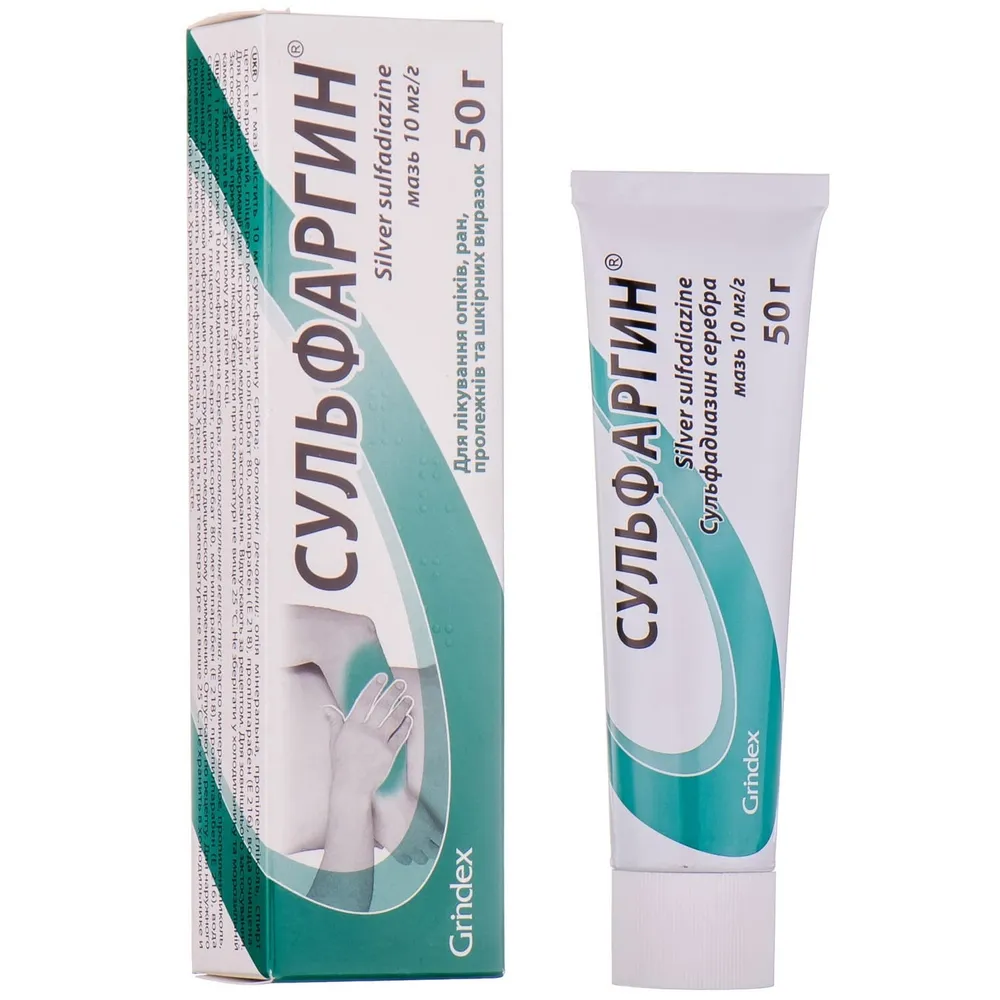
SULFARGIN® MINI
UkraineThe drug is used for short-term treatment (up to 7 days) of mild infections of a burn surface that does not exceed the size of the patient's palm (up to 1% of the body surface).
Frequently asked questions
How should the ointment be applied correctly?
Apply the ointment in a thin layer (2–4 mm) to the affected area 1–2 times daily. It can be applied directly to the wound or onto a sterile dressing, which is then applied to the affected site. Necrotic tissue must be removed before application.
Who should not use Sulfargin® mini?
The drug is contraindicated in individuals with hypersensitivity to silver sulfadiazine or sulfonamides, in cases of congenital glucose-6-phosphate dehydrogenase deficiency, in the presence of deep purulent wounds, as well as for pregnant women, breastfeeding women, and infants under 3 months of age (including premature infants). Use should also be avoided in cases of porphyria.
What are the possible side effects?
Nausea, vomiting, diarrhea, or inflammation of the tongue may occur frequently. Less commonly, allergic reactions, headache, convulsions, liver or kidney damage, and changes in blood composition (reduction in white blood cell or platelet counts) may occur. With prolonged use, the skin may take on a grayish tint (argyria).
Can this drug be combined with other agents?
It is not recommended to use the ointment simultaneously with agents that enzymatically cleanse the wound, as silver sulfadiazine may inactivate them.
What is the maximum dose of the drug?
The maximum allowable dose for a short course of treatment (less than 7 days) is 5 g of ointment (containing 50 mg of silver sulfadiazine).
Instructions for use
INSTRUCTION FOR MEDICAL USE OF THE MEDICINAL PRODUCT SULFARGIN® MINI (SULFARGIN MINI)
Composition:
Active substance: silver sulfadiazine;
1 g of the ointment contains 10 mg of silver sulfadiazine;
Excipients: mineral oil, propylene glycol, cetostearyl alcohol, glycerol monostearate, polysorbate 80, methylparaben (E 218), propylparaben (E 216), purified water.
Pharmaceutical form. Ointment.
Main physicochemical properties: white or almost white ointment with a characteristic odor.
Pharmacotherapeutic group.
Antibacterial and chemotherapeutic agents used in dermatology. Sulfonamides. ATC code D06B A01.
Pharmacological properties.
Pharmacodynamics. Silver sulfadiazine exerts antimicrobial activity against gram-positive and gram-negative microorganisms and fungi (Candida, Phycomycetes, Aspergillus spp., and dermatophytes). The activity of the ointment is based on silver ions, which are released into the wound due to the moderate dissociation of silver sulfadiazine, providing prolonged antimicrobial action that complements the effect of sulfadiazine (a sulfonamide). Silver ions are adsorbed onto the surface of microbial cells and exert a so-called oligodynamic bacteriostatic and bactericidal effect. The ointment does not have necrolytic or mutagenic effects and is characterized by moderate osmotic activity.
Pharmacokinetics. When applied topically, up to 1% of silver ions and up to 10% of sulfadiazine may be absorbed from the total amount of ointment applied to the wound. The majority of absorbed silver is excreted via bile. Absorbed sulfadiazine does not accumulate in the body and is rapidly excreted by the kidneys.
Clinical characteristics.
Indications.
The medicinal product SULFARGIN® MINI is used for short-term treatment (up to 7 days) of mild forms of burn surface infection, with an affected area not exceeding the size of the patient’s palm (i.e., 1% of body surface area).
Contraindications.
- Hypersensitivity to silver sulfadiazine, sulfonamides, or to any excipient contained in the ointment.
- Congenital deficiency of the glucose-6-phosphate dehydrogenase enzyme (when applied to large areas, hemolysis, i.e., destruction of red blood cells, may occur).
- Purulent deep wounds and burn wounds with abundant exudation (not recommended).
- Pregnancy or breastfeeding.
- Use in premature infants and children under 3 months of age.
Interaction with other medicinal products and other forms of interactions.
Silver sulfadiazine may inactivate enzymatic wound debriding agents; therefore, concomitant use of these products is not recommended.
Special precautions for use
Silver sulfadiazine should be used with caution in patients with impaired liver or kidney function.
The drug should be avoided in patients with porphyria.
The cream may cause transient leukopenia and decreased granulocyte count. These changes resolve upon discontinuation of treatment. If treatment with silver sulfadiazine is prolonged or the drug is applied to large burn surfaces, white blood cell counts should be monitored regularly due to the risk of developing leukopenia, thrombocytopenia, or eosinophilia.
As with other topically applied antimicrobial agents, superinfection may occur during use of this medicinal product.
C__SULFARGIN® MINI contains methylparaben (E 218) and propylparaben (E 216), which may cause allergic reactions (including delayed-type reactions) and, in rare cases, bronchospasm.
The cream also contains cetylstearyl alcohol, which may cause local skin reactions (e.g., contact dermatitis), and propylene glycol, which may cause skin irritation.
The packaging of this medicinal product contains latex. It may cause severe allergic reactions.
Due to the risk of kernicterus, silver sulfadiazine should not be used in premature infants or children under 3 months of age.
Use during pregnancy or breastfeeding.
Should not be used during pregnancy or breastfeeding.
Ability to influence reaction rate while driving or operating machinery.
There is no data indicating adverse effects.
Method of Administration and Dosage
The ointment is intended for topical external use.
After removal of necrotic tissue, the ointment is applied in a thin layer (2–4 mm) to the affected area once or twice daily, under a sterile dressing or to an open surface. The ointment may also be applied to a sterile dressing, which is then placed over the affected area.
The maximum recommended dose is 50 mg of silver sulfadiazine (5 g of ointment) for a short-term course of treatment (< 7 days).
The medicinal product must not be used for treating burn areas larger than the patient’s palm (i.e., exceeding 1% of the body surface area).
If a treatment course longer than 7 days is required for burn wound management, medical advice must be sought.
Application of the medicinal product is painless, and the ointment does not stain clothing or bed linen.
Children
The product must not be used in premature infants or children under 3 months of age (see section "Special Warnings and Precautions for Use").
Overdose
Overdose is unlikely when the product is used as directed.
The medicinal product is intended only for short-term use on small surface areas.
With prolonged treatment of large burn areas, plasma concentrations of sulfonamides may reach levels comparable to those achieved during systemic therapy. Therefore, adverse reactions similar to those observed with systemic administration of sulfonamides may occur (see section "Adverse Reactions").
Treatment is symptomatic.
Side effects
Common (less than 1 in 10 patients):
- nausea, vomiting;
- diarrhoea;
- glossitis (inflammation of the tongue).
Rare (less than 1 in 1,000 patients):
- allergic reactions;
- liver damage;
- headache;
- muscle cramps;
- crystalluria (presence of crystals of the active substance in urine);
- kidney damage;
- allergic skin reactions (skin rashes, burning sensation, itching, redness);
- leucopenia (reduced number of white blood cells), thrombocytopenia (reduced number of platelets), and eosinophilia (increased number of eosinophils in blood); to detect any changes as early as possible, blood parameters should be monitored regularly;
- argyria (due to silver accumulation in tissues, the skin may develop a slightly greyish tint. Usually occurs with prolonged treatment or application over large skin areas).
Very rare (less than 1 in 10,000 patients):
- local irritation (transient burning, pain), which disappears within 5–10 minutes.
Not known (frequency cannot be estimated from available data):
- joint pain;
- confusion.
Shelf life. 2 years.
Do not use after the expiry date stated on the packaging.
Storage conditions.
Store at a temperature not exceeding 25 °C. Do not store in a refrigerator or freezer. Keep out of the reach of children.
Packaging.
15 g in an aluminium tube; 1 tube per cardboard box.
Classification.
Over-the-counter (without prescription).
Manufacturer.
JSC Tallinn Pharmaceutical Plant.
Manufacturer's address.
Tondi TN 33, Kristiine district, Tallinn, Harjumaa county, 11316, Estonia.
Marketing Authorisation Holder.
JSC "Grindeks".
Address of the Marketing Authorisation Holder.
53 Krustpils Street, Riga, LV-1057, Latvia.
Tel./fax: +371 67083205 / 371 67083505.
E-mail: [email protected]
Similar drugs
| Brand name | Dosage form | Active substance / Dosage | Manufacturer |
|---|---|---|---|
| SULFARGIN® | ointment |
|
JSC Tallinn Pharmaceutical Plant |
The original data is available in the language of the country of manufacture.
Data source: State Register of Medicinal Products of Ukraine
Data last verified: August 13, 2026