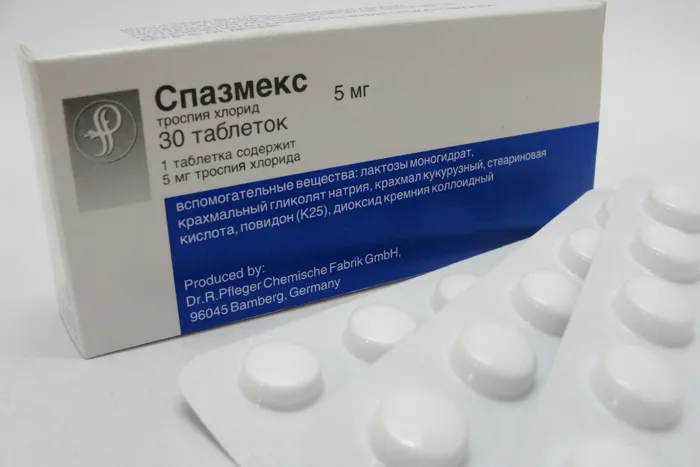
SPASMEX
UkraineThe drug is used for the symptomatic treatment of bladder dysfunction, specifically in cases of urinary incontinence, frequent urges to urinate, and overactive bladder.
Frequently asked questions
How should Spasmex be taken correctly?
Adults are recommended to take the drug orally on an empty stomach, without chewing, and swallowing with a sufficient amount of water. The recommended daily dose is 45 mg (for example, 1 tablet 3 times a day or 2 tablets in the morning and 1 in the evening), however, a doctor may prescribe a lower dose of 30 mg per day.
Who should not take this drug?
Use is contraindicated in cases of urinary retention, glaucoma, tachyarrhythmia, myasthenia, severe inflammatory bowel disease (Crohn's disease, ulcerative colitis), renal failure requiring dialysis, prostatic hyperplasia, urinary tract infections, severe liver disease, as well as during pregnancy, breastfeeding, and in children.
What are the possible side effects of Spasmex?
The most common side effects are dry mouth, dyspepsia, constipation, abdominal pain, and nausea. Tachycardia, headache, dizziness, visual disturbances (blurring), and skin rashes are also possible.
Can I drive a car during treatment?
During the treatment period, it is recommended to refrain from driving motor vehicles and operating machinery that requires high attention, as the drug may cause dizziness and visual disturbances (accommodation disorders).
How does the drug interact with other medicines?
The drug may enhance the effects of other anticholinergic agents (e.g., antidepressants) and beta-adrenomimetics. It may also reduce the effect of prokinetics. Simultaneous administration with products containing guar, cholestyramine, and cholestypol is not recommended, as this reduces the effectiveness of the treatment.
Instructions for use
INSTRUCTION FOR MEDICAL USE OF THE MEDICINAL PRODUCT SPASMEX® (SPASMEXâ)
Composition:
Active substance: trospium chloride;
One film-coated tablet contains 15 mg of trospium chloride;
Excipients: lactose monohydrate, microcrystalline cellulose, maize starch, sodium starch glycolate (type A), colloidal anhydrous silicon dioxide, stearic acid, povidone;
Coating composition: hypromellose, microcrystalline cellulose, titanium dioxide (E 171), stearic acid.
Pharmaceutical form. Film-coated tablets.
Main physico-chemical characteristics: almost white, odorless film-coated tablets, round, biconvex, with a "SNAP-TAB" break line on one side and an imprint "O" on the other side, approximately 9 mm in diameter. The tablet can be divided into two equal parts.
Pharmacotherapeutic group. Agents used in urology. Urinary tract spasmolytics. Trospium.
ATC code G04BD09.
Pharmacological Properties
Pharmacodynamics
Trospium chloride is a quaternary ammonium compound, a derivative of nor-tropanol, and belongs to the group of parasympatholytics or anticholinergics. Depending on the concentration, the drug competes with the endogenous neurotransmitter acetylcholine at the postsynaptic level. It is a competitive antagonist of acetylcholine at postsynaptic membrane receptors of smooth muscle, showing high affinity for M1- and M3-receptors, lower affinity for M2-receptors, and minimal binding to nicotinic receptors. As an M-cholinolytic, it acts on peripheral M-cholinergic receptors. Its mechanism of action involves competitive inhibition of acetylcholine at postsynaptic membrane receptors of smooth muscle in the gastrointestinal tract and urogenital system. The drug reduces smooth muscle tone of the urinary tract and relaxes the detrusor muscle of the urinary bladder, due to both its anticholinergic effect and direct antispasmodic action.
It exhibits ganglion-blocking activity. It inhibits secretion of salivary and sweat glands and causes paralysis of accommodation. Effects on the central nervous system have not been observed.
Trospium chloride produces a dose-dependent increase in heart rate.
Pharmacokinetics
After oral administration, maximum plasma concentration is reached within 4–6 hours. The elimination half-life ranges from 5 to 18 hours. The drug does not accumulate in the body and is 50–80% bound to plasma proteins.
Concomitant food intake, especially a high-fat diet, reduces the bioavailability of trospium chloride. After a high-fat meal, the mean maximum plasma concentration (Cmax) and AUC are reduced by 15–20% compared to fasting conditions.
When single doses in the range of 20–60 mg are administered, plasma concentration increases proportionally with the administered dose. The drug is excreted primarily by the kidneys, mostly in unchanged form, with a smaller portion (approximately 10%) eliminated as cyclic alcohols, formed via ester hydrolysis. The terminal elimination half-life is 10–20 hours. No drug accumulation occurs. Plasma protein binding ranges from 50–80%.
Trospium chloride does not cross the blood-brain barrier (thus does not cause adverse effects on the central nervous system).
There are no pharmacokinetic differences observed between patients of different ages or genders.
Hepatic metabolism plays a limited role in the elimination of trospium chloride.
Clinical characteristics.
Indications.
Symptomatic treatment of bladder dysfunction, including urinary incontinence and/or increased frequency of urination, as well as acute urges to urinate in patients with overactive bladder (idiopathic or neurogenic detrusor overactivity).
Contraindications.
- Hypersensitivity to any component of the drug;
- urinary retention;
- closed-angle glaucoma;
- tachyarrhythmia;
- myasthenia gravis;
- severe chronic inflammatory bowel diseases (ulcerative colitis and Crohn's disease);
- toxic megacolon;
- renal insufficiency requiring dialysis (creatinine clearance < 10 ml/min/1.73 m²);
- benign prostatic hyperplasia;
- urinary tract infections;
- severe liver function disorders;
- pregnancy and breastfeeding period;
- childhood.
Interaction with other medicinal products and other forms of interaction.
When used concomitantly, enhances the anticholinergic effect of amantadine, tricyclic antidepressants, quinidine, histamine H1-receptor blockers, and disopyramide.
When taken together with beta-adrenergic agonists, increases heart rate.
When used concomitantly with prokinetic agents (metoclopramide and cisapride), reduces the effect of prokinetics.
Since trospium chloride may affect gastrointestinal motility and secretion, the possibility of impaired absorption of other concurrently administered drugs cannot be excluded.
When used concomitantly with medicinal products containing guar, cholestyramine, and colestipol, the absorption of trospium chloride is reduced; therefore, simultaneous use of these drugs is not recommended.
Trospium chloride does not affect the activity of the cytochrome P450 enzyme system; therefore, it can be taken together with drugs metabolized by this system.
Trospium chloride has no effect on the pharmacokinetics of digoxin.
Special precautions for use.
Before starting therapy, organic causes of increased frequency of urination, imperative urges to urinate, and urinary incontinence should be excluded, such as heart disease, kidney dysfunction, polydipsia, or infections or tumors of the urinary tract.
The drug contains lactose monohydrate as an excipient; therefore, the drug must not be administered to patients with rare hereditary forms of galactose intolerance, lactase deficiency, or glucose-galactose malabsorption syndrome.
Patients with diabetes mellitus should take into account that 1 tablet corresponds to 0.14 g of carbohydrates (equivalent to 0.0115 carbohydrate units).
The drug should be used with caution in patients with:
- Gastrointestinal tract obstruction (e.g., pyloric stenosis);
- Obstructive disorders of urinary outflow with risk of residual urine;
- Autonomic (autonomic) neuropathy;
- Hiatal hernia associated with reflux esophagitis.
Use with particular caution in patients with ischemic heart disease and congestive heart failure, as well as in patients with tachycardia associated with hyperthyroidism.
Use with caution in patients with mild to moderate hepatic or renal impairment.
When prescribing the drug to patients with impaired detrusor function of the urinary bladder, ensure complete bladder emptying (including by catheterization if necessary).
Use during pregnancy or breastfeeding.
Pregnancy.
The safety of use during pregnancy has not been established, and therefore data regarding the drug's effects on the course of pregnancy and/or embryonal development, fetal development, labor, and postnatal development are insufficient. For this reason, Spasmex® should not be used during pregnancy.
Breastfeeding period.
The drug is not recommended for use during breastfeeding.
Ability to affect reaction speed when driving or operating machinery.
During treatment, it is recommended to refrain from driving vehicles and engaging in potentially hazardous activities requiring high concentration and rapid psychomotor reactions, due to the risk of accommodation disorders and dizziness.
Dosage and Administration.
For use in adults. Take orally on an empty stomach (before meals), without chewing, with sufficient amount of water.
The dosage regimen and duration of treatment are determined individually by a physician for each patient depending on the clinical picture and severity of the disease. The need for continued treatment is determined based on the results of regular patient monitoring performed at intervals of 3–6 months.
The recommended daily dose is 45 mg of trospium chloride. This dose may be reduced by a physician to 30 mg.
| Daily dose |
Dosing schedule |
Corresponds to a single dose |
| 45 mg (recommended daily dose) |
1 tablet 3 times daily or 2 tablets in the morning and 1 tablet in the evening |
15 mg trospium chloride 30 mg trospium chloride 15 mg trospium chloride |
| 30 mg |
2 times daily, 1 tablet with coating |
15 mg trospium chloride |
Patients with renal impairment
For patients with moderate or severe renal dysfunction (creatinine clearance of 10 to 50 mL/min/1.73 m²), the initial dose should be adjusted according to the severity of renal impairment.
The recommended daily dose is 1 × 15 mg or 2–3 × 7.5 mg (corresponding to 2–3 × ½ tablet). The individual dose should be determined based on individual efficacy and tolerability.
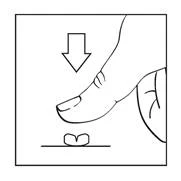
To reduce the daily dose by half, 15 mg coated tablets can be split into equal 7.5 mg doses as shown in the image below.
To do this, place the tablet on a hard surface and press firmly with the thumb along the break line (suddenly and with force).
**
**
The drug should be administered during meals in patients with severe renal impairment.
Patients with hepatic impairment
Dose adjustment is not required in patients with mild or moderate hepatic impairment.
The drug should not be used in patients with severe hepatic impairment.
Children.
The efficacy and safety of the drug in children have not been studied; therefore, the drug should not be prescribed to this age group.
Overdose.
Dry mouth, tachycardia, and urinary retention were observed in healthy volunteers after administration of a single maximum dose of 360 mg of trospium chloride. To date, no cases of severe overdose or intoxication in patients have been reported. The expected signs of intoxication are an intensification of anticholinergic effects.
In case of intoxication, the following measures should be taken:
- gastric lavage and reduction of absorption (e.g., activated charcoal);
- local application of pilocarpine in patients with glaucoma;
- catheterization in patients with urinary retention;
- treatment with parasympathomimetics (e.g., neostigmine) in case of severe symptoms;
- use of β-blockers in case of insufficient response, pronounced tachycardia, and/or circulatory instability (e.g., 1 mg intravenous propranolol with continuous monitoring of cardiac status by ECG and arterial pressure).
Adverse Reactions
Adverse reactions associated with the use of trospium chloride are systematized by organ system classes and frequency of occurrence: very common (≥ 1/10), common (≥ 1/100, < 1/10), uncommon (≥ 1/1000, < 1/100), rare (≥ 1/10,000, < 1/1000), very rare (< 1/10,000), not known (frequency cannot be estimated).
The most commonly observed adverse reactions are anticholinergic effects: dry mouth, dyspepsia, constipation, abdominal pain, nausea.
Regarding other systems, the following adverse effects may be observed in individual cases:
Urinary system: rare – urinary disturbances (e.g., residual urine, urinary retention);
Cardiovascular system: uncommon – tachycardia, tachyarrhythmia;
Eye disorders: rare – visual disturbances, including accommodation disorders (particularly in hyperopic patients and patients whose vision cannot be properly corrected);
Gastrointestinal system: very common – dry mouth; common – dyspepsia, constipation, abdominal pain, nausea; uncommon – gastritis, diarrhea, flatulence;
Hepatobiliary system: very rare – mild or moderate increase in serum transaminase levels;
Respiratory system: not known – dyspnea;
Skin and subcutaneous tissue: rare – rash; very rare – angioedema; not known – pruritus, urticaria, Stevens-Johnson syndrome (SJS)/toxic epidermal necrolysis (TEN);
Musculoskeletal and connective tissue: rare – myalgia, arthralgia;
Central nervous system: uncommon – headache; rare – dizziness; not known – hallucination*, confusion*, excitation*;
Immune system: not known – anaphylaxis;
General disorders: asthenia, chest pain.
*These adverse effects were mainly observed in elderly patients. Neurological disorders and/or concomitant use of other anticholinergic medicinal products may predispose to the development of these effects.
Shelf life. 5 years.
Storage conditions.
Store in the original packaging, out of the reach of children, at a temperature not exceeding 25 °C.
Packaging.
10 tablets per blister pack, 3 blisters per cardboard box.
Prescription status. Prescription only.
Manufacturer.
Dr. Pfleger Arzneimittel GmbH, Germany.
Manufacturer's name and address.
Dr.-Robert-Pfleger-Str. 12, 96052, Bamberg, Germany.
The original data is available in the language of the country of manufacture.
Data source: State Register of Medicinal Products of Ukraine
Data last verified: August 13, 2026