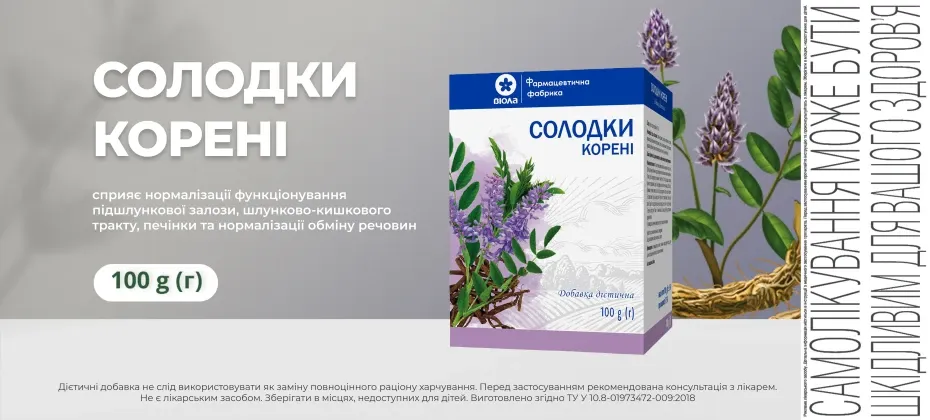
GLYCYRRHIZAE RADIX
UkraineThe preparation is used for respiratory tract diseases (bronchitis, pneumonia, bronchial asthma, bronchiectatic disease), inflammations of the kidneys and bladder (pyelitis, pyelonephritis, cystitis), as well as for gastric and duodenal ulcers (as part of complex therapy).
Frequently asked questions
How to correctly prepare and take Glycyrrhizae radix?
If using the roots: pour 200 ml of hot water over 1 tablespoon, infuse in a water bath for 30 min, cool, strain, and top up with water to a volume of 200 ml. If using filter bags: pour 200 ml of boiling water over 3 bags and infuse for 15-20 min. Take in warm form 30 min before meals. Dosage depends on age: adults and children over 14 years — 1-2 tbsp (or 1/3 cup) 3-4 times a day; children 12-14 years — 1 tbsp (or 2 tbsp) 2-3 times a day; children 5-12 years — 1 dessert/tablespoon 3-4 times a day; children 3-5 years — 1 dessert/tablespoon 2-3 times a day; children 1-3 years — 1 teaspoon/dessert spoon 2-3 times a day.
Who should not take this preparation?
Contraindications include hypersensitivity to the components, heart damage (myocarditis, pericarditis, myocardial infarction), high blood pressure, impaired liver or kidney function, low potassium levels (hypokalemia), and severe obesity. The preparation is also contraindicated for pregnant and breastfeeding women.
What side effects may Glycyrrhizae radix cause?
Possible side effects include increased blood pressure, decreased potassium levels in the body, as well as allergic reactions such as rash, itching, skin redness, or edema.
Can the preparation be taken with other medicines?
Simultaneous administration with cardiac glycosides, antiarrhythmic drugs (e.g., quinidine), diuretics (thiazide and loop diuretics), adrenocorticosteroids, and laxatives may lead to a decrease in potassium levels in the body.
What happens if an excessive dose is taken or the preparation is used for too long?
Prolonged use (over 2 months) or overdose may disrupt the water-electrolyte balance, which can lead to the development of myopathy and myoglobinuria, as well as exacerbate side effects.
Instructions for use
I N S T R U C T I O N for medical use of the medicinal product LICORICE ROOTS (GLYCYRRHIZAE RADICES)
Composition:
Active substance: licorice roots (Glycyrrhizae Radices);
1 pack contains: licorice roots (Glycyrrhizae Radices) 50 g or 100 g;
1 filter bag contains: licorice roots (Glycyrrhizae Radices) 1.5 g.
Pharmaceutical form. Roots.
Main physico-chemical properties: fragments of fibrous roots of various shapes, light-yellow, yellow, brownish-yellow in color, with reddish-gray, brown specks.
Pharmacotherapeutic group. Preparations used in cough and colds. ATC code R05C A.
Pharmacological Properties.
Pharmacodynamics.
Biologically active substances of the roots exhibit expectorant and demulcent properties, which soothe cough; they also exert diuretic, anti-inflammatory, spasmolytic, antihistamine, and anti-ulcer effects.
Clinical characteristics.
Indications.
Respiratory tract diseases (bronchitis, pneumonia, bronchial asthma, bronchiectasis), inflammatory diseases of the kidneys and urinary bladder (pyelitis, pyelonephritis, cystitis), peptic ulcer of the stomach and duodenum (as part of complex therapy).
Contraindications.
Hypersensitivity to biologically active components of the drug. Organic heart lesions (myocarditis, pericarditis, myocardial infarction); arterial hypertension; liver and kidney dysfunction; hypokalemia; severe degree of obesity.
Interaction with other medicinal products and other types of interactions. Concurrent use with cardiac glycosides, antiarrhythmic agents (quinidine), thiazide and loop diuretics, adrenocorticosteroids, and laxatives may enhance hypokalemia.
Special precautions.
Prolonged use of the drug is not recommended.
Use during pregnancy or breastfeeding. Contraindicated.
Ability to affect reaction rate when driving or operating machinery. No effect.
Dosage and Administration.
Place 1 tablespoon of the roots into an enameled container, pour 200 ml of hot boiled water, cover with a lid, and let stand on a boiling water bath for 30 minutes. Cool at room temperature for 10 minutes, strain, and squeeze the residue into the strained decoction. Adjust the volume of the decoction to 200 ml with boiled water. Take warm, 30 minutes before meals: for adults and children aged 14 years and older – 1–2 tablespoons 3–4 times daily; for children aged 12–14 years – 1 tablespoon 2–3 times daily; for children aged 5–12 years – 1 dessert spoon 3–4 times daily; for children aged 3–5 years – 1 dessert spoon 2–3 times daily; for children aged 1–3 years – 1 teaspoon 2–3 times daily. Shake the decoction before use.
Place 3 filter bags into a glass or enameled container, pour 200 ml of boiling water, cover, and let steep for 15–20 minutes. Take warm, 30 minutes before meals: for adults and children aged 14 years and older – ⅓ cup 3–4 times daily; for children aged 12–14 years – 2 tablespoons 2–3 times daily; for children aged 5–12 years – 1 tablespoon 3–4 times daily; for children aged 3–5 years – 1 tablespoon 2–3 times daily; for children aged 1–3 years – 1 dessert spoon 2–3 times daily.
Store the prepared aqueous extract at 8–15 °C for no more than 2 days.
The duration of treatment should be determined individually by a physician for each patient.
Children. The use of the drug is recommended for children aged 1 year and older.
Overdose. Overdose or prolonged use (more than 2 months) may cause disturbances in water-electrolyte balance, potentially leading to hypokalemic myopathy and myoglobinuria. Exacerbation of adverse effects is possible.
Side effects.
Increased blood pressure, hypokalemia, allergic reactions (including rash, itching, skin hyperemia, edema formation). If adverse reactions occur, the drug should be discontinued and medical advice should be sought.
Shelf life. 5 years. Do not use after the expiry date stated on the packaging.
Storage conditions. Store in the original packaging at a temperature not exceeding 30 °C, in a place inaccessible to children.
Packaging. 50 g or 100 g in packs with an inner pouch; 1.5 g in tea bags, 20 tea bags per pack or in a pack with an inner pouch.
Availability. Over-the-counter.
Manufacturer/Applicant. JSC "Liktravy", Ukraine.
Address of manufacturer and its business location/address of applicant.
Ukraine, 10001, Zhytomyr region, city of Zhytomyr, Kyivske shose, 21.
The original data is available in the language of the country of manufacture.
Data source: State Register of Medicinal Products of Ukraine
Data last verified: August 13, 2026