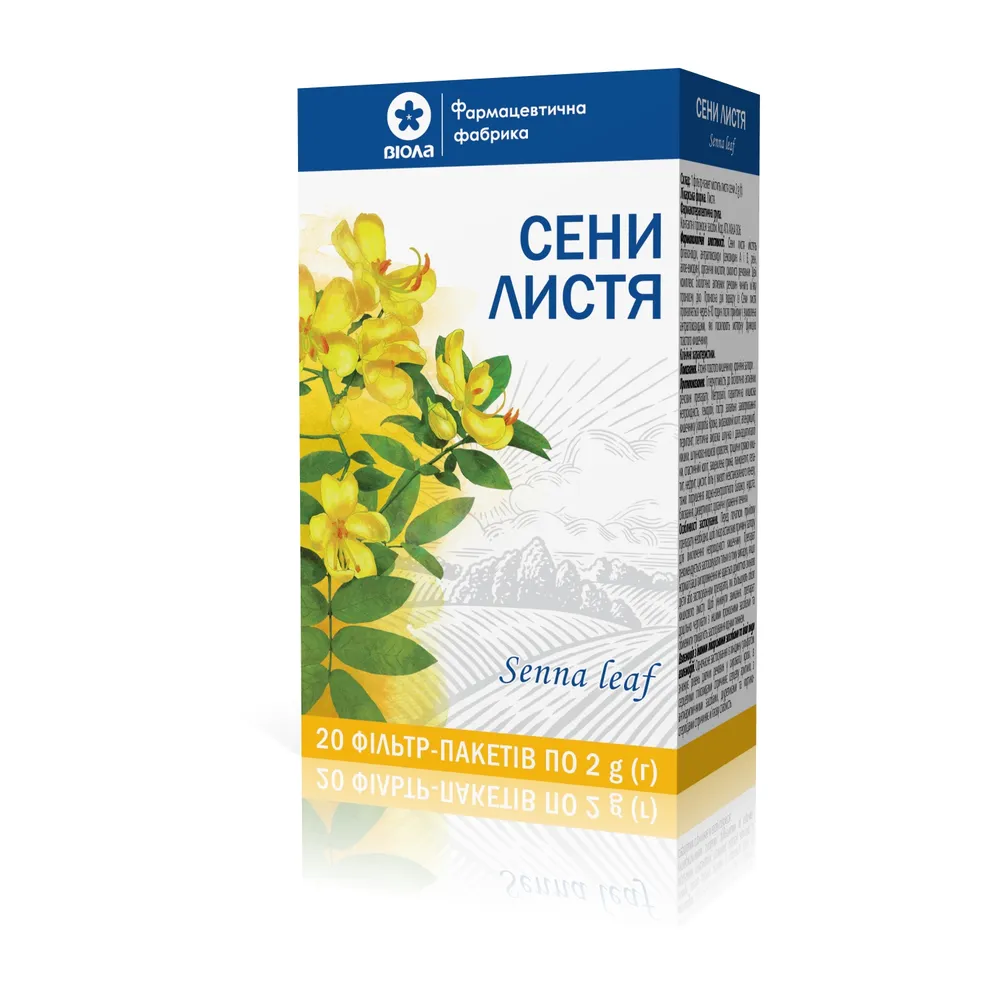
SENE LEAVES
UkraineThe drug is used for chronic constipation and atony of the large intestine.
Frequently asked questions
How should Sene leaves be taken correctly?
If using leaves, a decoction must be prepared (2 tablespoons per 200 ml of water, infuse in a water bath for 30 minutes). For adults, it is recommended to take 1/3–1/2 cup at night or 1 tablespoon 1–3 times a day. If using filter bags, pour 200 ml of boiling water over 2 bags and let them infuse until cooled. Adults should take 1 cup at night or 1/4 cup 1–3 times a day. Shake the decoction before use.
Who should not take this drug?
Contraindications include hypersensitivity to the components, hemorrhoids, acute intestinal inflammation (appendicitis, colitis, Crohn's disease), peritonitis, gastric ulcer, intestinal bleeding, anal fissures, pancreatitis, hepatitis, nephritis, cystitis, incarcerated hernia, severe water-electrolyte imbalance, as well as pregnancy and breastfeeding.
What are the possible side effects of Sene leaves?
Possible allergic reactions (rash, itching), digestive disturbances (colic, flatulence, diarrhea), change in urine color, muscle weakness, convulsions, cardiac disturbances, and water-salt balance disturbances.
Can the drug be combined with other medicines?
When taken simultaneously with quinidine, the level of active substances may decrease. Together with cardiac glycosides, the drug may cause arrhythmia, and together with diuretics, corticosteroids, or antiarrhythmic agents, it may cause muscle weakness.
How often can the remedy be used?
To avoid habituation, the duration of use should be limited to one week, and the drug should be alternated with other laxatives.
What to do in case of overdose?
An overdose may cause diarrhea, intestinal colic, dyspepsia, and water-salt balance disturbances. In such cases, the drug must be discontinued, and treatment should be symptomatic.
Instructions for use
INSTRUCTIONS FOR MEDICAL USE OF THE MEDICINAL PRODUCT SENNA LEAVES
Composition:
Active substance: senna leaves;
1 pack contains 50 g or 100 g of senna leaves (folia sennae); 1 filter bag contains 2 g of senna leaves (folia sennae).
Pharmaceutical form. Leaves.
Main physicochemical properties: fragments of leaves and fruits with admixtures of stem fragments, petioles, and flowers of various shapes. The color of leaves is grayish-green, yellowish-green; fruits are greenish-brown; petioles and flowers are yellow. Odor is weak.
Pharmacotherapeutic group. Contact laxatives. ATC code A06AB06.
Pharmacological properties.
"Senna leaves" contain flavonoids, anthra-glycosides (sennosides A and B, rhein, aloe-emodin), organic acids, and resinous substances. This complex of biologically active substances provides a mild laxative effect. The laxative effect of the decoction of "Senna leaves" manifests 6–10 hours after administration and is due to anthra-glycosides, which enhance the motor function of the large intestine.
Clinical characteristics.
Indications. Colonic atony, chronic constipation.
Contraindications.
Hypersensitivity to the biologically active substances of the medicinal product. Metrorrhagia, paralytic intestinal obstruction, hemorrhoids, acute inflammatory bowel diseases (Crohn's disease, ulcerative colitis, appendicitis), peritonitis, peptic ulcer of the stomach and duodenum, gastrointestinal bleeding, anal fissures, spastic colitis, incarcerated hernia, pancreatitis, hepatitis, nephritis, cystitis, abdominal pain of unknown origin, severe disturbances of water-electrolyte balance, nausea, vomiting, diverticulitis, organic liver lesions.
Interaction with other medicinal products and other types of interactions.
Concomitant use with quinidine sulfate reduces the serum levels of active substances; with cardiac glycosides — causes cardiac arrhythmia; with antiarrhythmic agents, diuretics, and corticosteroids — causes muscle weakness.
Special precautions for use.
Before starting treatment with this medicinal product, a physician must determine the cause of constipation in order to exclude intestinal obstruction. The product should only be used if normalization of bowel movements cannot be achieved by dietary changes or by using agents that increase stool bulk. To avoid habituation, Senna leaves should be alternated with other laxatives, and treatment duration should be limited to one week.
Senna leaves is a traditional herbal medicinal product used according to indications supported by long-standing use. The patient should consult a physician if symptoms persist during treatment or if adverse reactions occur that are not listed in the product's instructions for medical use.
Use during pregnancy or breastfeeding. Contraindicated.
Ability to affect reaction speed when driving or operating machinery. No effect.
Method of Administration and Dosage
Place 2 tablespoons of leaves into an enameled container, pour 200 ml of hot boiled water, cover with a lid, and steep on a boiling water bath for 30 minutes. Allow to stand at room temperature until completely cooled, then strain and squeeze the residue into the obtained decoction. Adjust the decoction volume to 200 ml by adding boiled water.
For adults, take warm, ⅓–½ cup at bedtime or 1 tablespoon 1–3 times daily. For children aged 12–14 years: 1 tablespoon; aged 14–16 years: 2 tablespoons; aged 16–18 years: ¼ cup at bedtime. Before use, the decoction should be shaken.
Place 2 filter packets into a glass or enameled container, pour 200 ml of boiling water, cover, and let steep until completely cooled. For adults, take internally 1 cup at bedtime or ¼ cup 1–3 times daily. For children aged 12–14 years: ¼ cup; aged 14–16 years: ⅓ cup; aged 16–18 years: ½ cup at bedtime.
The prepared aqueous extract should be stored in the refrigerator (at 2–8 °C) for no longer than 2 days.
The duration of treatment is determined individually by a physician for each patient.
Children. The medicinal product should be used in children aged 12 years and older, as recommended by a physician.
Overdose. In case of overdose, intestinal colic, dyspepsia, diarrhea, and electrolyte imbalance may occur, requiring discontinuation of the drug. Symptomatic treatment is recommended.
Prolonged use (up to several years) of high doses of the drug may lead to atrophy of the smooth muscle of the colon and impaired innervation.
Side effects.
Allergic reactions (rash, itching, urticaria, localized or generalized exanthema). Gastrointestinal disturbances, colicky intestinal pain, flatulence, diarrhea, anorexia, changes in urine color, pseudomelanosis of the intestine, water-electrolyte imbalance (hypokalemia, hypocalcemia), albuminuria, hematuria, hyperaldosteronism, cardiac dysfunction, increased fatigue, muscle weakness, cramps.
Shelf life. 3 years.
Storage conditions. Store in the original packaging at a temperature not exceeding 25 °C, in a place inaccessible to children.
Packaging. 50 g or 100 g per package with an inner pouch; 2 g in filter bags, pack of 10 or 20.
Availability category. Over-the-counter.
Manufacturer. JSC Pharmaceutical Factory "Viola".
Manufacturer's location and address of business activity.
4 Skladska Street, Zaporizhzhia, Ukraine, 69050.
Marketing Authorization Holder. JSC Pharmaceutical Factory "Viola".
Address of the Marketing Authorization Holder.
75 Akademika Amosova Street, Zaporizhzhia, Ukraine, 69063.
Similar drugs
| Brand name | Dosage form | Active substance / Dosage | Manufacturer |
|---|---|---|---|
| SENE LEAVES | leaves |
|
JSC "Lubnipharm" |
| SENE LEAVES | leaves |
|
Ternofarm LLC |
The original data is available in the language of the country of manufacture.
Data source: State Register of Medicinal Products of Ukraine
Data last verified: August 13, 2026