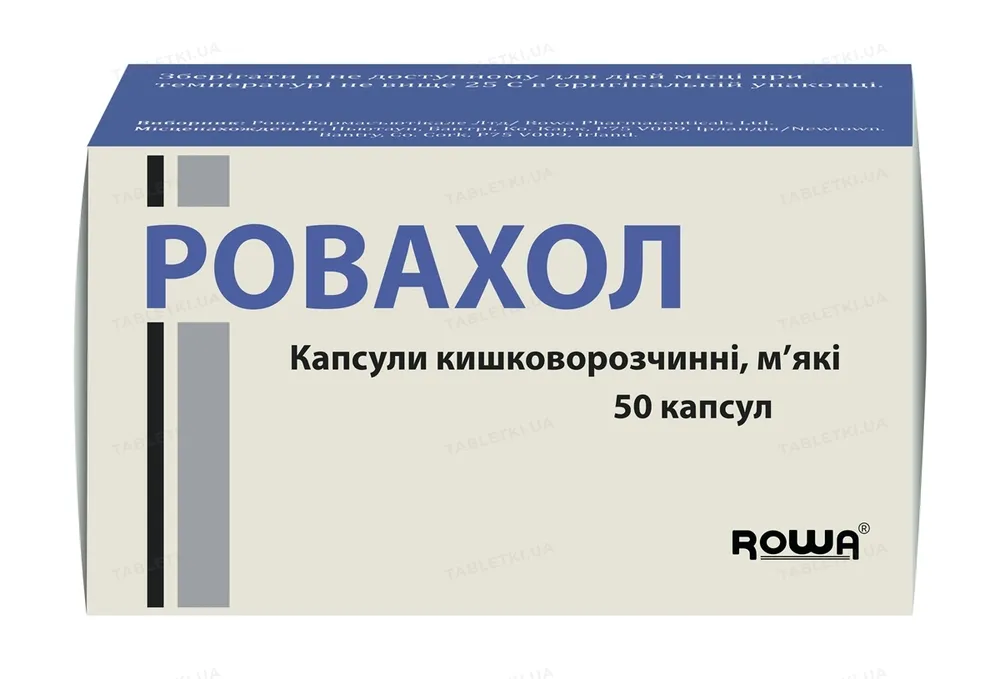
ROVACHOL
UkraineThe drug is used as an adjunct treatment for small stones in the gallbladder (microlithiasis), inflammation of the gallbladder and bile ducts, biliary dyskinesia, and following gallbladder removal.
Frequently asked questions
How should Rovachol be taken correctly?
For adults, it is recommended to take 1 capsule 3–4 times a day before meals (at least 30 minutes before). Capsules should be swallowed whole, without chewing, and taken with at least 100 ml of water.
What are the possible side effects of Rovachol?
A mild minty aftertaste in the mouth and belching are possible. In case of an allergic reaction, a rash or diarrhea may occur. Serious reactions, such as bile duct obstruction by a stone, have also been reported.
Who should not take this medication?
The drug is contraindicated in children under 18 years of age, pregnant women, and breastfeeding women. It should also not be taken in cases of epilepsy, bile duct obstruction, acute inflammation of the gallbladder or bile ducts, or hypersensitivity to the components of the product.
Can the drug be combined with other medicines?
Caution should be exercised if you are taking anticoagulants (e.g., warfarin). Caution is also required when taken concurrently with other medicines that are metabolized or excreted by the liver, especially at high doses.
What to do in case of overdose?
If you have taken too much of the drug, it is necessary to rinse the stomach and consult a doctor. Prolonged intake of large doses may lead to poisoning, manifesting as nausea, dizziness, shortness of breath, convulsions, or changes in mental state.
Instructions for use
I N S T R U C T I O N for medical use of the medicinal product R O W A C H O L (ROWACHOL)
Composition:
Active substances:
1 capsule contains: α-pinene 13.6 mg, β-pinene 3.4 mg, camphene 5.0 mg, cineole 2.0 mg, menthone 6.0 mg, levomenthol 32.0 mg, borneol 5.0 mg;
Excipients: purified olive oil; enteric soft capsule: gelatin, glycerol (85%), sodium ethylparahydroxybenzoate (E 215), sodium propylparahydroxybenzoate (E 217), sodium copper chlorophyllin (100%), water-soluble.
Pharmaceutical form. Enteric soft capsules.
Main physicochemical characteristics: green spherical enteric soft capsules with a minty odour.
Pharmacotherapeutic group.
Agents used in biliary disorders. ATC code A05AX.
Pharmacological properties.
Pharmacodynamics.
Rovachol inhibits the activity of HMG-CoA reductase, a key enzyme in cholesterol synthesis (which is the main component of gallstones), thereby reducing its content in liver cells. Rovachol promotes dissolution and breakdown, as well as elimination of gallstones. The drug increases bile production and relaxes bile ducts, exerting a spasmolytic effect on smooth muscle. This reduces painful spasms of the biliary tract. In addition, the drug facilitates the mild elimination of gallstones together with bile. Rovachol exhibits a broad spectrum of antibacterial and antifungal activity.
Pharmacokinetics.
Individual components of the drug are well absorbed and metabolized in the liver (glucuronidation reaction) and are excreted with bile and urine.
Clinical characteristics.
Indications.
An adjunctive agent in the treatment of the following conditions:
- Biliary microlithiasis, presented by small movable particles;
- Cholecystitis and inflammation of the biliary tract;
- Biliary dyskinesia;
- Post-cholecystectomy syndrome.
Contraindications.
Hypersensitivity to the components of the drug.
Obstruction of the bile ducts. Choledocholithiasis with surgical indications.
Acute inflammation of the gallbladder or bile ducts (empyema of the gallbladder).
Epilepsy.
Children under 18 years of age.
Pregnancy and lactation.
Interaction with other medicinal products and other forms of interaction.
Rovachol should be prescribed with caution to patients taking anticoagulants (e.g., warfarin).
Caution is advised when administering concomitantly with medicinal products that are primarily metabolized in the liver and/or excreted by the liver, especially when used in high doses.
Special precautions for use.
It has been noted that in macrolithiasis, complications related to the liver (biliary colic, jaundice, cholangitis) may occur, particularly in elderly patients. The medicinal product should be used only with a clearly established diagnosis and it is recommended to combine its use with a low-cholesterol diet.
Use during pregnancy or breastfeeding.
Pregnancy.
There is no information available regarding the use of the medicinal product during pregnancy.
Lactation.
Since some components of the drug can cross the placenta, Rovachol should not be used during breastfeeding in order to avoid any undesirable effects on the infant.
The use of the drug during pregnancy or breastfeeding is contraindicated.
Ability to influence reaction speed when driving vehicles or operating machinery.
There is no data available on the effect of the drug on reaction speed when driving vehicles or operating machinery.
Method of Administration and Dosage
The medicinal product should be taken before meals, at least 30 minutes prior. Capsules should be swallowed whole; chewing or crushing the capsules is not recommended. Rovachol should be taken with sufficient amount of water, not less than 100 ml.
Adults
Recommended dose – 1 capsule 3–4 times daily.
Duration of therapy is determined by the physician.
If you miss a dose, take it as soon as you remember. Take the next dose at your regular time (do not take two doses at the same time).
If you accidentally take more than the recommended dose, you must inform your doctor.
Children
Contraindicated in children (under 18 years of age) due to lack of clinical experience and lack of evidence of efficacy in pediatric use.
Overdose
Prolonged use or use in excessive doses may lead to intoxication. Menthol-induced intoxication may manifest as general malaise, dizziness, disorientation, epileptic seizures, nausea, dyspnea, and psychosensory disturbances.
Intoxication caused by essential oils may manifest as depression of the central nervous system, which may lead to stupor, respiratory insufficiency, agitation, and convulsions.
If the medicinal product has been taken in a higher than recommended dose and this occurred recently, gastric lavage should be performed. It is necessary to monitor vital functions and, if needed, apply symptomatic treatment.
Side effects.
A mild taste of mint and belching may occur.
In rare cases, allergic reactions (possibly delayed) may occur in individuals hypersensitive to any component of the drug.
The capsule contains sodium ethylparahydroxybenzoate (E 215) and sodium propylparahydroxybenzoate (E 217), which may cause allergic reactions (possibly delayed).
Hypersensitivity reactions may lead to rash or diarrhea.
A serious adverse reaction such as obstruction of the bile duct by a gallstone has been reported.
Shelf life. 5 years.
Storage conditions. Store in the original packaging, out of reach of children, at a temperature not exceeding 25 °C.
Packaging. 10 capsules in a PVC/PVdC aluminum blister. 5 blisters per cardboard box.
Prescription category. Prescription only.
Manufacturer/Applicant. Rowa Pharmaceuticals Ltd.
Manufacturer's address. Newtown, Bantry, Co. Cork, P75 V009, Ireland.
The original data is available in the language of the country of manufacture.
Data source: State Register of Medicinal Products of Ukraine
Data last verified: August 13, 2026