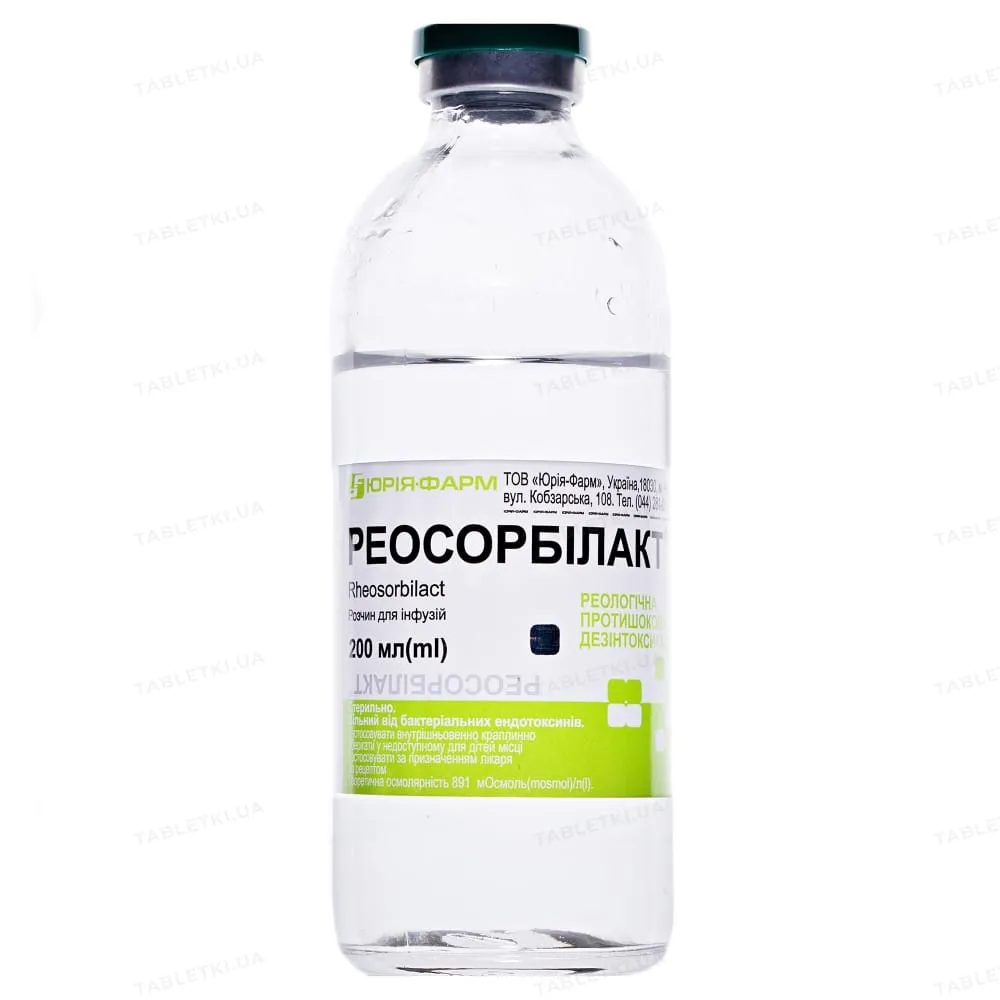
REOSORBILACT®
UkraineThe drug is used to improve blood flow in shock states (traumatic, surgical, burn, etc.), in cases of acute blood loss and burn diseases. It is also used for infections (pneumonia, sepsis, peritonitis), exacerbation of hepatitis, for preoperative preparation, and for the prevention of thrombosis and vascular diseases.
Frequently asked questions
How should Reosorbilact® be administered correctly?
The drug is administered intravenously to adults. This is usually done via drip at a rate of 40–60 drops per minute. In certain cases, rapid (bolus) administration is permitted, but a check of the body's reaction must be performed immediately afterward.
What are the possible side effects of Reosorbilact®?
Possible allergic reactions (edema, rash, itching, fever), changes in arterial blood pressure, palpitations, shortness of breath, headache, dizziness, nausea, or vomiting. Pain or burning at the injection site is also possible.
Who should not use this drug?
It must not be used in cases of increased blood alkalinity (alkalosis), or when large volumes of fluid cannot be administered (for example, in cerebral hemorrhage, heart failure, high blood pressure, or kidney problems). The drug is also contraindicated in individuals with hereditary fructose intolerance.
Can this solution be mixed with other medications?
No, this drug must not be used as a solvent for other medications. It also must not be mixed with solutions containing phosphates or carbonates.
What should be done in case of overdose?
Excessive administration may lead to acid-base imbalance, dehydration, or tachycardia. Symptoms usually subside quickly if the administration of the drug is stopped immediately.
Instructions for use
INSTRUCTIONS FOR MEDICAL USE OF THE MEDICINAL PRODUCT RHEOSORBILACT® (RHEOSORBILACT)
Composition:
Active substances: 1 ml of solution contains sorbitol 60.0 mg, sodium lactate (calculated as 100% substance) 19.0 mg, sodium chloride 6.0 mg, calcium chloride dihydrate (calculated as calcium chloride) 0.1 mg, potassium chloride 0.3 mg, magnesium chloride hexahydrate (calculated as magnesium chloride) 0.2 mg;
Excipient: water for injections.
Pharmaceutical form. Infusion solution.
Main physicochemical properties: clear, colorless liquid; theoretical osmolarity – 891 mOsmol/L; pH 6.00–7.60; ionic composition: 1 L of the preparation contains Na+ – 272.20 mmol, K+ – 4.02 mmol, Ca++ – 0.90 mmol, Mg++ – 2.10 mmol, Cl− – 112.69 mmol, Lac− – 169.55 mmol.
Pharmacotherapeutic group. Solutions affecting electrolyte balance. Electrolytes in combination with other agents. ATC code B05B B04.
Pharmacological properties.
Pharmacodynamics.
Reosorbilact® has rheological, anti-shock, detoxifying, and alkalizing effects and stimulates intestinal peristalsis. The main pharmacologically active substances of the medicinal product are sorbitol and sodium lactate. In the liver, sorbitol is initially converted into fructose, which is then transformed into glucose and subsequently into glycogen. Part of the sorbitol is used for immediate energy needs, while another part is stored as glycogen. An isotonic solution of sorbitol has a deaggregating effect and thus improves microcirculation and tissue perfusion.
In contrast to bicarbonate solution, correction of metabolic acidosis with sodium lactate occurs more slowly, as it gradually enters metabolism, avoiding sharp fluctuations in pH. The effect of sodium lactate becomes apparent 20–30 minutes after administration.
Sodium chloride exerts a rehydration effect and replenishes sodium and chloride ion deficits in various pathological conditions.
Calcium chloride replenishes calcium ion deficiency. Calcium ions are essential for nerve impulse transmission, skeletal and smooth muscle contraction, myocardial activity, bone tissue formation, and blood coagulation. They reduce cellular and vascular wall permeability, prevent inflammatory reactions, and enhance the body's resistance to infections.
Potassium chloride restores water-electrolyte balance. It exerts a negative chronotropic and bathmotropic effect; at high doses, it also has a negative inotropic and dromotropic effect, as well as a moderate diuretic effect. It participates in nerve impulse conduction, increases acetylcholine levels, and stimulates the sympathetic division of the autonomic nervous system. It improves skeletal muscle contraction in muscular dystrophy and myasthenia.
Magnesium is the second most abundant cation in intracellular fluid. Magnesium chloride is an essential cation for metabolism, participating in energy-dependent enzymatic processes, protein molecule synthesis, oxidative phosphorylation, muscle contraction, and nerve impulse transmission. It exhibits antispasmodic properties and promotes cholesterol elimination from the body.
Pharmacokinetics.
Sorbitol is rapidly incorporated into general metabolism. 80–90% is utilized in the liver and stored as glycogen, 5% is deposited in brain tissue, myocardium, and skeletal muscles, and 6–12% is excreted in urine. When administered intravascularly, sodium lactate releases sodium, CO₂, and H₂O, which form sodium bicarbonate, leading to an increase in blood alkaline reserve.
The distribution and elimination of sodium (Na⁺) and chloride (Cl⁻) are largely controlled by the kidneys, which maintain a balance between intake and excretion. Sodium chloride is rapidly eliminated from the vascular bed, only temporarily increasing circulating blood volume. It enhances diuresis.
Plasma calcium concentration is regulated by parathyroid hormone, calcitonin, and vitamin D. Approximately 47% of calcium in plasma exists in the ionized, physiologically active form, about 6% forms complexes with anions such as phosphate or citrate, and the remainder is bound to proteins, primarily albumin. Changes in plasma albumin concentration—either increased (as in dehydration) or decreased (commonly seen in malignant tumors)—affect the proportion of ionized calcium. Thus, total plasma calcium concentration is generally influenced by plasma albumin levels. Excess calcium is primarily excreted by the kidneys. Unabsorbed calcium is eliminated in feces, including via bile and pancreatic secretions. A small amount is excreted in sweat, as well as through skin, hair, and nails. Calcium crosses the placenta and is excreted in breast milk.
Factors affecting potassium distribution between intracellular and extracellular fluids, such as acid-base imbalances, may alter the relationship between plasma concentration and total body stores. Normally, potassium is excreted by the kidneys into urine (it is secreted in the distal tubules in exchange for sodium or hydrogen ions); the remainder is excreted in feces and in small amounts in sweat. The kidneys have a poor ability to retain potassium; even in severe depletion, minimal potassium excretion in urine continues.
50–60% of magnesium is distributed in bones and 1–2% in extracellular fluid. 30% of magnesium is bound to albumin. Magnesium is not metabolized. It is excreted by the kidneys, although the rate of excretion may vary. It crosses the placenta and is excreted in breast milk.
Clinical characteristics.
Indications.
- To improve capillary blood flow for the prevention and treatment of traumatic, surgical, hemolytic, toxic, and burn shock, in acute blood loss, and in burn disease;
- in infectious diseases accompanied by intoxication, including as part of complex treatment in patients with community-acquired pneumonia, purulent peritonitis, sepsis; in exacerbation of chronic hepatitis;
- for preoperative patient preparation and in the postoperative period;
- to improve arterial and venous circulation for the prevention of thrombosis, thrombophlebitis, endarteritis, and Raynaud's disease.
Contraindications.
Individual hypersensitivity to the components of the drug. Reosorbylact® must not be used in alkalosis, as well as in conditions where infusion of large volumes of fluid is contraindicated (intracerebral hemorrhage, thromboembolism, cardiovascular decompensation, grade III arterial hypertension, decompensated heart defects, terminal renal failure), dehydration, oliguria.
Interaction with other medicinal products and other forms of interactions.
Do not use as a solvent-carrier for other medicinal products.
Special precautions for use.
When using the drug, it is necessary to monitor acid-base balance and blood electrolyte levels, liver function, and arterial pressure. Exercise caution when administering to patients with calculous cholecystitis.
The drug contains sorbitol; therefore, it should not be used in patients with rare hereditary fructose intolerance.
Use during pregnancy or breastfeeding.
There are no data regarding contraindications during pregnancy or breastfeeding.
Ability to influence reaction rate while driving or operating machinery.
Since the drug is used under hospital conditions, data on such effects are not available.
Dosage and Administration
Reosorbilact® is administered intravenously by drip infusion to adults at a rate of 40–60 drops per minute. If necessary, rapid intravenous injection of the drug may be performed after preliminary testing via drip infusion at a rate of 30 drops/min. After administering 15 drops, the administration should be paused; if no reaction occurs, Reosorbilact® may then be administered by rapid intravenous injection.
In cases of traumatic, burn, postoperative, and hemolytic shock, adults should receive 600–1000 ml (10–15 ml/kg body weight) as a single dose, followed by repeated doses of 600–1000 ml (10–15 ml/kg body weight), initially by rapid injection and then by drip infusion.
In purulent peritonitis, administer 400–1200 ml intravenously by drip infusion to adults.
In community-acquired pneumonia and exacerbation of chronic hepatitis, administer 400 ml (6–7 ml/kg body weight) by drip infusion to adults.
In acute blood loss, administer 1500–1800 ml (up to 25 ml/kg body weight) to adults. In such cases, Reosorbilact® infusions are recommended to be administered at the pre-hospital stage using a specialized emergency ambulance vehicle.
In the preoperative period and following various surgical procedures – administer 400 ml (6–7 ml/kg body weight) by drip infusion over 3–5 days.
In thromboembolic vascular diseases – administer at a dose of 8–10 ml/kg body weight by drip infusion, repeated every other day, up to 10 infusions per treatment course.
Children
Insufficient data are available regarding use in children.
Overdose
Symptoms of alkalosis may occur, which resolve spontaneously upon immediate discontinuation of the drug. Occasionally, collapse and dehydration (due to enhanced diuresis) may develop. If the infusion rate exceeds recommended levels, tachycardia, increased arterial pressure, dyspnea, headache, chest pain, and abdominal pain may occur. These symptoms resolve rapidly after discontinuation or significant reduction of the infusion rate.
Adverse reactions.
Immune system side effects: anaphylactoid reactions, angioneurotic edema, hyperthermia.
Cardiovascular system side effects: increased or decreased blood pressure, tachycardia, dyspnea, acrocyanosis.
Neurological disorders: tremor, headache, dizziness, general weakness.
Skin and subcutaneous tissue changes: skin rashes, urticaria, pruritus.
Gastrointestinal disorders: nausea, vomiting.
General disorders: changes at the injection site, including pain and burning sensation.
Shelf life. 2 years.
Storage conditions.
Store at a temperature not exceeding 25 °C. Do not freeze. Keep out of reach of children.
Incompatibility.
Reosorbilak® must not be mixed with phosphate- or carbonate-containing solutions.
Packaging.
200 ml or 400 ml in a bottle, 1 bottle per carton; 200 ml or 400 ml in bottles.
Prescription status. Prescription only.
Manufacturer.
LLC "Yuria-Pharm".
Manufacturer's address and location of business activity.
108, Kozbirska St., Cherkasy, Cherkasy region, 18030, Ukraine. Tel.: (044) 281-01-01.
Similar drugs
| Brand name | Dosage form | Active substance / Dosage | Manufacturer |
|---|---|---|---|
| DETOXANT® | solution for infusion |
|
PJSC "Halychpharm" |
| NEOGEMODEX | solution for infusion |
|
LLC Firm Novofarm-Biosyntez |
| NEOHEMODEX | solution for infusion |
|
PJSC "Infuziya" |
| NEUROCYTIN® | solution for infusion |
|
Yuria-Pharm LLC |
| REODAR | solution for infusion |
|
PJSC «Pharmaceutical Company «Darnitsa» |
| ROFITIS® | solution for infusion |
|
JSC "Farmak" (full production cycle) |
| SORBILACT | solution for infusion |
|
Yuria-Pharm LLC |
The original data is available in the language of the country of manufacture.
Data source: State Register of Medicinal Products of Ukraine
Data last verified: August 13, 2026