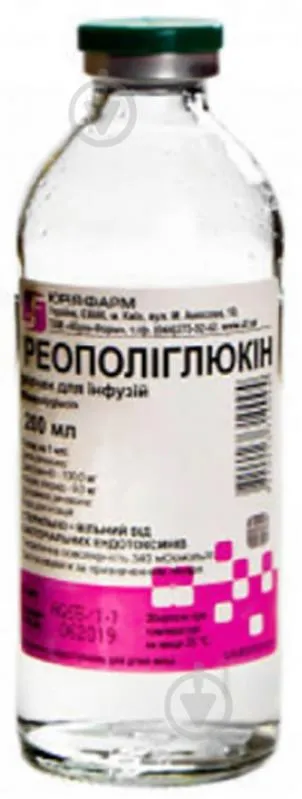
REOPOLYGLUCIN
UkraineThe drug is used for the prevention and treatment of shock states (hypovolemic, distributive), during transplantation and vascular surgeries, as well as an additive to the fluid in cardiopulmonary bypass machines during heart surgeries.
Frequently asked questions
How should Reopolyglucin be taken correctly?
The drug is administered intravenously as a drip, after preheating the solution to 35–37 °C. The dosage and infusion rate are determined by a physician depending on the patient's condition, weight, and the type of surgery or disease. It is important not to mix this solution with other medications.
What side effects can Reopolyglucin cause?
Possible allergic reactions (edema, rash, anaphylactic shock), fluctuations in arterial blood pressure, tachycardia, shortness of breath, edema, nausea, vomiting, headache, dizziness, weakness, as well as changes in kidney function and the blood system.
Who should not use this drug?
Contraindications include fluid overload (hypervolemia), low platelet levels, serious kidney diseases, uncompensated heart failure, disseminated intravascular coagulation syndrome, as well as hypersensitivity to dextran.
Can the drug be taken with other medicines?
If you are taking anticoagulants, their dosage must be reduced. It is also important to know that the drug may affect the accuracy of laboratory tests for blood group, protein, and bilirubin; therefore, it is better to undergo such tests before administering the agent.
Can the drug be used in children?
Yes, the drug can be used in children, but the dosage must be strictly calculated according to their body weight.
Instructions for use
INSTRUCTIONS FOR MEDICAL USE OF THE MEDICINAL PRODUCT REOPOLIGLUKIN (RHEOPOLYGLUCIN)
Composition:
Active substances: dextran 40, sodium chloride;
1 ml of solution contains dextran 40 – 100.0 mg, sodium chloride – 9.0 mg;
Excipient: water for injections.
Pharmaceutical form. Solution for infusion.
Main physico-chemical properties: clear, colorless or slightly yellowish liquid.
Pharmacotherapeutic group. Blood substitutes and perfusion solutions.
ATC code B05A A05.
Pharmacological Properties.
Pharmacodynamics.
Dextran (a glucose polymer) is a colloidal plasma substitute solution whose pharmacological effects are manifested in improving blood rheological properties, reducing blood viscosity, restoring microcirculatory blood flow, preventing and eliminating aggregation of blood cells, and normalizing arterial and venous circulation. When Reopoliglyukin is administered rapidly, blood plasma volume may increase by an amount nearly twice the volume of the administered drug, as every 10 mL of the drug promotes redistribution of 20–25 mL of fluid from tissues into the bloodstream.
Pharmacokinetics.
The half-life is 6 hours. The drug is primarily eliminated by the kidneys: approximately 60% within the first 6 hours and 70% within 24 hours. The remainder enters the reticuloendothelial system and liver, where it is gradually broken down by alpha-glucosidase into glucose; however, it is not a source of carbohydrate nutrition.
Clinical characteristics.
Indications.
Prevention and treatment of hypovolemic and distributive shock.
Vascular and plastic transplant surgeries.
Supplement to perfusion fluid in heart-lung machines during cardiac surgeries.
Contraindications.
Hyperhydration, hypervolemia, thrombocytopenia (platelet count 80**×**10^9/L and below), kidney diseases accompanied by oliguria and anuria, uncompensated cardiovascular insufficiency stage II−III, disseminated intravascular coagulation syndrome, predisposition to severe allergic reactions, hypersensitivity to dextran. Dextran with 0.9% sodium chloride solution should not be administered in case of pathological kidney changes, and with 5% glucose solution – in case of carbohydrate metabolism disorders, especially in diabetes mellitus.
Conditions in which fluid administration in large volumes is contraindicated.
Interaction with other medicinal products and other types of interactions.
When used concomitantly with anticoagulants, their doses should be reduced. The presence of dextran in blood may affect test results for bilirubin, protein, and blood group determination; therefore, these tests should be performed before administration of the drug.
Special precautions.
Use only under medical supervision.
Use with caution when administering to patients with impaired renal excretory function. If restriction of sodium chloride intake is required, administer dextran with 5 % glucose solution. In cases of carbohydrate metabolism disorders and other conditions where carbohydrate administration is contraindicated, dextran should be administered with 0.9 % sodium chloride solution. Administer with caution to patients with hypertension due to the potential for increased arterial pressure, and to patients with impaired cardiac function.
The contents of a vial are intended for use in a single patient only. After the vial seal is broken, any unused portion of its contents must be disposed of according to current regulations.
Use during pregnancy or breastfeeding.
The drug should be used only for life-threatening indications and with consideration of the benefit-risk ratio for the mother and fetus.
Ability to affect reaction rate when driving or operating machinery.
Not studied. However, the possibility of such adverse effects as general weakness and dizziness should be taken into account.
Method of administration and dosage.
Administer intravenously by drip infusion. Warm the solution to 35−37 °C before administration. The dosage and rate of infusion are determined individually.
In capillary blood flow disorders (various forms of shock), the maximum daily dose is 20 ml/kg for adults and 5−10 ml/kg for children (if necessary, up to 15 ml/kg).
During surgeries with extracorporeal circulation, add to blood at a dose of 10−20 ml/kg to fill the oxygenator pump; the dextran concentration in the perfusion solution must not exceed 3 %. In the postoperative period, administer the drug in the same doses as used for capillary blood flow disorders.
The drug should be administered without mixing with other medications. In life-threatening conditions, the drug should be administered rapidly, even by bolus infusion at a rate of 15 ml/kg.
In patients with hemorrhagic stroke or traumatic brain injury, the drug should be administered at a dose of 10−15 ml/kg and no more!
Children.
The drug can be used in children; the dosage is based on body weight.
Overdose.
Hypervolemia and hypocoagulation may occur.
Treatment. Symptomatic therapy.
Adverse reactions.
Allergic reactions. Anaphylactic shock, angioneurotic edema, rash, pruritus, sensation of heat, chills, increased sweating, hypersensitivity reactions.
Cardiovascular system. Fluctuations in blood pressure, tachycardia, dyspnea, edema.
Gastrointestinal tract. Nausea, vomiting, dry mouth, abdominal pain.
Nervous system. Headache, dizziness, tremor.
Urinary system. Usually, especially in hypovolemia, the drug causes an increase in diuresis. However, sometimes when Reopoliglyukin is administered, a decrease in diuresis may occur and urine becomes viscous, indicating patient dehydration. In such cases, intravenous crystalloid solutions must be administered to restore and maintain plasma osmolarity.
When the drug is administered at a dose exceeding 15 mL/kg, hyperosmolarity may develop, which can lead to tubular necrosis and subsequent acute renal failure. Accordingly, a decrease in diuresis and viscous urine may be observed.
Blood system. Acrocyanosis, hyperemia, decreased platelet function. The drug interferes with blood group determination.
Other. General weakness, limb edema, back pain, retrosternal pain, sensation of air hunger, seizures.
In case of adverse reactions (depending on the clinical situation), administration of the drug should be immediately discontinued and, without removing the needle from the vein, all emergency measures indicated in appropriate transfusion reaction guidelines should be initiated (administration of cardiovascular drugs, corticosteroids, antihistamines, crystalloid solutions; vasopressors and cardiotonics in case of collapse).
Shelf life.
4 years.
Storage conditions.
Store at a temperature not exceeding 25 °C, in a place inaccessible to children.
Incompatibility.
Due to possible physical and chemical incompatibility, no other medicinal products should be added to the Reopoliglyukin solution.
Packaging.
Glass bottles of 200 mL or 400 mL.
Prescription status.
Prescription only.
Manufacturer.
LLC "Yuria-Pharm".
Manufacturer's address and location of business activity.
108, Kozbartska St., Cherkasy, Cherkasy region, 18030, Ukraine. Tel.: (044) 281-01-01.
Similar drugs
| Brand name | Dosage form | Active substance / Dosage | Manufacturer |
|---|---|---|---|
| REOPOLYGLUCIN | solution for infusion |
|
PJSC "Infuziya" |
| REOPOLYGLUCIN-NOVOPHARM | solution for infusion |
|
LLC Firm Novofarm-Biosyntez |
The original data is available in the language of the country of manufacture.
Data source: State Register of Medicinal Products of Ukraine
Data last verified: August 13, 2026