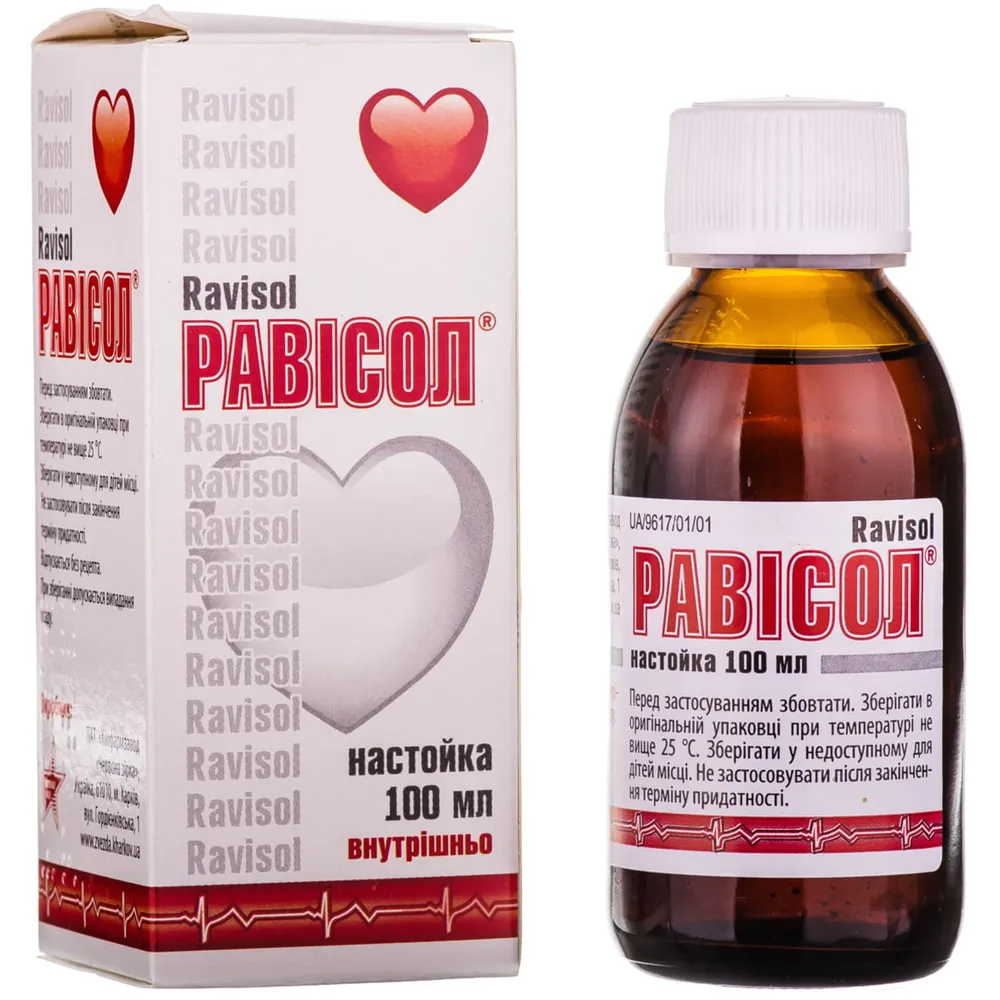
RAVISOL®
UkraineThe drug is used for atherosclerosis, vegetative vascular dystonia, headache, and dizziness. It also helps improve memory, concentration, general well-being, and work capacity in elderly people.
Frequently asked questions
How should Ravisol be taken correctly?
Adults and adolescents aged 16 and older should take 1 teaspoon (5 ml) three times a day, half an hour before meals, diluted with a small amount of water. Shake the bottle before use. The course of treatment is 10 weeks.
Who should not take this drug?
Contraindications include hypersensitivity to the components, severe kidney diseases (nephritis, nephrosis, chronic renal failure), pronounced arterial hypotension, and bradycardia. The drug is prohibited for children under 16, as well as for women during pregnancy and breastfeeding.
What are the possible side effects of Ravisol?
Possible side effects include stomach pain, nausea, vomiting, or diarrhea. Accelerated heartbeat, decreased blood pressure, allergic reactions (rash, itching, skin redness), and lower back pain or discomfort during urination may also be observed.
Can the drug be combined with other medicines?
The effect of the drug is reduced when taking antacids (containing aluminum, calcium, or magnesium) and sulfur-containing solutions. Ravisol enhances the effect of anticoagulants, cardiac glycosides, hypnotics, sedatives, and antihypertensive agents. It is not recommended to take it together with cisapride and alkaloid salts. Combination with aminoglycoside antibiotics and cephalosporins should also be avoided.
Does the drug affect the ability to drive a vehicle?
Since the tincture contains ethanol, it should be taken with caution while driving vehicles or operating machinery.
Instructions for use
INSTRUCTION for medical use of the medicinal product Ravisol® (RAVISOL)
Composition:
Active ingredient: tincture (1:10) from a mixture of herbal raw materials "Ravisol®": mistletoe stems and leaves (visci albi cormi et folia) – 1.5 g; field horsetail herb (equiseti arvensis herba) – 1 g; Japanese sophora fruits (sophora japonica fructus) – 1.5 g; horse chestnut seeds (hippocastani semina) – 1.5 g; hawthorn fruits (crataegi fructus) – 2 g; red clover flowers (trifolii flores) – 1 g; lesser periwinkle herb (vincae minoris herba) – 1.5 g; (extractant ethanol 40%);
Excipients: none, except the extractant.
Pharmaceutical form. Tincture.
Main physico-chemical properties: clear yellowish-brown liquid with a pleasant odor. Formation of sediment may occur during storage.
Pharmacotherapeutic group.
Lipid-lowering agents.
ATC code C10AX.
Pharmacological properties.
Pharmacodynamics.
Ravisol® reduces blood levels of total lipids, cholesterol, triglycerides, and β-lipoproteins. It improves cerebral and coronary blood flow, acts as a mild natriuretic diuretic, reduces the activity of the vasomotor center and peripheral vascular resistance. It has anti-aggregant and hypocoagulative effects, increases the coefficient of useful efficiency of myocardial contractile activity, stabilizes lysosomal membranes and reduces permeability of the plasma-lymphocyte barrier, exerting anti-inflammatory action.
Pharmacokinetics.
Not studied.
Clinical characteristics.
Indications.
Atherosclerosis, vegetative-vascular dystonia (as part of combination therapy).
Headache, dizziness. For improving memory and attention, as well as for enhancing general condition and work capacity in elderly individuals.
Contraindications.
Hypersensitivity to any component of the drug. Nephritis, nephrosis, nephrotic-nephritis. Severe kidney diseases, chronic renal failure. Marked arterial hypotension, bradycardia.
Interaction with other medicinal products and other forms of interaction.
The effect of Ravisol® is reduced when used concomitantly with medicinal products containing aluminum hydroxide and calcium- or magnesium-containing antacids, due to binding of flavonoids and tannins in Ravisol® with heavy metals present in these medicinal products.
The drug effect is reduced by sulfur-containing intravenous solutions (e.g., sodium thiosulfate). The drug enhances the effect of anticoagulants; therefore, if concomitant use with anticoagulants is necessary, the dose of the latter should be reduced (monitoring prothrombin index).
The drug should not be used simultaneously with aminoglycoside antibiotics due to increased nephrotoxic effect of aminoglycosides.
Cephalosporin antibiotics increase the concentration of free escin in blood and the risk of adverse effects.
May potentiate the effect of antiarrhythmic agents. The drug enhances the effects of cardiac glycosides, hypnotics, sedatives, and antihypertensive agents. Concomitant use with alkaloid salts is not recommended due to the possibility of forming unfavorable complexes. The drug should not be used together with cisapride.
Special precautions for use.
The drug should be used diluted. A standard hypocholesterolemic diet should be prescribed prior to initiating treatment and maintained throughout therapy. Prior to and during treatment with the drug, liver function tests should be performed.
Renal function should be monitored during treatment with the drug. Use with caution in patients with allergic disorders.
Use during pregnancy or breastfeeding.
The drug is contraindicated during pregnancy and breastfeeding.
If use of the drug is necessary, breastfeeding should be discontinued for the duration of treatment.
Ability to influence reaction rate when driving or operating machinery.
Due to the ethanol content, the drug should be used with caution when driving vehicles or operating potentially hazardous machinery.
Dosage and Administration.
For adults and children aged 16 years and older, the medication should be taken orally. Take 1 teaspoon (5 ml) three times daily, half an hour before meals, with a small amount of water. The medication must be shaken before use. The treatment course lasts 10 weeks.
Children.
The medication is contraindicated in children under 16 years of age.
Overdose.
Symptoms: possible manifestations of pro-oxidant properties (acceleration of redox processes, including lipid peroxidation, increased lipid metabolism, and enzyme transformations), leading to disturbances in the structure and function of cellular membranes and organ functions, primarily affecting the liver, heart, and kidneys. In case of exceeding the recommended doses, the following may occur: increased incidence of adverse effects, nephrotoxic reactions, arterial hypotension, thrombosis, and possible onset of somnolence and bradycardia. In such cases, the medication should be discontinued and symptomatic therapy initiated.
Adverse reactions.
Gastrointestinal disorders: epigastric pain, nausea, vomiting, diarrhea.
Cardiovascular system disorders: tachycardia, decreased arterial pressure.
Allergic reactions, including urticaria, skin redness, sensation of warmth, rash, itching.
Renal and urinary system disorders: renal tissue irritation manifested by lumbar pain and discomfort at the end of urination.
Shelf life.
2 years.
Do not use after the expiry date stated on the packaging.
Storage conditions.
Store in the original packaging at a temperature not exceeding 25 °C.
Keep out of the reach of children.
Packaging.
100 ml in a bottle; 1 bottle in a cardboard box.
100 ml in a polymer or glass bottle; 1 bottle in a cardboard box.
Supply category.
Over-the-counter (without prescription).
Manufacturer.
JSC "CHEMICAL PHARMACEUTICAL PLANT "CHERVONA ZIRKA".
Manufacturer's address and place of business.
Ukraine, 61010, Kharkiv region, city of Kharkiv, Gorbyenko Street, building 1.
The original data is available in the language of the country of manufacture.
Data source: State Register of Medicinal Products of Ukraine
Data last verified: August 13, 2026