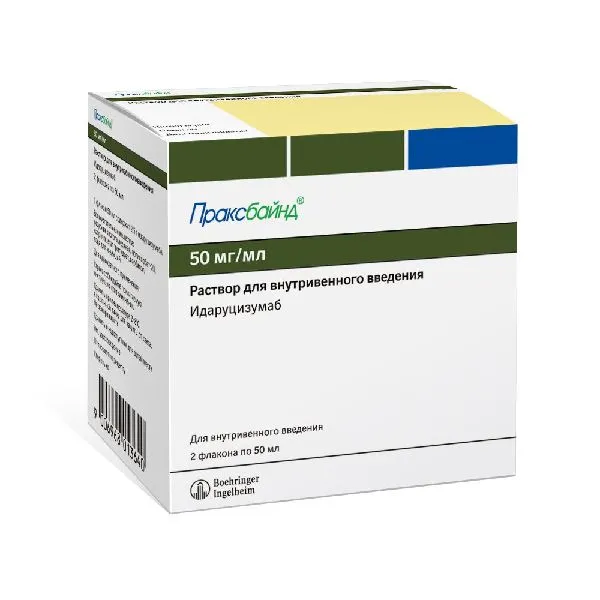
PRAXBIND
UkraineThe drug is intended for adults taking dabigatran in cases where its action needs to be urgently stopped. This is necessary in life-threatening situations or uncontrolled bleeding, as well as for performing emergency surgeries or procedures.
Frequently asked questions
What is the dosage of Praxbind?
The recommended dose is 5 g. In certain cases (for example, in the event of rebleeding or if the patient requires a second emergency surgery), the physician may consider administering a second dose of 5 g.
How should the drug be administered?
The drug is administered intravenously as a bolus injection or via two consecutive infusions (each lasting 5–10 minutes). Use is only possible in a hospital setting.
What are the possible side effects?
Studies have reported moderate symptoms of increased hypersensitivity (fever, rash, itching, bronchospasm, hyperventilation). Temporary appearance of protein in the urine (proteinuria) due to renal load is also possible.
Can Praxbind be used in case of renal or hepatic impairment?
Yes, dose adjustment is not required for patients with renal or hepatic impairment. Renal impairment does not affect the efficacy of the drug.
Does Praxbind interact with other medicines?
Clinically significant interactions with other drugs are unlikely due to its high specificity of action. It does not inhibit the action of other anticoagulants, except for dabigatran.
Who should exercise caution when using it?
Patients with hereditary fructose intolerance should be very cautious, as the drug contains sorbitol, which may cause serious complications. Risks should also be weighed for patients with a known allergy to the components of the drug.
Instructions for use
INSTRUCTIONS FOR MEDICAL USE OF THE MEDICINAL PRODUCT PRAZBEND® (PRAXBIND®)
Composition:
Active substance: idarucizumab;
1 ml of solution for injection/infusion contains 50 mg of idarucizumab;
1 vial (50 ml solution) contains 2.5 g of idarucizumab;
idarucizumab is produced using recombinant DNA technology with Chinese hamster ovary cells;
Excipients: sodium acetate trihydrate; acetic acid; sorbitol; polysorbate 20; water for injections.
1 vial (50 ml solution) contains 2 g of sorbitol and 25 mg of sodium (see section "Special precautions for use").
Pharmaceutical form. Solution for injection/infusion.
Main physicochemical properties: colorless or slightly yellowish, clear or slightly opalescent solution.
Pharmacotherapeutic group. Other medicinal products. Antidotes.
ATC code V03A B37.
Pharmacological Properties
Pharmacodynamics
Mechanism of Action
Idarucizumab is a specific, reversible agent for dabigatran. It is a human monoclonal antibody fragment (Fab) that binds to dabigatran with very high affinity—approximately 300-fold higher than the binding affinity of dabigatran to thrombin. The idarucizumab–dabigatran complex is characterized by rapid formation and very slow dissociation, resulting in a highly stable complex. Idarucizumab binds strongly and specifically to dabigatran and its metabolites, thereby neutralizing their anticoagulant effect.
Pharmacodynamic Effects
The pharmacodynamics of idarucizumab following administration of dabigatran etexilate was evaluated in 141 patients during Phase I studies. Results were compared with those from a representative subgroup of 6 healthy volunteers aged 45 to 64 years who received a 5 g dose via intravenous infusion. The average peak exposure of dabigatran in these healthy volunteers corresponded to a regimen of 150 mg dabigatran etexilate twice daily.
Effect of Idarucizumab on Dabigatran Exposure and Anticoagulant Activity
Immediately after administration of idarucizumab, plasma concentrations of unbound dabigatran decreased by more than 99%, to levels at which no anticoagulant activity was observed.
In most patients, sustained reduction in plasma dabigatran concentrations was maintained for 12 hours (≥ 90%). In a subgroup of patients, recovery of unbound dabigatran plasma levels and a concurrent increase in clotting time were observed, likely due to redistribution of dabigatran from the periphery. This occurred 1–24 hours after idarucizumab administration, primarily at time points ≥ 12 hours.
Dabigatran prolongs the clotting times of coagulation activity markers, including diluted thrombin time (dTT), thrombin time (TT), activated partial thromboplastin time (aPTT), and ecarin clotting time (ECT), which provide an approximate measure of the intensity of anticoagulant effect. Values within the normal range after idarucizumab administration indicate that the patient is no longer under anticoagulant therapy. Values above normal may indicate residual active dabigatran or other clinical conditions, such as the presence of other anticoagulants or transfusion-related coagulopathy. These tests are used to assess the anticoagulant effect of dabigatran. Complete and sustained reversal of dabigatran-induced clotting time prolongation was observed immediately after idarucizumab infusion and persisted throughout the observation period (at least 24 hours).
Thrombin Generation Assay Parameters
Dabigatran markedly affects endogenous thrombin potential (ETP) parameters. Treatment with idarucizumab normalized both the ratio of thrombin generation initiation phase and the ratio of time to peak thrombin levels within 0.5–12 hours after completion of idarucizumab infusion. Idarucizumab as monotherapy did not exhibit a procoagulant effect as measured by ETP, suggesting that idarucizumab does not have a prothrombotic effect.
Re-administration of Dabigatran Etexilate
Twenty-four hours after idarucizumab infusion, re-administration of dabigatran etexilate resulted in the expected anticoagulant effect.
Clinical Efficacy and Safety
The studied patient population included healthy volunteers and patients with specific characteristics such as age, body weight, race, sex, and presence of renal impairment. During these studies, the dose range of idarucizumab was from 20 mg to 8 g, and infusion duration ranged from 5 minutes to 1 hour.
Representative pharmacokinetic and pharmacodynamic parameters were established in healthy volunteers aged 45 to 64 years who received 5 g of idarucizumab.
In a clinical study involving adult patients with life-threatening or uncontrolled bleeding (Group A) on dabigatran therapy or requiring urgent surgery or emergency procedures (Group B), the primary endpoint was the maximum percentage of reversal of dabigatran’s anticoagulant effect within 4 hours after idarucizumab administration, based on diluted thrombin time (dTT) or ecarin clotting time (ECT) values determined at a central laboratory. A key secondary endpoint was restoration of hemostasis.
Results from a clinical trial involving 503 patients: 301 patients with severe bleeding (Group A) and 202 patients requiring emergency procedures/surgery (Group B). Approximately half of the patients in each group were male. The mean age was 78 years, and the mean creatinine clearance was 52.6 mL/min. 61.5% of patients in Group A and 62.4% in Group B were receiving dabigatran at a dose of 110 mg twice daily.
Neutralization could only be assessed in patients who had prolonged coagulation times before starting idarucizumab therapy. In the majority of patients in Groups A and B, complete neutralization of dabigatran’s anticoagulant effect was observed (dTT 98.7%; ECT 82.2%; aPTT 92.5% in evaluable patients of both groups) within the first 4 hours after administration of 5 g idarucizumab. The neutralizing effect was evident immediately after administration.
Hemostasis was restored in 80.3% of patients with significant bleeding, and normal hemostasis was observed in 93.4% of patients requiring emergency procedures.
Of the 503 patients, 101 died; each death could be attributed either to complications of the underlying condition or to comorbidities. Thrombotic complications occurred in 34 patients (23 of 34 did not receive antithrombotic therapy for treatment of the complication), and in each case, thrombotic events could be considered complications of the patient’s underlying disease. Moderate symptoms of hypersensitivity (fever, bronchospasm, hyperventilation, rash, and pruritus) were reported. A causal relationship between idarucizumab administration and adverse reactions could not be established.
Immunogenicity
Serum samples from 283 patients in Phase I studies (224 volunteers received idarucizumab) and 501 patients tested before and after treatment were analyzed for antibodies against idarucizumab. Antibodies with cross-reactivity to idarucizumab were detected in approximately 12% (33 of 283) of subjects in Phase I and in 3.8% (19 of 501) of patients. No impact on the pharmacokinetics, neutralizing effect of idarucizumab, or hypersensitivity reactions was observed.
Treatment-related, likely persistent antibodies to idarucizumab at low titers were observed in 4% (10 of 224) of subjects in Phase I and in 1.6% (8 of 501) of patients, indicating a low immunogenic potential of idarucizumab. In a subgroup of 6 patients in Phase I, idarucizumab was re-administered 2 months after the first dose. Anti-idarucizumab antibodies were not detected before re-administration. One patient developed treatment-related antibodies after the second dose. Nine patients received a repeat dose of idarucizumab within 6 days after the first dose. None of them tested positive for anti-idarucizumab antibodies.
Pharmacokinetics
The pharmacokinetics of idarucizumab were studied in 224 patients during Phase I trials. Results were compared with a representative subgroup of 6 healthy volunteers aged 45 to 64 years who received a 5 g dose via intravenous infusion.
Distribution
Idarucizumab exhibits multiphasic distribution kinetics and limited extravascular distribution. After intravenous infusion of 5 g, the geometric mean volume of distribution at steady state (Vdss) was 8.9 L (geometric coefficient of variation (gCV) 24.8%).
Biotransformation
Several pathways may contribute to the metabolism of antibodies. All involve biodegradation of the antibodies into smaller molecules—low-molecular-weight peptides and amino acids—which are subsequently reabsorbed and incorporated into general protein synthesis.
Elimination
Idarucizumab was rapidly eliminated with a total clearance of 47.0 mL/min (gCV 18.4%), an initial half-life of 47 minutes (gCV 11.4%), and a terminal half-life of 10.3 hours (gCV 18.9%). After intravenous administration of 5 g idarucizumab, 32.1% (gCV 60.0%) of the dose was recovered in urine over a 6-hour collection period, and less than 1% over the subsequent 18 hours. The remainder of the dose is eliminated via protein catabolism, primarily in the kidneys.
Cases of proteinuria have been reported after idarucizumab treatment. Transient proteinuria is a physiological response to increased renal load due to protein intake following a bolus/short-term intravenous administration of 5 g idarucizumab. The peak of transient proteinuria typically occurred approximately 4 hours after administration. The condition normalized within 12–24 hours. In isolated cases, transient proteinuria persisted beyond 24 hours.
Patients with Renal Impairment
During Phase I studies, PRAXBIND was studied in patients with creatinine clearance ranging from 44 to 213 mL/min. Patients with creatinine clearance below 44 mL/min were not included in Phase I studies.
Depending on the degree of renal impairment, total clearance was reduced compared to healthy volunteers, leading to increased exposure to idarucizumab.
Based on pharmacokinetic analysis in 347 patients with varying degrees of renal impairment (mean creatinine clearance (CrCl) 21–99 mL/min), mean exposure to idarucizumab (AUC0–24h) increased by 38% in patients with mild renal impairment (CrCl 50–< 80 mL/min), by 90% in patients with moderate renal impairment (30–< 50 mL/min), and by 146% in patients with severe renal impairment (0–< 30 mL/min). Since dabigatran is primarily eliminated via the kidneys, increased exposure to dabigatran is also observed in renal impairment.
Given these data and the extent of reversal of dabigatran’s anticoagulant effect in patients, renal impairment does not appear to affect the reversal efficacy of idarucizumab.
Patients with Hepatic Impairment
No effect of hepatic impairment, assessed by liver function test abnormalities, on the pharmacokinetics of idarucizumab was observed.
Idarucizumab was studied in 58 patients with varying degrees of hepatic impairment. Compared to 272 patients without hepatic impairment, the mean AUC of idarucizumab changed by -6%, 37%, and 10% in patients with AST/ALT elevations of 1 to < 2 times, 2 to 3 times, and > 3 times the upper limit of normal (N = 34, N = 3, and N = 21, respectively). Based on pharmacokinetic data from 12 patients with liver disease, the AUC of idarucizumab increased by 10% compared to patients without liver disease.
Effect of Age, Sex, and Race
Sex, age, and race do not have a clinically significant effect on the pharmacokinetics of idarucizumab.
Clinical characteristics.
Indications.
PRAXBIND is a specific reversible agent for dabigatran and is intended for adult patients receiving treatment with dabigatran etexilate when rapid reversal of the anticoagulant effect is required:
- for emergency surgery/emergency procedures;
- in the event of life-threatening or uncontrolled bleeding.
Contraindications.
None.
Interaction with other medicinal products and other forms of interactions.
Studies on the interaction of PRAXBIND with other medicinal products have not been conducted. Given the pharmacokinetic properties and high specificity of binding to dabigatran, clinically significant interactions with other medicinal products are unlikely.
Preclinical study results indicated absence of interaction with:
- vasopressor agents;
- coagulation factor concentrates, namely: prothrombin complex concentrates (PCC, e.g. factors II, IX, X), activated prothrombin complex concentrates (aPCC), and recombinant coagulation factor VIIa;
- other anticoagulants (e.g. thrombin inhibitors other than dabigatran, factor Xa inhibitors, including low molecular weight heparin, vitamin K antagonists, heparin).
Thus, idarucizumab does not inhibit the activity of other anticoagulants.
Special precautions for use
Idarucizumab specifically binds dabigatran and neutralizes its anticoagulant effect. It does not reverse the effects of other anticoagulants (see section "Pharmacological properties. Pharmacodynamics").
The medicinal product PRAXBIND may be used concomitantly with standard supportive measures considered medically necessary.
Traceability
To improve traceability of biological medicinal products, the name and batch number of the administered product should be clearly documented.
Hypersensitivity
The risk of using PRAXBIND in patients with known hypersensitivity (e.g. anaphylactoid reactions) to idarucizumab or any of the other components of the medicinal product should be carefully weighed against the potential benefit of such emergency medical intervention. In the event of an anaphylactic reaction or other serious allergic reaction, administration of PRAXBIND should be immediately discontinued and appropriate therapy initiated.
Hereditary fructose intolerance
The recommended dose of PRAXBIND contains 4 g of sorbitol as an excipient. In patients with hereditary fructose intolerance, parenteral administration of sorbitol has been associated with hypoglycemia, hypophosphatemia, metabolic acidosis, increased uric acid levels, acute hepatic insufficiency with impaired excretory and synthetic function, and death. Therefore, the risk of treating patients with hereditary fructose intolerance with PRAXBIND should be carefully weighed against the potential benefit of such emergency medical intervention. If these patients receive PRAXBIND, intensive medical monitoring should be provided during administration and for 24 hours after infusion.
Thromboembolic complications
Patients receiving dabigatran have underlying conditions predisposing them to thromboembolic complications. Reversal of dabigatran therapy increases the risk of prothrombotic events in these patients. To reduce this risk, anticoagulant therapy should be resumed as soon as medically appropriate (see section "Method of administration and dosage").
Protein in urine
PRAXBIND causes transient proteinuria as a physiological response to increased renal load due to protein metabolism following intravenous bolus/short-term infusion of 5 g idarucizumab (see section "Pharmacological properties. Pharmacokinetics").
Transient proteinuria does not indicate renal impairment and should be considered when interpreting urine analysis results.
Sodium content
PRAXBIND contains 50 mg of sodium per dose, equivalent to 2.5% of the WHO recommended maximum daily intake of 2 g sodium for adults.
Use during pregnancy or breastfeeding
Pregnancy
There are no data on the use of idarucizumab in pregnant women. Reproductive and embryotoxicity studies have not been conducted due to the nature and intended clinical use of the medicinal product. PRAXBIND may be used during pregnancy if the expected clinical benefit outweighs the potential risks.
Breastfeeding
It is unknown whether idarucizumab or its metabolites are excreted in human milk.
Fertility
There are no data on the effect of idarucizumab on fertility.
Ability to affect driving and operating machinery
The medicinal product is administered only in a hospital setting.
Method of Administration and Dosage
The medication is to be used only under hospital conditions.
Dosage
The recommended dose of PRAXBIND is 5 g (2 vials × 2.5 g / 50 mL).
In a subgroup of patients, recovery of plasma concentrations of unbound dabigatran and concurrent prolongation of coagulation time were observed for up to 24 hours after administration of idarucizumab (see section "Pharmacological Properties. Pharmacodynamics").
The need for administering a second 5 g dose of idarucizumab should be considered in the following cases:
- recurrence of clinically significant bleeding accompanied by prolonged coagulation time, or
- life-threatening rebleeding is possible and prolonged coagulation time is present, or
- the patient requires a second emergency surgery or urgent procedure and has prolonged coagulation time.
Appropriate coagulation parameters include activated partial thromboplastin time (aPTT), diluted thrombin time (dTT), and ecarin clotting time (ECT) (see section "Pharmacological Properties. Pharmacodynamics").
The maximum daily dose has not been studied.
Resumption of Antithrombotic Therapy
Dabigatran etexilate treatment may be restarted 24 hours after administration of idarucizumab in clinically stable patients and after achieving adequate hemostasis.
Alternative antithrombotic therapy (e.g., administration of low-molecular-weight heparin) may be initiated at any time after PRAXBIND administration in stable patients and after achieving adequate hemostasis.
Lack of antithrombotic therapy increases the risk of thrombotic complications associated with the underlying disease or condition.
Special Populations
Geriatric Patients
Dose adjustment is not required in elderly patients (aged 65 years and older) (see section "Pharmacological Properties. Pharmacokinetics").
Patients with Renal Impairment
Dose adjustment is not required in patients with impaired renal function. Renal impairment does not affect the reversal effect of idarucizumab (see section "Pharmacological Properties. Pharmacokinetics").
Patients with Hepatic Impairment
Dose adjustment is not required in patients with impaired hepatic function (see section "Pharmacological Properties. Pharmacokinetics").
Method of Administration
For intravenous use.
PRAXBIND (2 vials × 2.5 g / 50 mL) should be administered intravenously as two consecutive infusions, each lasting 5–10 minutes, or as a bolus injection.
The solution should be inspected visually for particulate matter and discoloration prior to administration.
PRAXBIND should not be mixed with other medicinal products. The medication may be administered through an established intravenous catheter. The catheter should be flushed with 9 mg/mL (0.9%) sodium chloride solution for injection before and after infusion. Other infusions should not be administered simultaneously through the same intravenous access.
PRAXBIND does not contain preservatives. The vial is intended for single use only (see section "Shelf Life").
Unused medicinal products or waste materials must be disposed of in accordance with local requirements.
Children
The safety and efficacy of PRAXBIND in children (under 18 years of age) have not been established.
No data available.
Overdose
There is no clinical experience regarding overdose with PRAXBIND.
The highest single dose of PRAXBIND studied in healthy volunteers was 8 g. No safety signals were detected in this population.
Adverse Reactions
The safety of PRAXBIND was evaluated in a Phase III study involving 503 patients who received PRADAXA (dabigatran etexilate) and required urgent reversal due to life-threatening or uncontrolled bleeding or emergency surgery or procedures. Safety was also assessed in 224 healthy volunteers in a Phase I study. Additionally, 359 patients were enrolled in a global post-marketing observational program to collect data on idarucizumab use in real-world settings.
No adverse reactions were identified.
Reporting of suspected adverse reactions
Reporting suspected adverse reactions after medicine authorization is important. It allows ongoing monitoring of the benefit-risk balance of the medicine. Healthcare professionals, as well as patients or their legal representatives, are encouraged to report any suspected adverse reactions and lack of efficacy through the automated pharmacovigilance information system at: https://aisf.dec.gov.ua
Shelf life.
4 years.
After opening, the solution remains chemically and physically stable for 6 hours at room temperature.
From a microbiological standpoint, if the method of opening does not exclude the risk of microbial contamination, the product should be used immediately. If not used immediately, the duration and storage conditions prior to use are the sole responsibility of the user.
Storage conditions.
Store at 2–8 °C. Do not freeze. Keep in the original packaging to protect from light. Keep out of reach of children.
Prior to use, the unopened vial may be stored at room temperature (up to 30 °C) for up to 48 hours, provided it is kept in the original packaging to protect from light. The solution should not be exposed to light for more than 6 hours (in unopened vials and/or during use).
For storage conditions after opening, see the section “Shelf life”.
Incompatibilities.
PRAXBIND must not be mixed with other medicinal products.
No incompatibility of PRAXBIND has been observed with infusion systems made of polyvinyl chloride, polyethylene, or polyurethane, or with syringes made of polypropylene.
Packaging.
50 ml in a vial, 2 vials in a cardboard box.
Prescription category. Prescription only.
Manufacturer.
Boehringer Ingelheim Pharma GmbH & Co. KG.
Manufacturer's address and location of operations.
Birkendorfer Strasse 65, 88397 Biberach/Riss, Germany.
The original data is available in the language of the country of manufacture.
Data source: State Register of Medicinal Products of Ukraine
Data last verified: August 13, 2026