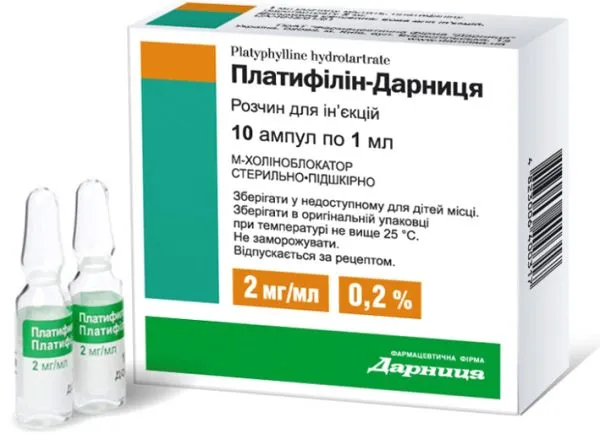
PLATIFILLIN-DARNITSA
UkraineThe drug is used as part of complex therapy for gastrointestinal spasms (gastroduodenitis, intestinal colic, cholecystitis), renal and biliary colic, bronchial asthma to prevent spasms, as well as for menstrual pain and vascular spasms.
Frequently asked questions
How should Platifillin-darnitsa be taken correctly?
The drug is administered subcutaneously. For adults and adolescents aged 15 and older, 1–2 ml is administered 1–2 times daily to relieve spastic pain or in cases of asthma. For long-term treatment, the dosage and frequency of administration must be determined by a physician.
What are the possible side effects of Platifillin-darnitsa?
Possible side effects include: dry mouth, visual disturbances (pupil dilation, increased intraocular pressure), palpitations (tachycardia), dizziness, headache, insomnia, urinary retention, or difficulty coughing up viscous sputum.
Who should not use this drug?
Contraindications include hypersensitivity to the ingredients, heart disease (arrhythmia, tachycardia, ischemic heart disease, severe hypertension), glaucoma, intestinal or esophageal obstruction, thyrotoxicosis, hepatic and renal insufficiency, as well as urinary retention.
Can the drug be combined with other medicines?
It must not be used simultaneously with anticholinesterase drugs. The drug may enhance the effects of sleeping pills and magnesium sulfate, and may also affect the effects of antipsychotics, digoxin, and certain antihistamines. Consult a physician regarding all combinations.
Does the drug affect the ability to drive a vehicle?
Yes, while using the drug, one should refrain from driving a vehicle or performing other tasks that require high concentration and rapid reaction time.
Instructions for use
INSTRUCTIONS FOR MEDICAL USE OF THE MEDICINAL PRODUCT PLATYPHYLLINE-DARNITSA (PLATYPHYLLINE-DARNITSA)
Composition:
Active substance: platyphylline hydrotartrate;
1 ml of solution contains 2 mg of platyphylline hydrotartrate;
Excipient: water for injections.
Pharmaceutical form. Injection solution.
Main physicochemical properties: clear, colorless liquid.
Pharmacotherapeutic group.
Agents used in functional disorders of the gastrointestinal tract.
Other agents used in functional disorders of the intestine.
ATC code A03A X.
Pharmacological properties.
Pharmacodynamics.
Platifillin is a natural alkaloid exhibiting M-cholinoblocking activity. It is similar to atropine in its effects on peripheral cholinoreactive systems, but is less toxic and better tolerated. It has a weaker effect on peripheral M-cholinoreceptors (its spasmolytic action on smooth muscle cells of the gastrointestinal tract and on the iris sphincter muscle is 5–10 times weaker than that of atropine). By blocking M-cholinoreceptors, platifillin disrupts the transmission of nerve impulses from postganglionic cholinergic nerves to the effector organs and tissues they innervate (heart, smooth-muscle organs, exocrine glands). It partially blocks N-cholinoreceptors as well. The cholinoblocking effect is more pronounced in the presence of increased parasympathetic autonomic nervous system tone or under the influence of M-cholinomimetics. It causes tachycardia to a lesser extent than atropine (especially when administered in high doses). By reducing vagus nerve influence, it improves cardiac conduction, increases myocardial excitability, and raises cardiac minute volume. It exerts ganglionic blocking and direct myotropic spasmolytic effects and causes dilation of small skin vessels. In high doses, it depresses the vasomotor center and blocks sympathetic ganglia, resulting in vasodilation and a decrease in arterial pressure (primarily when administered intravenously). It suppresses secretion of exocrine glands less than atropine does and causes significant reduction in smooth muscle tone, as well as in the amplitude and frequency of peristaltic contractions in the stomach, duodenum, small intestine, and large intestine. It moderately reduces gallbladder tone (in individuals with hyperkinesis of the biliary tract). In cases of hypokinesis, gallbladder tone increases toward normal. It induces relaxation of the smooth musculature of the uterus, urinary bladder, and urinary tract. Due to its spasmolytic effect, it alleviates pain syndrome. It relaxes bronchial smooth muscle during spasms caused by increased vagus nerve tone or cholinomimetics, increases respiratory volume, and suppresses bronchial gland secretion. After parenteral administration, it causes pupillary dilation due to relaxation of the iris sphincter muscle. Simultaneously, intraocular pressure increases and accommodation paralysis occurs (relaxation of the ciliary body's ciliary muscle). Compared to atropine, its effect on accommodation is less pronounced and shorter in duration. Platiffilin stimulates the central nervous system and respiratory center, and more significantly, the spinal cord (in high doses, convulsions may occur, as well as central nervous system (CNS) depression, and suppression of vasomotor and respiratory centers). It crosses the blood-brain barrier.
Pharmacokinetics.
After parenteral administration, platifillin rapidly and easily penetrates histohematic barriers, cellular and synaptic membranes. When administered in high doses, it accumulates in the CNS at significant concentrations. In the body, it undergoes hydrolysis to form platynecine and platynecinic acid. It is excreted by the kidneys in urine and through the intestine in feces. When used correctly (appropriate doses and intervals between administrations), the drug does not accumulate.
Clinical characteristics.
Indications.
As part of complex therapy: gastroduodenitis, functional dyspepsia, pylorospasm, cholecystitis, cholelithiasis, intestinal colic, renal colic, biliary colic. Bronchial asthma (for prevention of bronchospasm), bronchorrhea. Algomenorrhea. Cerebral artery spasm. Angioneurosis.
Contraindications.
Hypersensitivity to the components of the drug. Cardiovascular disorders in which an increase in heart rate may be undesirable: atrial fibrillation, tachycardia, chronic heart failure, ischemic heart disease, mitral stenosis, severe arterial hypertension. Acute bleeding. Thyrotoxicosis. Hyperthermic syndrome. Gastrointestinal disorders associated with obstruction (achalasia of the esophagus, pyloric stenosis, intestinal atony). Glaucoma. Hepatic and renal insufficiency. Myasthenia gravis. Urinary retention or predisposition to it. Brain injury.
Interaction with other medicinal products and other types of interactions.
When used concomitantly with haloperidol in patients with schizophrenia, a reduction in antipsychotic effect is possible.
Enhances the sedative and hypnotic effects of phenobarbital, pentobarbital, magnesium sulfate, and ethaminal sodium. Eliminates bradycardia caused by verapamil; nausea, vomiting, and bradycardia caused by morphine.
Blocks the effects of proserin (physostigmine).
Increases the effects of orally administered H2-histamine blockers, digoxin, and riboflavin (by slowing peristalsis and improving absorption).
Adrenomimetics and organic nitrates potentiate the increase in intraocular pressure.
M-cholinoblockers, amantadine, haloperidol, phenothiazines, monoamine oxidase inhibitors (MAOIs), tricyclic antidepressants, benzactizine, quinidine sulfate, isoniazid, certain antihistamines (diphenhydramine), disopyramide, procainamide increase the risk of developing anticholinergic adverse effects.
Exhibits antagonism with cholinesterase inhibitors. Do not use simultaneously with anticholinesterase agents.
Morphine enhances the depressant effect on the cardiovascular system; MAO inhibitors enhance the positive chronotropic and bathmotropic effects; cardiac glycosides enhance the positive bathmotropic effect; quinidine, procainamide enhance the cholinolytic effect.
In pain associated with smooth muscle spasm, the action of the drug is enhanced by analgesics, sedatives, tranquilizers; in vascular spasms – by antihypertensive and sedative agents.
Special precautions for use.
Use with caution in patients with prostatic hypertrophy or urinary tract obstruction, Down's syndrome, cerebral palsy in children; in patients with reflux esophagitis, hiatal hernia associated with reflux esophagitis; in ulcerative colitis, megacolon; in patients aged 40 years and older due to possible undiagnosed glaucoma; in patients with autonomic neuropathy; in elderly or debilitated patients; in chronic pulmonary diseases characterized by production of thick, difficult-to-expectorate mucus, or in reverse obstruction. In patients with xerostomia, prolonged use may lead to further reduction of salivary secretion.
Use during pregnancy or breastfeeding.
During pregnancy or breastfeeding, the medicinal product should be used with caution only when the expected benefit to the mother outweighs the potential risk to the fetus or infant.
Effect on the ability to drive or operate machinery.
When using this medicinal product, patients should refrain from driving or operating vehicles and other potentially hazardous activities requiring heightened attention and rapid psychomotor reactions.
Method of Administration and Dosage
Administer subcutaneously.
For adults and children aged 15 years and older, to relieve spasmodic pain, prolonged attacks of bronchial asthma, and cerebral or peripheral angiospasm, inject 1–2 mL of solution 1–2 times daily.
For course treatment, administer subcutaneously 1–2 mL 1–2 times daily for 10–15–20 days.
Single and daily doses, as well as frequency of administration, should be individually determined by a physician depending on the indication and patient's age.
Maximum doses for adults: single dose – 10 mg, daily dose – 30 mg.
Children
The medicinal product is indicated for children aged 15 years and older.
Overdose
Symptoms: paralytic intestinal obstruction, acute urinary retention (in patients with benign prostatic hyperplasia), accommodation paralysis, increased intraocular pressure; dryness of mucous membranes of the mouth, nose, and throat; difficulty swallowing, mydriasis (up to complete disappearance of the iris), tremor, seizures, hyperthermia, central nervous system (CNS) excitation followed by its depression, respiratory and vasomotor center depression.
Treatment: forced diuresis, administration of cholinesterase inhibitors (physostigmine, galantamine, or proserine) to alleviate intestinal paresis and reduce tachycardia. In cases of moderate excitation and mild seizures – administration of magnesium sulfate; in severe cases – administration of sodium oxybate, oxygen therapy, and artificial ventilation of the lungs. For life-threatening tachycardia – use of sulfated quinidine or propranolol.
Adverse reactions.
Eye disorders: mydriasis, photophobia, paralysis of accommodation, increased intraocular pressure.
Respiratory, thoracic and mediastinal disorders: decreased secretory activity and bronchial tone, leading to formation of viscous sputum difficult to expectorate.
Gastrointestinal disorders: dry mouth, thirst, taste disturbances, dysphagia, decreased intestinal motility up to atony, reduced tone of bile ducts and gallbladder.
Renal and urinary disorders: difficulty and retention of urination.
Nervous system disorders: headache, dizziness, dysarthria, CNS excitation, insomnia, anxiety, amnestic syndrome.
Cardiac disorders: tachycardia, arrhythmia including extrasystoles, facial flushing, hot flushes, decreased blood pressure.
Immune system disorders: anaphylactic reactions, anaphylactic shock.
Skin and subcutaneous tissue disorders: skin rashes, urticaria, exfoliative dermatitis, dry skin, decreased sweating.
Reporting of suspected adverse reactions.
Reporting of suspected adverse reactions after authorization of the medicinal product is an important procedure. It allows continuous monitoring of the benefit-risk balance of the medicinal product. Healthcare professionals are required to report any suspected adverse reactions via the national reporting system.
Shelf life. 5 years.
Storage conditions.
Store in the original packaging at a temperature not exceeding 25 °C. Do not freeze.
Keep out of reach of children.
Incompatibilities.
Do not mix with other medicinal products.
Packaging.
1 ml in an ampoule; 5 ampoules in a blister pack; 2 blisters per carton.
Prescription category. Prescription only.
Manufacturer. JSC "Pharmaceutical Company "Darnytsia".
Manufacturer's address and location of operations.
13, Borispilska Street, Kyiv, 02093, Ukraine.
Similar drugs
| Brand name | Dosage form | Active substance / Dosage | Manufacturer |
|---|---|---|---|
| PLATIPHYLLIN-ZDOROVYA | solution for injection |
|
LLC "Corporation "Zdorovya" |
The original data is available in the language of the country of manufacture.
Data source: State Register of Medicinal Products of Ukraine
Data last verified: August 13, 2026