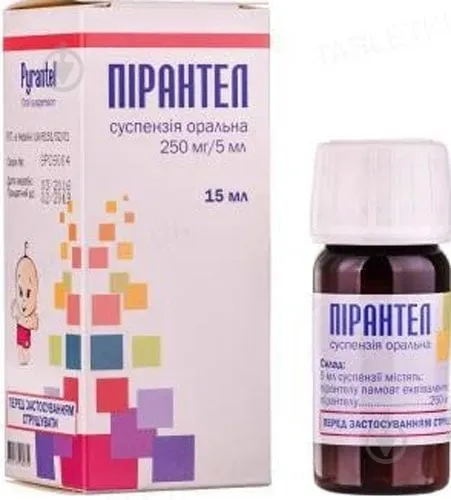
PYRANTEL
UkraineThe drug is used to treat enterobiasis, ascariasis, and ankylostomiasis.
Frequently asked questions
How should Pyrantel be taken correctly?
The suspension should be shaken before use. It is taken orally at any time, not necessarily on an empty stomach and without the use of laxatives. In case of enterobiasis, to prevent reinfection, it is recommended to take a repeat dose after 3 weeks.
What is the dosage for children and adults?
For enterobiasis and ascariasis, children are prescribed 2.5 ml for every 10 kg of body weight as a single dose. For adults weighing up to 75 kg — 15 ml as a single dose; over 75 kg — 20 ml as a single dose. For ankylostomiasis, the dosage is higher and is calculated by a physician over a period of 2–3 days.
Who should not take this drug?
The drug should not be used in case of hypersensitivity to any of its components. It should also not be combined with piperazine, as this agent interferes with the action of Pyrantel.
What are the possible side effects?
Possible side effects include nausea, vomiting, abdominal pain or spasms, diarrhea, dizziness, drowsiness, headache, insomnia, skin rash or urticaria, as well as general weakness and fatigue.
Can the drug be taken during pregnancy or breastfeeding?
During pregnancy, the drug may only be used in extreme cases after a physician has assessed the risks to the fetus. During breastfeeding, use is possible after consultation with a physician.
What should be done if dizziness or drowsiness occurs?
If you experience dizziness or drowsiness during treatment, you should refrain from driving vehicles or operating machinery.
Instructions for use
INSTRUCTIONS FOR MEDICAL USE OF THE MEDICINAL PRODUCT PIRANTEL (PYRANTEL)
Composition:
Active substance: pyrantel pamoate;
5 ml of suspension contain pyrantel pamoate equivalent to pyrantel 250 mg;
Excipients: xanthan gum, sucrose, citric acid monohydrate, sodium citrate, glycerol, methylparahydroxybenzoate sodium (E 219), propylparahydroxybenzoate sodium (E 217), polysorbate 80, pineapple flavor, purified water.
Pharmaceutical form. Oral suspension.
Main physicochemical properties: yellow-colored suspension with characteristic odor.
Pharmacotherapeutic group.
Antiparasitic agents, insecticides and repellents. Anthelmintic agents. Agents used in nematode infections. Tetrahydropyrimidine derivatives. Pyrantel.
ATC code P02CC01.
Pharmacological properties.
Pharmacodynamics.
Pyrantel is an anthelmintic agent. It is active against Enterobius vermicularis, Ascaris lumbricoides, Ancylostoma duodenale, and Necator americanus. Pyrantel causes neuromuscular blockade, paralyzing helminths, resulting in their elimination via intestinal peristalsis along with fecal matter. Pyrantel is effective against sensitive mature and immature forms of helminths. It does not affect migrating tissue larvae.
Pharmacokinetics.
Intestinal absorption of pyrantel is very low. After administration, plasma concentration is very low (0.05–0.13 mcg/mL) and reaches maximum levels within 1–3 hours. Up to 93% of the drug is excreted unchanged in feces. Less than 7% is found in urine, both unchanged and as metabolites.
Clinical characteristics.
Indications.
Enterobiasis, ascariasis, ancylostomiasis.
Contraindications.
Hypersensitivity to any component of the drug.
Interaction with other medicinal products and other types of interactions.
Do not use with piperazine, which is an antagonist of the anthelmintic action of pyrantel.
Special precautions for use.
In case of liver impairment, dose reduction is recommended.
Enterobiasis: To prevent re-infection, strict hygiene measures should be followed: daily perianal area hygiene, cleaning under the nails several times a day. Children's nails should be kept short. Underwear and nightwear should be changed regularly. Scratching should be avoided. Simultaneous treatment of all family members is recommended, since infection often proceeds asymptomatically.
Excipients.
This medicinal product contains sucrose. If intolerance to certain sugars has been diagnosed, consult your doctor before taking this medicinal product.
This medicinal product contains sodium methylparahydroxybenzoate and sodium propylparahydroxybenzoate, and therefore may cause allergic reactions (possibly delayed).
Use during pregnancy or breastfeeding.
Due to the absence of teratogenic effects in animals, congenital malformations in humans are not expected. Currently, congenital malformations or fetotoxic effects have not been clinically confirmed. However, monitoring of pyrantel use during pregnancy is insufficient to exclude all possible risks. Therefore, this medicinal product should be used during pregnancy only if clearly necessary, after careful evaluation of the benefit-risk ratio for the mother and the fetus, as determined by the physician.
Due to the lack of published studies on the adverse effects of pyrantel in breastfed infants, and considering the very low absorption of pyrantel, pyrantel may be used, if necessary, after consultation with a physician.
Ability to influence reaction speed when driving vehicles or operating machinery.
If dizziness or drowsiness occurs during treatment with this medicinal product, driving vehicles or operating machinery should be avoided.
Method of Administration and Dosage
Shake before use.
Take orally.
The drug can be taken at any time; there is no need to take the medication on an empty stomach or to use laxatives beforehand.
Enterobiasis and Ascariasis.
For the treatment of enterobiasis and ascariasis, the usual dose is a single dose of 10 mg/kg to 12 mg/kg.
Children: 2.5 mL per 10 kg of body weight as a single dose.
Adults with body weight less than 75 kg: 15 mL of suspension as a single dose.
Adults with body weight greater than 75 kg: 20 mL of suspension as a single dose.
In cases of enterobiasis, to achieve complete elimination of parasites, strict hygienic measures must be followed and all family members should be treated simultaneously. To prevent reinfection, a second dose should be administered 3 weeks after the initial dose.
Ancylostomiasis.
In endemic areas, in cases of infection with Necator americanus or heavy infestation with Ancylostoma duodenale, the dosage is 20 mg/kg per day (in 1 or 2 divided doses) for 2–3 days.
Children: 5 mL per 10 kg of body weight per day.
Adults with body weight less than 75 kg: 30 mL of suspension per day.
Adults with body weight greater than 75 kg: 40 mL of suspension per day.
In cases of mild infection with Ancylostoma duodenale (which typically occurs in non-endemic areas), a single dose of 10 mg/kg may be sufficient.
Adult patients are advised to use Pyrantel in tablet form; however, if tablets cannot be taken, administration of the suspension is recommended.
Children.
Should be prescribed to children with body weight of at least 10 kg.
Overdose.
Due to the low absorption coefficient of the drug, plasma concentrations remain low. Overdose, even significant, usually causes mild gastrointestinal disturbances (nausea, vomiting, diarrhea) and minor transient central nervous system effects (asthenia, dizziness, headache). Occasionally, elevated levels of liver transaminases (AcAT) may occur. Specific antidotes are not known. Immediate gastric lavage is recommended, along with monitoring of respiratory and cardiovascular functions. Treatment is symptomatic.
Adverse reactions.
Central nervous system: dizziness, drowsiness, insomnia, headache.
Immune system: hypersensitivity reactions.
Skin and subcutaneous tissue: skin rashes, urticaria.
Gastrointestinal tract: anorexia, nausea, vomiting, abdominal cramps, abdominal pain, diarrhea, tenesmus.
Hepatobiliary system: decreased or transient increase in transaminase levels.
Other: weakness, asthenia, increased fatigue.
Shelf life.
3 years.
Storage conditions.
Store in the original packaging at a temperature not exceeding 25 °C.
Keep out of reach of children.
Packaging.
15 ml of the preparation in a bottle or jar. Each bottle or jar is supplied in a cardboard box with a measuring spoon.
Prescription status.
Over-the-counter.
Manufacturer.
LLC "KUSUM PHARM".
Manufacturer's address and place of business.
40020, Ukraine, Sumy region, city of Sumy, Skryabina St., 54.
or
Manufacturer.
LLC "GLEDPHARM LTD".
Manufacturer's address and place of business.
40020, Ukraine, Sumy region, city of Sumy, Davydovskoho Hryhoriya St., 54.
Similar drugs
| Brand name | Dosage form | Active substance / Dosage | Manufacturer |
|---|---|---|---|
| HELMINTHOX | suspension, oral |
|
Innothera Shoesi (manufacturer responsible for quality control and batch release) |
| PYRANTEL | suspension, oral |
|
DKP "Pharmaceutical Factory" LLC |
| PYRANTEL POLPHARMA | suspension, oral |
|
Pharmaceutical Plant "Polpharma" S.A. (manufacturing, primary and secondary packaging, batch control; batch release) |
The original data is available in the language of the country of manufacture.
Data source: State Register of Medicinal Products of Ukraine
Data last verified: August 13, 2026