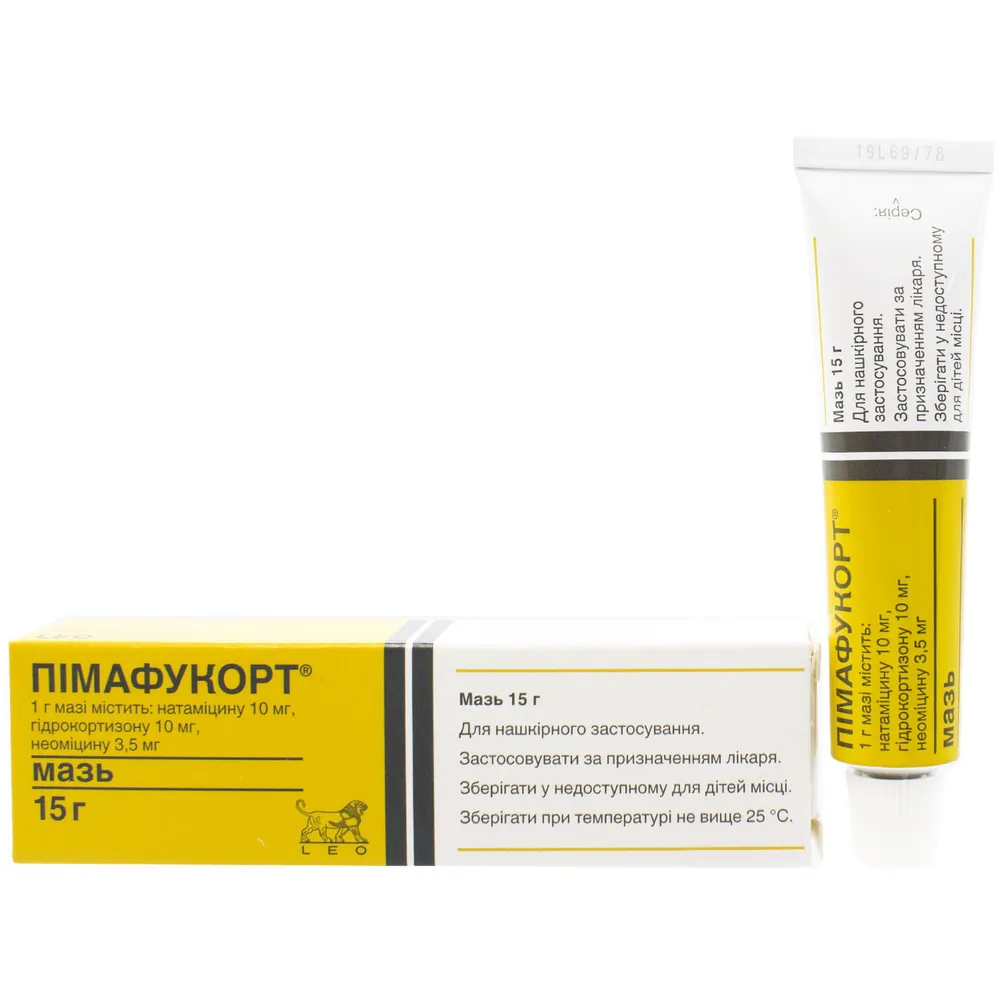
PIMAFUCORT
UkraineThe drug is used for the short-term treatment of superficial skin diseases accompanied by bacterial or fungal infection (including those caused by Candida fungi).
Frequently asked questions
How should Pimafucort be used correctly?
The ointment should be applied in a thin layer to the affected areas of the skin 2–4 times daily. Typically, the course of treatment should not exceed 14 days; the exact duration should be determined by a physician.
Who should not use this drug?
Contraindications include viral infections, parasitic diseases, skin wounds, burns, ulcers, as well as conditions such as acne, rosacea, psoriasis, ichthyosis, and skin atrophy. It should not be used in case of hypersensitivity to the ointment components or in the presence of primary bacterial or fungal infections.
What are the possible side effects of Pimafucort?
Possible allergic reactions, burning, irritation, itching, or rash may occur. Prolonged use may lead to skin thinning (atrophy). Changes in vision, such as blurred vision, increased intraocular pressure, or the risk of developing cataracts, are also possible.
Can the ointment be used by children?
The drug can be used in children aged 1 year and older, but only under medical supervision.
Can the drug be used during pregnancy and breastfeeding?
During pregnancy and breastfeeding, Pimafucort may be used for short courses on small areas of the skin. Prolonged use or application to large areas of the skin is not recommended.
Are there any special precautions when applying to the face or ears?
The ointment should not be applied to the eyelids to avoid contact with the eyes. If the eardrum is damaged, the drug must not be used in the external auditory canal.
Instructions for use
INSTRUCTIONS FOR MEDICAL USE OF THE MEDICINAL PRODUCT PIMAFUCORT® (PIMAFUCORT®)
Composition:
Active ingredients: natamycin, hydrocortisone, neomycin;
1 g of ointment contains 10 mg of natamycin, 10 mg of hydrocortisone, 3.5 mg of neomycin;
Excipients: polyethylene oleogel.
Pharmaceutical form. Ointment.
Main physicochemical properties: ointment from white to light yellow in color.
Pharmacotherapeutic group. Corticosteroids for dermatological use. Corticosteroids in combination with antibiotics. ATC code D07CA01.
Pharmacological properties.
Pharmacodynamics.
Pimafucort® is a combination medication containing the active substances: hydrocortisone, neomycin, and natamycin.
Hydrocortisone is a corticosteroid with anti-inflammatory and vasoconstrictive effects. Hydrocortisone suppresses inflammatory reactions and reduces the severity of symptoms in various skin disorders, which often cause itching, but does not eliminate the underlying disease causing these symptoms.
Neomycin is a broad-spectrum antibiotic active against certain Gram-positive (staphylococci, enterococci) and Gram-negative (Klebsiella spp., Proteus spp., Escherichia coli) bacteria. Pseudomonas aeruginosa is resistant to neomycin in vitro.
Natamycin belongs to the polyene macrolide group of antibiotics and has fungicidal activity against fungal infections, particularly those caused by Candida spp. Resistance of other fungal species to natamycin is unknown.
Cross-resistance between neomycin and other aminoglycoside antibiotics may occur due to plasmid development, the enzymes of which deactivate aminoglycosides and reduce cell membrane permeability, resulting in reduced aminoglycoside efficacy due to impaired energy metabolism or ribosomal mutation, although the latter mechanism is rare.
Pharmacokinetics.
Absorption
Natamycin and neomycin are practically not absorbed through intact skin and mucous membranes. Minimal absorption of neomycin may occur through damaged skin, wounds, and ulcers. Approximately 1–3% of hydrocortisone is absorbed through intact skin; in cases of eczema, the amount of absorbed hydrocortisone doubles, and in infectious skin lesions, it increases fivefold. In children, the extent of absorption decreases with age.
Clinical characteristics.
Indications. Short-term treatment of superficial dermatoses amenable to corticosteroid therapy, complicated by secondary bacterial and/or fungal infection (particularly caused by Candida species) sensitive to neomycin and nystatin.
Contraindications.
Since Pimafucort® contains hydrocortisone (a low-potency corticosteroid), the following contraindications apply:
- skin diseases caused by primary bacterial infections; primary infections caused by fungi and yeasts; parasitic infections (including extensive and severe skin lesions);
- viral infections;
- skin wounds and ulcers, trophic ulcers, burns;
- adverse reactions caused by corticosteroids (perioral dermatitis, striae);
- ichthyosis, juvenile plantar dermatosis, common acne (acne vulgaris), rosacea, cutaneous telangiectasia, skin atrophy.
Pimafucort® should not be used in the external auditory canal in the case of perforation of the tympanic membrane.
In addition, Pimafucort® should not be used in cases of hypersensitivity to neomycin, nystatin, aminoglycosides, corticosteroids (which is very rare), or to any of the excipients.
Interaction with other medicinal products and other forms of interaction. Data on drug interactions with Pimafucort® are lacking.
Special precautions for use.
The risk of local adverse reactions increases with prolonged treatment. The use of occlusive dressings (e.g., plastic) or application to skin folds increases this risk.
The skin of the face, scalp, and genital areas is particularly sensitive to the development of local reactions.
Application to the face, flexural areas, and other areas with thin skin may lead to skin atrophy and increased systemic absorption of the drug.
Topically applied corticosteroids may be hazardous in patients with psoriasis for several reasons, including "rebound syndrome" due to the development of tolerance, risk of generalized pustular psoriasis, or local systemic toxicity due to impaired skin barrier function. Steroids may be used in scalp psoriasis or chronic hyperkeratotic psoriasis of hands and feet. Close monitoring of patients is essential.
Improper use may mask and/or exacerbate bacterial, parasitic, fungal, and viral infections.
The medication should not be applied to the eyelids due to the risk of contact with the conjunctiva and increased risk of glaucoma or subcapsular cataract.
When applying Pimafucort® to large skin areas, in children, or when using occlusive dressings (i.e., situations where clinical experience is limited), patients should be informed about the potential for adrenal cortex suppression.
Visual disturbances
Visual disturbances may occur with both systemic and topical use of corticosteroids. If a patient develops symptoms such as blurred vision or other visual disturbances, an ophthalmological consultation should be sought to evaluate possible causes, including cataract, glaucoma, or rare conditions such as central serous chorioretinopathy (CSC), which has been reported after systemic or topical corticosteroid use.
There is a possibility of cross-sensitization between neomycin and chemically related antibiotics such as kanamycin, paromomycin, and gentamicin, as well as cross-resistance between neomycin and other aminoglycosides.
Therefore, to maintain adequate aminoglycoside levels during systemic use, indications for use and treatment duration must be strictly followed.
Prolonged treatment and application to wounds or damaged skin should be avoided due to the theoretical risk of ototoxicity and nephrotoxicity resulting from neomycin absorption.
The use of combinations of corticosteroids, antifungal agents, and antibiotics is indicated only under exceptional circumstances. An accurate diagnosis is essential to rule out the possibility of microbial resistance. In some cases, the use of two or more active substances may be necessary. However, the desired effect is often achieved using a single active ingredient.
If superinfection or excessive fungal growth occurs, treatment with the drug should be discontinued and appropriate measures taken.
Particular caution should be exercised when using medicinal products containing aminoglycosides in patients with renal impairment.
Use during pregnancy or breastfeeding.
Pregnancy
According to limited data, the use of nystatin during pregnancy has not been associated with an increased risk of congenital malformations. Systemic absorption of nystatin after topical application to small skin areas is minimal. There are no data on nystatin use in animal studies.
Ototoxicity has been reported with systemic use of aminoglycosides during pregnancy. Systemic absorption of aminoglycosides after topical application to small areas is minimal. Animal studies have shown neomycin to have toxic effects on reproductive function.
In animals, prenatal administration of aminoglycosides has been associated with fetal nephrotoxicity. Offspring of rats exposed to neomycin prenatally showed hearing loss. Topical application of corticosteroids to pregnant animals at high doses may cause developmental abnormalities such as cleft palate and intrauterine growth retardation. Preclinical data do not provide additional information beyond existing clinical experience.
Corticosteroids are capable of crossing the placenta. Teratogenic effects observed in animal studies have not been reported in humans. Systemic use of high-dose glucocorticosteroids has been associated with effects on the fetus/newborn (intrauterine growth retardation, adrenal suppression). Data on topical use of glucocorticosteroids in humans during pregnancy are limited. Their minimal systemic absorption should be considered. Weak and moderately potent glucocorticosteroids (Classes I and II), such as hydrocortisone, may be used in short courses on limited skin areas. The above-mentioned effects cannot be excluded with prolonged use or application to large areas of damaged skin.
Pimafucort® may be used during pregnancy in short courses on small skin areas. Prolonged use or application to large areas of damaged skin should only be considered in exceptional cases.
Breastfeeding
There is no information on the possible secretion of nystatin into breast milk. When used in short courses on small skin areas, glucocorticosteroids and neomycin are excreted into breast milk only in small amounts.
Pimafucort® may be used during breastfeeding in short courses on small skin areas. Breastfeeding is not recommended during prolonged use or application to large areas of damaged skin.
Ability to affect driving or operating machinery.
There are no data on the effect of Pimafucort® on the ability to drive or operate machinery, and such an effect is not expected.
Dosage and Administration.
Apply the medicinal product as a thin layer to the affected areas of the skin 2–4 times daily. The duration of treatment should be determined individually by a physician, depending on the nature of the disease. The treatment course should generally not exceed 14 days.
Pimafucort® in this pharmaceutical form is primarily indicated for the treatment of chronic skin disorders associated with lesions accompanied by scaling, dryness, fissures, and seborrhea.
Children.
The product may be used in children aged 1 year and older, under medical supervision.
Overdose.
There are no reported cases of overdose. There is a theoretical risk of ototoxic effects of neomycin when the product is applied to the area of the external auditory canal in the presence of tympanic membrane perforation, leading to direct exposure of neomycin to the middle ear. In individual cases, accidental oral ingestion of the entire contents of a package of Pimafucort® is likely to be well tolerated without development of toxic effects.
Side effects.
Rare (≥1/10,000 to < 1/1,000)
Endocrine system
Adrenocortical suppression due to local application of corticosteroid-containing drugs is rarely observed in adults. It is not expected to occur with the use of Pimafucort®. The possibility of systemic effects increases with the use of occlusive dressings, application to large areas of skin, prolonged use, and in children.
Skin and subcutaneous tissue
When using Pimafucort®, an initial slight worsening of skin reactions may occur. This does not require discontinuation of treatment.
- Hypersensitivity reactions, burning, skin irritation, dermatitis, eczema, contact dermatitis;
- Allergic contact reactions, particularly to neomycin;
- Corticosteroid-related side effects may occur, but the likelihood is lower with hydrocortisone than with more potent corticosteroids:
- Skin atrophy, often irreversible, accompanied by skin thinning, telangiectasia, purpura, and striae;
- Rosacea-like and perioral dermatitis, with or without skin atrophy;
- "Rebound" effect, which may lead to steroid dependence;
- Delayed wound healing;
- Depigmentation, hypertrichosis.
The risk of local adverse reactions increases with longer treatment duration. The use of occlusive dressings (e.g., plastic wrap) or application in skin folds increases this risk. Facial skin, scalp, and genital areas are particularly sensitive to local reactions.
With inappropriate use, bacterial, parasitic, fungal, and viral infections may be masked and/or exacerbated.
Very rare (<1/10,000)
Eye disorders: Increased intraocular pressure, increased risk of cataract development.
Frequency not known (cannot be estimated from available data)
Eye disorders: Blurred vision.
Skin and subcutaneous tissue: Skin rashes, pruritus, pustular acne.
The risk of systemic effects increases in the following cases: use with occlusive dressings (plastic wrap) or in skin folds; application to large skin areas; prolonged treatment; use in children (children are particularly sensitive due to thinner skin and relatively larger body surface area); presence of components or excipients enhancing penetration through the stratum corneum and/or enhancing the effect of the active substance.
The risk of local adverse reactions increases with the potency of the drug and duration of treatment. Use with occlusive dressings (plastic wrap) or in skin folds increases this risk. Facial skin, scalp, and genital areas are particularly sensitive. With inappropriate use, or in the presence of bacterial, parasitic, fungal, or viral infections, manifestations of these conditions may be masked and/or intensified.
Shelf life. 5 years.
Storage conditions.
Store at temperatures not exceeding 25 °C. Keep out of reach of children.
Packaging.
15 g of ointment in a tube; 1 tube per cardboard box.
Prescription status. Prescription only.
Manufacturer.
Temmler Italia S.r.l.
Manufacturer's address and place of business.
Via delle Industrie, 2, 20061, Carugate (MI), Italy.
Similar drugs
| Brand name | Dosage form | Active substance / Dosage | Manufacturer |
|---|---|---|---|
| HIOKZIZON | ointment |
|
PJSC "HIMFARMZAVOD "CHERVONA ZIRKA" |
The original data is available in the language of the country of manufacture.
Data source: State Register of Medicinal Products of Ukraine
Data last verified: August 13, 2026