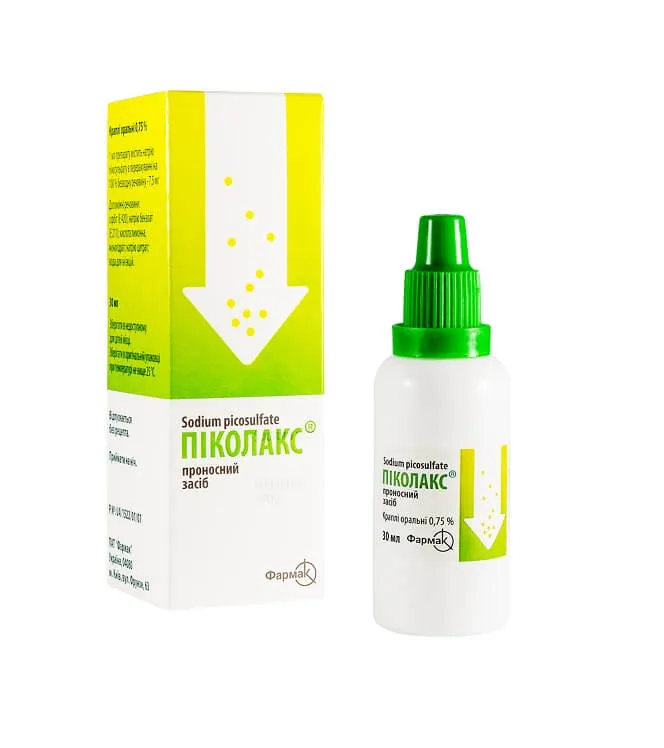
PICOLAX
UkraineThe drug is used to treat constipation or in cases where defecation needs to be facilitated.
Frequently asked questions
How should Picolax be taken correctly?
Adults are recommended to take 13–27 drops at night. Children from 4 years of age (only as prescribed by a physician) — 7–13 drops. It is advisable to start with the lowest dose. The drug can be taken with or without liquid. The effect usually occurs within 10–12 hours.
Who should not take this drug?
Contraindications include hypersensitivity to the components, intestinal obstruction, acute inflammatory bowel diseases, severe dehydration, as well as severe painful diseases of the abdominal organs (e.g., appendicitis). The drug should not be prescribed to children under 4 years of age.
What side effects can Picolax cause?
Diarrhea is the most common occurrence. Pain, discomfort, or abdominal cramps, as well as nausea or vomiting, are also frequently observed. Less commonly, dizziness or loss of consciousness may occur due to the body's reaction to abdominal pain or the defecation process. Allergic reactions and skin rashes are also possible.
Can the drug be combined with other medicines?
Simultaneous administration of large doses with diuretics or corticosteroids increases the risk of electrolyte imbalance. Antibiotics may weaken the effect of the drug.
Can the drug be used during pregnancy and breastfeeding?
During pregnancy, use is not recommended for safety reasons. During breastfeeding, administration is permitted as the active substance does not pass into breast milk.
What are the risks associated with long-term use?
The drug should not be used daily or for an extended period without establishing the cause of the constipation. Excessive use can lead to dehydration and the loss of potassium and other electrolytes, which may cause muscle weakness and cardiac dysfunction.
Instructions for use
INSTRUCTIONS FOR MEDICAL USE OF THE MEDICINAL PRODUCT PicoLax® (Picolaх)
Composition:
Active substance: sodium picosulfate;
1 ml of the preparation contains 7.5 mg of sodium picosulfate calculated as 100% anhydrous substance (20 drops);
Excipients: sorbitol (E 420); sodium benzoate (E 211); citric acid monohydrate; sodium citrate; water for injections.
Pharmaceutical form. Oral drops.
Main physicochemical properties: clear, colourless or slightly yellow liquid.
Pharmacotherapeutic group.
Contact laxatives. ATC code A06A B08.
Pharmacological properties.
Pharmacodynamics.
Sodium picosulfate, the active ingredient of PicoLax**®**, is a locally-acting laxative of the triarylmethane group. After bacterial cleavage in the large intestine, sodium picosulfate stimulates the mucosa, accelerating peristalsis and promoting accumulation of water and electrolytes in the lumen of the large intestine. As a result, defecation is stimulated, intestinal transit time is reduced, and stool is softened.
Pharmacokinetics.
After oral administration, sodium picosulfate reaches the colon without significant absorption.
The active metabolite, bis-(p-hydroxyphenyl)-pyridyl-2-methane, is formed following bacterial cleavage in the large intestine. The onset of action of PicoLax**®** usually occurs 6–12 hours after administration, depending on the release of the active metabolite. After oral administration, only a negligible amount of the drug may be detected in organs and body systems.
The laxative effect of the drug does not correlate with the plasma concentration of the active metabolite.
Clinical characteristics.
Indications.
Constipation or conditions requiring facilitation of defecation.
Like other laxatives, Picolax® should not be used daily or for prolonged periods without determining the cause of constipation.
Contraindications.
- Hypersensitivity to the active substance, other triarylmethanes, or any of the excipients of the medicine.
- Dynamic or mechanical intestinal obstruction.
- Severe painful and/or febrile abdominal conditions (e.g., appendicitis), potentially associated with nausea and vomiting.
- Acute inflammatory bowel diseases.
- Severe dehydration.
- Rare hereditary intolerance to any of the excipients of the medicine, for example, suspected undiagnosed fructose intolerance (see section "Special precautions").
Picolax® should be administered under medical supervision in conditions associated with disturbances in fluid and electrolyte balance (e.g., severe renal impairment).
Picolax® must not be administered to children under 4 years of age.
Interaction with other medicinal products and other forms of interaction.
Concomitant use of high doses of Picolax® with diuretics or corticosteroids may increase the risk of electrolyte imbalance, which may lead to increased sensitivity to cardiac glycosides.
Concomitant use with antibiotics may reduce the laxative effect of Picolax®.
Special precautions for use
Patients suffering from chronic constipation should undergo a full diagnostic evaluation to determine the cause of constipation.
Prolonged and excessive use of the drug may lead to disturbances in fluid and electrolyte balance and to hypokalemia.
Discontinuation of Picolax® may result in recurrence of symptoms. If Picolax® has been used for chronic constipation over a prolonged period, any recurrence of symptoms may be more pronounced.
Cases of dizziness and/or syncope occurring in temporal association with sodium picosulfate administration have been reported. Available data suggest that these events are consistent with defecation-induced syncope (associated with the Valsalva maneuver) or related to a vasovagal response to abdominal pain.
Patients with rare hereditary fructose intolerance should not take this medicine, as it contains sorbitol.
This medicinal product contains less than 1 mmol/dose of sodium, i.e. it is practically sodium-free.
This medicinal product contains 2 mg of sodium benzoate per 1 ml (30 mg sodium benzoate in the 15 ml bottle, 60 mg sodium benzoate in the 30 ml bottle).
Use during pregnancy or breastfeeding.
Pregnancy
Adequate clinical studies in pregnant women have not been conducted. Animal studies have demonstrated reproductive toxicity of the drug when administered at daily doses of 10 mg/kg and higher. For safety reasons, Picolax® should be avoided during pregnancy if possible.
Breastfeeding
Clinical data indicate that neither the active metabolite, bis-(p-hydroxyphenyl)-pyridyl-2-methane (BHPM), nor its glucuronides pass into breast milk. Therefore, Picolax® can be used during breastfeeding.
Fertility
Clinical studies evaluating the effect of the drug on fertility in humans have not been conducted.
Animal studies did not demonstrate any effect of the drug on fertility.
Ability to affect reaction speed when driving vehicles or operating machinery.
Studies on the influence of the drug on the ability to drive vehicles or operate machinery have not been conducted. However, patients should be warned about the possibility of developing adverse reactions such as dizziness and/or syncope as a result of a vasovagal response (particularly abdominal cramps). If abdominal cramps occur, patients should avoid potentially hazardous activities such as driving vehicles or operating machinery.
Method of Administration and Dosage
The medication is dosed using the manufacturer's dispenser.
Adults: 13–27 drops (corresponding to 5–10 mg of sodium picosulfate);
Children aged 4 years and older (only on medical advice): 7–13 drops (corresponding to 2.5–5 mg of sodium picosulfate).
It is recommended to start with the lowest dose. The dose may be adjusted up to the maximum recommended dose to achieve regular bowel movements. The maximum daily dose of 27 drops (for adults) or 13 drops (for children aged 4 years and older) must not be exceeded.
Picolax**®** should be taken at night. Bowel movement occurs approximately 10–12 hours after administration. The medication can be taken with or without liquid.
This medication should not be used daily or for prolonged periods without determining the underlying cause of constipation.
Children
This medication is indicated for children aged 4 years and older.
Overdose
Overdose may lead to watery stools (diarrhea), intestinal spasms, and clinically significant loss of fluids, potassium, and other electrolytes.
In cases of acute overdose, effects may be minimized or eliminated by inducing vomiting or gastric lavage shortly after ingestion of Picolax® oral drops. Rehydration and correction of electrolyte imbalances may be necessary. Antispasmodic agents may be used.
Cases of colonic mucosal ischemia have been reported following administration of large doses of Picolax®, substantially exceeding the usual recommended doses for constipation.
Like other laxatives, prolonged overdose of Picolax® may result in chronic diarrhea and abdominal pain, hypokalemia, secondary hyperaldosteronism, and possibly kidney stone formation. With long-term abuse of laxatives, renal tubular damage, metabolic alkalosis, and muscle weakness due to hypokalemia have been reported.
Adverse reactions.
Adverse reactions are listed by frequency of occurrence: very common (≥ 1/10), common (≥ 1/100 to < 1/10), uncommon (≥ 1/1,000 to < 1/100), rare (≥ 1/10,000 to < 1/1,000), very rare (< 1/10,000), frequency not known (cannot be estimated from available data).
Skin and subcutaneous tissue disorders:
Frequency not known: skin reactions (angioedema, drug toxicoderma, rash, pruritus).
Immune system disorders:
Frequency not known: allergic reactions.
Nervous system disorders:
Uncommon: dizziness;
Frequency not known: syncope.
The occurrence of dizziness and syncope is likely related to vasovagal reactions (such as abdominal cramps or defecation) (see section "Special precautions").
Gastrointestinal disorders:
Very common: diarrhea;
Common: abdominal discomfort, abdominal pain, abdominal cramps;
Uncommon: vomiting, nausea.
Prolonged and excessive use of the drug may lead to fluid loss, potassium, and other electrolytes. This, in turn, may result in muscle weakness and impaired cardiac function, especially when the drug is used concomitantly with diuretics or corticosteroids.
Shelf life.
3 years.
Do not use the drug after the expiry date stated on the packaging.
Storage conditions.
Store in the original packaging at a temperature not exceeding 25 °C.
Keep out of reach and sight of children.
Packaging.
15 ml or 30 ml in a bottle. 1 bottle per carton.
Pharmaceutical category.
Over-the-counter.
Manufacturer.
JSC "Farmak".
Manufacturer's name and address of the place of business.
74, Kyrylivska Street, Kyiv, 04080, Ukraine.
Similar drugs
| Brand name | Dosage form | Active substance / Dosage | Manufacturer |
|---|---|---|---|
| SLABILAX-ZDOROVYA | drops, oral |
|
LLC "Corporation "Zdorovya" |
The original data is available in the language of the country of manufacture.
Data source: State Register of Medicinal Products of Ukraine
Data last verified: August 13, 2026