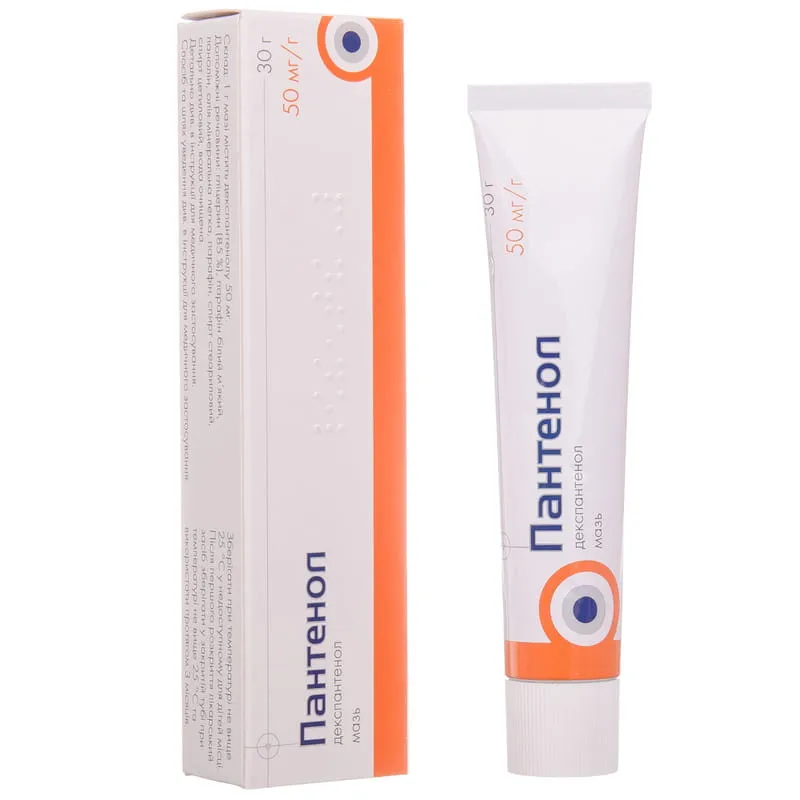
PANTHENOL
UkraineThe ointment is used to accelerate the healing of scratches and minor burns, for skin irritations (e.g., from the sun), for chronic ulcers, pressure sores, anal fissures, and cervical erosions. The drug also helps with dry and cracked skin, is used for the care of mammary glands in breastfeeding women, and for the prevention of diaper dermatitis in infants.
Frequently asked questions
How should Panthenol be used correctly?
When treating wounds and dry skin, apply the ointment once or several times a day as needed. For infant care, apply the ointment after each diaper change, and for breastfeeding women, after each feeding. When treating cervical erosions, application should take place under medical supervision.
Can the drug be used by children?
Yes, the drug can be used by children of various age groups, including infants.
What are the contraindications for use?
The product should not be used in case of hypersensitivity to its components. For patients with hemophilia, the drug is contraindicated for application to wounds due to the high risk of bleeding.
What are the possible side effects of Panthenol?
Possible allergic reactions include: contact or allergic dermatitis, itching, redness (erythema), eczema, rash, urticaria, skin irritation, or the appearance of blisters. If such symptoms occur, discontinue use and consult a physician.
Does the ointment interact with other medicines?
The drug may enhance the effect of certain muscle relaxants (succinylcholine chloride, decamethonium bromide) or weaken the effect of other muscle relaxants.
Are there any special precautions for use?
The ointment should not come into contact with the eyes and should not be applied to weeping wounds. When used in the genital area and the anus, the ointment may reduce the strength of condoms. Breastfeeding women must wash any remaining ointment from the nipples with warm water before feeding the child.
Instructions for use
INSTRUCTIONS FOR MEDICAL USE OF THE MEDICINAL PRODUCT PANTEHOL
Composition:
Active substance: dexpanthenol;
1 g of ointment contains dexpanthenol 50 mg;
Excipients: glycerol (85%), white soft paraffin, lanolin, light mineral oil, paraffin, stearyl alcohol, cetyl alcohol, purified water.
Pharmaceutical form. Ointment.
Main physicochemical properties: homogeneous pale-yellow ointment.
Pharmacotherapeutic group. Agents promoting wound healing (scar formation).
ATC code D03AX03.
Pharmacological properties.
Pharmacodynamics.
Dexpanthenol, the active substance of Panthenol ointment, is rapidly converted into pantothenic acid within cells and acts as a vitamin. Dexpanthenol is more readily absorbed than pantothenic acid following topical application.
Pantothenic acid is a component of coenzyme A (CoA), which plays a central role in the metabolism of every cell. Thus, pantothenic acid is essential for the restoration and regeneration of damaged skin and mucous membranes.
Pharmacokinetics.
Dexpanthenol is rapidly absorbed through the skin, then immediately converted into pantothenic acid and incorporated into the body's internal vitamin reservoir.
In the blood, pantothenic acid binds to plasma proteins (mainly to β-globulins and albumin). In healthy adult patients, the concentration is approximately 500–1000 μg/L and 100 μg/L in whole blood and blood serum, respectively.
Pantothenic acid is not metabolized in the body and is excreted unchanged. In adults, 2–7 mg of pantothenic acid is excreted daily in the urine; in children, 2–3 mg.
Clinical characteristics.
Indications.
Pantanol, ointment, should be used in the following cases:
- to accelerate healing and epithelialization of the skin in minor skin injuries (mild burns and abrasions); in skin irritations (e.g. due to radiotherapy, phototherapy, or ultraviolet radiation); in chronic skin ulcers and pressure sores; in anal fissures; in cervical erosions and after skin grafting;
- for prevention and treatment of skin fissures, roughness, and dryness;
- for regular prophylactic care of mammary glands in breastfeeding women, and for treatment of nipple irritations and fissures;
- for infant care: prevention and treatment of diaper dermatitis;
- for skin care in patients during and after local application of corticosteroids.
Contraindications.
Hypersensitivity to dexpanthenol or to any other component of the medicinal product.
Dexpanthenol is contraindicated for application on wounds in patients with hemophilia due to the high risk of bleeding.
Interaction with other medicinal products and other forms of interaction.
Dexpanthenol may enhance the effect of depolarizing muscle relaxants (e.g. succinylcholine chloride, decamethonium bromide) and reduce the effect of non-depolarizing muscle relaxants due to its ability to stimulate acetylcholine synthesis.
Special precautions for use.
When using the product, avoid contact with the eyes.
The ointment must not be applied to weeping wounds.
Lanolin, stearyl alcohol, and cetyl alcohol may cause local skin reactions (e.g. contact dermatitis).
When applying the ointment in the genital or anal area, and simultaneously using a condom, the strength of the condom may be reduced, and consequently its effectiveness impaired.
Use during pregnancy or breastfeeding.
There are no grounds to consider the topical use of the drug during pregnancy or breastfeeding as hazardous. During pregnancy, the drug should be used only as prescribed by a physician.
When used for the treatment of cracked nipples, any residual ointment must be removed with a wipe and the nipple and surrounding skin rinsed with warm boiled water before breastfeeding.
Ability to affect reaction rate while driving or operating machinery.
Has no effect.
Method of Administration and Dosage.
Treatment of superficial wounds of any origin and prevention of skin fissures, dryness, or roughness of the skin: apply Panthenol ointment once or several times daily, depending on need.
Care of mammary glands in breastfeeding women: apply the ointment to the nipples after each breastfeeding session.
Treatment of cervical mucosa defects: apply the ointment once or several times daily under medical supervision.
Care for infants: apply Panthenol ointment after each diaper (nappy) change.
Children. The drug can be used in children of all age groups, including infants.
Overdose.
The active ingredient of the medicinal product, dexpanthenol, is non-toxic. Hypervitaminosis has not been reported.
Side effects.
Immune system, and skin and subcutaneous tissue disorders.
Allergic reactions have been reported, including skin reactions: contact dermatitis, allergic dermatitis, pruritus, erythema, eczema, rash, urticaria, skin irritation, and vesicles.
If any adverse reactions occur, discontinue use of the medicinal product and consult a physician.
Shelf life. 5 years.
Storage conditions.
Store at a temperature not exceeding 25 °C in a place inaccessible to children.
After first opening, store the medicinal product in the closed tube at a temperature not exceeding 25 °C and use within 3 months.
Packaging. 30 g in a tube; 1 tube in a cardboard box.
Supply category. Over-the-counter.
Manufacturer. "Hemofarm" AD.
Manufacturer's address and location of business operations.
Beogradski put bb, 26300 Vrsac, Republic of Serbia.
Similar drugs
| Brand name | Dosage form | Active substance / Dosage | Manufacturer |
|---|---|---|---|
| BEPANTHEN® | ointment |
|
State Enterprise Grenzach Productions GmbH |
| PANTHENOL-TEVA | ointment |
|
Merkle GmbH (batch release; manufacturing of unpackaged products, primary and secondary packaging, quality control) |
The original data is available in the language of the country of manufacture.
Data source: State Register of Medicinal Products of Ukraine
Data last verified: August 13, 2026