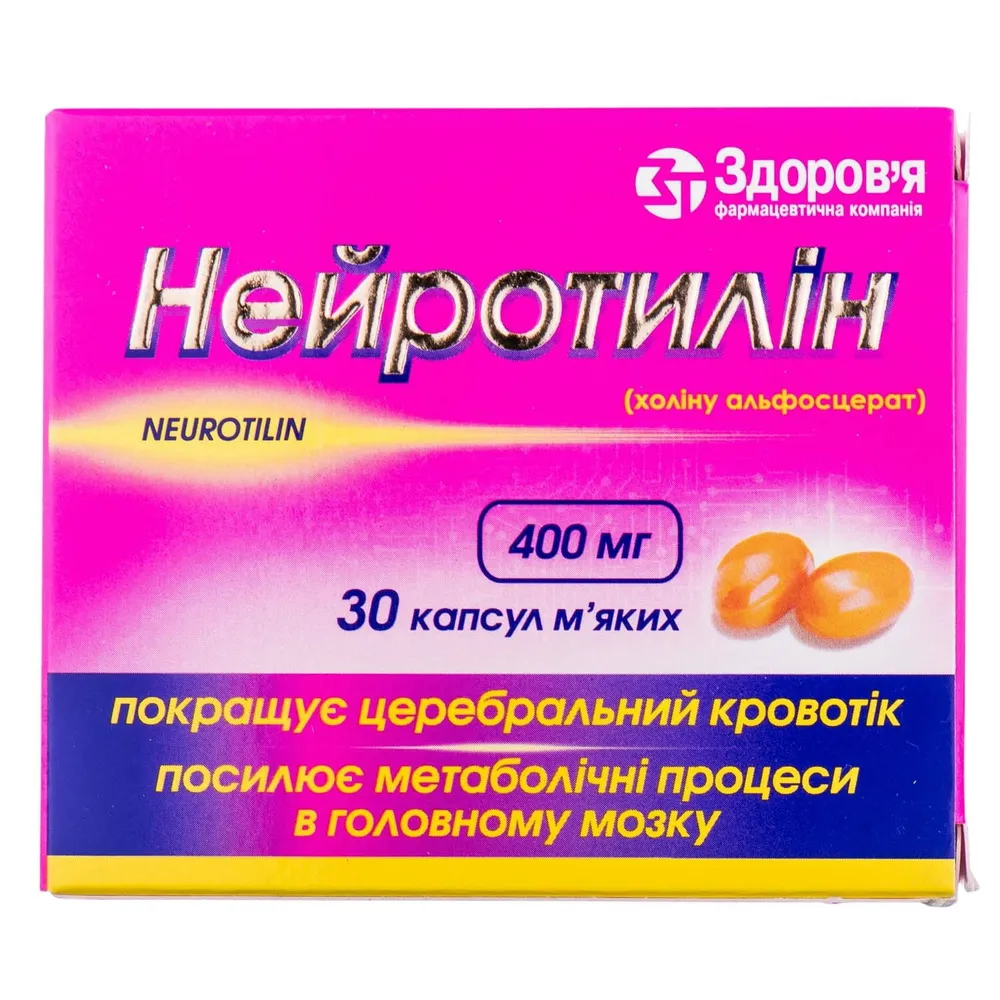
NEUROTYLIN
UkraineThe drug is prescribed for the treatment of cognitive impairments in elderly people accompanied by memory problems, disorientation, confusion, decreased concentration, as well as changes in emotional state (irritability, apathy, emotional instability).
Frequently asked questions
How should Neurotylin be taken correctly?
The drug is intended for adults only. It should be taken as 1 capsule 2 or 3 times a day. The duration of the treatment course must be determined by a physician.
What are the possible side effects of Neurotylin?
During the first days of treatment, temporary anxiety, agitation, or insomnia may occur. Nausea, headache, decreased blood pressure, and less frequently, abdominal pain and transient confusion may also occur. Allergic reactions are possible: rash, itching, skin redness, or swelling.
Who should not take this drug?
The drug is contraindicated in cases of known hypersensitivity to its components, during pregnancy or breastfeeding, as well as in patients with psychotic syndrome or severe psychomotor agitation.
Can I drive a vehicle during treatment?
The drug does not affect the ability to drive a vehicle or operate other mechanisms.
Does this drug interact with other medicines?
No clinically significant interactions with other medicinal products have been established.
What should be done in case of overdose?
If you experience nausea, restlessness, agitation, or insomnia due to an excessive dose, the dosage should be reduced. Therapy should be symptomatic.
Instructions for use
INSTRUCTIONS FOR MEDICAL USE OF THE MEDICINAL PRODUCT NEUROTILIN (NEUROTILIN)
Composition:
Active substance: choline alfoscerate;
1 capsule contains 400 mg of choline alfoscerate;
Excipients: glycerol; purified water; capsule shell containing: gelatin, sorbitol (E 420), glycerol, methylparaben (E 218), propylparaben (E 216), titanium dioxide (E 171), yellow iron oxide (E 172).
Pharmaceutical form. Soft capsules.
Main physicochemical characteristics: oval, opaque, soft gelatin capsules ranging from light yellow to dark yellow, containing a viscous solution.
Pharmacotherapeutic group.
Agents affecting the nervous system. Parasympathomimetics. Choline alfoscerate.
ATC code N07AX02.
Pharmacological properties.
Pharmacodynamics.
Neurolin is a drug belonging to the group of central cholinomimetics with a predominant effect on the central nervous system (CNS). Choline alfoscerate, as a choline carrier and a precursor of phosphatidylcholine, has the potential to prevent and correct biochemical impairments that are particularly significant among the pathogenic factors of psychorganic involutional syndrome; thus, it can influence reduced cholinergic tone and altered phospholipid composition of nerve cell membranes. The formulation contains 40.5% metabolically protected choline. Metabolic protection ensures the release of choline in the brain. Neurolin exerts a positive effect on memory functions and cognitive abilities, as well as on emotional state and behavior parameters, which deteriorated due to the development of brain involutional pathology.
The mechanism of action is based on the fact that after entering the body, choline alfoscerate is enzymatically cleaved into choline and glycerophosphate: choline participates in the biosynthesis of acetylcholine—one of the main mediators of nerve excitation; glycerophosphate serves as a precursor for neuronal membrane phospholipids (phosphatidylcholine). Thus, Neurolin improves nerve impulse transmission in cholinergic neurons, positively influences neuronal membrane plasticity and receptor function. Neurolin enhances cerebral blood flow, stimulates metabolic processes in the brain, activates the reticular formation structures of the brain, and restores consciousness in traumatic brain injury.
Pharmacokinetics.
On average, nearly 88% of the administered dose of Neurolin is absorbed. The drug accumulates predominantly in the brain (45% of the plasma concentration), lungs, and liver. Elimination of the drug occurs mainly via the lungs in the form of carbon dioxide (CO₂). Only 15% of the drug is excreted in urine and bile.
Clinical characteristics.
Indications.
Degenerative-involutional cerebral psycho-organic syndromes or secondary consequences of cerebrovascular insufficiency, i.e. primary and secondary cognitive impairments in elderly individuals characterized by memory disturbances, confusion, disorientation, reduced motivation and initiative, and decreased ability to concentrate; emotional and behavioral changes: emotional instability, irritability, indifference to the surrounding environment; pseudomelancholia in elderly individuals.
Contraindications.
Known hypersensitivity to the drug or its components.
Patients with psychotic syndrome or severe psychomotor agitation.
Pregnancy or breastfeeding period.
Interaction with other medicinal products and other forms of interactions.
Clinically significant interaction of the drug with other medicinal products has not been established.
Special precautions for use.
If a patient has known intolerance to certain sugars, medical advice should be sought before taking this medicinal product.
The presence of methylparaben (E 218) and propylparaben (E 216) in the formulation may cause allergic reactions (possibly delayed).
Use during pregnancy or breastfeeding.
The drug is contraindicated during pregnancy or breastfeeding.
Ability to influence reaction speed when driving or operating machinery.
The drug does not affect the ability to drive or operate machinery.
Dosage and Administration
The medication should be used only in adults.
Take 1 capsule 2 or 3 times daily.
The duration of treatment is determined individually by a physician.
Children. There is no experience with the use of Neurorilin in children.
Overdose.
In case of Neurorilin overdose, which may manifest as nausea, restlessness, excitement, or insomnia, the dose should be reduced. Treatment is symptomatic.
Adverse Reactions
The drug is generally well tolerated, even during prolonged use.
During the first days or weeks of treatment, the following adverse reactions may occur: anxiety, agitation, insomnia. These symptoms are temporary and do not require discontinuation of treatment; however, a temporary dose reduction may be considered.
Other possible adverse effects include nausea (mainly due to secondary dopaminergic activation), decreased blood pressure, headache, and very rarely abdominal pain and transient confusion. In such cases, the drug dosage should be reduced.
Hypersensitivity reactions may occur, including rash, pruritus, urticaria, angioedema, and skin redness. The drug may cause allergic reactions (possibly delayed-type).
Reporting of Adverse Reactions
Reporting of adverse reactions after drug registration is of great importance. It enables ongoing monitoring of the benefit-risk balance of the medicinal product. Healthcare and pharmacy professionals, as well as patients or their legal representatives, are encouraged to report all suspected adverse reactions and lack of efficacy via the Automated Pharmacovigilance Information System at: https://aisf.dec.gov.ua.
Shelf life. 2 years.
Storage conditions.
Store in the original packaging at a temperature not exceeding 25 °C.
Keep out of reach of children.
Packaging.
Soft capsules: No. 10 (10x1), No. 20 (10x2), No. 30 (10x3), No. 60 (10x6) in blisters, packed in a box.
Prescription status. Prescription only.
Manufacturer. LIMITED LIABILITY COMPANY "CORPORATION "ZDOROV'YA".
Manufacturer's address and location of operations.
100, Shevchenka St., lit. B-II (Building 4), Boryspil, Kyiv region, Ukraine, 08301.
Similar drugs
| Brand name | Dosage form | Active substance / Dosage | Manufacturer |
|---|---|---|---|
| CEREGLIA® | capsules, soft gelatin |
|
JSC "Kyiv Vitamin Plant" |
| GLIATILIN | capsules, soft gelatin |
|
Italfarmaco S.p.A. (responsible for primary and secondary packaging, quality control and batch release) |
| GLIATON | capsules, soft gelatin |
|
Farmak JSC |
The original data is available in the language of the country of manufacture.
Data source: State Register of Medicinal Products of Ukraine
Data last verified: August 13, 2026