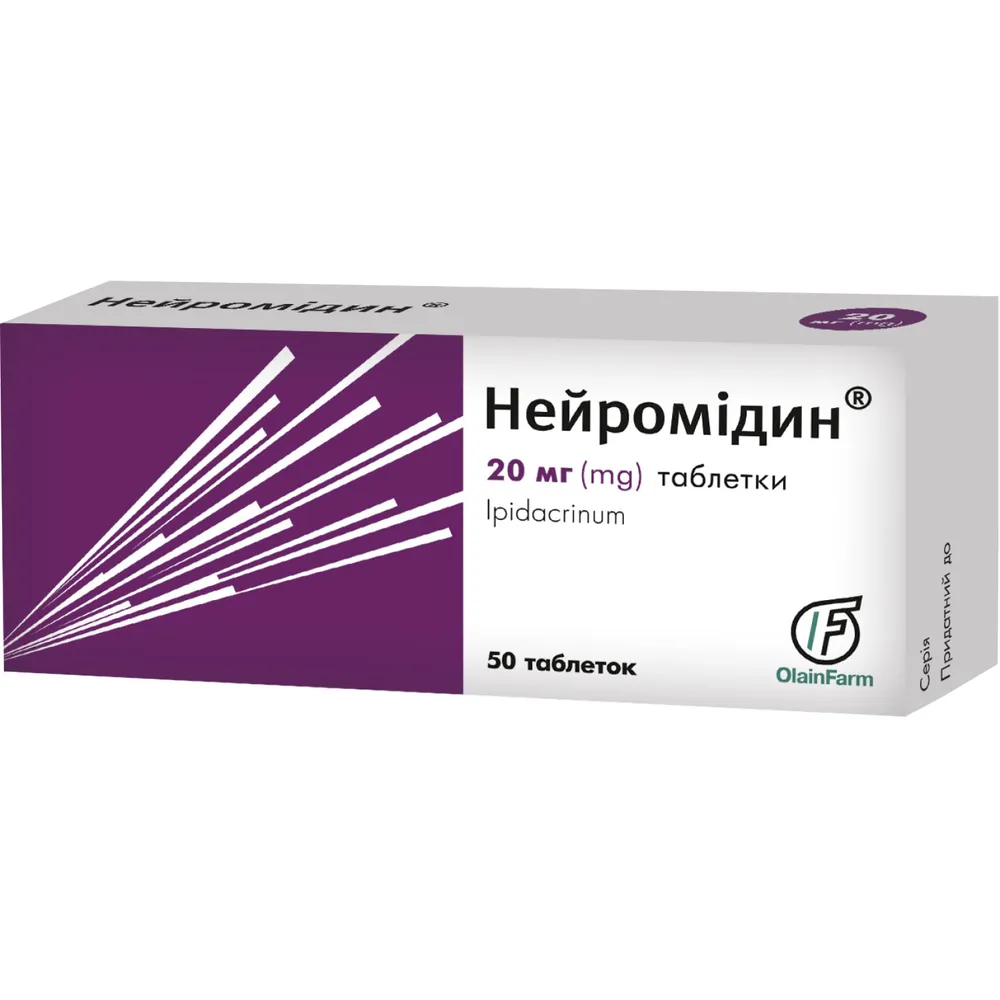
NEUROMIDIN®
UkraineThe drug is used for diseases of the peripheral nervous system (neuritis, polyneuropathies), myasthenia, bulbar paralysis, memory disorders (e.g., Alzheimer's disease), multiple sclerosis, and intestinal atony. It also aids in recovery after central nervous system damage.
Frequently asked questions
How should Neuromidin® be taken correctly?
The tablets are taken orally. The dosage depends on the disease: for example, for neuritis — 1 tablet 2-3 times a day; for myasthenia — 1 to 2 tablets 2-3 times a day (in severe cases, the dose may be higher as prescribed by a physician). In Alzheimer's disease, the dose is gradually increased over several weeks. For children aged 12 and older, the prescribed dose is 1 tablet 2-3 times a day.
Who should not take this drug?
Contraindications include hypersensitivity to the components, epilepsy, extrapyramidal disorders, angina pectoris, severe bradycardia, bronchial asthma, vestibular disorders, mechanical obstruction of the intestines or urinary tract, as well as acute gastric or duodenal ulcers. The drug is prohibited for pregnant and breastfeeding women.
What are the possible side effects of Neuromidin®?
The most common side effects may include palpitations, bradycardia (slowed heart rate), chest pain, increased salivation, and nausea. Increased sweating, dizziness, headache, drowsiness, muscle spasms, or allergic reactions (rash, itching) are also possible.
Can the drug be combined with other agents?
Neuromidin® can be used together with nootropic drugs; however, it may enhance the effects of agents that depress the central nervous system. Caution should be exercised when combining it with β-adrenoblockers and other cholinergic agents. Alcohol enhances the side effects of the drug.
How does the drug affect driving?
Since the drug may cause drowsiness and a sedative effect, caution should be exercised when driving vehicles.
Instructions for use
INSTRUCTIONS FOR MEDICAL USE OF THE MEDICINAL PRODUCT NEIROMIDIN® (NEIROMIDIN)
Composition:
Active substance: ipidacrine;
1 tablet contains ipidacrine hydrochloride 20 mg;
Excipients: lactose monohydrate; potato starch; calcium stearate.
Pharmaceutical form. Tablets.
Main physicochemical properties: flat cylindrical tablets of white or almost white color with a bevel.
Pharmacotherapeutic group.
Other agents acting on the nervous system. Parasympathomimetics. Anticholinesterase agents. ATC code N07A A.
Pharmacological properties.
Pharmacodynamics.
Neuromidin® is a drug that has a biologically favorable combination of two molecular effects – blockade of membrane potassium permeability and inhibition of cholinesterase. In this case, blockade of membrane potassium permeability plays the decisive role.
Blockade of membrane potassium permeability primarily leads to prolongation of the repolarization phase of the action potential of the excited membrane and increased activity of the presynaptic axon. This results in increased calcium ion influx into the presynaptic terminal, which in turn enhances neurotransmitter release into the presynaptic cleft in all synapses. Elevated neurotransmitter concentration in the synaptic cleft promotes stronger stimulation of the postsynaptic cell due to neurotransmitter-receptor interaction. In cholinergic synapses, cholinesterase inhibition leads to even greater accumulation of neurotransmitter in the synaptic cleft and enhanced functional activity of the postsynaptic cell (muscle contraction, impulse conduction).
Neuromidin® enhances the effects of acetylcholine, adrenaline, serotonin, histamine, and oxytocin on smooth muscles.
Neuromidin® exhibits the following significant pharmacological effects:
- stimulation and restoration of neuromuscular transmission;
- restoration of impulse conduction in the peripheral nervous system after its blockade by various agents (trauma, inflammation, local anesthetics, certain antibiotics, potassium chloride, toxins, etc.);
- enhanced contractility of smooth muscle organs;
- moderately stimulates the central nervous system with specific sedative effects;
- improved memory and learning ability;
- analgesic effect.
The drug has no teratogenic, embryotoxic, mutagenic, or carcinogenic effects, nor does it have allergenic, immunotoxic effects, or affect the endocrine system.
Pharmacokinetics.
After administration, the drug is rapidly absorbed from the gastrointestinal tract. Maximum concentration of the active substance in blood plasma is reached within 1 hour after administration. From the blood, Neuromidin® rapidly distributes into tissues; at the steady-state phase, only 2% of the drug remains in blood serum, with a distribution half-life of 40 minutes. 40–50% of the active substance is bound to plasma proteins. Neuromidin® is predominantly absorbed from the duodenum, to a lesser extent from the small and ileal intestine, and only 3% of the dose is absorbed in the stomach. Elimination of Neuromidin® from the body occurs through a combination of renal and extrarenal mechanisms (biotransformation, biliary secretion), with urinary excretion being predominant. Only 3.7% of Neuromidin® is excreted unchanged in urine, indicating rapid metabolism of the drug in the body.
Clinical characteristics.
Indications.
Diseases of the peripheral nervous system (neuropathies, neuritis, polyneuritis and polyneuropathies, myelopolyradiculoneuritis), myasthenia and myasthenic syndrome of various etiologies.
Bulbar palsies and pareses.
Memory disorders of various etiologies (Alzheimer's disease and other forms of senile dementia); in delayed mental development in children.
Recovery period following organic lesions of the central nervous system associated with motor disturbances;
In complex therapy of multiple sclerosis and other forms of demyelinating diseases of the nervous system.
Intestinal atony.
Contraindications.
Hypersensitivity to ipidacrine and other components of the drug.
Epilepsy.
Extrapyramidal disorders with hyperkinesia.
Angina pectoris.
Marked bradycardia.
Bronchial asthma.
Vestibular disorders.
Mechanical intestinal or urinary tract obstruction.
Peptic ulcer of the stomach or duodenum in the acute phase.
Interaction with other medicinal products and other types of interactions.
Neuromidin® enhances the sedative effect when used in combination with agents that suppress the central nervous system. The effect and adverse reactions are enhanced when used concomitantly with other cholinesterase inhibitors and M-cholinomimetic agents.
In patients with myasthenia, the risk of developing a "cholinergic" crisis increases if Neuromidin® is used simultaneously with cholinergic agents. The risk of bradycardia increases if β-adrenoblockers are used prior to starting treatment with Neuromidin®.
Neuromidin® can be used in combination with nootropic agents.
Alcohol enhances the adverse effects of the drug.
Cerebrolysin enhances the psychotropic effect of Neuromidin®.
Special precautions for use.
Use with caution in patients with a history of gastric or duodenal peptic ulcer, respiratory tract disorders, including acute respiratory infections, cardiovascular diseases not related to coronary pain, and in patients with thyrotoxicosis.
The drug contains lactose; therefore, it should not be used in patients with rare hereditary forms of galactose intolerance, lactase deficiency, or glucose-galactose malabsorption syndrome.
Use during pregnancy or breastfeeding.
Neuromidin® increases uterine tone and may cause premature labor; therefore, the use of the drug is contraindicated during pregnancy.
The use of the drug is contraindicated during breastfeeding.
Effect on the ability to drive or operate machinery.
Neuromidin® may produce sedative effects; therefore, caution should be exercised when driving or operating machinery.
Method of Administration and Dosage
Neuromidin® tablets are intended for oral administration.
For neuritis – 1 tablet 2–3 times daily. Treatment duration: 10–15 days for acute neuritis and up to 20–30 days for chronic neuritis. If necessary, the treatment course may be repeated 2–3 times with 2–4 week intervals until maximum therapeutic effect is achieved.
For polyradiculoneuritis and plexoneuritis, and for paresis – 1 tablet 2–3 times daily for 30–40 days. Treatment courses should be repeated multiple times with 1–2 month intervals until therapeutic effect is achieved.
For myasthenia and myasthenic syndromes – 1–2 tablets 2–3 times daily. In severe cases, the daily dose may be increased up to 200 mg (2 tablets 5 times daily, every 2–3 hours). Treatment should be administered in courses, alternating with classical anticholinesterase agents.
For multiple sclerosis and other forms of demyelinating nervous system disorders, bulbar palsy – 1 tablet 3–5 times daily for 60 days, 2–3 times per year.
For Alzheimer's disease and other forms of age-related cognitive impairment – start with a dose of 1–2 tablets daily, divided into 2 doses, gradually increasing the dose by 2 tablets per week up to 6–10 tablets daily (2 tablets 3–5 times daily). Treatment duration ranges from 4 months to 1 year. Intermittent (course-based) therapy is possible – 4–5 months of treatment followed by a 1–2 month break.
For organic CNS disorders associated with motor disturbances – 1 tablet 2–3 times daily. The average treatment course is 30 days. The course may be repeated if necessary.
For intestinal atony – 1 to 3 tablets daily, divided into 3 doses. Treatment duration is 1–3 weeks.
Children aged 12 years and older with delayed mental development or peripheral nervous system disorders – Neuromidin® should be administered at a dose of 1 tablet (20 mg) 2–3 times daily. Treatment duration is 1–2 months, depending on the clinical presentation.
Children
The drug may be used in children aged 12 years and older.
Overdose
In cases of severe intoxication, cholinergic crisis may develop.
Symptoms: bronchospasm, lacrimation, excessive sweating, miosis, nystagmus, increased gastrointestinal peristalsis, spontaneous defecation and urination, vomiting, jaundice, bradycardia, cardiac conduction disturbances, arrhythmias, decreased arterial blood pressure, restlessness, anxiety, excitement, fear sensation, ataxia, seizures, coma, speech disturbances, drowsiness, general weakness.
Treatment: symptomatic therapy. Use of m-cholinergic blockers (atropine, cycloheptoline, metacycline).
Side effects
Classification of side effect frequencies: very common (≥ 1/10); common (≥ 1/100 to < 1/10); uncommon (≥ 1/1000 to < 1/100); rare (≥ 1/10,000 to < 1/1000); very rare (< 1/10,000), including single cases; unknown (cannot be estimated from available data).
Neuromidin® is generally well tolerated. Possible side effects are associated with stimulation of M-cholinoreceptors.
Cardiac disorders: common – palpitations, bradycardia, chest pain.
Nervous system disorders: uncommon (with high doses) – dizziness, headache, drowsiness, general weakness, muscle cramps.
Respiratory, thoracic and mediastinal disorders: uncommon – increased bronchial secretion, bronchospasm.
Gastrointestinal disorders: common – salivation, nausea; uncommon (with high doses) – vomiting; rare – diarrhea, epigastric pain.
Hepatobiliary disorders: jaundice (frequency unknown).
Skin and subcutaneous tissue disorders: common – increased sweating; uncommon (after high doses) – allergic reactions such as urticaria, angioneurotic edema, pruritus, rash.
Reproductive system disorders: increased uterine tone.
Salivation and bradycardia may be reduced by anticholinergic agents (e.g., atropine). If adverse effects occur, the dose should be reduced or a short break in treatment (1–2 days) should be taken.
Shelf life. 5 years.
Storage conditions.
Store in a dry, light-protected place at a temperature not exceeding 25 °C.
Keep out of reach of children.
Packaging.
10 tablets per blister. 5 blisters per cardboard pack.
Prescription status.
Prescription only.
Manufacturer.
JSC "Olfa" / Olpha AS.
Manufacturer's name and address of the place of business.
5 Rupnicu Street, Olaine, Olaine region, LV-2114, Latvia / Rupnicu iela 5, Olaine, Olaines novads, LV-2114, Latvia.
Similar drugs
| Brand name | Dosage form | Active substance / Dosage | Manufacturer |
|---|---|---|---|
| IPIDACRIN-HEALTHY | tablets |
|
LLC "Corporation "Zdorovya" |
| IPIGRIX | tablets |
|
JSC "Grendix" |
| MEDIATORN® | tablets |
|
PJSC "Kyivmedpreparat" |
The original data is available in the language of the country of manufacture.
Data source: State Register of Medicinal Products of Ukraine
Data last verified: August 13, 2026