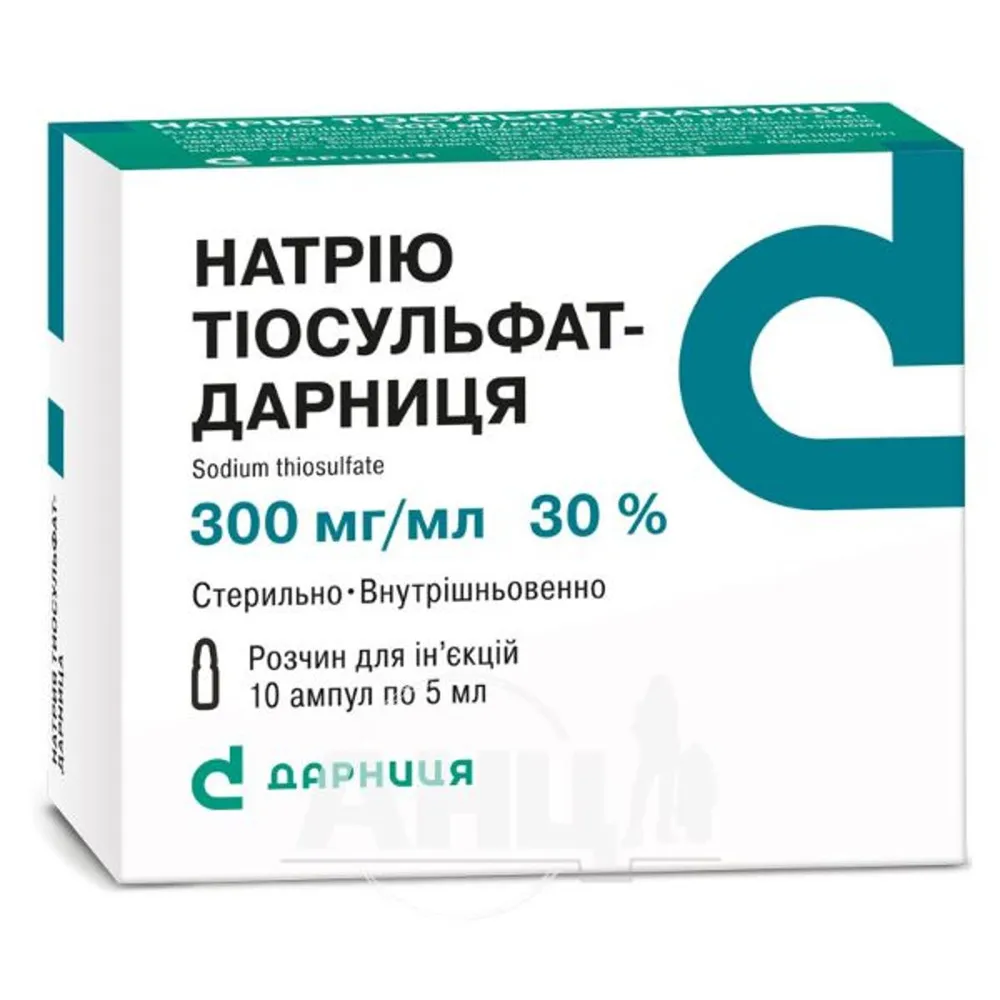
SODIUM THIOSULFATE-DARNITSA
UkraineThe drug is used as an antidote in poisonings by arsenic, mercury, lead, iodine, bromine compounds and their salts, as well as cyanide and its salts.
Frequently asked questions
What dosage of Sodium thiosulfate-darnitsa should be used?
In case of poisoning by arsenic, mercury, lead, iodine, or bromine, the drug is administered as an intravenous bolus at a dose of 1.5–3 g (5–10 ml). In case of poisoning by cyanide and its salts, it is administered slowly intravenously at a dose of 15 g (50 ml).
What side effects may occur from Sodium thiosulfate-darnitsa?
Possible side effects include shortness of breath, nausea, vomiting, headache, dizziness, impaired consciousness, decreased blood pressure (up to collapse), tachycardia, as well as skin reactions (itching, rash, urticaria) and allergic reactions.
Who should not take this drug?
The drug should not be used in case of hypersensitivity to its components, and in children due to a lack of clinical data.
Can the drug be taken during pregnancy or breastfeeding?
During these periods, the drug may only be prescribed for life-saving indications.
How does the drug interact with other medicines?
It may weaken the effect of drugs whose metabolism involves a redox stage. Additionally, iodides and bromides may not manifest their properties when used concurrently with it. The drug must not be mixed with nitrite or nitrate solutions or with other agents in the same syringe.
What precautions apply to elderly people and patients with kidney disease?
In patients with impaired renal function, the risk of toxic reactions may be higher. In elderly people, decreased renal function is more common, so caution should be exercised regarding dosage and renal status should be monitored.
Can you drive a car during treatment?
Since data on the effect on reaction speed are unavailable, one should refrain from driving motor vehicles or working with mechanisms that require high concentration during treatment.
Instructions for use
INSTRUCTIONS FOR MEDICAL USE OF THE MEDICINAL PRODUCT SODIUM THIOSULFATE-DARNITSA (SODIUMTHIOSULFATE-DARNITSA)
Composition:
Active substance: sodium thiosulfate;
1 ml of solution contains sodium thiosulfate 300 mg;
Excipients: sodium hydrogencarbonate, disodium edetate, water for injections.
Pharmaceutical form. Injection solution.
Main physicochemical properties: clear, colorless or slightly colored liquid.
Pharmacotherapeutic group. Antidotes. ATC code V03A B06.
Pharmacological properties.
Pharmacodynamics.
Sodium thiosulfate exhibits detoxifying, anti-inflammatory, and desensitizing effects. It acts as a donor of sulfur ions. It is used as a substrate by the body's rhodanese system for the synthesis of non-toxic thio-compounds. It serves as an antidote in poisoning with hydrocyanic acid and cyanides, arsenic, lead, mercury, and compounds of iodine and bromine. In poisoning with arsenic, mercury, and lead compounds, it forms non-toxic sulfides. In cyanide poisoning, it forms less toxic rhodanide compounds.
Pharmacokinetics.
After intravenous administration, it rapidly enters the extracellular fluid and is excreted unchanged in the urine. The half-life is 0.65 hours.
Clinical characteristics.
Indications.
Poisoning with arsenic, mercury, and lead compounds; hydrocyanic acid and its salts; iodine, bromine, and their salts.
Contraindications.
Hypersensitivity to the components of the medicinal product.
Interaction with other medicinal products and other forms of interactions.
Concomitant use of medicinal products whose metabolism proceeds via the rhodanation step leads to weakening of their pharmacological effects.
Medicinal products that are iodides or bromides may fail to exhibit their pharmacological properties when used concurrently with sodium thiosulfate.
Special precautions for use.
Use with caution in patients with arterial hypertension, liver cirrhosis, congestive heart failure, renal insufficiency, or pregnancy toxemia, as worsening of the patient's condition may occur.
In cyanide poisoning, treatment must initially involve administration of methemoglobin-forming agents, antidotes for cyanide, or amyl nitrite, followed by intravenous administration of sodium thiosulfate.
Prior to use, inspect the contents of the ampoule. The medicinal product should not be used if precipitate is present.
Patients with impaired renal function. Sodium thiosulfate is predominantly excreted via the kidneys, and the risk of toxic reactions to the drug may be higher in patients with impaired renal function.
Elderly patients. Elderly patients are more likely to have decreased renal function; therefore, caution should be exercised in dose selection and renal function should be monitored.
Use during pregnancy or breastfeeding.
The medicinal product may be prescribed during pregnancy or breastfeeding only if clearly needed and justified by life-threatening indications.
Ability to influence reaction rate when driving vehicles or operating machinery.
Clinical data are lacking; therefore, during treatment patients should refrain from driving vehicles or operating machinery requiring high attention concentration and rapid psychomotor reactions.
Administration and Dosage
In cases of poisoning with arsenic, mercury, lead, iodine, bromine, and their salts, administer the medicinal product intravenously as a bolus injection at a dose of 1.5–3 g (5–10 ml of a 30% solution). In cases of poisoning with hydrocyanic acid and its salts, administer the medicinal product slowly intravenously at a dose of 15 g (50 ml of a 30% solution).
The medicinal product should be administered throughout the entire toxicogenic period (from the onset of the first clinical symptoms of poisoning until complete elimination of the toxin from the body).
Children
The medicinal product is not recommended for use in children due to the lack of clinical data.
Overdose
Symptoms: Arthralgia, hyperreflexia, seizures, psychotic behavior including agitation and hallucinations; nausea, vomiting; intensification of adverse reactions.
Treatment: Hemodialysis; supportive therapy.
Adverse reactions.
Respiratory, thoracic and mediastinal disorders: Dyspnea, labored breathing.
Gastrointestinal disorders: Nausea, vomiting.
Nervous system disorders: Headache, dizziness, impaired consciousness, tinnitus, blurred vision.
Cardiovascular disorders: Decreased blood pressure up to collapse, loss of consciousness, tachycardia.
Immune system disorders: Hypersensitivity reactions, including anaphylactic reactions, arthralgia, fever.
Skin and subcutaneous tissue disorders: Itching, rash (including maculopapular), urticaria, hyperemia, sensation of heat.
General disorders and administration site conditions: Injection site reactions, general weakness, increased diuresis.
Shelf life. 3 years.
Storage conditions.
Store in the original packaging at a temperature not exceeding 25 °C. Do not freeze.
Keep out of reach of children.
Incompatibility.
Incompatible with nitrite and nitrate solutions. The medicinal product should not be mixed in the same syringe with other medicinal products.
Packaging.
5 ml in a vial; 5 vials in a contour cell pack, 2 contour cell packs in a carton.
Prescription status. Prescription only.
Manufacturer.
JSC "Pharmaceutical company "Darnytsia".
Manufacturer's address and place of business.
13, Borispilska St., Kyiv, 02093, Ukraine.
Similar drugs
| Brand name | Dosage form | Active substance / Dosage | Manufacturer |
|---|---|---|---|
| SODIUM THIOSULFATE-BIOLIC | solution for injection |
|
Biolik Pharma LLC |
The original data is available in the language of the country of manufacture.
Data source: State Register of Medicinal Products of Ukraine
Data last verified: August 13, 2026