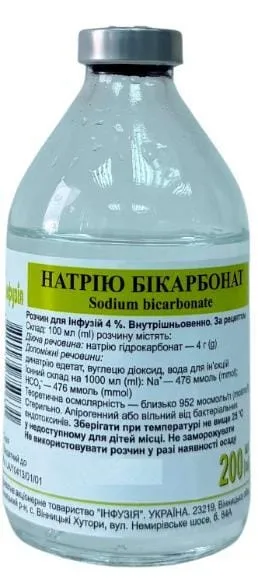
SODIUM BICARBONATE
UkraineThe drug is used to restore the alkaline state of the blood and to correct metabolic acidosis. It is prescribed for intoxications, severe burns, shock, diabetic coma, severe vomiting, diarrhea, massive blood loss, as well as for liver or kidney damage, or severe hypoxia in newborns. An absolute indication is a blood pH below 7.2.
Frequently asked questions
How should Sodium bicarbonate be taken correctly?
The drug is administered via infusion: adults — intravenously or rectally, children — intravenously only. Depending on the patient's condition, the solution is used undiluted or mixed with a 5% glucose solution in a 1:1 ratio. The dosage and infusion rate are determined by a physician based on blood tests.
What side effects can Sodium bicarbonate cause?
Possible side effects include nausea, vomiting, stomach pain, anorexia, headache, restlessness, increased blood pressure, convulsions, and the development of alkalosis.
Who should not use this drug?
Contraindications include metabolic or respiratory alkalosis, as well as low potassium levels (hypokalemia) and high sodium levels (hypernatremia) in the body.
Can this agent be combined with other medicines?
The drug may enhance the effect of the antihypertensive agent reserpine. It is also important not to mix the solution with phosphates, acids (e.g., ascorbic acid), alkaloids, cardiac glycosides, or salts of calcium, magnesium, and heavy metals, as this may lead to precipitation.
What should be done in case of overdose?
If the dose is exceeded, administration of the drug should be discontinued. Excitement, convulsions, increased sodium levels, and increased blood pH may be observed. In such cases, administration of an isotonic sodium chloride solution, 5% glucose solution, or calcium gluconate (for adults) may be required.
What special precautions exist during treatment?
During use, it is necessary to constantly monitor the acid-base and electrolyte balance of the blood. In patients with heart or kidney diseases, the development of edema and heart failure is possible.
Instructions for use
INSTRUCTIONS FOR MEDICAL USE OF THE MEDICINAL PRODUCT SODIUM BICARBONATE (SODIUM BICARBONATE)
Composition:
Active ingredient: sodium bicarbonate;
100 ml of solution contain 4 g of sodium bicarbonate;
Excipients: edetate disodium, carbon dioxide, water for injections.
Ion composition per 1000 ml of the product: Na+ — 476 mmol, HCO3− — 476 mmol.
Pharmaceutical form. Infusion solution.
Main physicochemical properties: clear, colorless liquid.
Theoretical osmolarity — approximately 952 mosmol/L, pH 7.4–8.5.
Pharmacotherapeutic group. Plasma substitutes and perfusion solutions. Electrolyte solutions. ATC code B05XA02.
Pharmacological properties.
Pharmacodynamics.
A drug for restoration of blood alkaline balance and correction of metabolic acidosis. Upon dissociation of sodium bicarbonate, bicarbonate anions are released; they bind hydrogen ions to form carbonic acid, which then decomposes into water and carbon dioxide that is exhaled during respiration. As a result, blood pH shifts toward the alkaline side, and blood buffering capacity increases.
The medicinal product also enhances excretion of sodium and chloride ions from the body, increases osmotic diuresis, alkalinizes urine, and prevents precipitation of uric acid in the urinary system. The bicarbonate anion does not penetrate into cells.
Pharmacokinetics.
Not studied.
Clinical characteristics.
Indications.
Uncompensated metabolic acidosis, which may occur in intoxications of various etiologies, severe postoperative course, extensive burns, shock, diabetic coma, prolonged diarrhea, intractable vomiting, acute massive blood loss, severe liver and kidney damage, prolonged critical conditions, severe neonatal hypoxia. Absolute indication is blood pH reduction below 7.2 (normal range 7.37–7.42).
Contraindications.
Metabolic or respiratory alkalosis, hypokalemia, hypernatremia.
Special precautions.
The medicinal product should be administered while monitoring acid-base and electrolyte balance through laboratory tests.
Interaction with other medicinal products and other forms of interaction.
May potentiate the antihypertensive effect of reserpine.
Special precautions for use.
It is necessary to monitor the acid-base and electrolyte balance of the blood. In patients with concomitant heart or kidney diseases, heart failure and edema may develop. If acidosis is corrected too rapidly, especially in the presence of impaired lung ventilation, rapid release of CO₂ may exacerbate cerebral acidosis.
Use during pregnancy or breastfeeding.
There is no experience with the use of the medicinal product during pregnancy or breastfeeding. It should be administered only if the expected benefit to the mother outweighs the potential risk to the fetus. The drug may be used during breastfeeding only under life-threatening conditions.
Ability to influence reaction rate while driving or operating machinery.
Data are lacking due to the exclusive use of the medicinal product under hospital conditions.
Administration and Dosage
The solution should be administered while monitoring the acid-base status of the blood. Administer intravenously or rectally by infusion in adults; in children — intravenously by infusion. Depending on the severity of acidosis, the preparation may be used undiluted or diluted with 5% glucose solution in a 1:1 ratio.
In adults, administer intravenously at a rate of approximately 60 drops per minute, up to 200 mL per day. The frequency of administration depends on acid-base balance parameters.
In newborns, administer intravenously at a dose of 4–5 mL per 1 kg of body weight; in children of other age groups — at a dose of 5–7 mL per 1 kg of body weight. Subsequent administration is determined by acid-base balance parameters. The maximum daily dose in adults is 200 mL. The duration of treatment is determined by the physician based on acid-base balance parameters.
Children. The drug may be used in pediatric practice.
Overdose
Exceeding the recommended dose may lead to the development of hyperalkalosis, hypernatremia, hyperosmia, and tetanic seizures. If signs of alkalosis occur (seizures, including tetany, excitability, decreased levels of potassium and calcium, elevated sodium levels in blood, increased pH), discontinue administration of the drug. If necessary, administer isotonic sodium chloride solution or 5% glucose solution. In case of risk of tetany development, administer 1–3 g of calcium gluconate intravenously to adults.
Adverse reactions.
Nausea, vomiting, anorexia, stomach pain, headache, restlessness, arterial hypertension, seizures, alkalosis.
Shelf life. 2 years.
Storage conditions. Store at a temperature not exceeding 25 °C, in a place inaccessible to children. Do not freeze. Do not use the solution if sediment is present.
Incompatibility. Acidic substances (ascorbic acid, nicotinic acid, and other acids), alkaloids (atropine, apomorphine, caffeine, theobromine, papaverine), cardiac glycosides, calcium, magnesium, and heavy metal salts (iron, copper, zinc) must not be dissolved in sodium bicarbonate solution, as precipitation or hydrolysis of organic compounds may occur. Do not mix with phosphate-containing solutions.
Packaging. 100 mL, 200 mL, or 400 mL of the preparation in bottles.
Prescription status. Prescription only.
Manufacturer. Private Joint-Stock Company "Infuziya".
Manufacturer's address and location of business activity.
84A Nemirivske Highway, Vinnytski Khutory Village, Vinnytsia District, Vinnytsia Oblast, 23219, Ukraine.
Similar drugs
| Brand name | Dosage form | Active substance / Dosage | Manufacturer |
|---|---|---|---|
| SODA-BUFFER® | solution for infusion |
|
Yuria-Pharm LLC |
| SODIUM HYDROGENCARBONATE | solution for infusion |
|
Yuria-Pharm LLC |
The original data is available in the language of the country of manufacture.
Data source: State Register of Medicinal Products of Ukraine
Data last verified: August 13, 2026