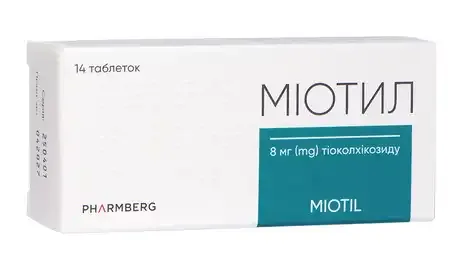
MYOTIL
UkraineThe drug is used as adjunctive therapy for painful muscle contractures arising from acute spinal pathologies in adults and adolescents aged 16 years and older.
Frequently asked questions
How should Myotil be taken correctly?
Tablets should be swallowed whole with a glass of water. The recommended dose is 8 mg every 12 hours (maximum 16 mg per day). The course of treatment should not exceed 7 consecutive days.
Who should not take this drug?
Contraindicated in cases of hypersensitivity to the components, flaccid paralysis or muscle hypotonia, as well as during pregnancy and breastfeeding. The drug should also not be taken by individuals with intolerance to galactose, lactase, or glucose-galactose malabsorption syndrome.
What are the possible side effects of Myotil?
Possible side effects include drowsiness, convulsions (especially in patients with epilepsy), allergic reactions (itching, rash, Quincke's edema), gastrointestinal disorders (abdominal pain, diarrhea, nausea, vomiting), and liver damage (hepatitis).
Can the drug be combined with other medicines?
Caution should be exercised when taken concurrently with other muscle relaxants, central nervous system depressants (including alcohol), antihypertensive agents, and curare-like drugs, as this may enhance the effect on the nervous system and lower blood pressure. Co-administration with anticoagulants increases the risk of bleeding.
What are the important precautions regarding pregnancy planning?
Due to the risk of impaired fetal development, women of reproductive age should use effective contraception during treatment and for 1 month after completion. Men must use contraception during administration and for 3 months after completing the course.
Instructions for use
for medical use of the medicinal product MIOTIL
Composition:
Active substance: thiocolchicoside;
1 tablet contains 8 mg of thiocolchicoside;
Excipients: lactose monohydrate, microcrystalline cellulose (type 101), microcrystalline cellulose (type 102), povidone (type K30), colloidal anhydrous silicon dioxide, crospovidone (type A), magnesium stearate.
Pharmaceutical form. Tablets.
Main physicochemical properties: yellow, round, biconvex tablets.
Pharmacotherapeutic group.
Muscle relaxants with central mechanism of action. ATC code M03BX05.
Pharmacological Properties
Pharmacodynamics
Thiocolchicoside is a semi-synthetic myorelaxant derived from the glycoside colchicoside. It exhibits selective affinity for gamma-aminobutyric acid (GABA) and glycine receptors.
The myorelaxant effect is predominantly exerted at the supraspinal level through complex regulatory mechanisms; a glycine-mediated mechanism of action is also not excluded.
Binding of thiocolchicoside to GABA receptors is qualitatively and quantitatively distinct from that of its active metabolite—glucuronidated derivative.
Thiocolchicoside and its derivatives do not exhibit sedative effects.
Pharmacokinetics
Absorption
After intramuscular administration, maximum plasma concentration (Cmax) of thiocolchicoside is observed within 30 minutes: levels of 113 ng/mL are reached after a 4 mg dose, and 175 ng/mL after an 8 mg dose. Corresponding values for the area under the concentration-time curve (AUC) are 283 ng·h/mL and 417 ng·h/mL, respectively.
The pharmacologically active metabolite SL18.0740 is also detected at lower concentrations, with a Cmax of 11.7 ng/mL reached 5 hours after administration, and an AUC of 83 ng·h/mL.
Data on the inactive metabolite SL59.0955 are not available.
The pharmacologically active metabolite SL18.0740 is also observed at lower concentrations, with a Cmax of 11.7 ng/mL reached 5 hours after dosing, and an AUC of 83 ng·h/mL. No data are available for the inactive metabolite SL59.0955.
Following oral administration of thiocolchicoside, only two metabolites are detected in plasma: the pharmacologically active metabolite SL18.0740 and the inactive metabolite SL59.0955. Maximum plasma concentrations of both metabolites are reached approximately 60 minutes after administration. After a single 8 mg oral dose, Cmax and AUC values for metabolite SL18.0740 are approximately 60 ng/mL and 130 ng·h/mL, respectively. For metabolite SL59.0955, values are much lower: Cmax is approximately 13 ng/mL, and AUC ranges from 15.5 ng·h/mL (up to 3 hours) to 39.7 ng·h/mL (up to 24 hours).
Distribution
The volume of distribution of thiocolchicoside is approximately 42.7 L after administration of an 8 mg dose. Data on the volume of distribution of metabolites are not available.
Metabolism
Following oral administration, thiocolchicoside is rapidly metabolized to aglycone-3-dimethylthiocolchicoside (SL59.0955). This occurs primarily via intestinal metabolism, explaining the absence of unchanged thiocolchicoside after oral administration. Metabolite SL59.0955 is glucuronidated to SL18.0740, which has equivalent pharmacological activity to thiocolchicoside and thus provides pharmacological activity following oral administration of thiocolchicoside. SL59.0955 is also demethylated to form dimethylthiocolchicine.
Elimination
After oral administration of 14C-thiocolchicoside, the compound is primarily excreted in feces (79%), with only 20% eliminated in urine. Unchanged thiocolchicoside is not excreted in urine or feces. Metabolites SL18.0740 and SL59.0955 are detected in both urine and feces, whereas didemethylthiocolchicine is excreted only in feces.
After oral administration of thiocolchicoside, the elimination half-life of metabolite SL18.0740 is 3.2–7 hours, and that of metabolite SL59.0955 is on average 0.8 hours.
Clinical characteristics.
Indications.
Adjunctive therapy for painful muscular contractures in acute spinal disorders in adults and adolescents aged 16 years and older.
Contraindications.
- Hypersensitivity to the active substance or to any of the excipients of the medicinal product;
- Flaccid paralysis or muscular hypotonia;
- Pregnancy and breastfeeding.
Contraindicated in women of childbearing potential who are not using effective contraception during treatment with thiocolchicoside and for 1 month after the end of treatment (see sections "Special precautions" and "Use in pregnancy or lactation").
Contraindicated in men who are not using effective contraception during treatment with thiocolchicoside and for 3 months after the end of treatment (see sections "Special precautions" and "Use in pregnancy or lactation").
Interaction with other medicinal products and other forms of interaction.
Information regarding interactions is lacking. However, caution is recommended when administering Miotil concomitantly with other muscle relaxants.
Concomitant use with medicinal products that depress the central nervous system (CNS), including alcohol, antihypertensive agents, and curare-like compounds, may enhance muscle relaxation and CNS depression, leading to hypotension.
Concomitant use with anticoagulants may increase the risk of bleeding.
Special precautions for use
Thiocolchicoside should be used with caution in patients with epilepsy or those at risk of epileptic seizures. If seizures occur, treatment should be discontinued.
Thiocolchicoside may provoke convulsions, particularly in patients with epilepsy or those at risk of seizures (see section "Adverse reactions").
Since thiocolchicoside was introduced to the market, cases of liver injury (e.g., cytolytic or cholestatic hepatitis) have been reported. Severe cases (fulminant hepatitis) have been observed in patients who were concurrently taking nonsteroidal anti-inflammatory drugs or paracetamol. Patients should discontinue treatment and consult a physician if signs or symptoms of liver injury occur (see section "Adverse reactions").
In case of diarrhea, the dose should be reduced.
The medicinal product may be used concomitantly with antacids, if necessary.
One of the metabolites of thiocolchicoside (SL59.0955) is known to induce aneuploidy (i.e., an abnormal number of chromosomes in dividing cells) at concentrations close to those observed in human plasma when an oral dose of 8 mg twice daily is administered. Aneuploidy is a risk factor for teratogenicity, embryo-/fetotoxicity, spontaneous abortion, male fertility impairment, and carcinogenesis. Therefore, the use of the medicinal product at doses exceeding the recommended ones or for prolonged periods should be avoided (see section "Dosage and administration").
Patients (of both sexes) should be informed about the potential risk during pregnancy and the necessity of using effective contraception during and after treatment (see sections "Contraindications" and "Use during pregnancy or breastfeeding").
The medicinal product contains lactose monohydrate and therefore should not be used in patients with rare hereditary forms of galactose intolerance, lactase deficiency, or glucose-galactose malabsorption syndrome.
Use during pregnancy or breastfeeding
Myotil is contraindicated in women of childbearing potential and in men who do not use effective contraception (see section "Contraindications").
Due to the aneugenic potential of thiocolchicoside and its metabolites, women of childbearing potential must use effective contraception during treatment with thiocolchicoside and for one month after the end of treatment (see section "Contraindications").
Men must use effective contraception during treatment with thiocolchicoside and for three months after the end of treatment (see section "Contraindications").
Pregnancy
Information on the use of thiocolchicoside in pregnant women is limited. Therefore, the potential risk to the embryo and fetus is unknown.
Animal studies have shown teratogenic effects (see section "Contraindications").
The medicinal product is contraindicated during pregnancy and in women of reproductive potential who do not use appropriate contraceptive measures.
Breastfeeding
Since thiocolchicoside passes into breast milk, the medicinal product is contraindicated during breastfeeding (see section "Contraindications").
Fertility
Fertility studies conducted in rats did not show changes in fertility at doses up to 12 mg/kg, i.e., at doses below those causing clinical effects. However, thiocolchicoside and its metabolites exhibit aneugenic activity at various concentration levels, which represents a potential risk factor for human fertility.
Ability to influence reaction speed when driving or operating machinery
There are no data indicating the effect of thiocolchicoside on the ability to drive or operate machinery.
Somnolence may occur during treatment with thiocolchicoside, which should be taken into account when driving or operating machinery.
Method of administration and dosage.
For oral use.
Tablets should be swallowed whole with a glass of water.
The recommended dose is 8 mg every 12 hours (the daily dose is 16 mg). The duration of treatment should not exceed 7 consecutive days.
Exceeding the recommended dose or prolonged use should be avoided (see section "Special precautions for use").
Children.
The medicinal product should not be used in children under 16 years of age.
Overdose.
Gastrointestinal reactions may occur, such as diarrhea or vomiting.
In case of overdose, careful medical monitoring of the patient and symptomatic therapy are recommended.
Adverse reactions.
The adverse reactions listed below are systematized according to system organ classes and frequency: very common (> 1/10), common (≥ 1/100, < 1/10), uncommon (≥ 1/1000, < 1/100), rare (≥ 1/10,000, < 1/1000), very rare (< 1/10,000), frequency not known (cannot be estimated from the available data).
Immune system disorders: very rare — arterial hypotension; rare — allergic reactions (urticaria, Quincke's edema); frequency not known — angioneurotic edema and anaphylactic reactions, including anaphylactic shock.
Skin and subcutaneous tissue disorders: uncommon — allergic skin reactions; rare — vesicular rashes; very rare — pruritus, erythema, maculopapular rashes.
Gastrointestinal disorders: rare — abdominal pain, diarrhea, nausea and vomiting, heartburn.
Hepatobiliary disorders: frequency not known — hepatic disorders (e.g., cytolytic or cholestatic hepatitis).
Nervous system disorders: common — drowsiness; rare — excitement and temporary suppression of consciousness; frequency not known — seizures or recurrence of seizures in patients with epilepsy.
Shelf life.
2 years.
Storage conditions.
Store at temperatures not exceeding 25 ºC in a place inaccessible to children.
Packaging.
14 tablets in a blister pack, 1 blister pack in a cardboard box.
Prescription category. Prescription only.
Manufacturer.
Biopharm Sp. z o.o.
Manufacturer's address and location of operations.
13 Walbrzyska Street, Poznan, 60-198, Poland.
Similar drugs
| Brand name | Dosage form | Active substance / Dosage | Manufacturer |
|---|---|---|---|
| THIONEX | tablets |
|
Biofarm Ltd (full-cycle manufacturing) |
| THIOZID | tablets |
|
NOBEL ILAC SANAYI VE TICARET A.S. |
The original data is available in the language of the country of manufacture.
Data source: State Register of Medicinal Products of Ukraine
Data last verified: August 13, 2026