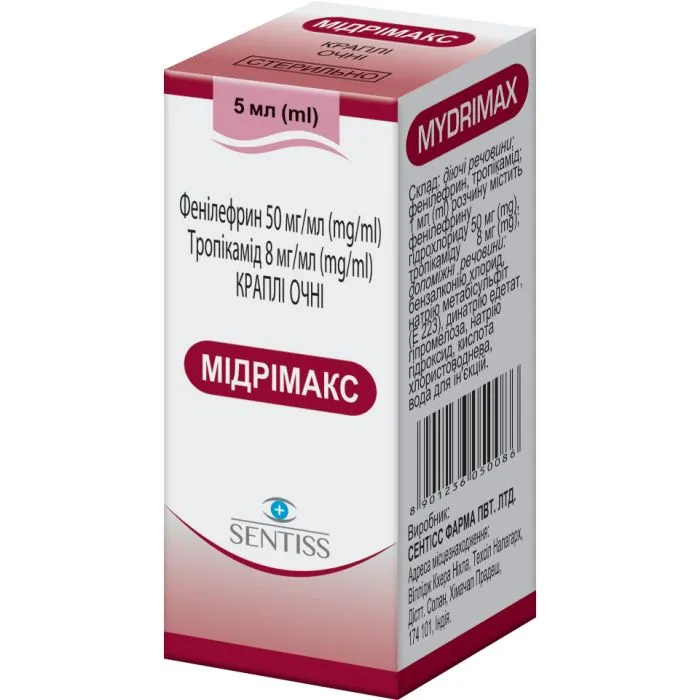
MIDRIMAX
UkraineThe drug is used in ophthalmology for pupil dilation (mydriasis) and paralysis of accommodation (cycloplegia) during diagnostic procedures or as preparation for eye surgeries.
Frequently asked questions
How to use Midrimax correctly?
Adults and children aged 12 and older are typically prescribed 1–2 drops in the eye 15–30 minutes before the procedure. You should pull down the lower eyelid, instill the drops, and apply pressure to the inner corner of the eye for 1–2 minutes to reduce systemic absorption. If you are using other eye drops, maintain an interval of at least 5 minutes.
Who should not use this drug?
Contraindications include hypersensitivity to the components of the product, severe cardiovascular or cerebrovascular diseases, loss of integrity of the eyeball, glaucoma (especially angle-closure glaucoma), pregnancy, breastfeeding, as well as certain thyroid diseases, urinary tract diseases, and diabetes. The drug should not be used in children under 12 years of age.
What are the possible side effects of Midrimax?
Possible side effects include eye pain and burning, blurred vision, photophobia, eye redness, headache, dizziness, palpitations, or changes in blood pressure. In some cases, allergic reactions, nausea, or impaired coordination may occur. Side effects may be more pronounced in elderly people and children.
Can I drive a car after using the drops?
Since the drug may temporarily impair vision, you must not drive a car or operate machinery until vision has fully recovered, which may take up to six hours.
How to handle contact lenses when using the product?
Lenses must be removed before instilling the drops. They can be worn no earlier than 30 minutes after using the product, as it contains a preservative that may damage soft lenses and irritate the eye.
Instructions for use
INSTRUCTIONS FOR MEDICAL USE OF THE MEDICINAL PRODUCT MIRIMAX (MYDRIMAX)
Composition:
Active substances: phenylephrine, tropicamide;
1 ml of solution contains phenylephrine hydrochloride 50 mg, tropicamide 8 mg;
Excipients: benzalkonium chloride, sodium metabisulfite (E 223), disodium edetate, hypromellose, sodium hydroxide, hydrochloric acid, water for injections.
Pharmaceutical form. Eye drops, solution.
Main physicochemical properties: clear solution, colorless or slightly brownish-yellow.
Pharmacotherapeutic group.
Agents used in ophthalmology. Mydriatic and cycloplegic agents. Anticholinergic agents. ATC code S01F A56.
Pharmacological Properties.
Pharmacodynamics.
Phenylephrine.
Phenylephrine is a synthetic amine with sympathomimetic activity. After topical application to the conjunctiva, phenylephrine acts directly on ocular α-adrenergic receptors, causing contraction of the iris dilator muscle and small arteries of the conjunctiva. The agent causes only slight relaxation of the ciliary muscle, without significant cycloplegia.
After topical administration of a 2.5% solution of phenylephrine hydrochloride to the eye, maximum mydriasis is achieved within 15–60 minutes, with recovery occurring within 3 hours. Administration of a 10% solution of phenylephrine hydrochloride induces maximum mydriasis within 10–90 minutes; recovery occurs within 3–7 hours.
The action of phenylephrine complements that of tropicamide, as they have different mechanisms of action. When used in combination with tropicamide, phenylephrine attenuates or neutralizes the tendency of tropicamide to increase intraocular pressure.
This combination of active substances is used for pupil dilation in cases where monocomponent agents are not fully effective.
Tropicamide.
Tropicamide is an anticholinergic agent that blocks cholinergic stimulation of the iris sphincter muscle and ciliary muscle, thereby causing pupil dilation (mydriasis). At higher concentrations (1%), tropicamide induces paralysis of accommodation. The drug acts rapidly, but its effect is relatively short-lived.
After topical ophthalmic administration, tropicamide blocks the action of acetylcholine, resulting in relaxation of the cholinergically stimulated iris sphincter muscle. Adrenergic stimulation of the radial fibers thus encounters no resistance, leading to pupil dilation.
Cholinergic stimulation of the accommodative ciliary muscle is also blocked.
The anticholinergic effect of tropicamide leads to pupil dilation (mydriasis) and paralysis of accommodation (cycloplegia). Tropicamide exhibits a greater mydriatic than cycloplegic effect. This is clinically important, as the presence of mydriasis induced by tropicamide does not necessarily indicate adequate cycloplegia.
Pharmacokinetics.
Phenylephrine.
Phenylephrine is generally not absorbed into the systemic circulation after topical application, but absorption may occur following instillation into the conjunctival sac, potentially causing systemic (sympathomimetic) effects. It is metabolized in the liver by the enzyme monoamine oxidase (MAO).
Tropicamide.
After topical administration, tropicamide is rapidly absorbed into the systemic circulation. Peak plasma concentrations vary between 1.3–5.2 ng/mL among individual patients. The mean peak plasma concentration is 2.8 ± 1.7 ng/mL within 5 minutes after instillation. Plasma concentrations of tropicamide are 0.46 ± 0.51 ng/mL at 60 minutes and less than 240 pg/mL at 120 minutes after instillation.
Clinical characteristics.
Indications.
The combination of phenylephrine/tropicamide is used to achieve mydriasis and cycloplegia in ophthalmology for:
- diagnostic procedures;
- preoperative preparation for surgical procedures requiring visualization of structures located behind the iris of the eye.
Contraindications.
Hypersensitivity to any component of the medicinal product or to tropic acid derivatives;
severe arteriosclerotic diseases in elderly patients;
severe cardiovascular (tachycardia, heart failure) or cerebrovascular disorders, vascular aneurysm, especially in elderly patients;
disruption of the integrity of the eyeball;
impaired tear production (including during anesthesia in surgical procedures);
hyperthyroidism, thyrotoxicosis;
pheochromocytoma;
metabolic acidosis, hypercapnia, hypoxia;
prostatic gland disorders with increased risk of urinary retention;
obstructive urinary tract diseases;
hepatic porphyria;
myasthenia gravis (excessive muscle weakness);
acute pulmonary edema;
congenital glucose-6-phosphate dehydrogenase deficiency;
concomitant use of monoamine oxidase inhibitors (MAOIs), or use within 2 weeks after discontinuation of MAOI therapy;
insulin-dependent diabetes mellitus;
concomitant use with tricyclic antidepressants, antihypertensive agents (including beta-blockers);
Additional pupil dilation during surgery in patients with disruption of the integrity of the eyeball or impaired tear secretion
pregnancy;
dry rhinitis;
primary glaucoma, especially angle-closure glaucoma.
Interaction with other medicinal products and other forms of interaction.
The mydriatic effect of phenylephrine is enhanced by local administration of atropine and reduced by local administration of other ophthalmic preparations containing miotics. The drug may impair the ability of miotics to reduce intraocular pressure.
The effect of the drug may be enhanced when used concomitantly with other medicinal products having antimuscarinic (anticholinergic) properties, such as amantadine, certain antihistamines, antipsychotics — phenothiazine derivatives, butyrophenones, disopyramide, metoclopramide.
Antihypertensive medicinal products. Antihypertensive medicinal products (including beta-adrenergic blockers) are contraindicated for concomitant use with phenylephrine for local application, as mutual antagonism may occur, potentially leading to fatal outcomes.
Beta-blockers may enhance the vasopressor effect of phenylephrine by inhibiting vasodilation.
Monoamine oxidase inhibitors (MAOIs). Concomitant use of phenylephrine during therapy with monoamine oxidase inhibitors (MAOIs) and within 2 weeks after discontinuation of MAOI therapy is contraindicated due to an increased risk of enhanced adrenergic reactions. This risk persists for up to three months after MAOI use. Medicinal products containing phenylephrine should be used with caution.
Tricyclic antidepressants are contraindicated for concomitant use with phenylephrine. The vasopressor effect of adrenergic agents may be enhanced by tricyclic antidepressants (risk of cardiac arrhythmia, including for several days after discontinuation), propranolol, reserpine, guanethidine, methyldopa, and anticholinergic agents.
Inhalation anesthesia. The drug may potentiate cardiovascular depression during inhalation anesthesia. Due to an increased risk of ventricular fibrillation, the drug should be used cautiously during general anesthesia with anesthetics such as halothane (fluothane), which increase myocardial sensitivity to sympathomimetics.
Cardiac glycosides or quinidine. Increased risk of arrhythmia.
Special precautions for use
Phenylephrine hydrochloride is a medicinal product with adrenergic action, used in ophthalmology primarily to achieve mydriatic effect. The drug exerts minimal effect on the ciliary muscle of the eye, so significant influence on accommodation is not observed, although pupil dilation may reduce depth of focus and cause blurred vision.
Since the effect of pupil dilation may last 1–3 hours, patients may experience photophobia. Therefore, until vision is fully restored, the eye(s) should be protected from bright sunlight, including by wearing sunglasses. Visual strain (reading, watching television) should be avoided until residual signs of mydriasis have disappeared.
The medicinal product is contraindicated for concomitant use with monoamine oxidase inhibitors (MAOIs) and within 2 weeks after discontinuation of MAOIs, due to the possible development of systemic adrenergic effects. The effect of adrenergic agents on blood pressure may also be potentiated by tricyclic antidepressants.
In elderly patients, local application of phenylephrine may cause reactive miosis. In such cases, pupillary response to subsequent administration is reduced. Reactive miosis has been reported in elderly patients approximately one day after administration of phenylephrine solution. Repeated administration resulted in diminished mydriatic response. Psychotic reactions and behavioral disturbances should be considered in patients with increased sensitivity to anticholinergic agents.
Due to the risk of undiagnosed angle-closure glaucoma or predisposition to elevated intraocular pressure in elderly patients, the depth of the anterior chamber angle should be evaluated before administration of the drug. To prevent discomfort during phenylephrine instillation, anesthetic eye drops may be administered several minutes prior to instillation.
Phenylephrine should be used with caution in patients with hypertension, progressive atherosclerotic changes, orthostatic hypotension, mild cardiac disorders, or bronchial asthma.
Excessive use may lead to systemic toxic effects, especially in individuals with increased sensitivity.
The drug should be administered with caution in cases of inflammatory eye conditions, as hyperemia significantly increases the rate of systemic absorption through the conjunctiva.
To reduce systemic absorption after instillation, the lacrimal sac should be compressed with a finger at the inner canthus of the eye for approximately 1 minute.
This medicinal product contains benzalkonium chloride as a preservative and therefore should not be used in patients wearing hydrophilic (soft) contact lenses, as the preservative may be absorbed, causing eye irritation and discoloration of contact lenses. Contact lenses must be removed before administration of the product and reinserted no sooner than 30 minutes after instillation.
Instillation of the medicinal product into the eye following trauma, in cases of inflammatory eye conditions, or during surgical procedures may result in significant absorption of phenylephrine in quantities sufficient to initiate a systemic vasoconstrictive response.
Due to the pronounced effect of the drug on pupil dilation, temporary appearance of floating pigment spots in the intraocular fluid may occur in elderly patients within 30–45 minutes after instillation of phenylephrine solution.
Use with special caution in patients with Down's syndrome, children with spastic paralysis or cerebral disorders; in open-angle glaucoma (there is a risk of increased intraocular pressure with tropicamide administration). Patients aged 65 years and older and individuals with Down's syndrome are particularly sensitive to tropicamide.
Monitoring of intraocular pressure is recommended, especially in cases of repeated administration.
After local administration of tropicamide, careful monitoring of patients with elevated blood pressure, excessive thyroid hormone production, high blood glucose levels, or cardiovascular disorders is advised.
Tropicamide may increase intraocular pressure. The drug should be administered with caution to elderly patients and patients with elevated intraocular pressure. To prevent acute glaucoma attack due to angle closure, the physician must first assess intraocular pressure as well as the depth and angle of the anterior chamber of the eye before initiating treatment. Monitoring of intraocular pressure is recommended, particularly with repeated use.
In general, anticholinergic drugs should also be used with caution in patients with prostatitis. However, if the drug is administered only once, as in the case of a single examination, the likelihood of complications is very low.
The drug should be used with particular caution in children and in patients sensitive to belladonna alkaloids due to increased risk of systemic toxicity.
Other toxic effects of anticholinergic medicinal products include dryness of mucous membranes, reduced sweat gland secretion, decreased gastrointestinal motility, and reduced bronchial and tear secretion.
Pediatric population. The lowest effective dose should always be used. Care must be taken to prevent the drug from entering the child’s mouth or coming into contact with the cheeks. The person administering the eye drops should wash their hands as well as the child’s hands and cheeks after administration.
Use during pregnancy or breastfeeding.
Adequate controlled studies on the effects of the drug on fertility, contraception, and pregnancy planning have not been conducted. Animal studies have shown that phenylephrine administered parenterally in late pregnancy or during labor may cause fetal anoxia, and administration to pregnant animals during the last three months of pregnancy resulted in delayed fetal growth and early onset of labor.
The safety of using the drug during pregnancy has not been established; therefore, the drug is contraindicated during pregnancy.
It is unknown whether the drug passes into breast milk. However, since most substances are excreted in breast milk, breastfeeding should be discontinued during treatment with this drug.
Ability to affect reaction speed when driving or operating machinery.
Since transient reduction in visual acuity may occur immediately after instillation, patients should wait until vision is fully restored before driving or operating machinery. The period required for complete recovery may last up to six hours.
Dosage and Administration
An ophthalmic medicinal product intended for local diagnostic use. For adults and children aged 12 years and older, 1–2 drops are usually instilled into the conjunctival sac 15–30 minutes before the procedure for diagnostic or preoperative preparation.
Use in elderly patients. Dose adjustment is not required. In elderly patients, repeated instillations may produce a less pronounced mydriasis.
Administration method. Tilt the head backward, gently pull down the lower eyelid of the affected eye with a finger, instill 1–2 drops of the medication, and then close the eye. Press the inner corner of the eye with a finger for 1–2 minutes to prevent the medication from entering the nasolacrimal duct and to reduce the possibility of systemic absorption. Avoid blinking. Wipe away any excess medication around the eye with a clean tissue, taking care to avoid contact with the eye.
If more than one ophthalmic agent is used, the interval between administrations should be at least 5 minutes. Ophthalmic ointments should be applied last.
To prevent contamination of the dropper tip, do not let it touch the eyelids or surrounding areas.
Children. Not recommended for children under 12 years of age.
The medicinal product may cause disorders of the central nervous system, which can be dangerous in children. Excessive use in children may lead to symptoms of systemic intoxication. Use with caution in children with Down syndrome, spastic paralysis, or cerebral disorders.
Overdose.
In case of local overdose, remove excess medication from the eye by rinsing it with warm running water.
Systemic intoxication may occur after local administration, especially in children.
Symptoms: facial flushing, dryness of the skin and mucous membranes (rash may occur in children), blurred vision, rapid and irregular pulse, fever, seizures, psychiatric disturbances (hallucinations or psychotic behavior), loss of neuromuscular coordination, photophobia, pronounced mydriasis and cycloplegia, tachycardia, excitement, hyperactivity, hyperthermia.
Treatment. If any of these symptoms occur, discontinue the use of eye drops and consult a physician. Symptomatic and supportive treatment should be administered. The skin surface of children should be kept moist.
Treatment of local overdose: instillation of pilocarpine or physostigmine eye drops.
Treatment of systemic intoxication: gastric lavage and administration of activated charcoal; intravenous administration of physostigmine 1–2 mg, repeated hourly if necessary; for seizures — intravenous administration of 10–20 mg diazepam; for hyperthermia — physical measures; for reflex bradycardia, administer atropine (in children, dose of 0.01–0.02 mg/kg body weight); in cases of dangerous increase in blood pressure, administer phentolamine, a peripheral alpha-receptor antagonist.
Adverse Reactions
Phenylephrine
Ocular disorders: Eye pain, burning sensation (at the beginning of administration), reactive hyperemia, blurred vision, conjunctival irritation, allergic reactions, lacrimation, transient keratitis, photophobia, increased intraocular pressure in patients with narrow-angle or closed-angle glaucoma, reactive miosis (the following day after administration; repeated instillations may produce less pronounced mydriasis than the previous day; this effect occurs more frequently in elderly patients), sensation of discomfort.
There have been reports of allergic blepharoconjunctivitis; the reaction usually begins 3–4 hours after instillation of the drug and may last approximately 12 hours, with gradual regression within 72 hours.
Cardiovascular system disorders: Tachycardia, palpitations, cardiac arrhythmias including ventricular and extrasystolic arrhythmias, mild arterial hypertension, reflex bradycardia, coronary artery occlusion, pulmonary artery embolism, myocardial infarction, dyspnea. Subarachnoid hemorrhage and seizures are rare systemic reactions following topical ocular administration. Fatal reactions have been reported in patients with a history of cardiovascular disease.
Immune system disorders: Hypersensitivity, allergic conjunctivitis.
Skin and subcutaneous tissue disorders: Contact dermatitis.
Respiratory, thoracic and mediastinal disorders: Pulmonary edema, dyspnea, shortness of breath.
Central nervous system disorders: Headache, migraine, excitement, loss of consciousness, dizziness, tremor, paresthesia, insomnia.
Vascular disorders: Pallor of facial skin.
Gastrointestinal disorders: Nausea, vomiting, decreased appetite.
General disorders: Weakness, fainting. Prolonged (up to several hours) paralysis of the ciliary muscle may occur. In individual cases, the drug may cause accommodation disturbances up to 3 diopters. Occasionally, powerful compressive responses have been reported, accompanied by rapid heartbeat, tachycardia, cardiac rhythm disturbances, and severe headaches. Such systemic effects were mainly observed in patients with conjunctival hyperemia, hemorrhages into the conjunctival sac, and epithelial defects of the cornea or conjunctiva.
Prolonged use may lead to significant redness and corneal thickening due to edema, cause pupillary constriction in elderly patients, conjunctival xerosis (epithelial keratinization), and obstruction of the lacrimal duct. The medication may even exacerbate narrowing of the anterior chamber angle, triggering an attack of glaucoma. If the drug is administered in patients with glaucoma, additional medications to reduce intraocular pressure (e.g., pilocarpine) should be used.
Tropicamide
Immune system disorders: Allergic reactions, rash, facial flushing, contact dermatitis.
Ocular disorders: Photophobia, with or without transient corneal clouding, eye pain (burning upon instillation), blurred vision, visual impairment, eye discomfort, accommodation disturbances, increased intraocular pressure, eye irritation, ocular hyperemia, conjunctivitis, eye swelling, punctate keratitis, development of congestive glaucoma, eye itching. With prolonged use, changes in lens color and corneal opacification (keratopathy) may occur.
Cardiac disorders: Bradycardia, tachycardia, arrhythmia, severe palpitations, extrasystoles.
Vascular disorders: Facial flushing, pallor, syncope, arterial hypotension or hypertension.
Psychiatric disorders: Psychotic disorders, hallucinations, abnormal behavior, disorientation. Autonomic nervous system stimulation is also possible.
Nervous system disorders: Headache, coordination disturbances, somnolence, dizziness.
Respiratory system disorders: Nasal dryness, cardiorespiratory collapse.
Gastrointestinal disorders: Nausea, vomiting, constipation, dry mouth, defecation disorders.
Skin and subcutaneous tissue disorders: Rash, skin dryness, skin redness, contact dermatitis.
Renal and urinary disorders: Dysuria, urinary retention.
General and administration site conditions: Prolonged drug effect, increased body temperature, allergic reactions.
The above-mentioned adverse reactions are most pronounced in children and elderly patients.
This medication may cause central nervous system disturbances, which may be dangerous in children. It should be noted that hypersensitivity to anticholinergic agents may lead to psychotic reactions and behavioral disorders, as well as cardiorespiratory collapse.
Since the product contains benzalkonium chloride as a preservative, reactions related to this substance may occur, including redness, increased corneal epithelial permeability, reduced density of goblet cells, enhanced irritation, and inflammation. With prolonged use, a cytotoxic effect on the cornea may occur, characterized by inhibition of cytokinesis, direct reduction in epithelial cell count, decreased cell motility, and impaired cell division within 2 hours after administration, as well as damage to cells of the anterior segment of the eye.
Reporting of suspected adverse reactions
Reporting of adverse reactions after drug registration is of great importance. It enables continuous monitoring of the benefit-risk balance of the medicinal product. Healthcare professionals and pharmacists, as well as patients or their legal representatives, should report all suspected adverse reactions and lack of drug efficacy via the automated pharmacovigilance information system at: https://aisf.dec.gov.ua.
Shelf life
2 years.
Shelf life after first opening of the container — 30 days.
Do not use after the expiry date stated on the packaging.
Storage conditions
Store at temperatures not exceeding 25 °C in a light-protected place.
Do not freeze.
Keep out of reach and sight of children.
Packaging
5 mL in a plastic dropper bottle or plastic bottle with dropper, 1 bottle per cardboard box.
Prescription status
Prescription only.
Manufacturer
SENTISS PHARMA PVT. LTD., India / SENTISS PHARMA PVT. LTD., India.
Manufacturer's address and location of operations
Village Khera Nihla, Tehsil Nalagarh, Distt. Solan, Himachal Pradesh, 174 101 /
Village Khera Nihla, Tehsil Nalagarh, Distt. Solan, Himachal Pradesh, 174 101.
Marketing Authorization Holder
SENTISS PHARMA PVT. LTD., India / SENTISS PHARMA PVT. LTD., India.
Contact person for pharmacovigilance (for reporting all cases of suspected adverse reactions and lack of drug efficacy, 24/7):
Phone numbers and email address: 0681291858 (mobile), 0445850460 (telephone/fax), [email protected].
Address of the Marketing Authorization Holder
212/D-1, Ashirwad Commercial Complex, Green Park, New Delhi, 110016, India /
212/D-1, Ashirwad Commercial Complex, Green Park, New Delhi, 110016, India.
The original data is available in the language of the country of manufacture.
Data source: State Register of Medicinal Products of Ukraine
Data last verified: August 13, 2026