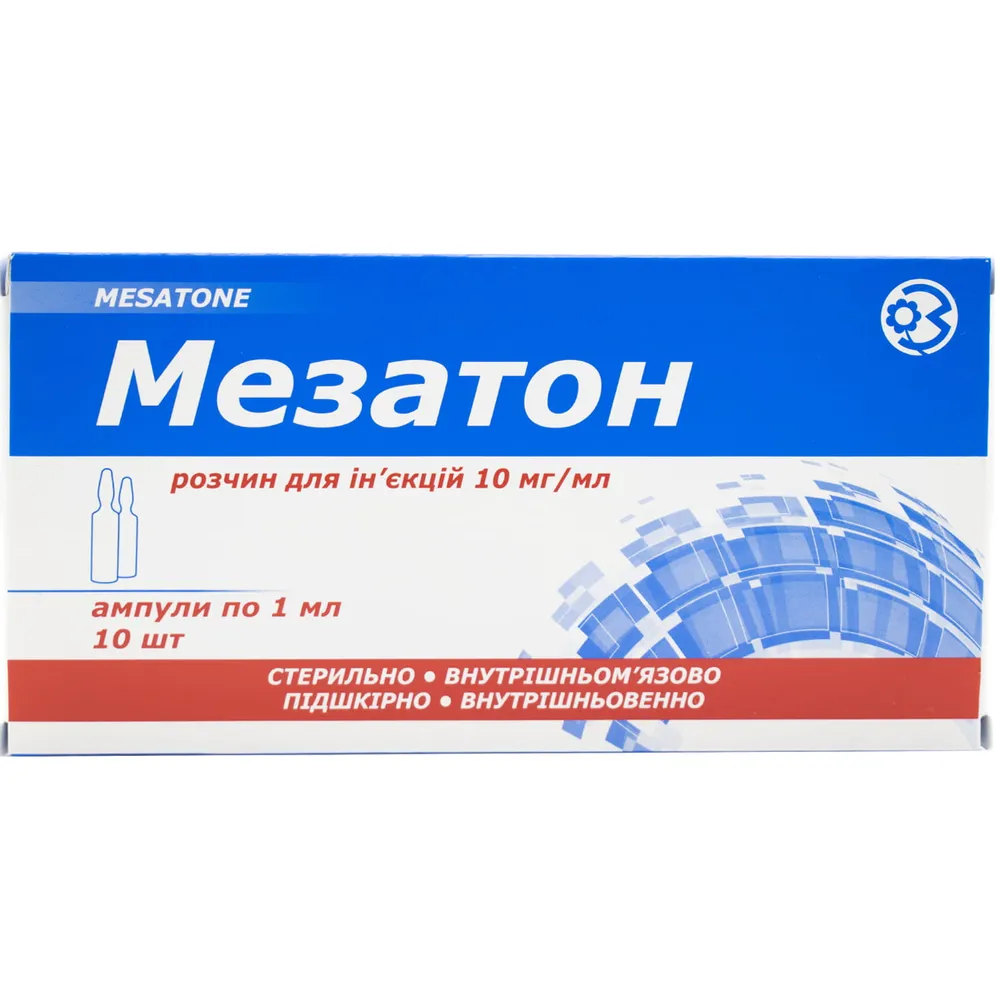
MEZATON
UkraineThe drug is used for arterial hypotension (low blood pressure), shock states (traumatic or toxic), vascular insufficiency due to vasodilator overdose, and as a vasoconstrictor during local anesthesia.
Frequently asked questions
How to take Mezaton correctly?
The drug is intended for adults only and is administered intravenously, intramuscularly, or subcutaneously. The dosage depends on the route of administration and the patient's condition. For intravenous administration, it is recommended to dilute the solution in saline or glucose and administer it slowly. During prolonged use, the dose should be gradually reduced to avoid a sudden drop in blood pressure.
Who should not use this drug?
Use is contraindicated in cases of high blood pressure, heart diseases (infarction, cardiosclerosis, arrhythmia, hypertrophic cardiomyopathy), vascular diseases (atherosclerosis, Raynaud's disease, thromboembolism), glaucoma, diabetes mellitus, thyrotoxicosis, and certain other conditions. The drug is prohibited for pregnant women, breastfeeding women, and children.
What are the possible side effects of Mezaton?
Possible cardiovascular reactions (changes in blood pressure, heart rhythm disturbances, chest pain), neurological disorders (headache, dizziness, tremor, anxiety), nausea, vomiting, urinary disturbances, as well as skin rashes and changes at the injection site (possible necrosis).
Can the drug be combined with other medicines?
Any interaction requires caution. Mezaton may reduce the effect of blood pressure medications and diuretics. At the same time, it enhances the effects of antidepressants, oxytocin, and certain other drugs, which may lead to a dangerous increase in blood pressure or arrhythmia. The use of inhalation anesthetics increases the risk of cardiac disturbances.
Can I drive a car during treatment?
No, driving vehicles or working with dangerous mechanisms is contraindicated during the use of the drug.
Instructions for use
INSTRUCTION FOR MEDICAL USE OF THE MEDICINAL PRODUCT MESATON
Composition:
Active substance: phenylephrine;
1 ml of solution contains 10 mg of phenylephrine hydrochloride;
Excipients: glycerin, water for injections.
Pharmaceutical form. Injection solution.
Main physicochemical characteristics: clear colorless liquid.
Pharmacotherapeutic group. Adrenergic and dopaminergic agents. ATC code C01CA06.
Pharmacological properties.
Pharmacodynamics.
Methyldopamine is an α1-adrenergic agonist with minimal effect on cardiac β-adrenoreceptors. It is not a catecholamine, as it contains only one hydroxyl group in the aromatic ring. It causes vasoconstriction of arterioles and increases arterial blood pressure (with possible reflex bradycardia). Compared to norepinephrine and epinephrine, it increases blood pressure less sharply but acts longer due to lower susceptibility to catechol-O-methyltransferase. It does not increase cardiac output. The effect begins immediately after administration and lasts for 5–20 minutes following intravenous injection. After subcutaneous administration, the effect lasts up to 50 minutes. After intramuscular administration, the effect lasts up to 1–2 hours.
Pharmacokinetics.
After intramuscular administration, it is rapidly absorbed into systemic circulation. Plasma protein binding is low. It is almost completely metabolized in the liver. It is excreted by the kidneys in the form of metabolites.
Clinical characteristics.
Indications.
Arterial hypotension.
Shock (traumatic, toxic).
Vascular insufficiency due to vasodilator overdose.
As a vasoconstrictor in local anesthesia.
Contraindications. Hypersensitivity to the components of the drug. All forms of arterial hypertension, cardiosclerosis, halothane or cyclopropane anesthesia, hypertrophic cardiomyopathy, pheochromocytoma, ventricular fibrillation, occlusive vascular diseases: arterial thromboembolism, atherosclerosis, thromboangiitis obliterans (Buerger's disease), Raynaud's disease, tendency to vascular spasm in frostbite, diabetic endarteritis, thyrotoxicosis, tachyarrhythmia, metabolic acidosis, hypercapnia, hypoxia, closed-angle glaucoma, severe aortic valve stenosis, acute myocardial infarction, porphyria, glucose-6-phosphate dehydrogenase deficiency, diabetes mellitus. Patients with prostate disorders associated with an increased risk of urinary retention. Concomitant use with MAO inhibitors and within 14 days after discontinuation of their use. Elderly patients.
Interaction with other medicinal products and other forms of interaction. Reduces the antihypertensive effect of diuretics and antihypertensive drugs. Neuroleptics and phenothiazine derivatives reduce the hypertensive effect of the drug. MAO inhibitors, oxytocin, ergot alkaloids, tricyclic antidepressants, methylphenidate, and adrenergic agonists enhance the pressor effect and arrhythmogenic potential of Mezaton. β-Blockers reduce the cardiac stimulant activity of the drug. Use of the drug following prior administration of reserpine may lead to hypertensive crisis due to depletion of catecholamine stores in adrenergic nerve endings and increased sensitivity to adrenergic agonists. Inhalational anesthetics (including chloroform, enflurane, halothane, isoflurane, methoxyflurane) increase the risk of severe atrial and ventricular arrhythmias, as they markedly increase myocardial sensitivity to sympathomimetics. Ergometrine, ergotamine, methylergometrine, oxytocin, and doxapram enhance the vasoconstrictor effect. Reduces the antianginal effect of nitrates, which in turn may reduce the pressor effect of Mezaton and the risk of arterial hypotension (concomitant use is permitted depending on achieving the required therapeutic effect). Thyroid hormones mutually increase the effectiveness of the drug and the associated risk of coronary insufficiency (especially in coronary atherosclerosis).
Use of Mezaton during labor for correction of arterial hypotension in the context of drugs stimulating labor activity (vasopressin, ergotamine, ergometrine, methylergometrine) may lead to persistent increase in arterial pressure in the postpartum period.
Special precautions. Correction of hypovolemia, hypoxia, acidosis, and hypercapnia is mandatory before or during treatment of shock states.
The drug should be used with caution in patients with atrial fibrillation, pulmonary arterial hypertension, hypovolemia, or ventricular arrhythmia.
During treatment, ECG, arterial pressure, minute volume of blood, peripheral circulation, and injection site should be monitored. In patients with arterial hypertension, in case of drug-induced collapse, it is sufficient to maintain systolic arterial pressure at a level 30–40 mm Hg below the usual value.
Use during pregnancy or breastfeeding. The drug is contraindicated during pregnancy or breastfeeding.
If use of the drug is necessary, breastfeeding should be discontinued.
Ability to affect reaction speed when driving or operating machinery. Use of the drug contraindicates driving or operating other potentially hazardous machinery.
Administration and Dosage
The drug should be administered intravenously, intramuscularly, and subcutaneously to adults. The single dose for intravenous administration in collapse is 0.1–0.3–0.5 mL of a 1% solution. For intravenous administration, dilute the single dose in 20 mL of 5% glucose solution or 0.9% sodium chloride solution and administer slowly by injection. Repeat administration if necessary.
The drug may be administered by intravenous infusion; for this purpose, dilute 1 mL of a 1% Mesaton solution in 250–500 mL of 5% glucose solution.
For intramuscular and subcutaneous administration, the single dose for adults is 0.3–1 mL of a 1% solution.
For local anesthesia, add 0.3–0.5 mL of a 1% solution to 10 mL of anesthetic solution.
To prevent the "withdrawal syndrome" (recurrent decrease in arterial pressure after discontinuation of the drug), the dose should be gradually reduced after prolonged infusion.
Resume infusion if systolic arterial pressure decreases to 70–80 mm Hg.
Higher doses for adults:
- For intramuscular and subcutaneous administration: single dose – 10 mg, daily dose – 50 mg.
- For intravenous administration: single dose – 5 mg, daily dose – 25 mg.
Children. The drug is contraindicated in children.
Overdose.
Symptoms: ventricular extrasystoles, short paroxysms of ventricular tachycardia, sensation of heaviness in the head or extremities, excessive increase in arterial pressure.
Treatment: administer short-acting α-adrenoblockers (phentolamine) intravenously. In case of cardiac arrhythmia, administer β-adrenoblockers (propranolol).
Adverse Reactions.
Cardiovascular system: angina attacks, bradycardia, increased or decreased arterial pressure, tachycardia, ventricular arrhythmias (especially when used in high doses), palpitations.
Nervous system: headache, irritability, restlessness, dizziness, sensation of fear, anxiety, weakness, pallor of the facial skin, tremor, seizures, cerebral hemorrhage.
Gastrointestinal tract: nausea, vomiting.
Respiratory system: dyspnea.
Allergic reactions: skin rashes, pruritus.
Eyes: eye pain, conjunctival hyperemia, allergic reactions of the eyelids, mydriasis.
Urinary system: urinary disturbances, urinary retention.
Other: increased sweating, hypersalivation, sensation of tingling and coldness in the extremities, flushing, hyperglycemia.
The drug has an irritant effect; possible local changes at the injection site, necrosis.
Shelf life. 4 years.
Storage conditions. Store at a temperature not exceeding 25 °C in the original packaging.
Keep out of reach of children.
Incompatibility. The drug should not be mixed with other medicinal products in the same container.
Packaging. 1 ml in ampoules, № 10 in a pack; № 10, № 5x2 in blisters in a pack.
Prescription category. Prescription only.
Manufacturer.
Limited Liability Company "Research Plant "GNCLS".
LIMITED LIABILITY COMPANY "CORPORATION "ZDOROVIYA".
Manufacturer's address and place of business.
Ukraine, 61057, Kharkiv region, Kharkiv city, Vorobiova street, building 8.
(Limited Liability Company "Research Plant "GNCLS")
Ukraine, 61013, Kharkiv region, Kharkiv city, Shevchenka street, building 22.
(LIMITED LIABILITY COMPANY "CORPORATION "ZDOROVIYA")
The original data is available in the language of the country of manufacture.
Data source: State Register of Medicinal Products of Ukraine
Data last verified: August 13, 2026