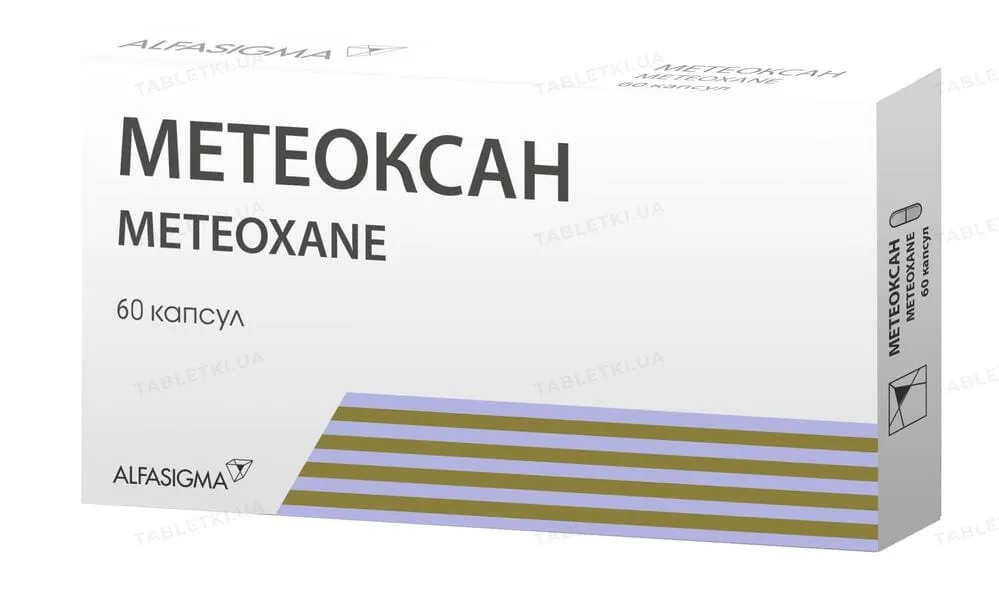
METEOXAN
UkraineThe drug is used for the adjunctive treatment of functional bowel disorders, particularly in cases of meteorism (bloating) and diarrhea.
Frequently asked questions
How should Meteoxan be taken correctly?
Capsules should be taken orally with a small amount of water. It is recommended to take 2 capsules 3 times a day before meals or when pain occurs. The maximum daily dose should not exceed 6 capsules.
What are the possible side effects of Meteoxan?
Hypersensitivity reactions may occur, such as skin rash, itching, urticaria, angioedema, or bronchospasm. The risk of anaphylactic shock also cannot be ruled out.
Who should not take this drug?
The drug is contraindicated in cases of hypersensitivity to its components, intestinal obstruction, or obstructive gastrointestinal conditions. It should also not be taken together with opioid analgesics.
Can the drug be taken during pregnancy or breastfeeding?
Use is not recommended during the first trimester of pregnancy and during the breastfeeding period. In the II–III trimesters of pregnancy, it is necessary to consult a physician before use.
Does the drug affect interactions with other medicines?
Avoid combining it with strong analgesics (e.g., morphine), as this may cause spasms. If you are taking levothyroxine, at least four hours should elapse between taking it and taking this drug to avoid reducing the effectiveness of the medication.
Can you drive a car during treatment?
The drug has a negligible effect on the ability to drive motor vehicles or operate other machinery.
Instructions for use
INSTRUCTIONS FOR MEDICAL USE OF THE MEDICINAL PRODUCT METEOXAN (METEOXANE)
Composition:
Active substances: 1 capsule contains phloroglucinol dihydrate 80 mg, simethicone 125 mg;
Excipients: colloidal anhydrous silicon dioxide, talc, microcrystalline cellulose, calcium hydrogen phosphate, gelatin, sulfur dioxide (E 220), titanium dioxide (E 171).
Pharmaceutical form. Capsules.
Main physicochemical properties: white, opaque capsules, size 0, containing white powder.
Pharmacotherapeutic group.
Agents for the treatment of functional gastrointestinal disorders.
ATC code A03AX.
Pharmacological Properties
Pharmacodynamics
Meteospasmin is a combination drug containing the non-anticholinergic spasmolytic agent, phloroglucinol dihydrate, and simethicone, which prevents accumulation of intestinal gas.
Simethicone is a non-toxic, inert surface-active agent based on silicon, which prevents formation and promotes breakdown of gas bubbles. By reducing surface tension, it causes coalescence of gas bubbles in the gastrointestinal tract, resulting in dispersion and physiological elimination of gas.
Simethicone prevents artifacts caused by gas bubbles during ultrasonography or radiological examinations.
Phloroglucinol dihydrate reduces excessive motility of the colon and large intestine, commonly occurring in response to food intake in patients with functional gastrointestinal disorders.
Clinical studies confirm its relaxing effect on the smooth musculature of the gastrointestinal tract.
Pharmacokinetics
After oral administration, phloroglucinol is rapidly absorbed and metabolized during the first pass through the liver, and is excreted from the body primarily in the form of metabolites in urine. The time to reach maximum plasma concentration, Tmax, is 1 hour, with Cmax of 2.74 mg/ml; the elimination half-life, T½, is 2 hours. Systemic bioavailability after oral administration is 30%.
Simethicone is not absorbed in the body and passes through the gastrointestinal tract unchanged, being excreted in the same form.
Clinical characteristics.
Indications.
As an adjunctive treatment for functional intestinal symptoms, particularly flatulence and diarrhea.
Contraindications.
Hypersensitivity to the active substances or to any of the excipients of the medicinal product.
Concomitant use of opioid analgesics.
First trimester of pregnancy and breastfeeding period.
Intestinal obstruction, obstructive conditions of the gastrointestinal tract.
Interaction with other medicinal products and other forms of interaction.
Interaction of floroglucinol with strong analgesics such as morphine or its derivatives should be avoided due to the possible spasmogenic effect.
Simeticone may bind levothyroxine in the gastrointestinal tract and reduce its absorption. Administration of simeticone and levothyroxine should be separated by an interval of at least four hours.
Special precautions for use
Patients with a history of serious allergic or skin reactions (e.g., angioedema, exanthema) should be closely monitored.
Use during pregnancy or breastfeeding
Pregnancy
There are no clinical data on the use of simethicone during pregnancy. Animal studies do not indicate a risk of reproductive toxicity.
Animal studies have not revealed embryotoxic or teratogenic effects of phloroglucinol. However, due to the lack of clinical data on its use in pregnant women, phloroglucinol should not be used during the first trimester of pregnancy.
Therefore, the use of this medicinal product should be avoided during the first three months of pregnancy.
For use of Mетеоксан during the second and third trimesters of pregnancy, consultation with a physician is required.
Breastfeeding period
In the absence of clinical studies, Mетеоксан should be avoided during breastfeeding.
Ability to affect the reaction rate when driving or operating machinery
Mетеоксан has negligible or no influence on the ability to drive or operate machinery.
Method of administration and dosage.
Take the medicinal product orally, swallowing with a small amount of water. Take 2 capsules three times daily before meals or when experiencing pain.
The maximum daily dose is 6 capsules, corresponding to 480 mg of floreglycinol dihydrate and 750 mg of simethicone.
Children.
The safety and efficacy of Meteocin in children have not been established.
Overdose.
Cases of overdose have not been reported to date.
Side effects.
Side effects are classified by organ systems and frequency of occurrence: very common (≥ 1/10), common (from ≥ 1/100 to < 1/10), uncommon (from ≥ 1/1000 to < 1/100), rare (from ≥ 1/10000 to < 1/1000), very rare (≤ 1/10000), frequency not known (cannot be estimated based on available data).
Immune system disorders.
Frequency not known: anaphylactic shock.
Skin and subcutaneous tissue disorders.
Frequency not known: hypersensitivity reactions such as skin rashes, urticaria, pruritus, angioedema (Quincke's edema), acute generalized exanthematous pustulosis, bronchospasm.
Shelf life. 2 years.
Do not use the medicinal product after the expiry date stated on the packaging.
Storage conditions. Store at a temperature not exceeding 25 °C, in a place inaccessible to children. Do not freeze!
Packaging. 15 capsules per blister, 1, 2 or 4 blisters per cardboard box.
Availability category. Over-the-counter (without prescription).
Manufacturers.
Alfasigma S.p.A.
Manufacturer's address and location of business activity.
Via Enrico Fermi, 1, Alanno, 65020, Italy.
The original data is available in the language of the country of manufacture.
Data source: State Register of Medicinal Products of Ukraine
Data last verified: August 13, 2026