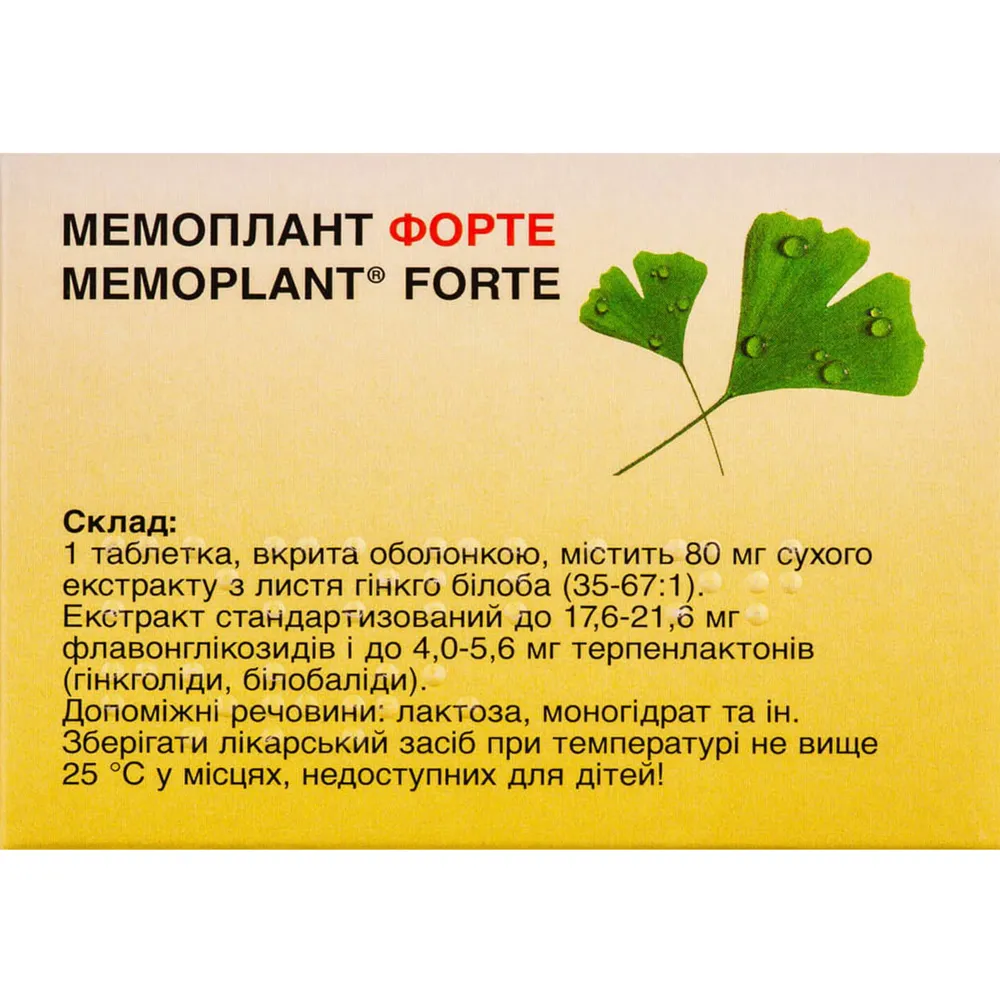
MEMOPLANT FORTE
UkraineThe drug is used for cognitive impairments (problems with memory, attention, intellect, sleep, or feelings of fear) resulting from stroke, head injuries, dementia, or old age. It is also used for hearing impairments, dizziness, tinnitus, as well as circulatory problems in the lower limbs.
Frequently asked questions
How should Memoplant forte be taken correctly?
It is necessary to take 1 tablet 2 times a day during meals, drinking half a glass of water. The average course duration is 3 months. The first improvements are usually noticeable after 1 month.
What are the possible side effects of Memoplant forte?
Headache, dizziness, nausea, vomiting, or stomach discomfort are possible. Skin reactions (itching, rash, redness) or allergic reactions (swelling, urticaria) may also occur. In rare cases, bleeding has been reported.
Who should not take this drug?
The drug is contraindicated for people with hypersensitivity to its components, as well as patients with congenital galactosemia or lactase deficiency (since the composition contains lactose).
Can the drug be combined with other medicines?
It should be combined with caution with anticoagulants and antiplatelets (e.g., aspirin or warfarin), as this may increase the risk of bleeding. Co-administration with efavirenz is also not recommended, and caution should be exercised when used with dabigatran or nifedipine.
Should the drug be discontinued before surgery?
Yes, the drug should be discontinued 3-4 days before surgical intervention due to the risk of increased bleeding tendency.
Can the drug be taken during pregnancy or breastfeeding?
It is not recommended, as there is no clinical data regarding its safety in these cases.
Does the drug affect the ability to drive a car?
During treatment, caution should be exercised when driving a car or operating machinery.
Instructions for use
INSTRUCTIONS FOR MEDICAL USE OF THE MEDICINAL PRODUCT MEMOPLANT FORTE
Composition:
Active substance: dry extract (EGb 761®) from leaves of Ginkgo biloba (Ginkgo biloba);
One film-coated tablet contains 80 mg of dry extract (EGb 761®) from leaves of Ginkgo biloba (35−67:1), standardized to 17.6−21.6 mg of ginkgo flavone glycosides and 4.32−5.28 mg of terpene lactones, of which 2.24−2.72 mg are ginkgolides A, B, C and 2.08−2.56 mg are bilobalide, and not more than 0.4 μg of ginkgolic acids [extraction solvent: acetone 60% (m/m)];
Excipients: lactose monohydrate, microcrystalline cellulose, corn starch, colloidal anhydrous silicon dioxide, sodium croscarmellose, magnesium stearate, hypromellose, polyethylene glycol 1500, titanium dioxide (E 171), iron oxide red (E 172), iron oxide brown (E 172), anti-adherent emulsion SE 2 (dimethicone, colloidal anhydrous silicon dioxide, stearic acid polyethylene glycol ether, sorbic acid), talc.
Pharmaceutical form. Film-coated tablets.
Main physicochemical properties: red-colored, smooth, round film-coated tablets.
Pharmacotherapeutic group.
Agents used in dementia. ATC code N06DX02.
Pharmacological Properties
Pharmacodynamics
A plant-derived medicinal product that normalizes cellular metabolism, blood rheological properties, and microcirculation. It improves cerebral blood flow and enhances oxygen and glucose supply to the brain, prevents erythrocyte aggregation, and inhibits platelet-activating factor. It exerts a dose-dependent regulatory effect on the vascular system by stimulating the production of endothelium-derived relaxing factor (nitric oxide – NO), dilating small arteries, and increasing venous tone, thereby regulating vascular blood filling. It reduces vascular wall permeability (exhibiting anti-edematous effects both in the brain and peripherally). The drug demonstrates antithrombotic activity due to stabilization of platelet and erythrocyte membranes, influence on prostaglandin synthesis, and reduction of biologically active substances and platelet-activating factor. It prevents the formation of free radicals and lipid peroxidation of cell membranes. It normalizes the release, reuptake, and catabolism of neurotransmitters (noradrenaline, dopamine, acetylcholine) and their ability to bind to receptors. It exerts an anti-hypoxic effect, improves metabolism in organs and tissues, promotes accumulation of macroergic compounds in cells, enhances utilization of oxygen and glucose, and normalizes neurotransmitter processes in the central nervous system.
Pharmacokinetics
Active ingredient: standardized dry extract of Ginkgo biloba (EGb 761®) containing 24% flavonoids and 6% terpene lactones (ginkgolides A, B, and bilobalide).
After oral administration, the bioavailability of ginkgolides A, B, and bilobalide is 80–90%. Maximum concentration is reached within 1–2 hours after administration. Elimination half-lives are approximately 4 hours (for bilobalide and ginkgolide A) and 10 hours (for ginkgolide B).
These substances are not metabolized in the body and are almost completely excreted in urine, with a minor amount eliminated in feces.
Clinical characteristics.
Indications.
- Cognitive deficits of various etiologies (due to dyscirculatory encephalopathy (dementia), stroke, traumatic brain injury, age-related cognitive decline), manifesting as attention and/or memory disorders, reduced intellectual abilities, feelings of fear, and sleep disturbances;
- Intermittent claudication in chronic obliterative arteriopathies of the lower limbs (Fontaine stage II);
- Hearing disturbances, tinnitus, dizziness, and coordination disorders, predominantly of vascular origin.
Contraindications.
Hypersensitivity to the components of the medicinal product.
Interaction with other medicinal products and other forms of interaction.
When used concomitantly with anticoagulants (e.g., phenprocoumon, warfarin) or antiplatelet agents (e.g., clopidogrel, acetylsalicylic acid, and other nonsteroidal anti-inflammatory drugs), the effect of these agents may be enhanced.
Results of studies on concomitant use with warfarin do not indicate the presence of interaction; however, appropriate monitoring is recommended at the beginning of therapy, when changing dosage, discontinuing, or replacing the product.
Studies on interaction with talinolol have shown that Ginkgo biloba leaf extract may inhibit P-glycoprotein activity in the gastrointestinal tract. This may lead to increased intestinal levels of medicinal products metabolized via P-glycoprotein, such as dabigatran etexilate. Concomitant use of medicinal products containing Ginkgo biloba leaf extract and dabigatran is therefore recommended with caution.
In one interaction study, the Cmax of nifedipine was increased during concomitant administration with the extract. In some individuals, this increase reached 100%, resulting in dizziness and intensified flushing.
Concomitant use of medicinal products containing Ginkgo biloba leaf extract and efavirenz is not recommended; efavirenz plasma concentrations may decrease due to induction of CYP3A4.
Interactions with medicinal products that inhibit blood coagulation cannot be excluded. In a placebo-controlled, double-blind study conducted over 7 days in 50 subjects, no interaction was observed between EGb 761® (daily dose 240 mg) and acetylsalicylic acid (daily dose 500 mg).
Special precautions for use
The first signs of improvement appear one month after the beginning of treatment.
Before starting treatment with "Memoplant Forte", it should be established whether the pathological symptoms observed are not consequences of an underlying disease requiring specific treatment.
If dizziness and tinnitus occur frequently, medical advice should always be sought. In case of sudden hearing loss or decreased hearing, immediate medical consultation is required.
In patients with a pathological tendency to bleeding (hemorrhagic diathesis), as well as when anticoagulants are used concomitantly, the drug should be administered only after consultation with a physician.
Medicinal products containing Ginkgo biloba extract may increase the tendency to bleeding; therefore, treatment should be discontinued 3–4 days prior to any surgical intervention.
In patients with epilepsy, the possibility of increased frequency of epileptic seizures induced by medicinal products containing Ginkgo biloba leaf extract cannot be excluded.
Concomitant use of medicinal products containing Ginkgo biloba extract and efavirenz is not recommended.
Since this medicinal product contains lactose, it is contraindicated in patients with congenital galactosemia, glucose-galactose malabsorption syndrome, or lactase deficiency.
Use during pregnancy and breastfeeding
Due to the lack of clinical data, the drug is not recommended during pregnancy or breastfeeding.
Ability to influence reaction rate when driving or operating machinery
Caution is required while driving or operating machinery during treatment.
Dosage and Administration.
Take 1 tablet twice daily during meals. Swallow with ½ glass of water. The average duration of treatment is 3 months.
Children.
There is insufficient experience regarding the use of the drug in children.
Overdose.
There is no information available on overdose. In case of overdose, adverse effects may be intensified.
Side effects.
Possible side effects:
- Blood and lymphatic system disorders: bleeding in individual organs has been reported (eyes, nose, cerebral and gastrointestinal bleeding);
- Gastrointestinal disorders: including dyspeptic symptoms, nausea, vomiting;
- Nervous system disorders: headache, dizziness;
- Immune system disorders: hypersensitivity reactions, including angioedema, urticaria, dyspnea;
- Skin disorders: skin inflammation, redness, swelling, itching, rash, eczema.
If any adverse reactions occur, discontinue use of the medicinal product and consult a physician.
Shelf life.
5 years.
Storage conditions.
Store at temperatures not exceeding 25 °C in a place inaccessible to children.
Packaging.
10 film-coated tablets in a blister; 2 or 3 blisters in a cardboard box.
20 film-coated tablets in a blister; 3 blisters in a cardboard box.
Availability category.
Over-the-counter.
Manufacturer.
Dr. Willmar Schwabe GmbH & Co. KG.
Manufacturer's address and place of business.
Willmar-Schwabe-Strasse 4, 76227 Karlsruhe, Germany.
Similar drugs
| Brand name | Dosage form | Active substance / Dosage | Manufacturer |
|---|---|---|---|
| MEMOPLANT | tablets, film-coated | Dr. Willmar Schwabe GmbH & Co. KG | |
| TANAKAN | tablets, film-coated | BOFUUR Ipsen Industries | |
| TEBOCAN | tablets, film-coated | Dr. Willmar Schwabe GmbH & Co. KG |
The original data is available in the language of the country of manufacture.
Data source: State Register of Medicinal Products of Ukraine
Data last verified: August 13, 2026