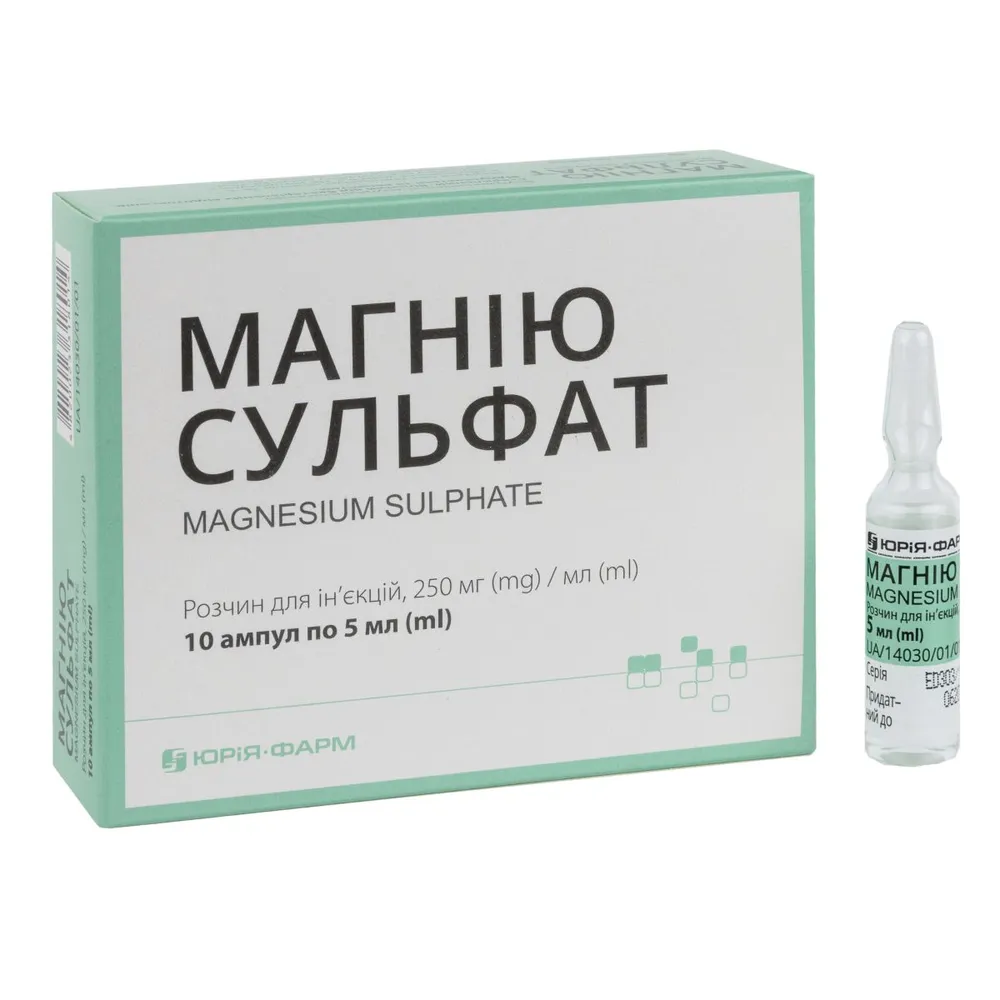
MAGNESIUM SULFATE
UkraineThe drug is used for replacement therapy in magnesium deficiency (hypomagnesemia), for the prevention and control of seizures in preeclampsia and eclampsia, and for correcting magnesium levels during parenteral nutrition.
Frequently asked questions
How should Magnesium sulfate be taken correctly?
The drug is administered intravenously or intramuscularly. Dosage and method of administration depend on the patient's condition, age, and the purpose of treatment. During intravenous administration, the rate must be slow, and the solution must be diluted.
When should this drug not be used?
Magnesium sulfate is contraindicated in cases of heart block and myocardial damage.
What are the possible side effects of Magnesium sulfate?
Side effects are usually associated with overdose and may include flushing, sweating, decreased blood pressure, decreased reflexes, respiratory depression, hypothermia, and circulatory collapse.
Can the drug be taken during pregnancy?
The drug should be used during pregnancy only in cases of extreme necessity. Continuous administration for more than 5-7 days may cause fetal developmental abnormalities.
How does the drug interact with other medicines?
Magnesium may enhance the effects of hypnotics, narcotics, and anesthetics. It may also reduce the efficacy of certain antibiotics (streptomycin, tetracycline, tobramycin). When used simultaneously with calcium, the effect of magnesium may be reduced, and with cardiac glycosides, it may increase the risk of heart block.
Does the drug affect the ability to drive a vehicle?
Yes, the drug has a sedative effect; therefore, patients should refrain from driving vehicles or operating dangerous machinery.
Instructions for use
INSTRUCTIONS FOR MEDICAL USE OF THE MEDICINAL PRODUCT MAGNESIUM SULFATE (MAGNESIUM SULFATE)
Composition:
Active substance: magnesium sulfate heptahydrate;
1 ml of solution contains 500 mg of magnesium sulfate heptahydrate;
Excipients: water for injections, sodium hydroxide, sulfuric acid.
Pharmaceutical form. Injection solution.
Main physico-chemical properties: clear, colorless liquid.
Pharmacotherapeutic group. Plasma substitutes and infusion solutions. Electrolyte solution. ATC code B05X A05.
Pharmacological Properties
Pharmacodynamics
Magnesium is an essential cofactor for enzymatic reactions and plays an important role in neurochemical transmission and muscular excitability. Deficiency is associated with various structural and functional disturbances; the precise mechanism of action has not been fully elucidated. Early symptoms of hypomagnesemia (less than 1.5 mEq/L) may develop within 3 to 4 days or over several weeks.
The main symptoms of magnesium deficiency are neurological disorders, such as muscle excitability, clonic twitching, and muscle tremor. Hypocalcemia and hypokalemia are frequently associated with low serum magnesium levels. Although the body contains a large magnesium reservoir, primarily intracellular and in the bones of adults, these stores are often not sufficiently mobilized to maintain plasma levels. Parenteral magnesium therapy restores plasma magnesium levels and alleviates symptoms of hypomagnesemia.
Magnesium prevents or controls seizures by blocking neuromuscular transmission and reducing the amount of acetylcholine released into the synaptic cleft. Magnesium is known to exert a depressant effect on the central nervous system (CNS); however, it does not have adverse effects on the woman, fetus, or newborn when used as directed in the treatment of eclampsia or preeclampsia. The normal magnesium level in blood plasma ranges from 1.5 to 2.5 mEq/L.
When plasma magnesium levels increase above 4 mEq/L, deep tendon reflexes are first diminished and then disappear as plasma magnesium levels approach 10 mEq/L. At this level, respiratory paralysis may occur. Cardiac blockade may also occur at this or even at lower plasma magnesium concentrations. Serum magnesium concentrations exceeding 12 mEq/L may result in fatal outcomes.
Magnesium causes peripheral vasodilation. At low doses, only flushing and sweating occur, but higher doses lead to a reduction in arterial blood pressure. Intravenous administration of calcium reduces both central and peripheral manifestations of magnesium overdose.
Pharmacokinetics
After intravenous administration, the onset of anticonvulsant effect is immediate and lasts approximately 30 minutes. Following intramuscular administration, the onset of action occurs after approximately 1 hour and persists for 3 to 4 hours. The effective anticonvulsant serum level ranges from 2.5 to 7.5 mEq/L. Magnesium is excreted exclusively by the kidneys at a rate proportional to the plasma concentration and glomerular filtration rate.
Clinical characteristics.
Indications.
Replacement therapy for magnesium deficiency, particularly in acute hypomagnesemia accompanied by signs of tetany similar to those observed in hypocalcemia. In such cases, serum magnesium levels are usually below the lower limit of normal (1.5–2.5 mEq/L), while serum calcium levels are normal (4.3 to
5.3 mEq/L) or elevated.
Parenteral nutrition (TPN) – for correction or prevention of hypomagnesemia that may occur during therapy.
Prophylaxis and control of seizures in pre-eclampsia and eclampsia, respectively.
Contraindications.
Magnesium sulfate is contraindicated in heart block and myocardial damage.
Interaction with other medicinal products and other forms of interaction.
When concomitant administration of barbiturates, narcotics, or other hypnotics (or systemic anesthetics), or other medicinal products that depress the CNS with magnesium is necessary, their doses should be adjusted due to additive CNS-depressant effects of magnesium. Calcium ions have an antagonistic effect on magnesium ions, leading to reduced central and peripheral pharmacological effects of magnesium sulfate when administered simultaneously.
Use magnesium sulfate with caution together with muscle relaxants, as neuromuscular blockade may be enhanced.
Use with special caution in patients receiving cardiac glycosides, as their concomitant use may lead to heart block. Intravenous calcium administration is used to treat magnesium overdose.
Special precautions for use.
Use with caution if flushing or sweating occurs during administration. When concomitant use with barbiturates, narcotics, or other hypnotic agents (or systemic anesthetics) is necessary, their doses should be adjusted due to additive CNS-depressant effects of magnesium.
Since magnesium is excreted exclusively by the kidneys, the drug should be administered with caution in patients with renal insufficiency. Diuresis should be maintained at a level of 100 mL or more during the 4 hours preceding each dose. It is important to monitor serum magnesium levels and the patient's clinical condition to prevent overdose in cases of toxemia. A clinical sign of a safe dosing regimen is the presence of the patellar reflex (knee jerk) and absence of respiratory depression (approximately 16 breaths per minute or more). When repeated doses are administered parenterally, the patellar reflex should be checked before each dose; if it is absent, magnesium sulfate should not be administered until reflexes return. An adequate serum magnesium level for seizure control is generally between 3 and 6 mg/100 mL (2.5–5 mEq/L). Deep tendon reflexes begin to diminish when magnesium levels exceed 4 mEq/L. Reflexes may be absent at serum magnesium levels of 10 mEq/L, where respiratory paralysis is a potential risk. Injectable calcium salts should be readily available for treatment of potential magnesium intoxication in eclampsia.
Magnesium sulfate (50%) must be diluted to a concentration of 20% or less before intravenous infusion. The rate of administration should be slow due to the risk of hypermagnesemia. The 50% magnesium sulfate solution should also be diluted to 20% or less for intramuscular injections in infants and children.
Laboratory diagnostics
Serum magnesium levels should be determined before initiating therapy. Magnesium sulfate should not be administered unless hypomagnesemia is confirmed and serum magnesium concentration is monitored. Normal serum magnesium levels range from 1.5 to 2.5 mEq/L.
Use during pregnancy or breastfeeding.
Pregnancy
Magnesium sulfate may cause fetal abnormalities when administered to pregnant women for more than 5–7 days. Retrospective epidemiological studies and case reports have documented such fetal abnormalities as hypocalcemia, skeletal demineralization, osteopenia, and other skeletal abnormalities following administration of magnesium sulfate to pregnant women for more than 5–7 consecutive days. The minimum duration of treatment that may cause fetal harm is unknown.
Magnesium sulfate should be used during pregnancy only if clearly needed.
Nonteratogenic effects
When administered via continuous intravenous infusion (especially for more than 24 hours before delivery) to control seizures in a pregnant woman, newborns may exhibit signs of magnesium intoxication, including neuromuscular blockade or respiratory depression (see section "Overdose").
Breastfeeding
Since magnesium passes into breast milk, the drug should be used with caution in nursing mothers.
Ability to affect reaction speed when driving or operating machinery.
Patients should be advised to refrain from operating potentially hazardous machinery or driving vehicles, as the drug has a sedative effect.
Dosage and Administration
The dosage of magnesium sulfate should be adjusted according to individual requirements and response, and administration should be discontinued as soon as the desired therapeutic effect is achieved.
Administer by intravenous and intramuscular injection.
The therapeutic level of magnesium in blood plasma is reached within 60 minutes after intramuscular injection of undiluted 50% magnesium sulfate solution, whereas with intravenous administration, the therapeutic level is achieved almost immediately. The rate of intravenous administration should generally not exceed 150 mg/minute (1.5 mL of 10% solution or equivalent amount), except in severe eclampsia with convulsions (see below). Administration of magnesium sulfate to pregnant women for more than 5–7 consecutive days may cause fetal abnormalities.
Before administration, solutions for intravenous infusion should be diluted according to a 1:1.5 ratio (medicinal product:solvent) or less. Suitable diluents include 0.9% sodium chloride solution, 5% glucose for injection, Ringer's lactate solution, and 5% glucose in 0.9% sodium chloride solution.
For intramuscular injections in adults, use undiluted 50% magnesium sulfate solution. However, for intramuscular injection in children, the solution should be diluted to a concentration of 20% or less.
Physical and chemical stability of solutions prepared under aseptic conditions has been demonstrated for 24 hours at 25°C after dilution in 0.9% sodium chloride solution, 5% glucose for injection, Ringer's lactate solution, and 5% glucose in 0.9% sodium chloride solution. From a microbiological standpoint, if the dilution method does not exclude the possibility of microbial contamination, the medicinal product should be used immediately. If not used immediately, storage time and conditions during use are the responsibility of the user.
Replacement Therapy in Magnesium Deficiency
For treatment of mild magnesium deficiency, the single dose for adults is 1 g, equivalent to 8.12 mEq of magnesium (2 mL of 50% solution), administered intramuscularly 4 times daily every 6 hours (equivalent to a total daily dose of 32.5 mEq magnesium). In severe hypomagnesemia, administer up to 250 mg (approximately 2 mEq) per kg of body weight (0.5 mL of 50% solution) intramuscularly every 4 hours as needed.
Alternative regimen: Dilute 5 g (approximately 40 mEq) in one liter of 5% glucose for injection or 0.9% sodium chloride solution for slow intravenous infusion (over at least 3 hours).
To ensure accurate dosing, magnesium levels should be monitored, taking into account urinary fluid losses.
Parenteral Nutrition (TPN)
Magnesium requirements during parenteral nutrition are not precisely known. The maintenance dose used in adults ranges from 8 to 24 mEq (1 to 3 g) daily; for infants, the range is from 2 to 10 mEq (0.25 to 1.25 g) daily.
Treatment of Pre-eclampsia and Eclampsia
In severe pre-eclampsia or eclampsia, the total initial dose is 10–14 g of magnesium sulfate. Intravenously, administer 4–5 g in 250 mL of 5% glucose for injection or 0.9% sodium chloride solution for injection. Simultaneously, administer doses up to 10 g intramuscularly (5 g or 10 mL of undiluted 50% solution in each buttock). Alternatively, the initial intravenous dose of 4 g may be given by diluting the 50% solution to a concentration of 10% or 20%; the diluted solution (40 mL of 10% solution or 20 mL of 20% solution) should be administered intravenously over at least 3–4 minutes. Subsequently, administer 4–5 g (8–10 mL of 50% solution) intramuscularly, alternating buttocks every 4 hours, as needed and depending on the presence of the patellar reflex and adequate respiratory function.
Alternatively, after the initial intravenous dose, administer 1–2 g/hour via continuous intravenous infusion. Therapy should continue until convulsions cease. A serum magnesium level of 6 mg/100 mL is considered optimal for controlling convulsions. The total daily (24-hour) dose should not exceed 30–40 g. In cases of severe renal insufficiency, the maximum dose of magnesium sulfate is 20 g/48 hours, and serum magnesium concentration should be monitored frequently. Administration of magnesium sulfate during pregnancy for more than 5–7 consecutive days may cause fetal developmental abnormalities.
Other Uses
As an antidote for muscle-stimulating effects in barium poisoning, the usual dose of magnesium sulfate is 1–2 g intravenously.
For control of convulsions associated with epilepsy, glomerulonephritis, or hypothyroidism, the usual adult dose is 1 g administered intramuscularly or intravenously.
In paroxysmal atrial tachycardia, magnesium should be used only when simpler measures have failed and there is no evidence of myocardial damage. The usual dose is 3–4 g (30–40 mL of 10% solution), administered intravenously over 30 seconds with caution.
For reduction of cerebral edema, administer 2.5 g (25 mL of 10% solution) intravenously.
Children
Magnesium sulfate may be used in pediatric practice when necessary. The 20% solution should be administered intramuscularly. The need for administration, dosage, and duration of treatment in children should be determined by the physician, taking into account the clinical condition, age, and body weight of the patient.
Overdose
Symptoms. Magnesium intoxication manifests as a sharp drop in arterial pressure and respiratory paralysis. Disappearance of the patellar reflex is an important clinical sign of the initial stage of hypermagnesemia. In case of overdose, artificial ventilation of the lungs (prior to intravenous administration of calcium salts) may be required to prevent and treat neuromuscular blockade caused by magnesium.
Treatment. Artificial ventilation of the lungs may be required. Administer intravenously 10–20 mL of 5% calcium solution (diluted with isotonic sodium chloride solution for injection) to prevent hypermagnesemia. Administer physostigmine subcutaneously, 0.5–1 mg.
Hypermagnesemia in newborns may require resuscitation and artificial ventilation of the lungs via endotracheal intubation or positive pressure ventilation, as well as intravenous administration of calcium.
Adverse reactions.
Adverse reactions following parenteral administration of magnesium are usually due to magnesium intoxication. Symptoms include hyperemia, sweating, hypotension, diminished reflexes, flaccid paralysis, hypothermia, circulatory collapse, depression of cardiac and central nervous system (CNS) function, which may lead to respiratory paralysis. Secondary hypocalcemia with signs of tetany has been reported during treatment of eclampsia with magnesium sulfate.
Reporting of adverse reactions following drug registration is of great importance. It enables ongoing monitoring of the benefit-risk balance of the medicinal product. Healthcare and pharmaceutical professionals, as well as patients or their legal representatives, should report all suspected adverse reactions and lack of therapeutic efficacy via the Automated Pharmacovigilance Information System at the following link: https://aisf.dec.gov.ua.
Shelf life. 5 years.
Storage conditions. Store at a temperature not exceeding 30 °C.
Keep out of reach of children.
Incompatibility.
Pharmaceutically incompatible (forms precipitate) with calcium preparations, ethanol (at high concentrations), carbonates, bicarbonates, hydroxides and phosphates of alkali metals, arsenic acid salts, barium, strontium, clindamycin phosphate, heavy metals, sodium hydrocortisone succinate, polymyxin B sulfate, procaine hydrochloride, salicylates and tartrates.
Potential incompatibility may often be influenced by changes in reagent concentrations and solution pH.
It has been reported that magnesium may reduce the antibacterial activity of streptomycin, tetracycline and tobramycin when administered simultaneously.
Parenteral medicinal products should be inspected visually for particulate matter and discoloration prior to administration.
Packaging. 5 ml or 10 ml in an ampoule; 5 ampoules per blister pack; 2 blisters per carton.
Prescription status. Prescription only.
Manufacturer: JSC "Halychpharm".
Manufacturer's address and location of business activity:
6/8 Opryshkivska Street, Lviv, 79024, Ukraine.
Similar drugs
| Brand name | Dosage form | Active substance / Dosage | Manufacturer |
|---|---|---|---|
| MAGNESIUM SULFATE | solution for injection |
|
Yuria-Pharm LLC |
| MAGNESIUM SULFATE | solution for injection |
|
PJSC "Lekhim - Kharkiv" |
| MAGNESIUM SULFATE | solution for injection |
|
Farmasel LLC |
| MAGNESIUM SULFATE | solution for injection |
|
PJSC "Halychpharm" |
| MAGNESIUM SULFATE-DARNITSA | solution for injection |
|
PJSC «Pharmaceutical Company «Darnitsa» |
The original data is available in the language of the country of manufacture.
Data source: State Register of Medicinal Products of Ukraine
Data last verified: August 13, 2026