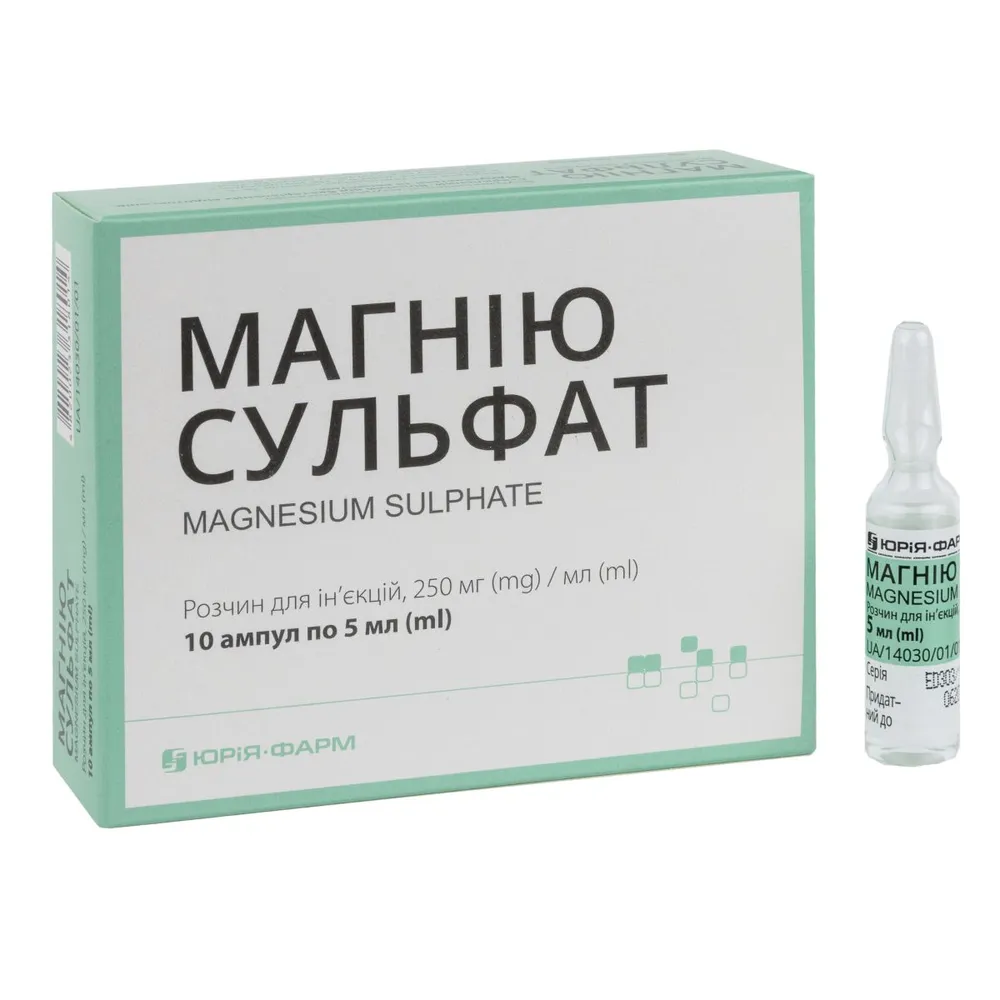
MAGNESIUM SULFATE
UkraineThe drug is used in hypertensive crises, cardiac rhythm disorders, convulsive syndrome, eclampsia, and magnesium deficiency in the body. It is also used in the complex therapy of preterm labor, for angina pectoris, and as an antidote in heavy metal poisoning (e.g., lead or barium).
Frequently asked questions
How should Magnesium sulfate be taken correctly?
The drug is administered intramuscularly or intravenously (slowly or as an infusion). Dosage and method of administration depend on the specific disease and the patient's condition. For example, in hypomagnesemia, doses are selected individually, and for infusions, the solution is diluted in saline or glucose.
What are the possible side effects of Magnesium sulfate?
Possible side effects include cardiovascular reactions (low blood pressure, rhythm disturbances), respiratory reactions (shortness of breath, respiratory depression), nervous system reactions (headache, dizziness, drowsiness, weakness), as well as nausea, vomiting, skin rash, or swelling at the injection site.
Who should not use this drug?
Contraindications include hypersensitivity to the components, low blood pressure, very low heart rate (less than 55 beats per minute), impaired kidney or liver function, myasthenia gravis, cachexia, and certain other conditions associated with calcium deficiency or respiratory depression.
Can the drug be taken with other medicines?
Magnesium can interact with many substances. It enhances the effect of drugs that depress the nervous system and may potentiate the effect of muscle relaxants. Calcium ions reduce the effect of magnesium. The drug may also affect the action of antibiotics (tetracycline), cardiac glycosides, and antithrombotic agents.
How does the drug affect the ability to drive a vehicle?
Since the drug may cause drowsiness and a sedative effect, patients should be cautious when driving a car or operating machinery.
Instructions for use
INSTRUCTIONS FOR MEDICAL USE OF THE MEDICINAL PRODUCT MAGNESIUM SULFATE (MAGNESIUM SULFATE)
Composition:
Active substance: magnesium sulfate heptahydrate;
1 ml of solution contains 250 mg of magnesium sulfate heptahydrate;
Excipients: sodium hydroxide, water for injections.
Pharmaceutical form. Injection solution.
Main physicochemical properties: clear, colorless liquid.
Pharmacotherapeutic group. Plasma substitutes and infusion solutions. Electrolyte solution. ATC code B05X A05.
Pharmacological Properties
Pharmacodynamics
Magnesium is a physiological antagonist of calcium and a metabolic cofactor for most metabolic reactions, including those associated with energy synthesis and release. It reduces catecholamine secretion, regulates the function of Na+/K+-ATPase, neurotransmission, and muscle excitability, and decreases acetylcholine levels in the central and peripheral nervous systems, thereby exerting sedative, analgesic, anticonvulsant, spasmolytic, choleretic, and tocolytic effects. The drug dilates coronary and peripheral arteries, reduces arterial blood pressure and cardiac afterload, and inhibits the development of myocardial reperfusion injury. It reduces the frequency of ventricular and supraventricular arrhythmias and slows conduction in the area of the sinoatrial and atrioventricular nodes.
The antiplatelet properties of magnesium are associated with reduced synthesis of thromboxane A2 and lipoxygenase derivatives (12-HETE), as well as stimulation of prostacyclin and high-density lipoprotein synthesis. At higher doses, magnesium may cause negative inotropic and muscle-relaxant effects.
Pharmacokinetics
After parenteral administration, magnesium rapidly distributes into organs and tissues, crosses the blood-brain barrier and placenta, and passes into breast milk in high concentrations. The drug is primarily excreted in the urine.
Systemic effects develop within 1 minute after intravenous administration and within 1 hour after intramuscular administration. The duration of action of magnesium is 30 minutes after intravenous administration and 3–4 hours after intramuscular administration.
Clinical characteristics.
Indications.
Hypertensive crisis, ventricular cardiac arrhythmias (tachycardia "torsades de pointes"); convulsive syndrome; eclampsia, hypomagnesemia, increased magnesium requirements.
The drug should also be used in the complex therapy of preterm labor, angina pectoris, poisoning with salts of heavy metals, tetraethyllead, and soluble barium salts (antidote).
Contraindications.
Increased individual sensitivity to the components of the drug; arterial hypotension; pronounced bradycardia (heart rate (HR) less than 55 beats per minute); atrioventricular block; conditions caused by calcium deficiency and respiratory center depression; cachexia; renal function disorders; severe hepatic or renal insufficiency; myasthenia; malignant neoplasms.
Interaction with other medicinal products and other types of interactions.
Calcium ions have antagonistic action to magnesium ions, which leads to reduced pharmacological effects of magnesium sulfate when used concomitantly. The drug enhances the effect of agents that suppress the central nervous system (narcotics, analgesics). When used concomitantly with muscle relaxants and nifedipine, neuromuscular blockade is enhanced. Concurrent use with calcium channel blockers, such as nifedipine, may lead to calcium imbalance and impaired muscle function.
Barbiturates, narcotic analgesics, and antihypertensive agents increase the likelihood of respiratory center depression. Cardiac glycosides increase the risk of conduction disturbances and atrioventricular block.
The effect of antithrombotic agents, vitamin K antagonists, isoniazid, and non-selective inhibitors of neuronal monoamine reuptake is reduced.
Excretion of mexiletine may be slowed, thus requiring a review of the dosage of the latter.
Propafenone: the effect of both drugs is enhanced, and the risk of toxic effects increases. The drug impairs absorption of tetracycline group antibiotics, intestinal obstruction is possible, and the effect of streptomycin and tobramycin is diminished.
Special precautions for use.
Before initiating therapy, serum magnesium levels should be determined. In adults, the normal magnesium level in blood plasma ranges from 0.75 to 1.26 mmol/L.
When using the medicinal product, it should be taken into account that increased urinary excretion of magnesium occurs with an increase in extracellular fluid, renal vasodilation, hypercalcemia, elevated urinary sodium excretion, administration of osmotic diuretics (urea, mannitol, glucose), loop diuretics (furosemide, ethacrynic acid, thiazides), use of cardiac glycosides, calcitonin, thyreoidin, and during prolonged administration of desoxycorticosterone acetate (more than 3–4 days). Delayed excretion of magnesium is observed during parathyroid hormone administration. In renal insufficiency, magnesium excretion is slowed, and its accumulation may occur with repeated administration. Therefore, in elderly patients and patients with severe renal impairment, the dose should not exceed 20 g of magnesium sulfate (81 mmol Mg2+) over 48 hours. Magnesium sulfate should not be administered intravenously rapidly in patients with oliguria or severe renal dysfunction. Urinary tract infections accelerate precipitation of ammonium-magnesium phosphates; therefore, magnesium therapy is temporarily contraindicated in such cases. After parenteral administration of magnesium sulfate, impaired excretion of magnesium may lead to hypermagnesemia.
Use with caution in myasthenia gravis and respiratory tract diseases. During prolonged use of the medicinal product, monitoring of the cardiovascular system, tendon reflexes, renal function, and respiratory rate is recommended.
Intravenous administration of magnesium sulfate must be performed slowly: rapid infusion may result in hypermagnesemia (symptoms include nausea, paresthesia, sedative effect, hypoventilation up to apnea, and decreased deep tendon reflexes). Concurrent parenteral administration of vitamin B6 and insulin enhances the efficacy of magnesium therapy.
If simultaneous intravenous administration of magnesium sulfate and calcium preparations is required, they should be administered into separate veins. It should be noted that magnesium levels depend on calcium levels in the body.
Use during pregnancy or breastfeeding.
During pregnancy, magnesium sulfate should be used with particular caution and only after considering serum magnesium levels, when the expected therapeutic benefit outweighs the potential risk to the fetus. When used for analgesia during labor, possible inhibition of uterine muscle contractility should be considered, which may necessitate the use of agents that stimulate labor.
If use of the medicinal product is necessary, breastfeeding should be discontinued.
Ability to affect reaction speed while driving or operating machinery.
Patients should be advised to exercise caution when operating potentially hazardous machinery or driving vehicles, as the medicinal product has a sedative effect.
Administration and Dosage
Administer intramuscularly, slowly intravenously, or as an intravenous infusion. The frequency and dosage are individual and depend on the indication and therapeutic response. For infusion, dilute the medicinal product with 0.9% sodium chloride solution or 5% glucose solution. During intravenous injection, the rate of administration should generally not exceed 150 mg/min (0.6 mL/min), except in the treatment of arrhythmias and eclampsia in pregnant women.
Prepared infusion solutions must be used immediately after preparation (they are not suitable for storage).
Hypomagnesemia. In moderate hypomagnesemia (0.5–0.7 mmol/L), administer 4 mL (1 g of magnesium sulfate) intramuscularly every 6 hours to adults.
In severe hypomagnesemia (< 0.5 mmol/L), increase the total intramuscular dose to 1 mL/kg (250 mg/kg), administered in divided doses over 4 hours. For intravenous infusion in severe hypomagnesemia, add 20 mL of the drug (5 g of magnesium sulfate) to 1 L of 0.9% sodium chloride solution or 5% glucose solution and administer over at least 3 hours.
The maximum daily dose for intravenous administration is 72 mL (18 g). If necessary, repeat the infusion over several days.
Arterial hypertension. In stage I–II arterial hypertension, administer 5–10–20 mL intramuscularly daily. The treatment course consists of 15–20 injections. Along with a reduction in blood pressure, a decrease in the severity of angina may also be observed.
Hypertensive crisis. Administer 10–20 mL intramuscularly or slowly intravenously as a bolus.
Cardiac arrhythmias. To control arrhythmias, administer 4–8 mL (1–2 g of magnesium sulfate) intravenously over 5–10 minutes; repeat the injection if necessary (total administration up to 4 g of magnesium sulfate). Initial loading dose may be 8 mL administered over at least 5 minutes, followed by infusion of 20 mL of the drug diluted with 0.9% sodium chloride solution or 5% glucose solution over at least 6 hours; alternatively, 8 mL over at least 30 minutes followed by infusion over at least 12 hours.
Ischemic stroke. Administer 10–20 mL intravenously daily for 5–7 days.
Seizure syndrome. In adults, administer 5–10–20 mL intramuscularly. In children, administer intramuscularly at a dose of 0.08–0.16 mL/kg body weight (20–40 mg/kg).
Pregnancy toxemia. Administer 10–20 mL 1–2 times daily intramuscularly (can be combined with concomitant administration of neuroleptics).
In cases of preeclampsia or eclampsia, administer intramuscularly or intravenously. Initially, administer a single dose of 10 mL intramuscularly into each buttock or 16 mL (4 g of magnesium sulfate) intravenously over 3–4 minutes. Subsequently, continue administration intramuscularly at 16–20 mL (4–5 g) every 4 hours or intravenously by drip at 4–8 mL/hour (1–2 g/hour), with continuous monitoring of tendon reflexes and respiratory function. Continue therapy until seizure cessation. The maximum daily dose is 40 g of magnesium sulfate; in case of renal impairment, the maximum dose is 20 g/48 hours.
Pain relief during labor. Administer 5–10–20 mL intramuscularly; if necessary, combine magnesium sulfate with analgesics.
Urinary retention. In cases of urinary retention and lead colic, administer 5–10 mL intramuscularly or 5–10 mL intravenously diluted 5-fold in 25% magnesium sulfate solution (also administer as an enema).
As an antidote. In mercury, arsenic, or tetraethyllead poisoning, administer 5–10 mL intravenously of 25% magnesium sulfate solution diluted 2.5–5 times. In poisoning with soluble barium salts, administer 4–8 mL intravenously or perform gastric lavage with a 1% magnesium sulfate solution.
Neonates. In neonates with intracranial hypertension and severe asphyxia, initiate intramuscular administration at a dose of 0.2 mL/kg body weight per day, increasing the dose to 0.8 mL/kg body weight per day by the 3rd–4th day, administered over 3–8 days as part of combination therapy. To correct magnesium deficiency in neonates, administer 0.5–0.8 mL/kg once daily for 5–8 days.
Children.
The medicinal product may be used in pediatric practice.
Overdose.
Symptoms: signs of hypermagnesemia in order of increasing serum magnesium concentration:
reduction in deep tendon reflexes (2–3.5 mmol/L);
prolongation of the PQ interval and widening of the QRS complex on ECG (2.5–5 mmol/L);
loss of deep tendon reflexes (4–5 mmol/L);
respiratory center depression (5–6.5 mmol/L);
cardiac conduction disturbances (7.5 mmol/L);
cardiac arrest (12.5 mmol/L).
Additionally, hyperhidrosis, anxiety, lethargy, polyuria, and uterine atony may occur.
Treatment: calcium preparations (calcium chloride or calcium gluconate) are specific antidotes and should be administered slowly intravenously. In moderate hypermagnesemia, furosemide may be prescribed. Respiratory depression should be managed by intravenous administration of 5–10 mL of 10% calcium chloride solution, oxygen inhalation, and artificial ventilation of the lungs. In severe cases, peritoneal dialysis or hemodialysis is indicated. Symptomatic agents correcting cardiovascular and central nervous system functions should also be administered.
Adverse reactions.
Cardiovascular system: arterial hypotension, bradycardia, palpitations, conduction disturbances, flushing/hot flushes, prolongation of the PQ interval and widening of the QRS complex on ECG, arrhythmia, coma, cardiac arrest.
Respiratory system: dyspnea, respiratory depression.
Nervous system: headache, dizziness, general weakness, somnolence, confusion, loss of consciousness, depression, decreased tendon reflexes, diplopia, anxiety, speech disturbances, tremor and numbness of extremities.
Musculoskeletal system: muscle weakness.
Gastrointestinal tract: nausea, vomiting.
Immune system: anaphylactic shock, angioneurotic edema, hyperthermic syndrome, chills.
Skin and subcutaneous tissues: hyperemia, itching, rash, urticaria, increased sweating.
Urinary system: polyuria.
Reproductive system and mammary glands: uterine atony.
Metabolic and nutritional disorders: hypocalcemia, hypophosphatemia, hyperosmolar dehydration.
Local reactions at injection site: hyperemia, swelling, pain.
Reporting suspected adverse reactions
Reporting of suspected adverse reactions after drug registration is important. It enables ongoing monitoring of the benefit-risk balance of the medicinal product. Healthcare and pharmacy professionals, as well as patients or their legal representatives, should report all suspected adverse reactions and lack of efficacy via the Automated Pharmacovigilance Information System at: https://aisf.dec.gov.ua.
Shelf life. 2 years.
Storage conditions. Store in original packaging at a temperature not exceeding 25 °C. Keep out of reach of children.
Incompatibility. Pharmacologically incompatible (precipitate forms) with calcium preparations, ethanol (at high concentrations), carbonates, bicarbonates and phosphates of alkali metals, arsenic acid salts, barium, strontium, clindamycin phosphate, sodium hydrocortisone succinate, polymyxin B sulfate, procaine hydrochloride, salicylates and tartrates. In mixtures for total parenteral nutrition, when Mg²⁺ concentration exceeds 10 mmol/mL, separation of lipid emulsions may occur.
Packaging. 5 mL in a polyethylene ampoule. 10 or 50 ampoules per cardboard pack.
10 mL in a polyethylene ampoule. 10 ampoules per cardboard pack.
Prescription status. Prescription only.
Manufacturer. LLC "FARMASEL".
Manufacturer's address and location of business activity.
3, Prorizna Street, Kvitneve, Brovary District, Kyiv Oblast, 07408, Ukraine.
Similar drugs
| Brand name | Dosage form | Active substance / Dosage | Manufacturer |
|---|---|---|---|
| MAGNESIUM SULFATE | solution for injection |
|
Yuria-Pharm LLC |
| MAGNESIUM SULFATE | solution for injection |
|
PJSC "Lekhim - Kharkiv" |
| MAGNESIUM SULFATE | solution for injection |
|
PJSC "Halychpharm" |
| MAGNESIUM SULFATE | solution for injection |
|
PJSC "Halychpharm" |
| MAGNESIUM SULFATE-DARNITSA | solution for injection |
|
PJSC «Pharmaceutical Company «Darnitsa» |
The original data is available in the language of the country of manufacture.
Data source: State Register of Medicinal Products of Ukraine
Data last verified: August 13, 2026