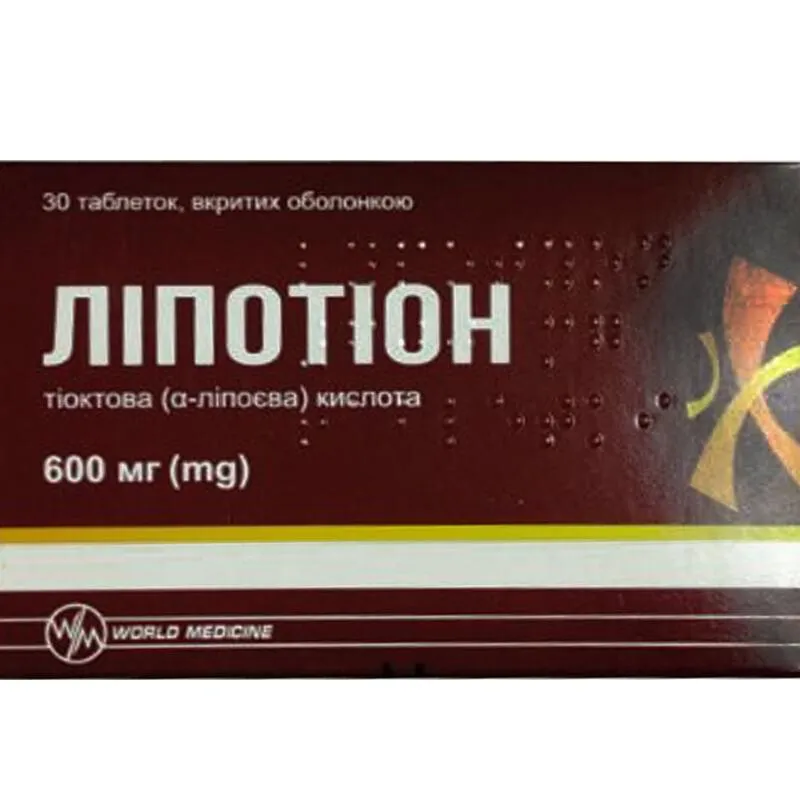
LIPOTYON
UkraineThe drug is used to treat the symptoms of peripheral (sensorimotor) diabetic polyneuropathy.
Frequently asked questions
How should Lipotyon be taken correctly?
For adults, the recommended dose is 1 tablet (600 mg) per day. Tablets should be taken on an empty stomach, without chewing, and swallowed with a sufficient amount of water. It is best to take the entire daily dose 30 minutes before breakfast, as food may reduce the efficacy of the drug.
What side effects may Lipotyon cause?
Possible reactions include dizziness, nausea, headache, changes in taste sensation, or increased sweating. In very rare cases, allergic reactions (rash, itching), visual disturbances, gastrointestinal disorders, or low blood sugar (hypoglycemia) may occur. At the beginning of treatment, a temporary intensification of the 'pins and needles' sensation is possible.
Can this drug be combined with other medicines or foods?
It is not recommended to take the drug simultaneously with iron or magnesium preparations, or with dairy products (due to calcium content), as this may interfere with its action. Iron or magnesium preparations should be taken at lunch or in the evening. Caution should also be exercised when used concurrently with insulin or antidiabetic agents, as the blood sugar-lowering effect may be enhanced. It should not be combined with cisplatin.
Who should not take this drug?
The drug is contraindicated in individuals with hypersensitivity to the active substance or excipients. Due to its lactose content, it should not be used in rare forms of galactose intolerance or lactase deficiency.
Does the drug affect driving?
While taking the medication, caution should be exercised when driving or performing other tasks that require high concentration, as dizziness or visual disturbances may occur.
Instructions for use
INSTRUCTIONS FOR MEDICAL USE OF THE MEDICINAL PRODUCT LIPOTION (LIPOTION)
Composition:
Active substance: thioctic (α-lipoic) acid;
One film-coated tablet contains 600 mg of thioctic (α-lipoic) acid;
Excipients: lactose monohydrate; colloidal anhydrous silicon dioxide; simethicone; sodium croscarmellose; microcrystalline cellulose; hypromellose; magnesium stearate;
Coating composition: Opadry® 200 Optimized Performance Coating 200F210038 green (polyvinyl alcohol, talc, titanium dioxide (E 171), macrogol, methacrylic acid copolymer dispersion, quinoline yellow (E 104), indigo carmine (E 132), sodium bicarbonate).
Pharmaceutical form. Film-coated tablets.
Main physicochemical properties: elongated, biconvex film-coated tablets of yellow-green color.
Pharmacotherapeutic group.
Agents affecting the digestive system and metabolic processes. Thioctic acid. ATC code A16AX01.
Pharmacological Properties
Pharmacodynamics
α-Lipoic acid acts as a coenzyme in the oxidative decarboxylation of α-keto acids.
Hyperglycemia caused by diabetes leads to the accumulation of glucose on matrix proteins of blood vessels and the formation of so-called "advanced glycation end-products." This process results in reduced endoneurial blood flow and endoneurial hypoxia/ischemia, accompanied by increased production of reactive oxygen species, which cause damage to peripheral nerves.
Animal studies have shown that α-lipoic acid influences biochemical processes induced by streptozotocin-induced diabetes, leading to improved endoneurial blood flow and increased levels of the physiological antioxidant glutathione. As an antioxidant, it also reduces the amount of reactive oxygen species in diabetic-affected nerves.
The effects observed during experiments indicate that peripheral nerve function may be improved by α-lipoic acid. This is relevant to sensory disturbances in diabetic polyneuropathy, which may manifest as paresthesia such as burning, pain, numbness, and "pins and needles."
Pharmacokinetics
Absorption
After oral administration, α-lipoic acid is rapidly absorbed. Due to a significant first-pass effect, the absolute bioavailability of α-lipoic acid (measured as the parent compound) after oral administration is approximately 20% compared to intravenous administration.
Similar to the oral solution, which is considered the standard formulation with maximum absorption, tablets of α-lipoic acid exhibit an absorption profile with a rapid influx of the active substance, accompanied by reduced inter-individual variability. The relative bioavailability of tablets (compared to the oral solution) is > 60%. A maximum plasma concentration of 4 μg/mL was observed approximately 0.5 hours after oral administration of 600 mg α-lipoic acid.
Biotransformation
Biotransformation of α-lipoic acid occurs mainly through oxidative shortening of side chains (β-oxidation) and/or via S-methylation of the corresponding thiols.
Elimination
Due to rapid tissue distribution, the elimination half-life of α-lipoic acid is approximately 25 minutes.
Animal experiments (rats, dogs) using radiolabeled tracers showed that α-lipoic acid is excreted predominantly via the kidneys (80–90%), mainly in the form of metabolites. In humans, only a negligible amount of unchanged substance is excreted in urine.
Clinical characteristics.
Indications.
Treatment of symptoms of peripheral (sensorimotor) diabetic polyneuropathy.
Contraindications.
Hypersensitivity to the active substance and/or to any of the excipients of the medicinal product.
Interaction with other medicinal products and other forms of interaction.
When used concomitantly, thioctic acid reduces the efficacy of cisplatin.
Thioctic acid should not be administered simultaneously with metal compounds (iron or magnesium preparations, dairy products containing calcium), as it acts as a metal chelator. If the daily dose of thioctic acid is taken 30 minutes before breakfast, preparations containing iron or magnesium should be taken at lunch or in the evening.
Thioctic acid forms poorly soluble complexes with sugar molecules (e.g., with lavulose solution).
Concomitant use of thioctic acid may enhance the hypoglycemic effect of insulin and/or other antidiabetic agents. When such medicinal products are used together, especially at the beginning of treatment, regular monitoring of blood glucose levels is required. In some cases, to prevent symptoms of hypoglycemia, it may be necessary to reduce the dose of insulin and/or oral antidiabetic agent.
Caution
Regular alcohol consumption is a significant risk factor for the development and progression of neuropathic symptoms and may thus negatively affect treatment with thioctic acid. Therefore, patients with diabetic polyneuropathy are generally advised, whenever possible, to abstain from alcohol consumption. This restriction also applies during treatment-free intervals between therapy courses.
Special precautions for use
After administration of thioctic acid, an unusual odor of urine may occur; this phenomenon is clinically insignificant.
At the beginning of treatment for polyneuropathy, short-term intensification of paresthesia with sensations of "crawling ants" may occur due to regenerative processes.
Autoimmune insulin syndrome (AIS) has been reported during use of thioctic acid. Patients with human leukocyte antigen genotypes such as HLA-DRB1*04:06 and HLA-DRB1*04:03 alleles are more susceptible to developing AIS. The HLA-DRB1*04:03 allele (susceptibility to AIS: 1.6) has been particularly observed in Caucasians, with higher prevalence in southern compared to northern Europe, while the HLA-DRB1*04:06 allele (susceptibility to AIS: 56.6) has been particularly observed in Japanese and Korean patients. AIS should be considered in the differential diagnosis of spontaneous hypoglycemia in patients receiving this medicinal product (see section "Adverse reactions").
The medicinal product contains lactose; therefore, it should not be administered to patients with rare hereditary forms of galactose intolerance, lactase deficiency, or glucose-galactose malabsorption syndrome.
The medicinal product contains less than 1 mmol (23 mg)/dose of sodium, i.e., it is practically sodium-free.
Use during pregnancy or breastfeeding
The medicinal product is not recommended for use during pregnancy due to lack of adequate clinical data.
There are no data on the passage of thioctic acid into breast milk; therefore, the medicinal product is not recommended for use during breastfeeding.
Ability to influence reaction speed when driving vehicles or operating machinery
During use of the medicinal product, caution should be exercised (due to possible adverse reactions such as dizziness and visual disturbances) when driving vehicles or engaging in other potentially hazardous activities requiring increased attention and rapid psychomotor reactions.
Method of Administration and Dosage
The medicinal product is intended for oral administration. Tablets should be taken on an empty stomach, without chewing, and with sufficient amount of water. Taking the medicinal product during meals may reduce the absorption of thioctic acid; therefore, it is recommended to take the entire daily dose 30 minutes before breakfast (first meal of the day).
Adults
The daily dose is 600 mg of thioctic acid (1 tablet).
The duration of treatment is determined individually by a physician.
Children
As there are no data on the safety and efficacy of thioctic acid in children, the medicinal product is not recommended for use in this age group.
Overdose
Symptoms
In case of overdose, nausea, vomiting, and headache may occur. After accidental ingestion or in suicide attempts involving oral administration of thioctic acid in doses ranging from 10 g to 40 g in combination with alcohol, severe intoxication has been observed, in some cases resulting in death. At the initial stage, the clinical picture of intoxication may present as psychomotor agitation or impaired consciousness. Subsequently, generalized seizures and lactic acidosis may develop.
In addition, high-dose thioctic acid intoxication has been associated with hypoglycemia, shock, acute necrosis of skeletal muscles, hemolysis, disseminated intravascular coagulation syndrome, bone marrow suppression, and multiorgan failure.
Treatment
In suspected cases of severe intoxication (e.g., more than 10 tablets of 600 mg for adults or more than 50 mg/kg body weight for children), immediate hospitalization is recommended, along with measures according to general principles of management in accidental poisoning (e.g., induction of emesis, gastric lavage, administration of activated charcoal). Treatment of life-threatening complications such as generalized seizures and lactic acidosis should be carried out in accordance with modern intensive care principles; such treatment should be symptomatic. To date, the benefit of hemodialysis, hemoperfusion, or filtration techniques with forced elimination of thioctic acid has not been confirmed.
Side effects.
Side effects that may occur during the use of thioctic acid are classified according to the following frequency: very common (≥ 1/10), common (≥ 1/100 to < 1/10), uncommon (≥ 1/1,000 to < 1/100), rare (≥ 1/10,000 to < 1/1,000), very rare (< 1/10,000), frequency not known (cannot be estimated from the available data).
Immune system disorders:
very rare – allergic reactions, including skin rashes, urticaria (urticarial rash), pruritus, and eczema; frequency not known – autoimmune insulin syndrome (see section "Special precautions").
Metabolism and nutrition disorders:
very rare – hypoglycemia*.
Nervous system disorders:
common – dizziness; very rare – altered or impaired taste sensation, headache*, increased sweating*.
Eye disorders:
very rare – visual disturbances*.
Respiratory, thoracic and mediastinal disorders:
dyspnea (difficulty breathing).
Gastrointestinal disorders:
common – nausea; very rare – gastrointestinal disorders, including vomiting, abdominal pain, gastrointestinal pain, diarrhea.
*As a result of improved glucose utilization, blood glucose levels may decrease in very rare cases. Consequently, symptoms of hypoglycemia such as dizziness, increased sweating, headache, and blurred vision may occur.
Reporting of suspected adverse reactions.
Reporting suspected adverse reactions after drug authorization is important. It allows ongoing monitoring of the benefit-risk balance of the medicinal product. Healthcare professionals, as well as patients or their legal representatives, should report any suspected adverse reactions and lack of efficacy through the Automated Pharmacovigilance Information System at the following link: https://aisf.dec.gov.ua.
Shelf life.
3 years.
Storage conditions.
Store at temperatures not exceeding 25 °C in the original packaging and in a place inaccessible to children.
Packaging.
10 tablets in a blister; 3, 6, or 10 blisters in a cardboard box.
Prescription status.
Prescription only.
Manufacturer.
UORLID MEDITSIN ILACH SAN. VE TIDJ. A.S.H./
WORLD MEDICINE ILAC SAN. VE TIC. A.S.
Manufacturer's address and location of business activity.
15 Temmuz Mahallesi Cami Yolu Caddesi No:50 Gunesli Bagcilar/ Istanbul, Turkey /
15 Temmuz Mahallesi Cami Yolu Caddesi No:50 Gunesli Bagcilar/Istanbul, Turkey.
Marketing authorization holder.
LLC "UORLID MEDITSIN", Ukraine /
WORLD MEDICINE, LLC, Ukraine.
Similar drugs
| Brand name | Dosage form | Active substance / Dosage | Manufacturer |
|---|---|---|---|
| ALPHA-LIPON | tablets, film-coated |
|
JSC "Kyiv Vitamin Plant" |
| ALPHA-LIPON | tablets, film-coated |
|
JSC "Kyiv Vitamin Plant" |
| DIALIPON | tablets, film-coated |
|
Farmak JSC |
| ESPA-LIPON® 600 | tablets, film-coated |
|
Pharma Vernigerode GmbH (quality control) |
| LIPOIKA | tablets, film-coated |
|
PJSC «Pharmaceutical Company «Darnitsa» |
| LIPOYKA | tablets, film-coated |
|
PJSC «Pharmaceutical Company «Darnitsa» |
| THIOGAMMA® 600 HR | tablets, film-coated |
|
MEDA Manufacturing GmbH (manufacturer responsible for production of unpackaged products, primary and secondary packaging, quality control) |
| TIOGAMA® | tablets, film-coated |
|
Dragenopharm Apotheker Puschl GmbH |
The original data is available in the language of the country of manufacture.
Data source: State Register of Medicinal Products of Ukraine
Data last verified: August 13, 2026