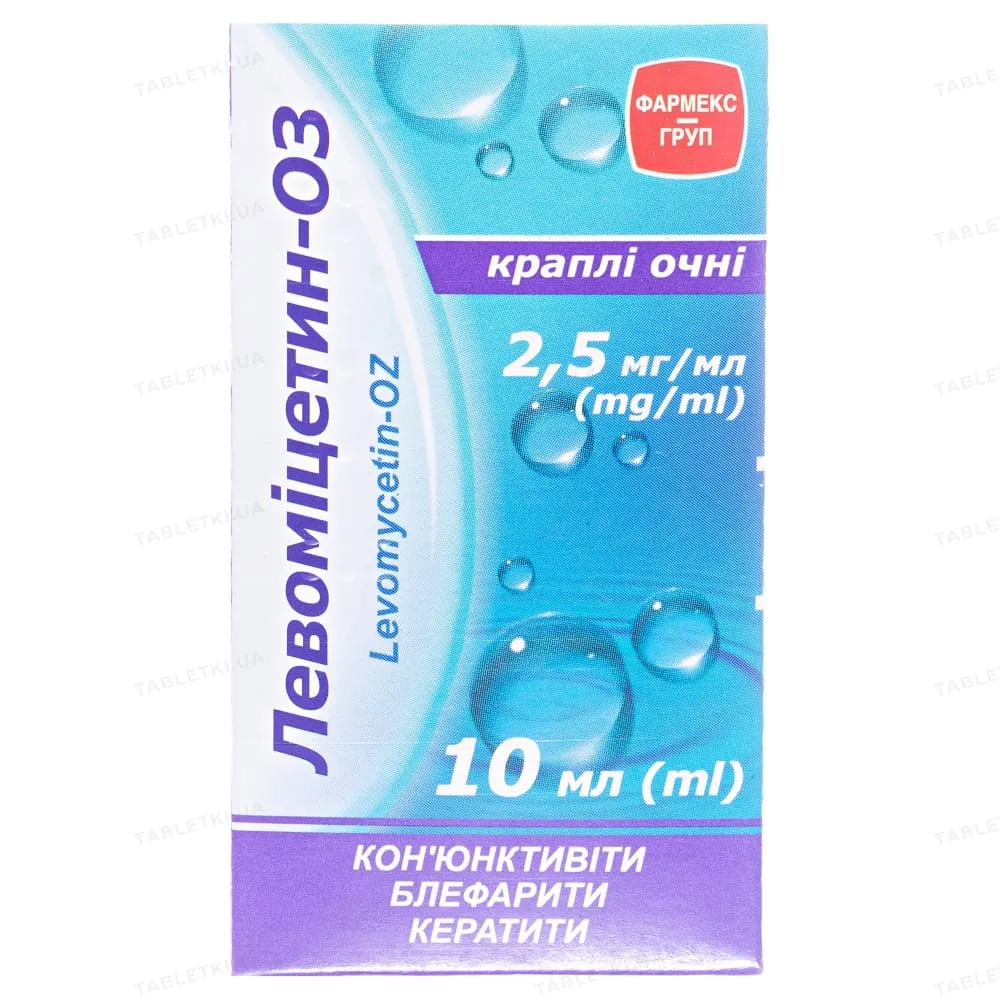
LEVOMYCETIN-OZ
UkraineThe drug is used to treat conjunctivitis, keratitis, and blepharitis caused by microorganisms to which this antibiotic is effective.
Frequently asked questions
How should Levomycetin-oz be taken correctly?
Adults and children should instill 1 drop into each eye 3 times a day. The duration of treatment is usually from 5 to 15 days.
What side effects may occur from using Levomycetin-oz?
Possible local reactions include: eyelid swelling, itching, eye irritation, and tearing. Allergic reactions (rash, urticaria, swelling), headache, or dizziness may also occur.
Who should not use these drops?
The drug is contraindicated in individuals with hypersensitivity to its components, as well as in cases of skin diseases (eczema, psoriasis, fungal infections).
Can the drug be used by pregnant or breastfeeding women?
The drug is contraindicated during pregnancy. Breastfeeding must be discontinued during treatment.
Can you drive a car after using the drops?
It is not recommended to drive a car or operate machinery for 1 hour after using the product until vision clears.
How should these drops be combined with other ophthalmic products?
If you are using other ophthalmic preparations, maintain an interval of at least 15 minutes between them. Ophthalmic ointments should be applied last.
What should be done in case of overdose?
If you have used too many drops and experience a temporary decrease in visual acuity, rinse the eye with running water.
Instructions for use
INSTRUCTION FOR MEDICAL USE OF THE MEDICINAL PRODUCT LEVOMISETIN-OZ
Composition:
Active substance: chloramphenicol;
1 ml of solution contains chloramphenicol 2.5 mg;
Excipients: boric acid, purified water.
Pharmaceutical form. Eye drops.
Main physicochemical properties: clear, colorless liquid.
Pharmacotherapeutic group. Ophthalmological agents. Antibiotics. Chloramphenicol. ATC code S01A A01.
Pharmacological Properties
Pharmacodynamics.
Chloramphenicol is a broad-spectrum antibiotic effective against many Gram-positive and Gram-negative bacteria, rickettsiae, spirochetes, agents of trachoma, psittacosis, and venereal lymphogranuloma. It acts on bacterial strains resistant to penicillin, streptomycin, and sulfonamides. It is weakly active against acid-resistant bacteria, Pseudomonas aeruginosa, protozoa, and Clostridium species. Microbial resistance to chloramphenicol develops relatively slowly. At usual doses, it exerts a bacteriostatic effect. The mechanism of antimicrobial action of chloramphenicol is associated with inhibition of microbial protein synthesis.
Pharmacokinetics.
The drug penetrates well into tissues and body fluids. Therapeutic concentrations of chloramphenicol are achieved in the vitreous body, cornea, iris, and aqueous humor of the eye following local administration as eye drops. The drug does not penetrate into the lens.
Clinical characteristics.
Indications. Conjunctivitis, keratitis, blepharitis caused by microorganisms sensitive to the drug.
Contraindications. Individual hypersensitivity to the components of the drug. Skin disorders (psoriasis, eczema, fungal infections).
Interaction with other medicinal products and other forms of interaction. Interaction with other drugs during topical administration of eye drops has not been established. If other topical ophthalmic drugs are used concomitantly, an interval of at least 15 minutes between applications should be maintained. Ophthalmic ointments should be applied last.
Special precautions. Unsupervised use of chloramphenicol, especially in pediatric practice, is not recommended.
Use during pregnancy or breastfeeding. The drug is contraindicated during pregnancy. Breastfeeding should be discontinued for the duration of treatment with this drug.
Ability to influence reaction speed when driving or operating machinery. For 1 hour after drug administration (until vision clears), patients should refrain from driving or operating machinery.
Method of Administration and Dosage
For adults and children: 1 drop in each eye 3 times daily. Treatment duration is 5–15 days (depending on the nature and severity of the disease, as well as the therapeutic effect achieved).
Children. In children under 4 weeks of age, use only if strictly indicated.
Overdose. Excessive doses of chloramphenicol may lead to temporary reduction in visual acuity. In such case, rinse the eye with running water.
Side effects.
Local reactions may occur, including eyelid swelling, itching, eye irritation, and tearing. Allergic reactions, including rash, angioedema, urticaria, pruritus, and skin hyperemia, are possible. Headache and dizziness may also occur.
Shelf life. 2 years. The solution may be used for up to 15 days after opening the bottle.
Storage conditions. Store at a temperature not exceeding 25 °C in the original packaging.
Keep out of reach of children.
Packaging. 5 ml or 10 ml in a bottle with a dropper cap in a carton.
Prescription status. Over-the-counter (without a prescription).
Manufacturer.
Limited Liability Company "Experimental Plant "GNCLS".
Limited Liability Company "FARMEKS GROUP".
Manufacturer's address and place of business.
8 Vorobiova Street, Kharkiv, Kharkiv region, Ukraine.
(Limited Liability Company "Experimental Plant "GNCLS")
100 Shevchenka Street, Boryspil, Kyiv region, 08301, Ukraine.
(Limited Liability Company "FARMEKS GROUP")
Similar drugs
| Brand name | Dosage form | Active substance / Dosage | Manufacturer |
|---|---|---|---|
| LEVOMYCETIN | drops, ophthalmic |
|
FZ "STADA" LLC |
| LEVOMYCETIN | drops, ophthalmic |
|
PJSC "Fitofarm" |
The original data is available in the language of the country of manufacture.
Data source: State Register of Medicinal Products of Ukraine
Data last verified: August 13, 2026