LAFEBIYON
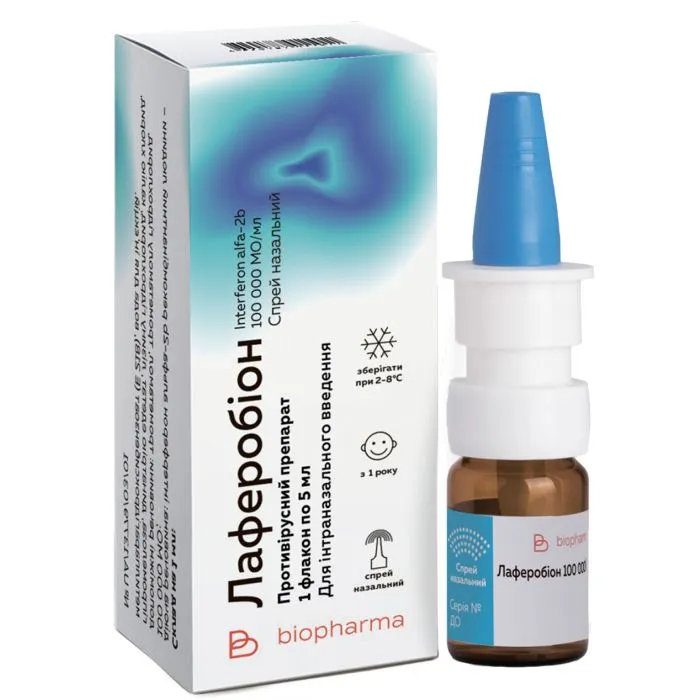
UkraineThe drug is used for the prevention and treatment of acute respiratory viral infections (ARVI). It is beneficial for those who frequently suffer from upper respiratory tract diseases, when in contact with individuals suffering from ARVI, after exposure to cold, or during periods of seasonal increases in morbidity.
Frequently asked questions
How should Lafebiyon be used correctly?
The spray is administered into each nostril while in an upright position. First, remove the cap and perform a test spray to activate the dispenser. One dose is one short press of the pump. It is recommended to use the vial individually to avoid spreading infection.
What is the dosage of Lafebiyon for adults and children?
At the first signs of ARVI, adults should take 3 spray doses into each nostril 5–6 times a day. For children aged 1 to 3 years — 2 doses 3–4 times a day; from 3 to 14 years — 2 doses 4–5 times a day; from 14 to 18 years — 3 doses 5–6 times a day. For prevention after contact with a sick person, adults should take 3 doses 2 times a day for 5–7 days.
Who should not take this drug?
The drug is contraindicated in cases of hypersensitivity to its components, severe allergic diseases, thyroid, liver, or kidney dysfunction, cardiovascular diseases, epilepsy, psoriasis, and autoimmune diseases. It should also not be used during pregnancy and breastfeeding.
What are the possible side effects?
The most common side effect is influenza-like syndrome (chills, fever, muscle and joint pain, fatigue). Nausea, dizziness, skin rash, visual disturbances, changes in blood pressure, sleep disturbances, anxiety, or cough are also possible. In exceptional cases, serious allergic reactions such as Quincke's edema or bronchospasm may occur.
Can vasoconstrictor drops be used together with this product?
It is not recommended to use nasal vasoconstrictor drugs simultaneously, as they may cause dryness of the nasal mucosa.
Instructions for use
I N S T R U C T I O N for medical use of the medicinal product LAFEROBION
Composition:
Active substance: interferon alfa-2b;
1 ml of the preparation contains 100,000 IU of recombinant human interferon alfa-2b;
Excipients: trometamol, trometamol hydrochloride, hypromellose, disodium edetate, lysine hydrochloride, potassium chloride, methylparaben (E 218), water for injections.
Pharmaceutical form. Nasal spray.
Main physicochemical characteristics: clear, colorless liquid.
Pharmacotherapeutic group. Immunostimulants. Interferons. Interferon alfa-2b. ATC code L03A B05.
Pharmacological Properties
Pharmacodynamics
LAFEROBIAN is an antiviral, antimicrobial, anti-inflammatory, immunomodulatory, and antiproliferative agent. The biological activity of interferon is characterized by the following effects:
- Antiviral effect – inhibits replication of viruses (including adenoviruses, influenza viruses, and others) by suppressing transcription and translation processes;
- Antiproliferative effect – suppresses cell proliferation (particularly of most DNA- and RNA-containing viruses);
- Immunomodulation – enhances phagocytic activity of macrophages and increases specific cytotoxicity of lymphocytes against target cells.
Interferon induces the synthesis of a specific enzyme – protein kinase – which inhibits translation by phosphorylating one of the initiation factors of this process. It also activates a specific ribonuclease that degrades viral messenger RNA (mRNA). Additional effects of interferon include stimulation of other cytokine production and induction of specific enzymes.
Pharmacokinetics
Not studied.
Clinical characteristics.
Indications.
Prevention and treatment of acute respiratory viral infections (ARVI):
- in patients who frequently and persistently suffer from upper respiratory tract diseases;
- upon contact with patients suffering from ARVI;
- during hypothermia;
- during seasonal increase in morbidity.
Contraindications. Hypersensitivity to alpha-2b interferon and other components of the medicinal product; severe forms of allergic diseases in medical history; thyroid dysfunction; presence of severe visceral disorders in patients with Kaposi's sarcoma; severe cardiovascular diseases; psoriasis; pronounced impairment of liver and/or kidney function; epilepsy and other central nervous system disorders (including functional ones); chronic hepatitis on the background of progressive or decompensated liver cirrhosis; chronic hepatitis in patients who are receiving or have recently received immunosuppressive therapy (except for a short course of corticosteroid therapy); autoimmune hepatitis or other autoimmune diseases in medical history. Myeloid bone marrow suppression. Pregnancy and breastfeeding.
Interaction with other medicinal products and other forms of interaction. If you are taking any other medicinal products, you must inform your physician; if you are self-medicating, consult your doctor regarding the possibility of using the drug.
Concomitant use of intranasal vasoconstrictive agents is not recommended, as they may promote dryness of the nasal mucosa.
Special precautions for use.
The product contains methyl parahydroxybenzoate, which may cause allergic reactions, including delayed-type reactions, and in rare cases bronchospasm.
The product should not be used if the packaging integrity or labelling is compromised, if there are changes in physical properties (colour or clarity of the solution), or after the expiry date.
To prevent the spread of infection, individual use of the vial is recommended.
Use during pregnancy or breastfeeding. Contraindicated.
Ability to influence reaction rate when driving or operating machinery. No effect.
Method of Administration and Dosage
The medication is administered into each nostril.
1 spray-dose = 1 short press of the dispenser.
Instructions for nasal spray administration:
- Remove the protective cap from the bottle.
- Prime the micro-dispenser atomizer by pressing (initial priming spray).
- While in an upright position, insert the tip of the nozzle into one nostril and press the pump dispenser. Repeat administration in the other nostril.
- After use, cover the bottle with the cap.
At the first signs of respiratory viral infection (for 5 days)
Adults: 3 spray-doses into each nostril 5–6 times daily (single dose — 30,000 IU, daily dose — 150,000 – 180,000 IU).
Children.
Children aged 1 to 3 years: 2 spray-doses into each nostril 3–4 times daily (single dose — 20,000 IU, daily dose — 60,000 – 80,000 IU).
Children aged 3 to 14 years: 2 spray-doses into each nostril 4–5 times daily (single dose — 20,000 IU, daily dose — 80,000 – 100,000 IU).
Children aged 14 to 18 years: 3 spray-doses into each nostril 5–6 times daily (single dose — 30,000 IU, daily dose — 150,000 – 180,000 IU).
For prevention of respiratory viral infections in adults
Upon contact with an infected person or after exposure to cold: 3 spray-doses twice daily for 5–7 days. Prophylactic courses may be repeated as needed. For single exposure, a single application is sufficient.
During seasonal increases in respiratory infections: single morning application every 1–2 days.
Children.
To be used in children aged 1 year and older at the first signs of respiratory viral infection.
Overdose. There is no available data regarding overdose of this medicinal product.
Side effects.
General disorders: common – dose-dependent influenza-like syndrome (chills, fever, headache, muscle pain, joint pain, fatigue, malaise, sweating); rare – nausea, vomiting, dizziness, flushes. Electrolyte imbalance. Hypersensitivity reactions to the drug may occur, including anaphylactic shock, Quincke's edema.
Skin and subcutaneous tissue disorders: skin rash (in isolated cases), including herpetic rash, pruritus, hyperemia, skin swelling, urticaria, dry skin, alopecia.
Endocrine system disorders: thyroid function disorders.
Eye disorders: visual disturbances, conjunctival hyperemia.
Gastrointestinal disorders: loss of appetite, increased levels of alanine aminotransferase, aspartate aminotransferase, alkaline phosphatase.
Hepatobiliary disorders: liver function disorders.
Renal and urinary disorders: kidney function disorders.
Blood and lymphatic system disorders: leukopenia, thrombocytopenia, anemia, epistaxis.
Cardiovascular system disorders: arterial hypertension and hypotension, tachycardia.
Nervous system disorders: dizziness, sleep disturbances, ataxia, paresthesia, confusion, anxiety and depressive states, increased excitability, somnolence.
Respiratory, thoracic and mediastinal disorders: cough, dyspnea.
If adverse reactions occur, consult a physician.
Shelf life. 2 years. Shelf life after opening the vial, under storage conditions at 2 to 8 °C, is 10 days.
Storage conditions. Store in the original packaging to protect from light at a temperature of 2 to 8 °C.
Keep out of reach of children.
Packaging. 5 ml in a vial sealed with a microdosing spray pump; 1 vial per cardboard box.
Prescription status. Over-the-counter.
Manufacturer. FZ "STADA" LLC, Ukraine.
Manufacturer's address and location of business operations.
37 Kyivska Street, Bila Tserkva, Kyiv Oblast, 09100, Ukraine.
Similar drugs
| Brand name | Dosage form | Active substance / Dosage | Manufacturer |
|---|---|---|---|
| NAZOFERRON | spray, nasal |
|
Farmak JSC |
The original data is available in the language of the country of manufacture.
Data source: State Register of Medicinal Products of Ukraine
Data last verified: August 13, 2026